All about photo.com: photo contests, photography exhibitions, galleries, photographers, books, schools and venues.
LAST CALL TO WIN A SOLO EXHIBITION IN MAY 2026 - DEADLINE APRIL 21
Harry Callahan
Harry Callahan

Harry Callahan

Country: United States
Birth: 1912 | Death: 1999

Harry Callahan (Harry Morey Callahan) (October 22, 1912 – March 15, 1999) was an American photographer and educator. He taught at both the Institute of Design in Chicago and the Rhode Island School of Design. Callahan's first solo exhibition was at the Art Institute of Chicago in 1951. He had a retrospective at the Museum of Modern Art in New York in 1976/1977. Callahan was a recipient of the Edward MacDowell Medal and the National Medal of Arts. Along with the painter Richard Diebenkorn, he represented the United States in the Venice Biennale in 1978.

Harry Callahan was born in Detroit, Michigan. He worked at Chrysler when he was a young man then left the company to study engineering at Michigan State University. He dropped out, returned to Chrysler and joined its camera club. Callahan began teaching himself photography in 1938. He formed a friendship with Todd Webb who was also to become a photographer. A talk given by Ansel Adams in 1941 inspired him to take his work seriously. In 1941, Callahan and Webb visited Rocky Mountain State Park but didn't return with any photographs. In 1946 he was invited to teach photography at the Institute of Design in Chicago by László Moholy-Nagy. He moved to Rhode Island in 1961 to establish a photography program at the Rhode Island School of Design, eventually inviting his close friend and fellow artist Aaron Siskind to join him, teaching there until his retirement in 1977.

Callahan met his future wife, Eleanor Knapp, on a blind date in 1933. At that time she was a secretary at Chrysler Motors in Detroit and he was a clerk. They married three years later. In 1950 their daughter Barbara was born. Callahan died in Atlanta in 1999. His wife Eleanor died on February 28, 2012 in a hospice in Atlanta at the age of 95. Callahan left almost no written records—no diaries, letters, scrapbooks or teaching notes. His technical photographic method was to go out almost every morning, walk through the city he lived in and take numerous pictures. He then spent almost every afternoon making proof prints of that day's best negatives. Yet, for all his photographic activity, Callahan, at his own estimation, produced no more than half a dozen final images a year. He photographed his wife and daughter and the streets, scenes and buildings of cities where he lived, showing a strong sense of line and form, and light and darkness. Even prior to birth, his daughter showed up in photographs of Eleanor's pregnancy. From 1948 to 1953 Eleanor, and sometimes Barbara, were shown out in the landscape as a tiny counterpoint to large expanses of park, skyline or water.

He also worked with multiple exposures. Callahan's work was a deeply personal response to his own life. He encouraged his students to turn their cameras on their own lives, leading by example. Callahan photographed his wife over a period of fifteen years, as his prime subject. Eleanor was essential to his art from 1947 to 1960. He photographed her everywhere—at home, in the city streets, in the landscape; alone, with their daughter, in black and white and in color, nude and clothed, distant and close. He tried several technical experiments—double and triple exposure, blurs, large and small format film.

Callahan was one of the few innovators of modern American photography noted as much for his work in color as for his work in black and white. In 1955 Edward Steichen included his work in The Family of Man, MoMA's popular international touring exhibition.

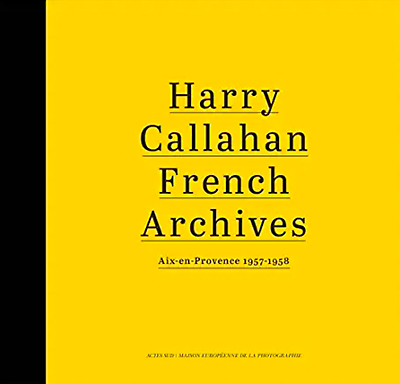
In 1956, he received the Graham Foundation Award, which allowed him to spend a year in France with his family from 1957 to 1958. He settled in Aix-en-Provence, where he took many photographs. In 1994, he selected 130 original prints with the help of the gallery owner Peter MacGill, and brought them together under the name of French Archives, to offer them to the Maison Européenne de la Photographie in Paris. Some of these images were taken in Aix-en-Provence and in the South of France, and are the subject of a temporary exhibition at the Granet Museum in Aix-en-Provence in 2019.

Callahan left behind 100,000 negatives and over 10,000 proof prints. The Center for Creative Photography at the University of Arizona maintains his photographic archives. In 2013, Vancouver Art Gallery received a gift of almost 600 Callahan photographs from the Larry and Cookie Rossy Family Foundation.

Source: Wikipedia


Harry Callahan has won many awards for his photography, including a Guggenheim Fellowship in 1972 and the Photographer and Educator Award from the Society for Photographic Education in 1976, and he was designated Honored Photographer of the Rencontres Internationales de la Photographie in Arles, France in 1977, and received ICP's Master of Photography Infinity Award in 1991. Among the major exhibitions of his work were Photographs of Harry Callahan and Robert Frank (1962), one of the last shows curated by Edward Steichen at the Museum of Modern Art, and retrospectives at the Museum of Modern Art (1976) and at the National Gallery in Washington, DC (1996).

Callahan was widely respected in the photography community for his open mind and experimental attitude, qualities reinforced by his association with Moholy-Nagy and the principles of Bauhaus design. He produced work in both formalist and more documentary modes and worked in both black-and-white and color. He used a 35-millimeter and an 8x10 camera and worked with multiple exposures as well as straight images. Such versatility contributed to his success as a teacher, his students ranging widely in style--among them Ray K. Metzker, Emmet Gowin, Kenneth Josephson, and Bill Burke.

Source: International Center of Photography



Harry Callahan's Video

Selected Books

Inspiring Portfolios

Call for Entries
AAP Magazine #57 Portrait
Publish your work in our printed magazine and win $1,000 cash prizes
 
Stay up-to-date  with call for entries, deadlines and other news about exhibitions, galleries, publications, & special events.

More Great Photographers To Discover

Cayetano González
My grandparents met during their studies in the University of Fine Arts in Valencia. Most of my close relatives work in the field of visual arts. On my behalf, I've always wanted to be a painter, and was fascinated by many artists: Sorolla, Velázquez, Rembrandt, Delacroix... During High School I had the opportunity to work on a short film for one of the courses, I then realised I wanted to work in the film industry. In 2006 I started my adventure. I studied Film in Valencia, and afterwards worked as a freelancer in a television production company for a year. At that time everything we did was recorded on tapes, and the cinematography quality I was searching for was unattainable. Fortunately, my grandfather lent me his Leica and everything changed. I slowly began learning how to use different cameras and I knew I had found my calling. Before even realising it I was already working as a photographer. I knew (or at least I thought I knew) how to use a camera, but not what to express with it, I needed to expand my knowledge of Art and extend my perspective. I began my studies in Fine Arts, and it was one of the best decisions I have ever made. I still don't know the meaning of Art, fully, but I was able to learn what people could achieve thanks to having artistic values. During the last two years of my Arts studies I concentrated on Contemporary Art, Film and Photography. When I finished I wanted to specialise in Cinematography and decided to move to Barcelona to study a Masters in Cinematography in ESCAC (Superior School of Cinema of Catalonia). Since then I'm based in Barcelona and my work is focused mainly on Photography and Cinematography. I also teach workshops specialised in natural light and try to direct my work towards a more natural feel, creating atmospheres that recall the painters I've always admired. About Light In 2016, after years of studying arts and photography I decided I wanted to specialise in natural light. I wanted to learn everything I could about it, so I began to research and practice, studying from artists starting from the 15th century until today. This research evolved in a personal project called "aboutlight", shot with natural light, about beauty, femininity, loneliness, melancholy and any type of feeling you can transmit while in a state of calm. I'm currently teaching and learning constantly, improving and making others improve. It's this combination that's helping me grow and develop my skills day to day. Find out more in his exclusive interview
Bettina Rheims
France
1952
Bettina Rheims, born Bettina Caroline Germaine Rheims is a French artist and photographer. She began her career with a series of images of striptease dancers and acrobats, and over the years she became one of the most notable persons behind the lens. "I adore flesh. I am a skin photographer," she says famously, and that perfectly explains her work. It is raw and erotic, frequently involving nudity and stuffed animals, and she achieves a visceral emotion that captivates the audience. Some of her most well-known pieces raise problems of gender, androgyny, and transsexuality. Although Bettina Rheims began with obscure and marginalized subjects, her later assignments included advertising campaigns for fashion and major brands like Chanel and Lancôme, as well as prominent international magazines. Madonna, Charlotte Rampling, Catherine Deneuve, Kylie Minogue, Claudia Schiffer, and many others were photographed by Rheims. And there's something indisputably human and true in every photograph she takes, perhaps too natural and personal. I have always believed that whether the work is my idea or a commission, it is personal work.... In the end, as my old master Helmut Newton used to say, there are only two kinds of pictures: the good ones and the bad ones. -- Bettina Rheims Bettina Rheims was born in Neuilly-sur-Seine, France. She is the daughter of the French Academy's Maurice Rheims. She began her career as a photographer in 1978, at the age of 26, after working as a model, a journalist, and running an art gallery. Initially, she accomplished a lot of commissioned work, such as record covers for Jean-Jacques Goldman and celebrity portraits. She devoted herself entirely to photography beginning in 1980. She created a series of images of strippers and acrobats, which were presented in two personal exhibits in Paris in 1981, at the Centre Pompidou and the Galerie Texbraun. Encouraged by her success, she began work on a series of plush animal portraits, which were shown in Paris and New York. In 1982, Rheims' Animal series allowed her to focus her lens on a different type of nudity: stuffed animals with fixed looks, "which seemed to desire to express something beyond death." "I had to capture their stare," the photographer claimed. The photographer questioned gender, androgyny, and transsexuality in Modern Lovers (1989-1990). Les Espionnes (1992) and Kim (1993) were two subsequent publications on the same subject (1994). At the same time she took portrait images for worldwide magazines and advertising campaigns (Well and Chanel), created her first fashion series, worked on cover sleeves, and film posters, and in 1986 directed her first advertising campaign. Her female portraits were published in a monograph, Female Trouble, in 1989, and exhibited in Germany and Japan. The next year, she created Modern Lovers, a series of portraits of androgynous youths that were presented in France, the United Kingdom, and the United States, as well as being published in book form. I still find myself having to justify being a woman taking pictures of naked women. It never occurred to me that there was something bizarre about it, it always felt very natural. -- Bettina Rheims Bettina Rheims began work on one of her major series, Chambre Close, in the early 1990s (1990-1992). This was her first color work, and it marked the beginning of her partnership with novelist Serge Bramly, in which her images were combined with the writer's fiction. Chambre Close is a parody of the first pornographic images in form — chambers with fading walls and old-fashioned wallpaper — but in substance, it attempts to stage amateur models in stances that play on the eroticism and misunderstanding between those looking and those displaying themselves. At the close of his presidential campaign in 1995, Jacques Chirac allowed Rheims to work behind the scenes on a series of images depicting the last moments of the election. Following the election, the French Republic's Presidency commissioned Bettina Rheims to create the official picture of Jacques Chirac. According to Libération, she intended to give the President "the easygoing look of the great heroes in westerns." The decade ended with the publishing of the book I.N.R.I. and its accompanying exhibition in 1999. I.N.R.I. constructs a philosophical debate on the history of the crucifixion through images of episodes from Christ's life, from the Annunciation to the Ascension, once again connecting the gaze of Rheims with the writing of Serge Bramly. Bettina Rheims advocated "modern illustrations, following the advent of photography, cinema, and advertising imagery, as if Jesus were to return today." The release of this work was highly contentious in France. During two long stays in Shanghai in 2002, Bettina Rheimsmade a series about the city. "The initial impressions of a visitor coming in Shanghai are of people with deep-rooted ancestral rituals and customs who have thrown themselves into the frenzied race of the modern world." Rheims, blending into this 'alternative way of thinking,' offers us a fresh perspective on the enigma that is China's coexistence with its millenary traditions, avant-garde facet, official elements, and underground qualities. Rheims exhibited Héroïnes, a piece that was essentially an homage to sculpture, at the Galerie De Noirmont in 2005. On this occasion, the photographer worked with designer Jean Colonna to outfit the women in unique outfits. "Thus, old haute couture gowns were reassembled on each of these contemporary icons. These unusually beautiful women then toyed with a stone, which became their pedestal for a brief while." Bettina Rheims collaborated with Serge Bramly again at the end of the 2000s, and Rose, c'est Paris was shown at the Bibliothèque Nationale de France in 2010. Bettina Rheims and Serge Bramly crafted a fictional thread from autobiographical parts for the photographic story. In this piece, Paris plays "the role of the muse more than the subject, and [appears] in an almost allegorical manner through the figures weaved into a story." A young woman we'll call B. is hunting for Rose, her twin sister who she thinks has vanished. Rose, c'est Paris is presented as a "great mysterious series," a genre beloved by surrealists, and is divided into thirteen episodes in which we discover, among other things, an unusual or obscure Paris that is voluntarily timeless." Exhibited in 2012 in Düsseldorf, the Gender Studies series pursues the questioning of gender representation. The device linking image and sound (by Frédéric Sanchez) presents 27 sound portraits of young men and women who responded to a request the photographer posted on Facebook. The photos are accompanied by interview clips and have featured in several exhibitions and a book. Rheims has also worked on advertising campaigns for fashion and big brands, such as Chanel and Lancôme, as well as taking portraits of famous women for international magazines. Rheims says that she has been inspired by Diane Arbus and Helmut Newton as well as by the work of early painters.
Ralph Milewski
Germany
1968
Ralph Milewski is an artist from Germany who works with photography. His work moves between documentary observation and conceptual approaches and engages with spaces, transitions, and traces of human presence. At the center of his artistic practice is the ongoing project Rear Seat Diaries. The images are created from the back seat of a VW Caddy and photographed through the side window. The window frame forms a constant visual system: the world moves through this fixed frame while the perspective remains unchanged. Within this structure, Milewski works with repetition and variation. Everyday situations, passing scenes, and fleeting encounters appear under the same visual conditions and gradually form a coherent body of work over time. Alongside these observational images, conceptual works also emerge within the project. They explore questions of movement, time, and perception and expand the original visual system. His working method is deliberately reduced. Milewski works with minimal equipment and uses existing situations and lighting conditions as the starting point for his images. His photographs emerge from scarcity, not from abundance. Rear Seat Diaries: Rear Seat Diaries is an ongoing photographic project that began in 2022 from a simple observation: the side window of my vehicle became the fixed frame of my images. Over time, this frame developed into a visual system. While places, situations, and light constantly change, the frame remains constant and structures each photograph. Within this system, both observed moments and deliberately staged situations emerge. Everyday encounters, interventions, experiments with movement, or longer exposures are brought together through the same fixed frame. Rear Seat Diaries is not a finished project but an open working process. The recurring frame becomes a constant structure within which different forms of observation, time, and intervention unfold.
Amy Anderson
United States
1977
Amy Anderson is an award-winning portrait photographer living in Minneapolis, Minnesota. Her work has been exhibited internationally and hangs in local and national galleries, museums and private collections. She has had works acquired by the Museum of Fine Arts, Houston and the Florida Photographic Museum. She has received the prestigious Minnesota State Arts Board grant in 2012 and again in 2018 resulting in several solo shows. Funded again in 2021 by the state of Minnesota, she is currently working on a new body of portraits exploring ways to encourage reconnection in her own community after a time of isolation and unrest. Statement I strive to impact my community by creating authentic portraits that explore the universal themes that connect us as humans. My practice has been to live alongside a community and create connection with the people I photograph in hopes of presenting a meaningful image of a an individual to our larger collective community. I have completed several large, multi-year projects including At Risk, With Promise ; a series exploring the challenges and triumphs of at-risk youth in Minnesota. Over the course of this project I explored themes like marginalization and resilience, adolescence and personal growth, disconnection and intersecting identities. At Risk, With Promise culminated in a full and completed body of work that received recognition and was included in many local and national exhibitions. In 2018 with funding from the Minnesota State Arts Board, I began a new body of work exploring these and other themes in the context of several different communities, most significantly the elderly. Working closely with one woman, Rose Kaprelian, allowed me to dig deeper into the everyday realities of this nearly invisible marginalized group. As a nonagenarian in a culture increasingly connected by technologies that are foreign and largely inaccessible, women like Rose face isolation and stagnation as they age. This work is developing to encompass many universal themes from a unique perspective as well as preserving voices that are fading from our collective conversations. During the isolation and uprising in my city in 2020 I continued to make portraits as a way to document and explore the events that changed our world. From window portraits of those who were isolated to protest photos of those who marched, each image was an attempt to connect with my community and explore the changing landscape in which we found ourselves. I continue this exploration daily.
Eszter Halasi
I am Eszter Halasi, a self-taught photographer from Hungary currently residing in England. With a passion for capturing meaningful moments, I specialize in portraits of children and families, and the ethnic group lifestyle. My goal is to challenge stereotypes and promote understanding through my images. Throughout my journey, I have received recognition for my work, including a bronze prize in the Budapest Photo Awards and honorable mentions in International Competitions. I continually seek opportunities for growth. I achieved second place in the Hungarian Press Photo, Portrait and Human Portrait category in 2021. I has been shortlisted on : Portrait of Britain (2022) and ( 2023), Global Peace Photo Award (2023), International Women in Photo Award 2023, Finalist at the BCN-DH International Photo Festival 2023 My photographs have been featured in online publications and exhibited at festivals, showcasing the diverse narratives I strive to capture. Through my lens, I aim to evoke empathy, challenge perceptions, and celebrate the beauty of life. As I continue to explore the art of photography, I am dedicated to telling compelling stories and making a positive impact through my images. I hope my work is a visual journey into the essence of human experiences. Whoever believes in the miracle of Csatka It will happen to them Every year around Mary’s Day, the Csatka Pilgrimage is held - this is when Roma families from all over the Carpathian Basin who believe in the mystery of the Csatka Holy Well travel to the village in Komárom-Esztergom county. . This year I visited the Csatka Pilgrimage for the first time, which I had only heard of before, and it became clear to me on the spot that it is a duty for a photographer of Roma origin to take pictures. This event still brings families together. Many meet their relatives once a year, who live far away. They settle down in the meadow next to the church, cook, chat, walk down to the wonderful spring, pray, light a candle. Joy, happiness and quiet humility permeate the whole pilgrimage - I tried to capture this in the pictures. Károly Eötvös, a renowned jurist and equally famous storyteller of the turn of the century, said that the Csatka pilgrimage began in 1867. The Catholic Church did not officially recognize Csatka as a place of pilgrimage, only as a place of worship. The pilgrimage is also a real social event in the life of the gypsies, besides religion: many baptize their children here, but marriages are also common, and business deals are made in the tents and tables set up on the nearby hilltop. Many poured the healing water of the holy well into empty bottles, fewer into smaller ones, and before or after they all visited the Virgin Mary chapel, which József Csöbönyei built in 1862 in the middle of the beautiful valley, because the mother of the Son of God appeared to the hermit. at this place.
Advertisement
AAP Magazine #57 Portrait
Win a Solo Exhibition in May
AAP Magazine #57 Portrait

Latest Interviews

Exclusive Interview with Carolyn Moore
American photographer Carolyn Moore explores the inner landscape of emotion, memory, and personal transformation through a deeply intuitive photographic practice. Her work unfolds as a quiet dialogue between artist and viewer, where images become a space for reflection, vulnerability, and connection.
Exclusive Interview with Luca Desienna and Laura Estelle Barmwoldt
For over seven years, Of Lilies and Remains has explored the depths of the goth and darkwave underground, unfolding in Leipzig—a city long associated with a vibrant and enduring subcultural scene. Moving between iconic gatherings such as Wave-Gotik-Treffen and more intimate moments on the fringes, the project offers a rare and immersive glimpse into a world often misunderstood, yet rich in expression and community. Created by Luca in collaboration with Laura Estelle Barmwoldt, the work embraces a cinematic and deeply personal approach. Rather than documenting from a distance, it moves within the scene itself, capturing its atmosphere, its codes, and its quiet contradictions. The title Of Lilies and Remains hints at this duality—where beauty and darkness, fragility and strength coexist. As the book prepares for its release, we spoke with both artists about the origins of the project, their process, and what it means to document a subculture that continues to evolve while remaining true to its spirit.
Exclusive Interview with Matthew Finley
American photographer Matthew Finley turns inward, using photography as a way to explore identity, memory, and emotional truth. Based in Los Angeles, his practice moves between performance, gesture, and found imagery, creating a visual language that is both intimate and deeply personal
Exclusive Interview with Jan Janssen
Dutch photographer Jan Janssen explores universal human experiences through his long-term project It Matters, winner of the May 2025 Solo Exhibition. Begun in 2016, the series captures intimate moments of everyday life—love, loss, connection, and belonging—across Central and Eastern Europe. Working in countries such as Turkey, Azerbaijan, and Armenia, Janssen spends extended time within communities, building relationships based on trust and respect. His approach allows him to move beyond observation, revealing deeply human and authentic moments. Rooted in travel and personal discovery, It Matters reflects Janssen’s search for what connects us all in an increasingly divided world. The project is ongoing and will culminate in a photobook scheduled for publication in 2026.
Exclusive Interview with Henk Kosche
German photographer Henk Kosche turns his lens toward the streets of Halle an der Saale, capturing everyday life in the late years of the former German Democratic Republic. At the time, Kosche was studying design and exploring the city with his camera, drawn to the atmosphere of its industrial landscape and the quiet rhythms of daily life. His series Street Photography at the End of the 80s, selected as the Solo Exhibition for July 2025, revisits a body of work created just before a period of profound change. Rediscovered decades later in a small box of 35mm negatives, these photographs offer glimpses of a city and its people at a moment suspended between the familiar and the unknown.
Exclusive Interview with Anastasia Samoylova
Anastasia Samoylova is an American artist whose photographic practice is shaped by close observation and a deep attentiveness to place. Working between documentary and formal exploration, she photographs landscapes, architecture, and everyday scenes with a sensitivity to light, structure, and atmosphere. Since relocating to Miami in 2016, her work has increasingly focused on how environments—both natural and built—carry social, cultural, and emotional traces. We asked her a few questions about her practice and her way of seeing, to better understand the thoughts and experiences that shape her work—while allowing the images themselves to remain open and speak in their own time.
Exclusive Interview with Marijn Fidder
Marijn Fidder is a Dutch documentary photographer whose work powerfully engages with current affairs and contemporary social issues. Driven by a deep sense of social justice, she uses photography to speak on behalf of the voiceless and to advocate for the rights of those who are most vulnerable. Her images have been widely published in major international outlets including National Geographic, CNN Style, NRC Handelsblad, Volkskrant, GUP New Talent, and ZEIT Magazin. Her long-term commitment to disability rights—particularly through years of work in Uganda—culminated in her acclaimed project Inclusive Nation, which earned her the title of Photographer of the Year 2025 at the All About Photo Awards. She is also the recipient of multiple prestigious honors, including awards from World Press Photo and the Global Peace Photo Award. We asked her a few questions about her life and work.
Exclusive Interview with Josh S. Rose
Josh S. Rose is a multidisciplinary artist working across photography, film, and writing. His practice bridges visual and performing arts, with a strong focus on movement, emotion, and the expressive potential of the image. Known for his long-standing collaborations with leading dance companies and performers, Rose brings together authenticity and precise composition—a balance he describes as “technical romanticism.” His work has been commissioned and exhibited internationally, appearing in outlets such as Vogue, at the Super Bowl, in film festivals, and most recently as a large-scale installation for Lincoln Center for the Performing Arts. A sought-after collaborator, he has worked with major artists, cultural institutions, and brands, following a previous career as Chief Creative Officer at Interpublic Group and the founder of Humans Are Social. We asked him a few questions about his life and work.
Interview with Maureen Ruddy Burkhart
Photographer Maureen Ruddy Burkhart brings a quietly attentive and deeply human sensibility to her exploration of the world through images. Shaped by a life immersed in photography, film, and visual storytelling, her work is guided by intuition, observation, and an enduring interest in the emotional undercurrents of everyday life. With a practice rooted in both fine art traditions and documentary awareness, she approaches her subjects with sensitivity, allowing subtle moments to emerge naturally rather than be imposed. Her series Til Death, selected as the Solo Exhibition for February 2025, reflects this long-standing commitment to photography as a space for reflection rather than spectacle. Drawn to moments that exist just outside the expected frame, Burkhart’s images suggest narratives without resolving them, leaving room for ambiguity, humor, and quiet connection. We asked her a few questions about her life and work.
Call for Entries
Win A Solo Exhibition in May
Get International Exposure and Connect with Industry Insiders