All about photo.com: photo contests, photography exhibitions, galleries, photographers, books, schools and venues.
FINAL CHANCE to enter All About Photo Awards: $5,000 Cash Prizes - Juror Steve McCurry
Xiaoping Lin
Xiaoping Lin
Xiaoping Lin

Xiaoping Lin

Country: China
Birth: 1972

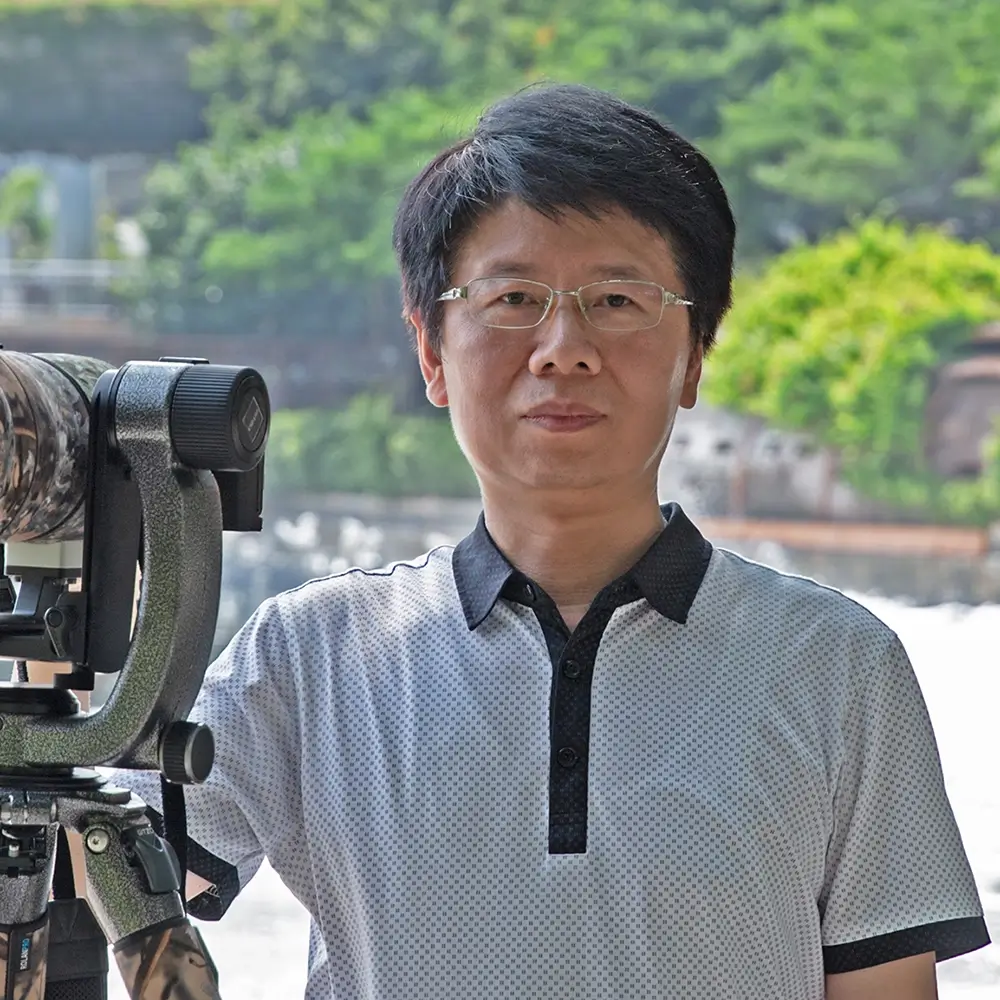
Xiaoping Lin, a Chinese bird photographer, has been involved in photography since 1992. He has won numerous honors, including the 2025 CEWE Winner, 2022 XPOSURE First Place, 2023 HIPA Merit Medal, 2023 BigPicture Winner, and 2024 NBP Winner. His photographic works have been exhibited in photography shows around the world and published in various magazines and books. His works accurately capture vivid details of bird ecological behavior from a unique perspective, while interpreting the meaning of life through the language of the lens. These images not only inspire audiences to engage in profound philosophical reflections on the laws of nature but also prompt the public to rediscover the majestic charm of the natural world, evoking deep inquiries into the essence of life and the mysteries of nature. He always hopes to convey the beauty of nature through the lens, awaken the public’s deep understanding and aesthetic resonance of nature, and then cherish the ecological environment and fulfill the responsibility of protection.

Statement:
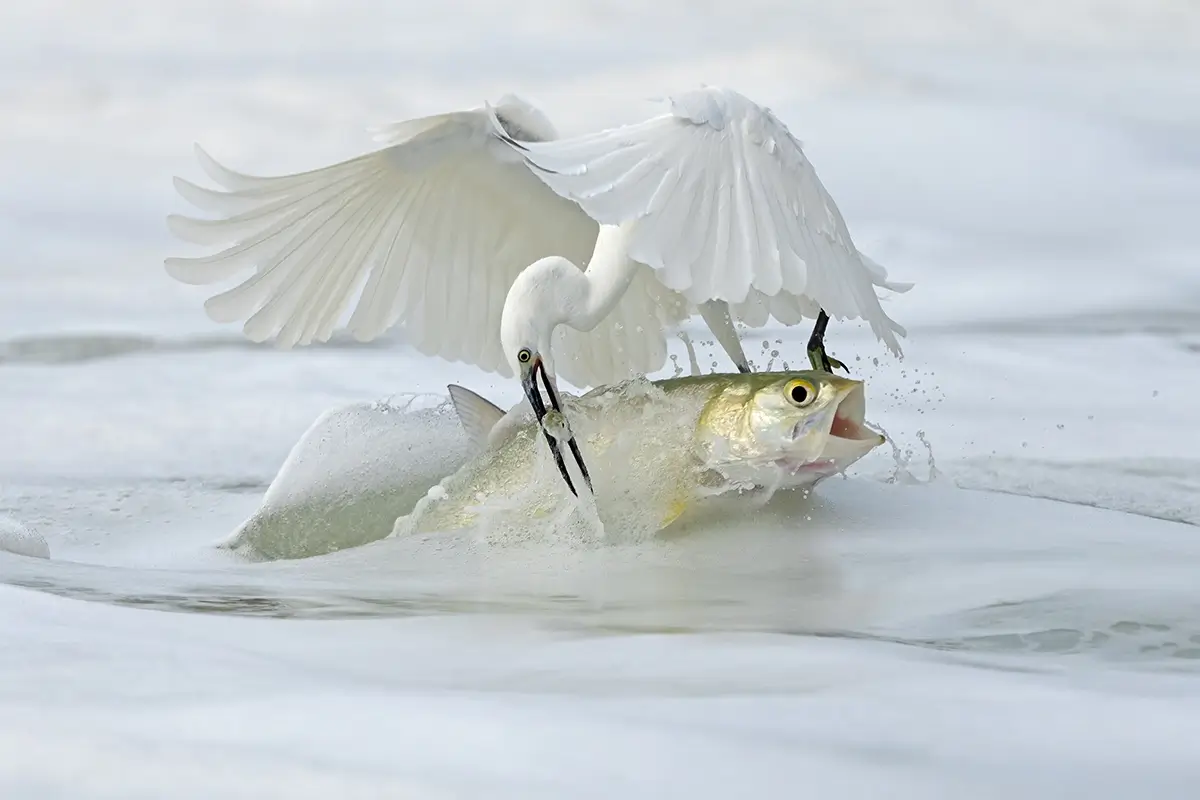
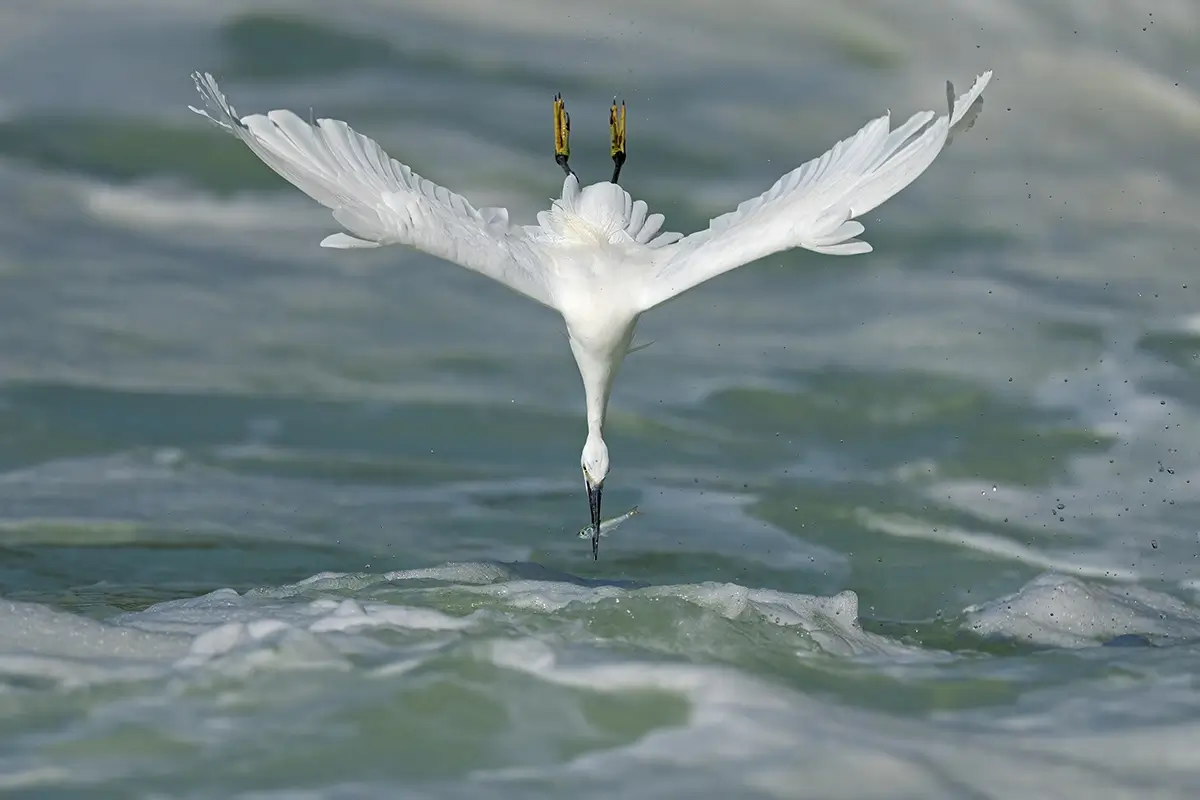
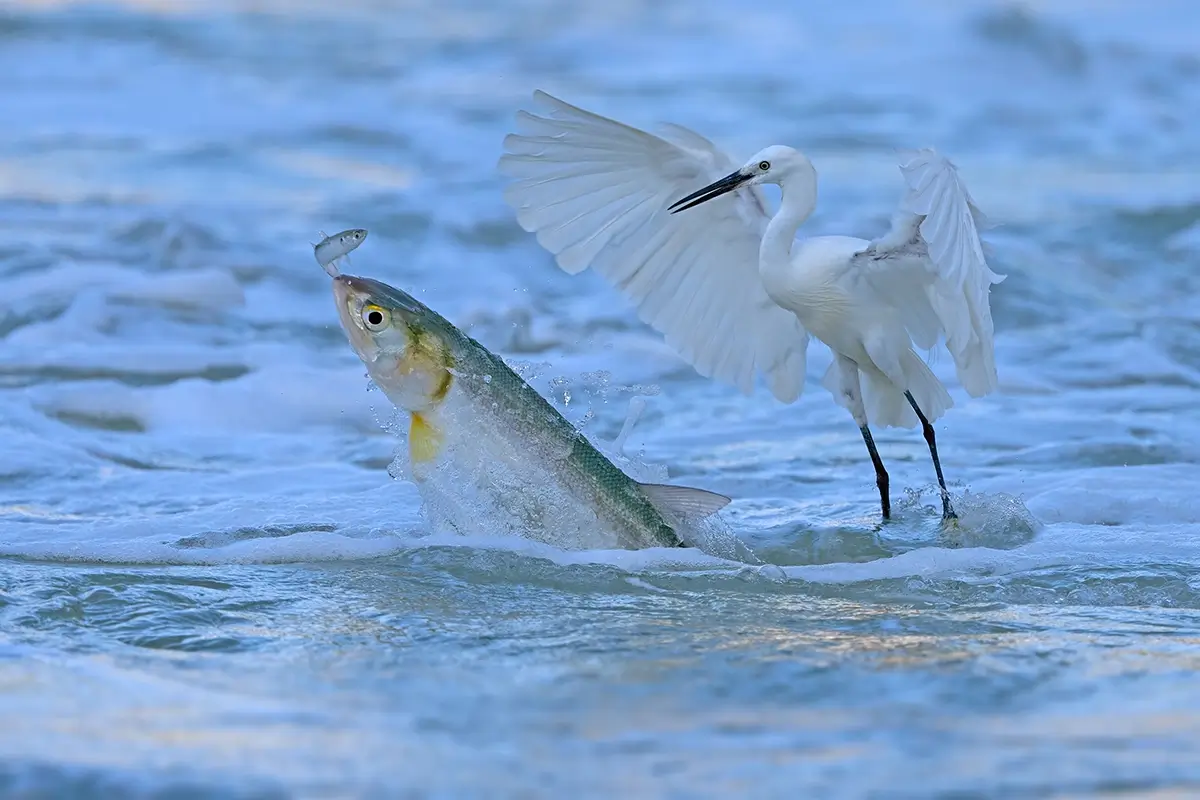
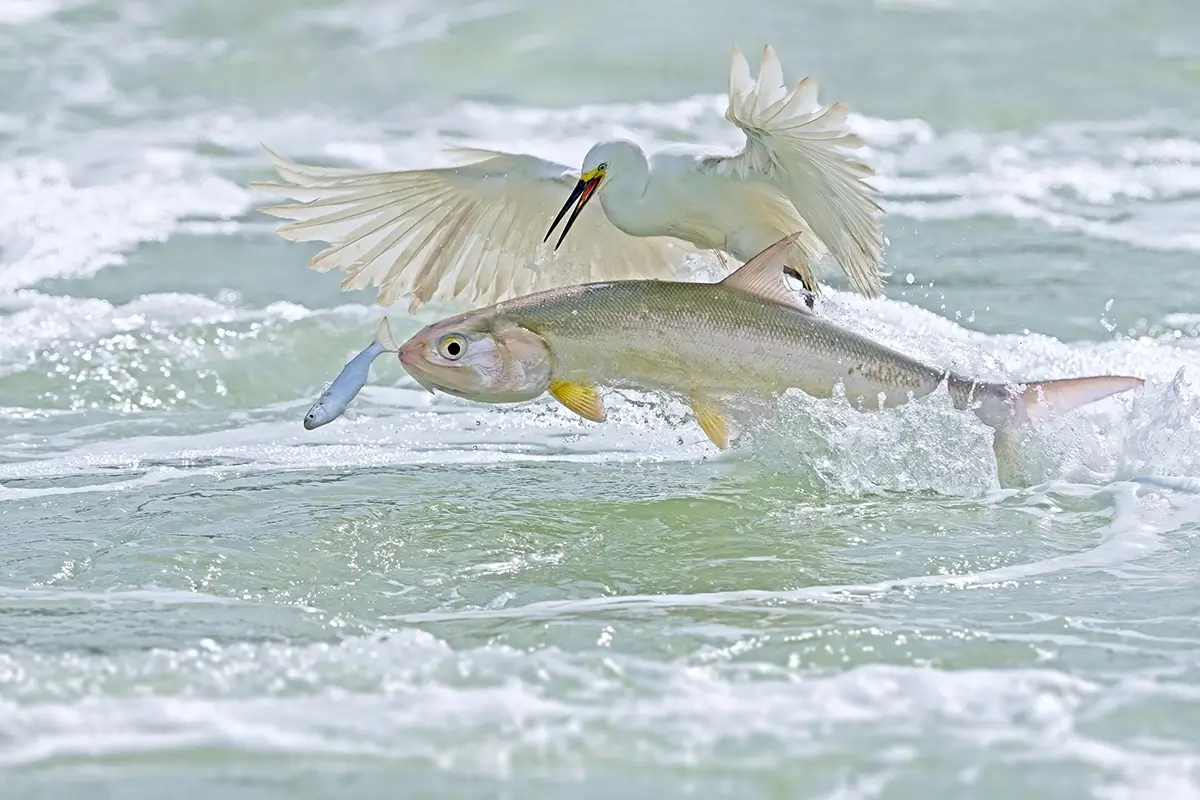
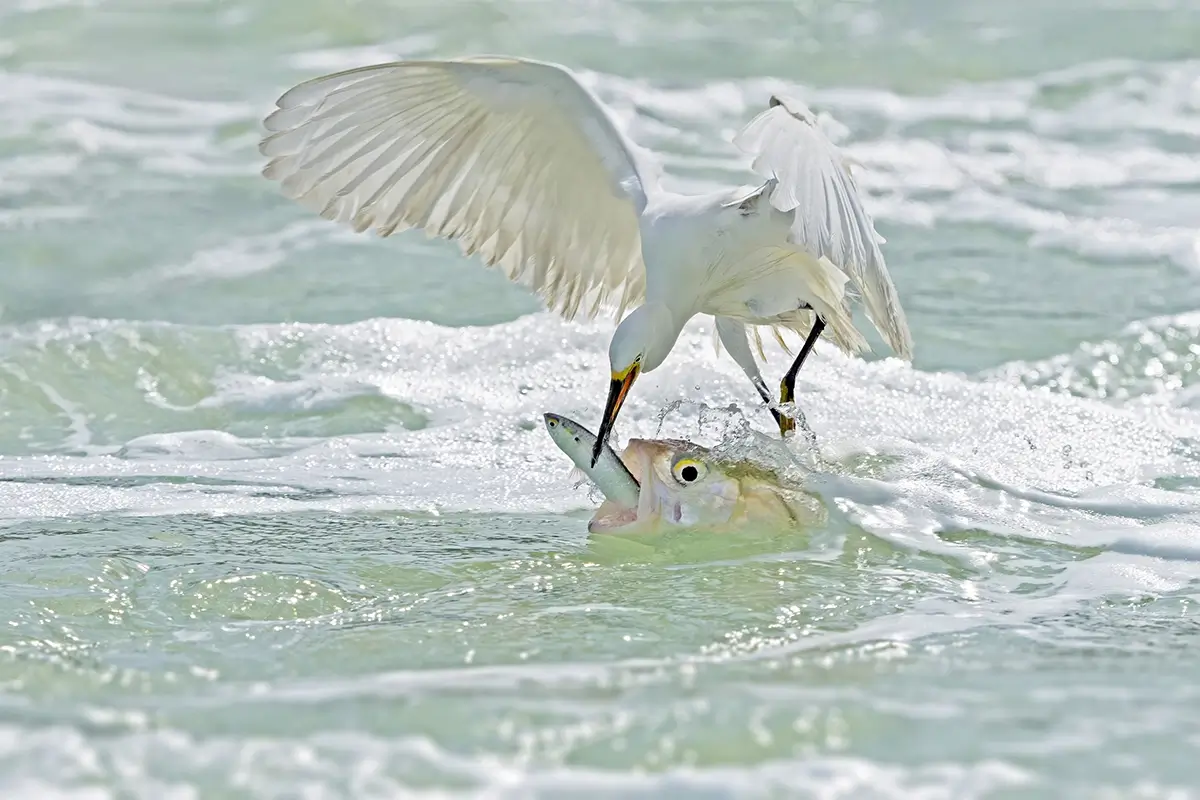
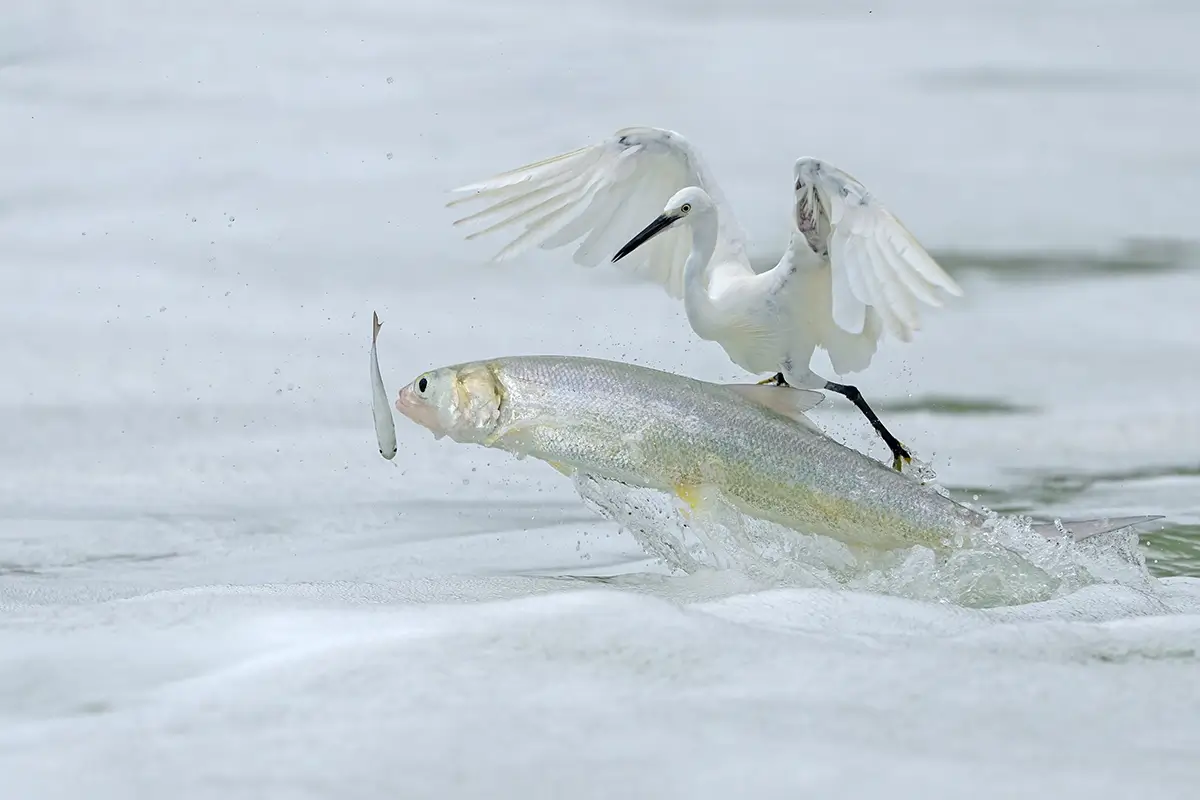
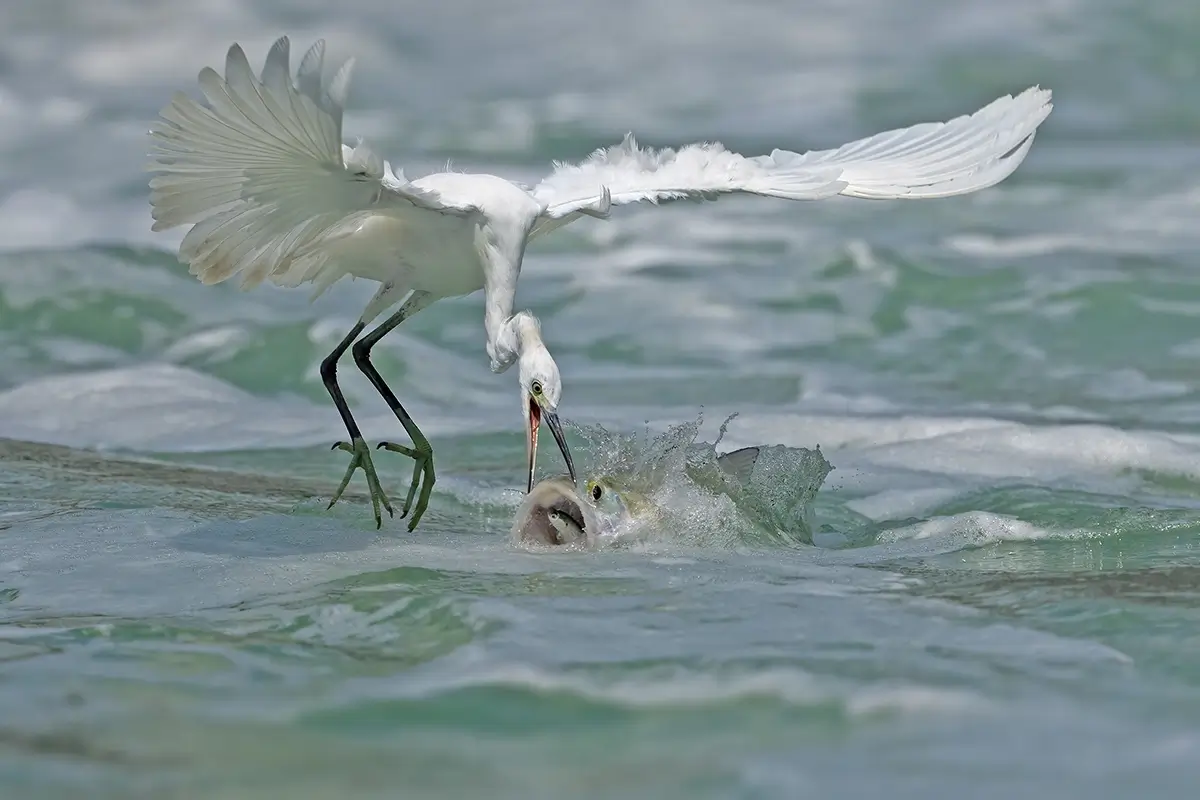
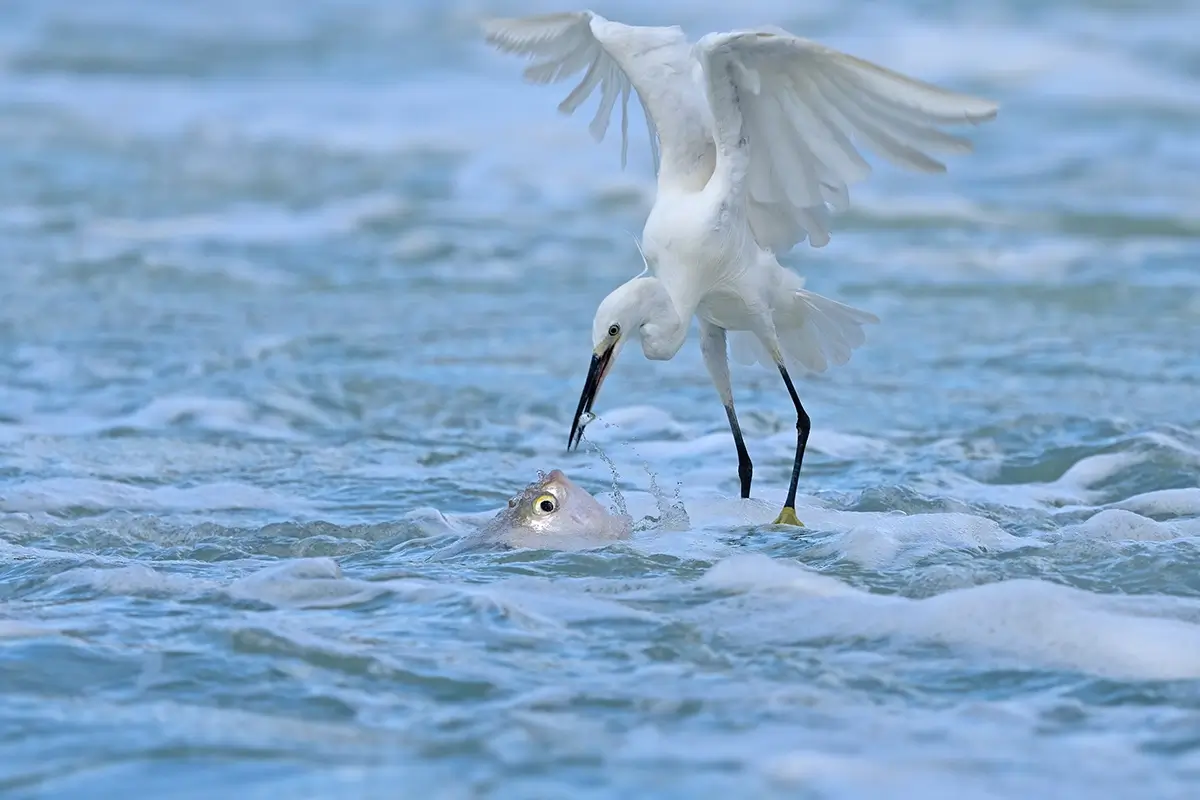
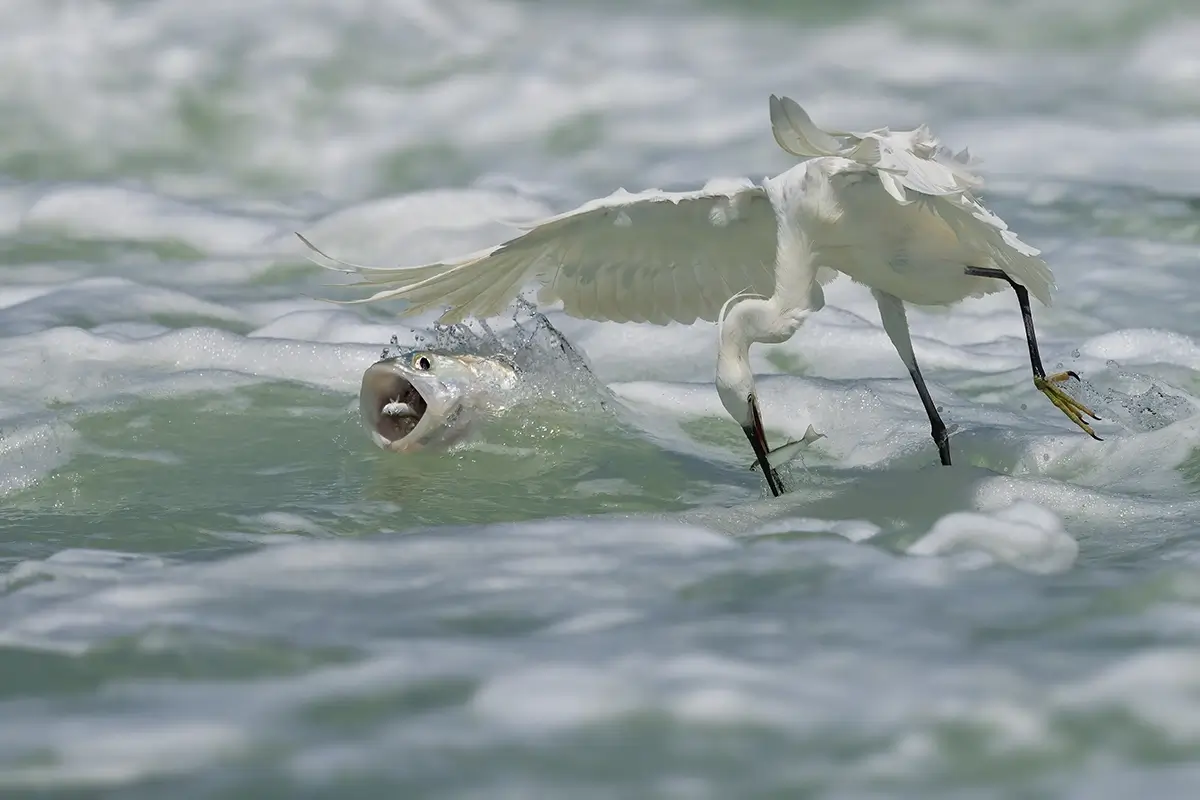
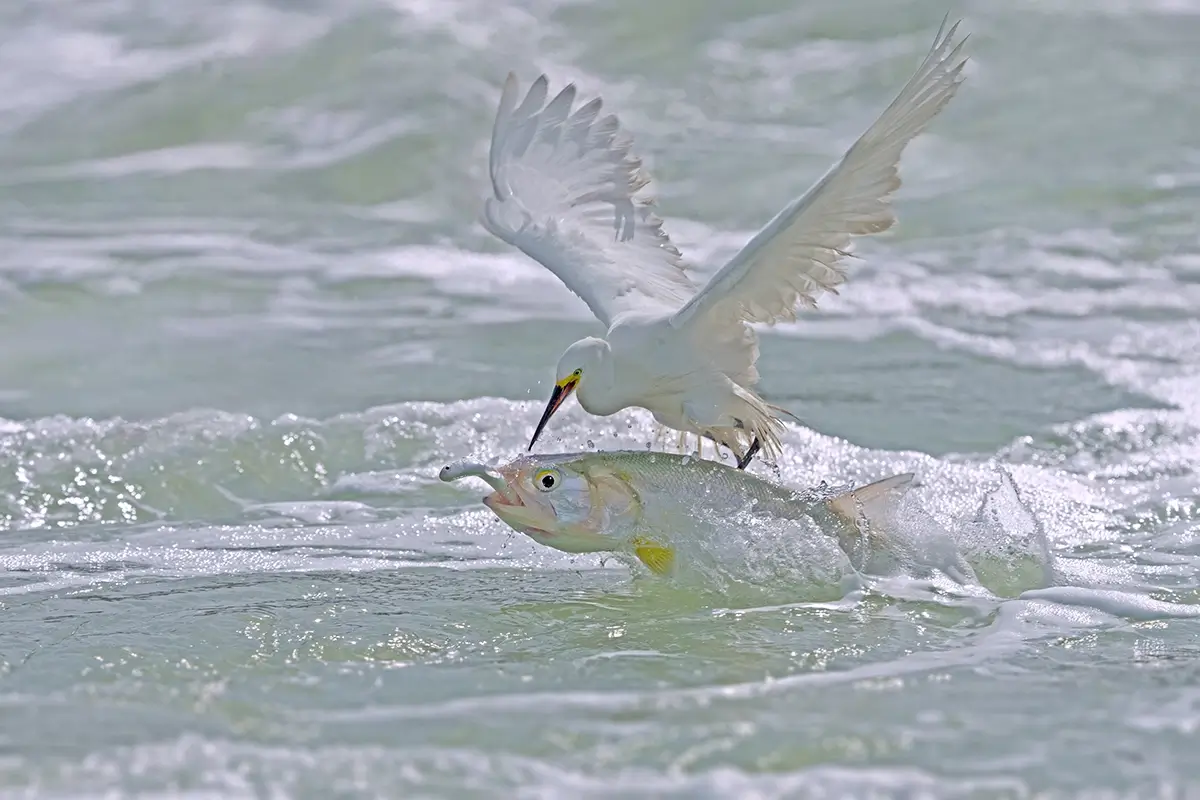
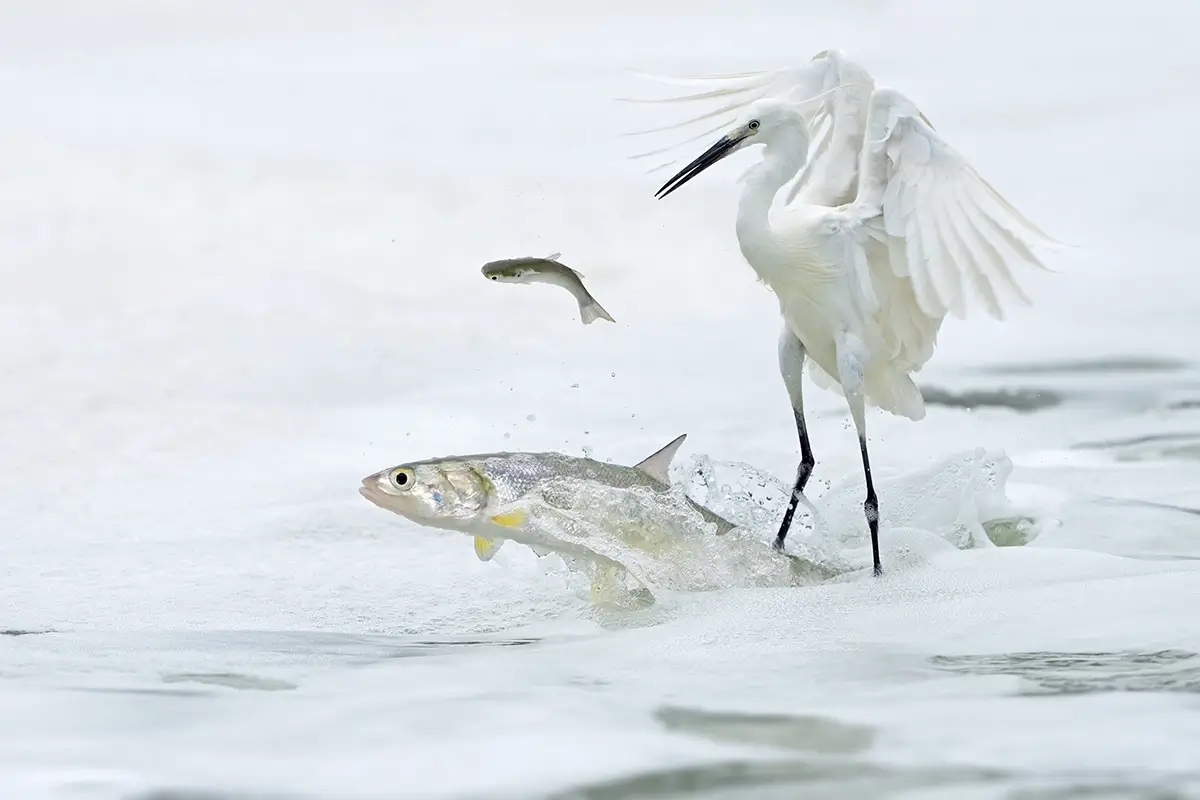
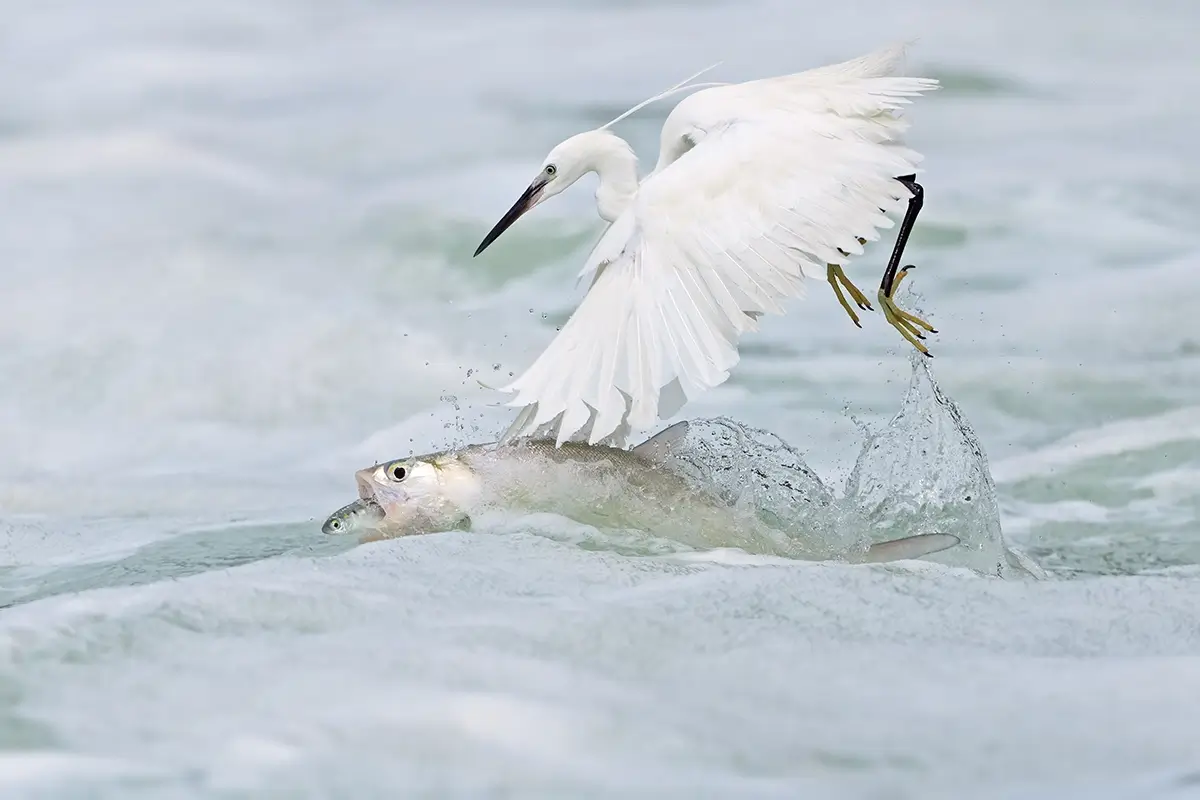
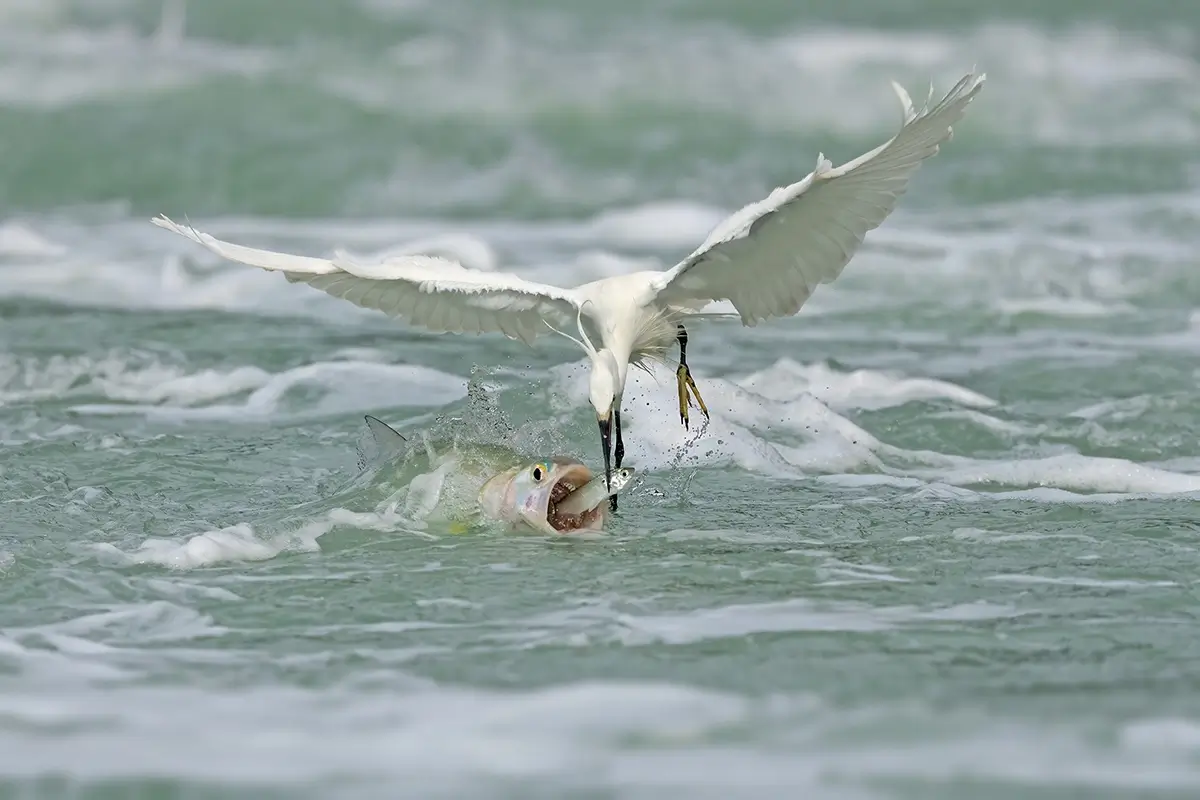
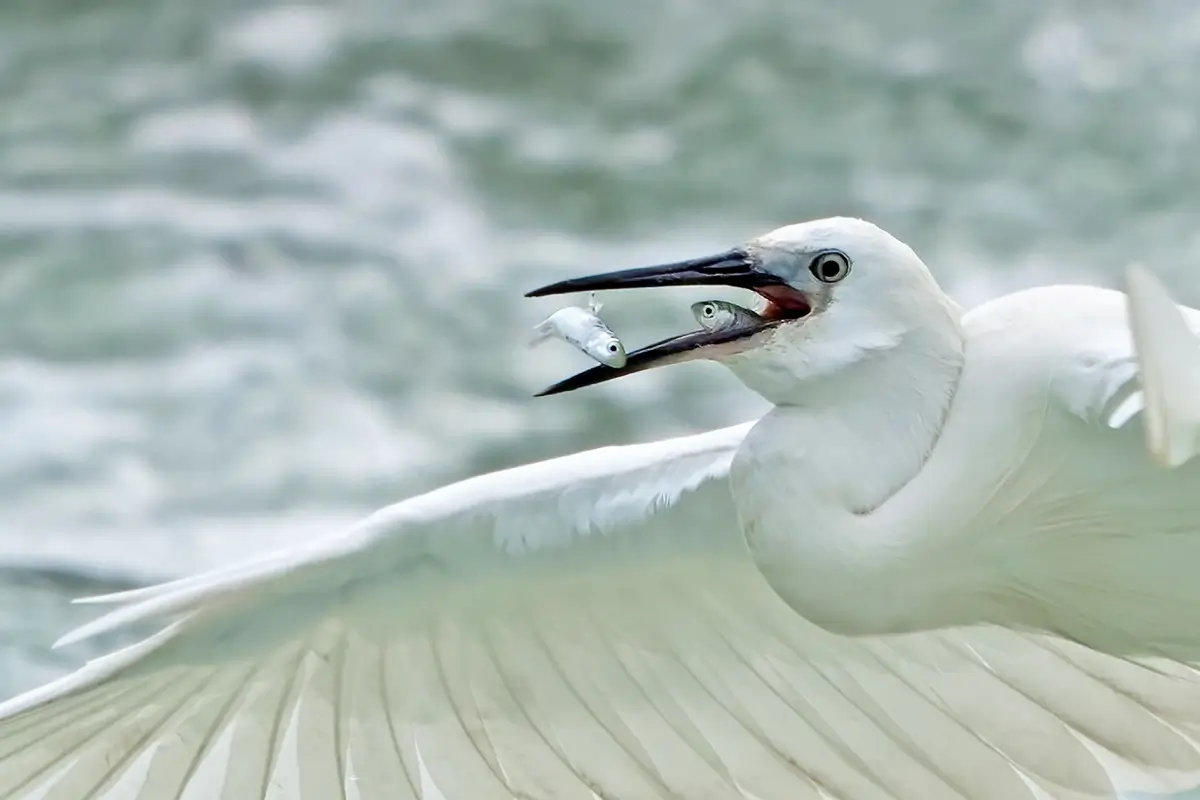
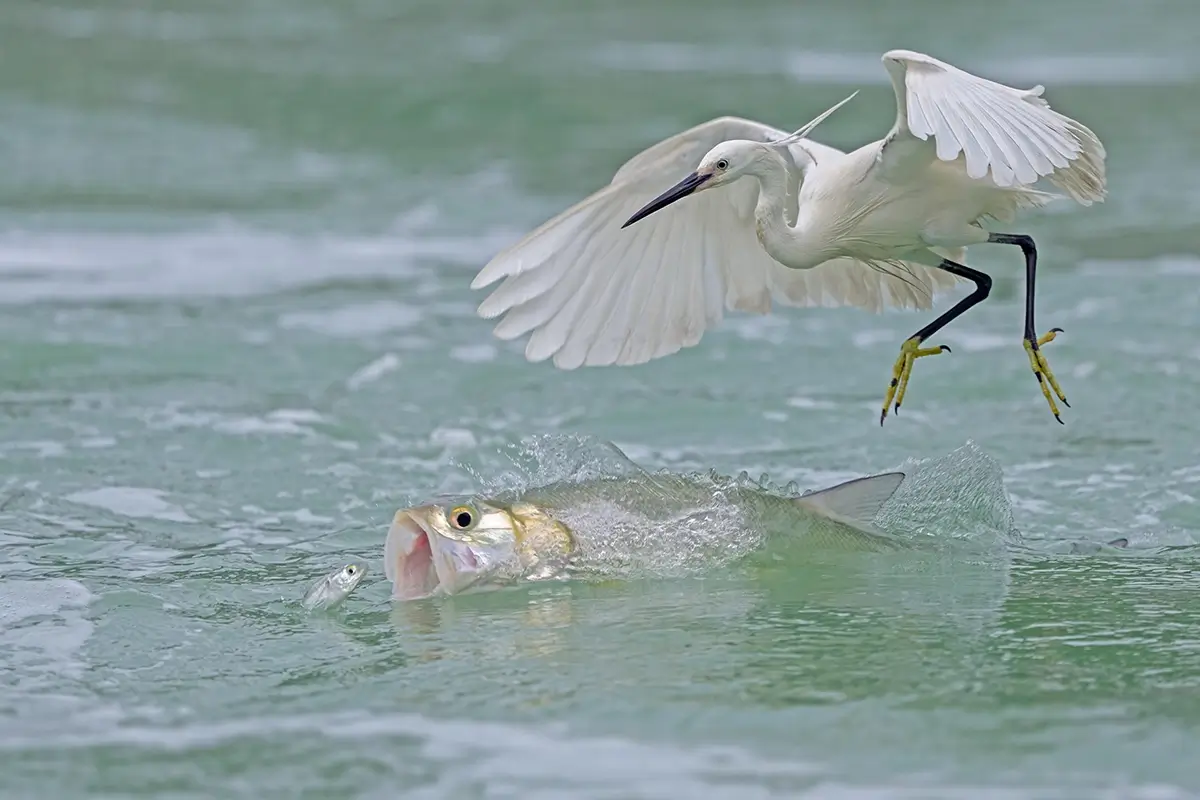
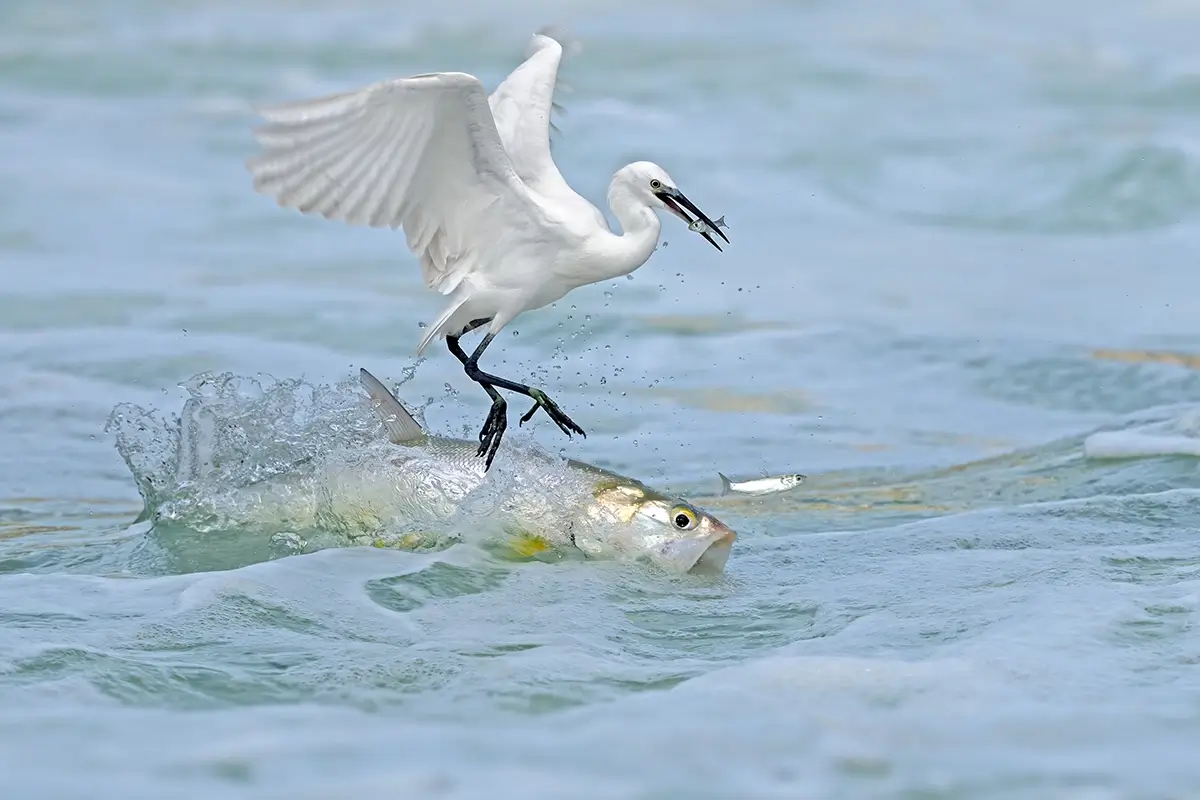
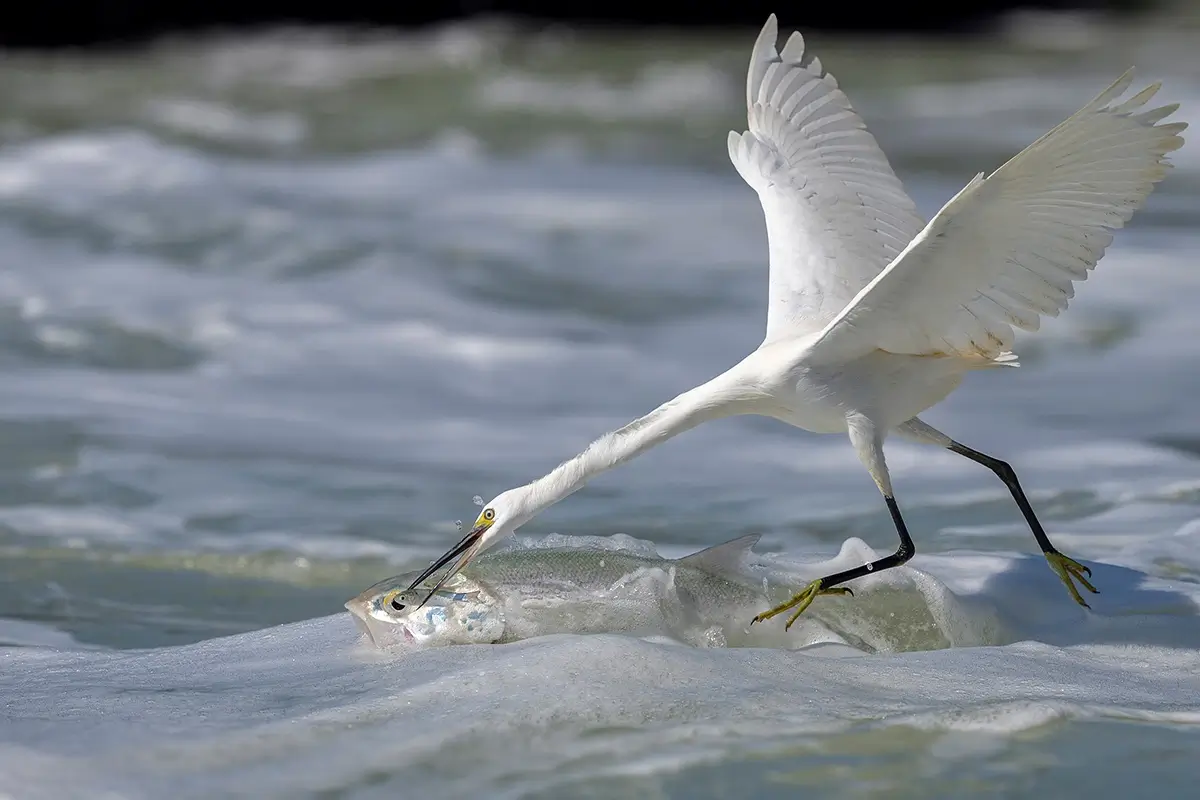
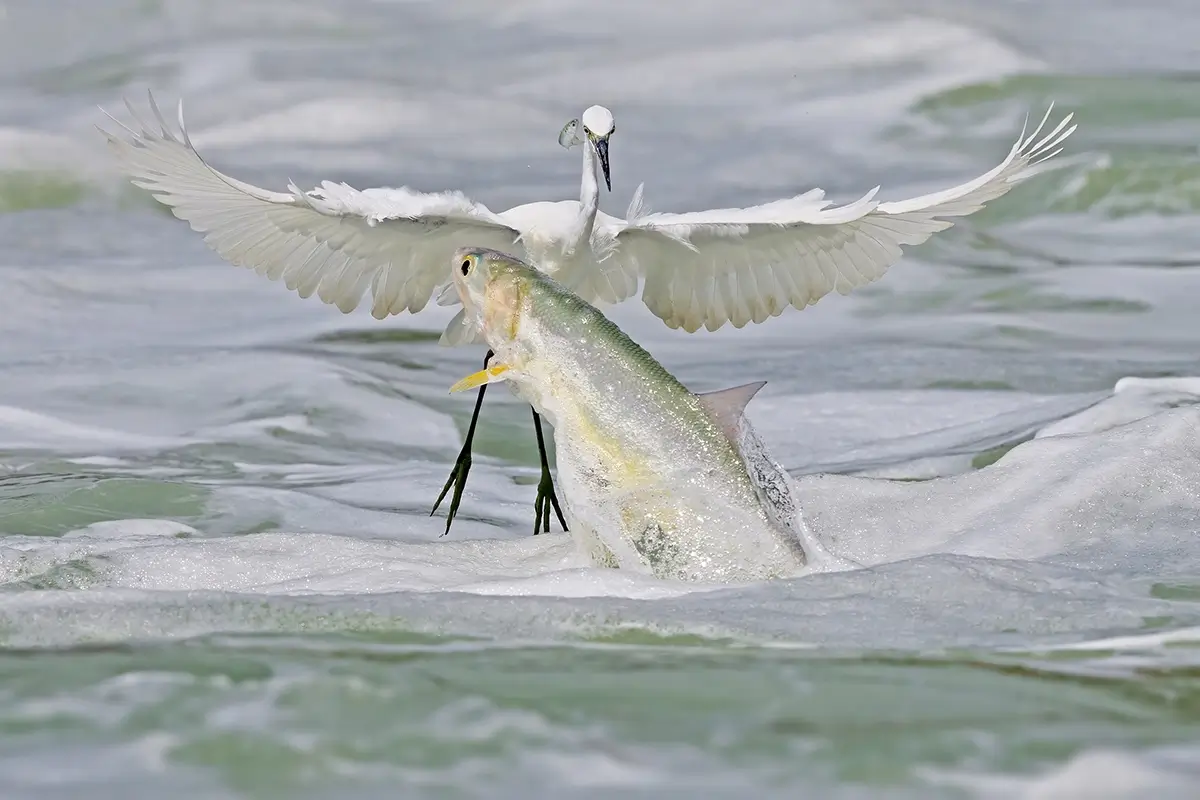
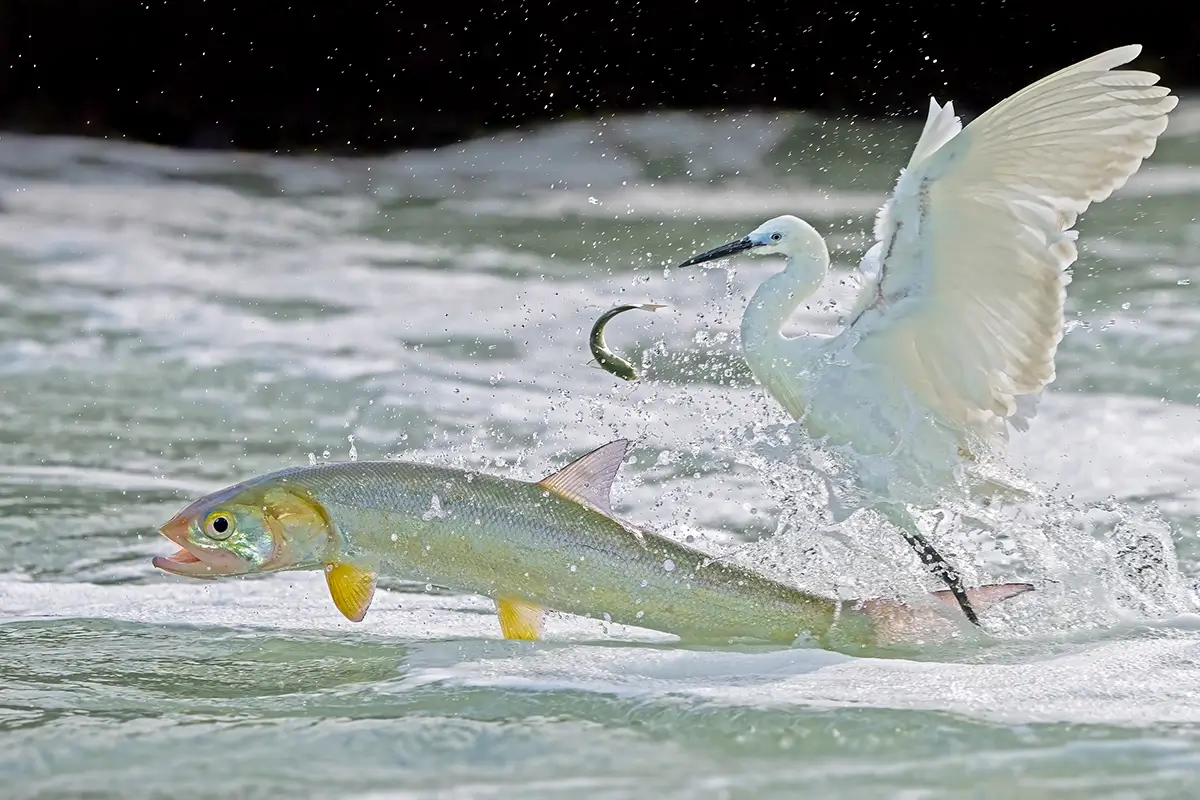
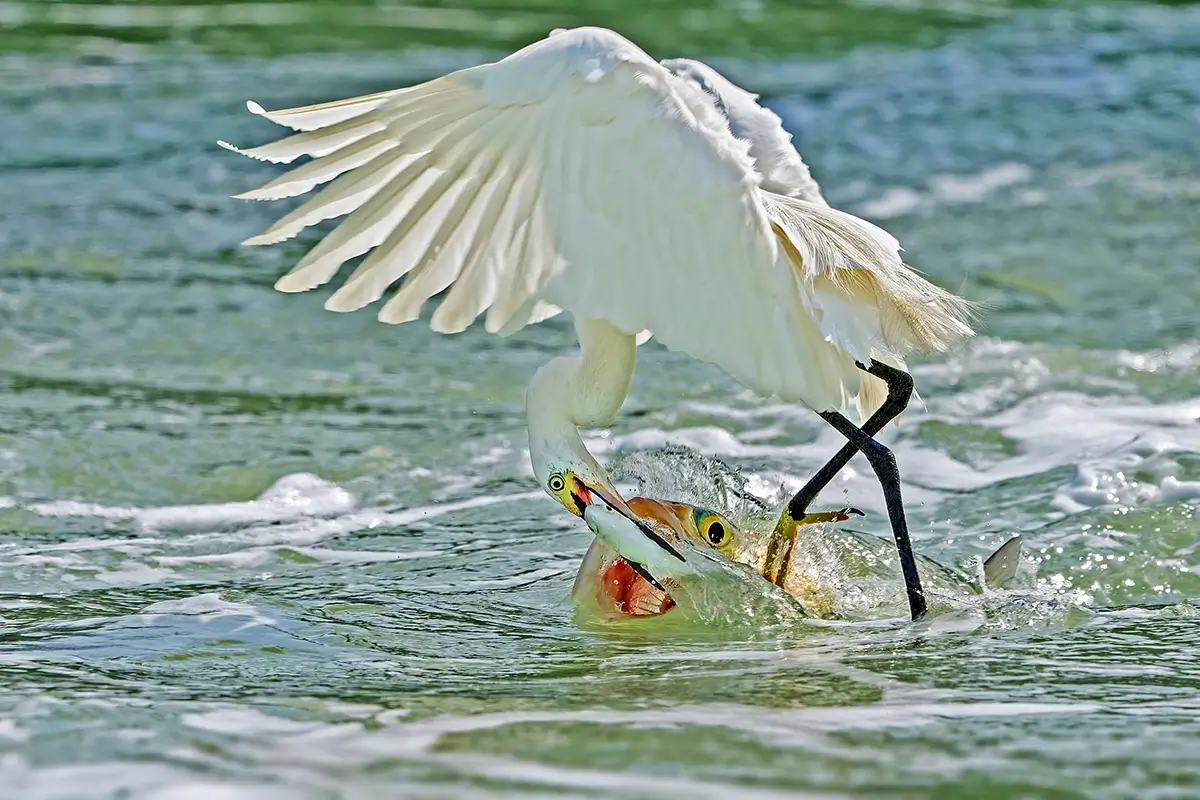
The scene of “opening the gate to release the tide and egrets catching fish” is a major attraction of Yundang Lake in Xiamen, China. Xiamen has long pursued sustainable ecological civilization, improving bay water dynamics and protecting the marine ecosystem, with the lake area’s environment greatly improved. Every time the tide rises, the gates of the West Embankment in Xiamen are opened to let seawater into Yundang Lake. It is often seen that small fish are rolling and leaping in the surging seawater, and egrets in the air and big fish in the lake are competing for the small fish at the gate - a spectacular sight of "egrets and fish flying together". The series of photography works titled "The Epic of Survival in the Waves - The Life Struggle Between Egrets and Fish" was captured between 2022 and 2025. The speed at which egrets and large fish compete for small fish is so fast that a shutter speed of at least 1/2000 and a high-speed continuous shooting rate of 20 frames per second are required to freeze the thrilling moments. This speed is beyond the reaction time of the human eye. This series of photography works records the most primitive competition in nature from a nearly cold perspective, allowing me to see the most genuine form of life: not the cold law of the survival of the fittest, but the survival epic that every living being is writing with all their might. Those that sparkle in the waves are both the cruel truth of nature and the brilliant light of life that never compromises. I hope these photography works can prompt the audience to deeply reflect on the mysteries of nature and the essence of life, and thereby cherish the ecological environment and fulfill the responsibility of protection.

AAP Magazine

AAP Magazine 54 Nature

 

Inspiring Portfolios

Call for Entries
All About Photo Awards 2026
$5,000 Cash Prizes! Juror: Steve McCurry
 
Stay up-to-date  with call for entries, deadlines and other news about exhibitions, galleries, publications, & special events.

More Great Photographers To Discover

Grace Weston
United States
Grace Weston creates narrative photography in her studio with miniature staged vignettes that address psychological themes. Among her many honors, most recently Weston made the Top 50 in Photolucida’s Critical Mass 2023, and from that was awarded the additional prize of a solo show for 2025 at the Southeast Center for Photography. Weston was awarded both First Place Overall Portfolio category as well as Gold Winner in the Fine Art Portfolio category in the 2021 Tokyo International Foto Awards. She has earned fellowships from both the Oregon Arts Commission and Artist Trust (Washington State), nominations for Portland Art Museum’s Contemporary Northwest Art Awards (Oregon), and numerous grants during her career spanning more than 25 years. In 2012, she had her first European solo exhibition at Paci Contemporary in Brescia, Italy. An extensive exhibition of her work was shown at the Center for Photography in Yekaterinburg, Russia in 2021. She has exhibited widely in the US, as well as Europe, Scandinavia, Russia and Japan. In 2009, she was a finalist in PhotoEspana’s Descubrimientos exhibition in Madrid and named one of the “Nine to Watch” in the Whatcom Museum Photography Biennial (Washington) in 2008. Weston's work has been acquired by the Portland Art Museum (OR), the Amon Carter Museum of American Art (Fort Worth, TX), the University of the Arts (Philadelphia PA), Seattle Public Utilities Portable Artworks Collection (WA), King County Public Art Collection (WA), Photographic Center Northwest (WA), Portland Community College (OR), King County 4Culture (WA), the City of Seattle Portable Works (WA), as well as numerous private collections in the US, Europe and Japan. Weston’s signature photography has been commissioned for print magazines and book covers in the United States, Italy, Spain, China, and the Netherlands, including O, the Oprah Magazine, Discover magazine, and Geo Magazine (Italia). She is included in the book Microworlds (Laurence King Publishing, UK 2011). In 2020 Peanut Press published a monograph of her work entitled The Neighbors Will Talk, and self-published Character Studies in 2023. Statement I am an interdisciplinary artist working in the genre of staged photography, creating miniature narrative scenes with characters, props and sets that I source, alter, or fabricate from scratch, to then light and photograph. Although I never depict actual people in my photographs, the human psyche is undeniably at the center of my work. Power dynamics, gender roles, clandestineness, mythos, mystique, and feelings of isolation and alienation are explored in my work, all with a deceptively playful overlay. Reclaiming the Muse My staged miniature photography series, RECLAIMING THE MUSE, reframes historic artworks and stories in contemporary terms. In centering the women, historically cast as objects of beauty or scorn, I strive to revitalize the muse with agency, furthering the issues important to me as a contemporary female artist, flipping the patriarchal gaze on its head. The Long Night In these miniature narrative Noir scenes, lone characters appear in decidedly suburban environments: cul-de-sacs, dark and empty roads, the small-town bar, private basements and bedrooms, all offering an impression of seclusion, ripe for clandestine schemes. The scenarios take place at night, with minimal lighting, heavy with mystery and tension. We get to squirm with the sense of being voyeurs. These images are inspired not only from the television and film mysteries and spy stories of my childhood, but also from the sense of being a silent observer of the shadowy grown-up lives around me. My props and characters may come from a child’s world, but these are adult stories. Escaping Gravity: Breathing, Dying, Swimming, Flying I presented a multi-media installation at Nine Gallery in Portland, Oregon in 2018 about loss, its lifelong ripples, release, and liberation. There were two chambers in this installation, one being the Pond, the other, the Pool, symbolizing my older brother’s death by drowning when he was eight-years old, and my learning to swim very late in life.
Anton Corbijn
Netherlands
1955
Anton Corbijn (born 20 May 1955) is a Dutch photographer, music video director, and film director. He is the creative director behind the visual output of Depeche Mode and U2, having handled the principal promotion and sleeve photography for both for almost 3 decades. Some of his works include music videos for Depeche Mode's "Enjoy the Silence" (1990), U2's "One" (version 1) (1991), Bryan Adams' "Do I Have to Say the Words? and Nirvana's "Heart-Shaped Box" (1993), as well as the Ian Curtis biopic Control (2007), George Clooney's The American (2010), and A Most Wanted Man (2013) based on John le Carré's 2008 novel of the same name. Anton Corbijn was born on 20 May 1955 as Anton Johannes Gerrit Corbijn van Willenswaard in Strijen, the Netherlands, where his father had been appointed as parson to the Dutch Reformed Church the previous year. Father Anton (Hilversum, 12 Nov 1917 - Amersfoort, 9 Mar 2007) would take up the same position in Hoogland (1966) and Groningen (Diakonessenhuis, 1972) moving his wife and four children with him. His mother, Marietje Groeneboer (11 Sep 1925 - Hoogland, 15 Sep 2011), was a nurse and was raised in a parson's family. Photographer and director Maarten Corbijn (Strijen, 1960) is a younger brother. Grandfather Anton Johannes (Corbijn) van Willenswaard (Schoonhoven, 24 Nov 1886 - Hilversum, 16 Aug 1959) was an art teacher at Christian schools in Hilversum and an active member in the local Dutch Reformed church in Hilversum. Corbijn started his career of music photographer when he saw the Dutch musician Herman Brood playing in a café in Groningen around 1975. He took a lot of photos of the 'rising star' Herman Brood & His Wild Romance. Because of the pictures taken by Corbijn, Brood's fame rose quickly, and as a result Corbijn's own exposure increased. Corbijn has photographed Joy Division, Depeche Mode, Tom Waits, Pr?ta V?tra, David Bowie, Peter Hammill, Miles Davis, Björk, Captain Beefheart, Kim Wilde, Robert De Niro, Stephen Hawking, Elvis Costello, Siouxsie and the Banshees, Morrissey, Simple Minds, Clint Eastwood, The Cramps, Roxette and Herbert Grönemeyer, amongst others. Perhaps his most famous, and longest standing, association is with U2, having taken pictures of the band on their first US tour, as well as taking pictures for their Joshua Tree and Achtung Baby albums (et al) and directing a number of accompanying videos. From the late 70s the London based NME, (New Musical Express), a weekly music paper, featured his work on a regular basis and would often feature a photograph of his as the front page. One such an occasion was a portrait of David Bowie back stage in New York at his play The Elephant Man in nothing more than a loin cloth. In the early years of London based The Face, a glossy monthly post-punk life style / music magazine, Anton Corbijn was a regular contributor. He made his name working only in black and white. In May 1989 he began taking pictures in colour using filters: his first try was done for Siouxsie Sioux. Between 1998 through 2000, in collaboration with the painter Marlene Dumas, he worked on a project called "Stripping Girls", which took the strip clubs and peep shows of Amsterdam as their subject; while Corbijn later exhibited photographs, Dumas took Polaroids which she then used as sources for her paintings. Corbijn has photographed album covers for U2, working with sleeve designer Steve Averill and Peter Hammill, Depeche Mode, The Creatures (the second band of Siouxsie Sioux), Nick Cave, Bryan Adams, Metallica, Therapy?, The Rolling Stones, Simple Minds, R.E.M., The Bee Gees, Saybia and Moke.Source: Wikipedia
Erik Johansson
Sweden
1985
Erik Johansson (born 1985) is a photographer and visual artist from Sweden based in Prague, Czech Republic. His work can be described as surreal world created by combining different photographs. Erik works on both personal and commissioned projects with clients all around the world. In contrast to traditional photography he doesn't capture moments, he captures ideas with the help of his camera and imagination. The goal is to make it look as realistic as possible even if the scene itself contains impossible elements. In the end it all comes down to problem solving, finding a way to capture the impossible. To Erik it's always important with a high level of realism in his work. He want's the viewer to feel like they are part of the scene. Although his work consists of a lot of work in post-production and combining photogaphs he always tries to capture as much as possible in camera. "No one can tell you that it doesn’t look realistic if you actually captured it for real." Light and perspective are crucial parts when combining images in a realistic way and if some parts are not possible to shoot on location, a similar scene has to be built up in a controlled environment. Having an understanding of both photography and post production is very important to make everything come together seamlessly. Every photograph and part has its purpose. Erik always do all the post production himself to be in complete control of the end result. The idea, photography and post production are all connected. The final image doesn’t become better than the photographs used to capture it. Just like the photographs don’t become stronger than the idea. There are no computer generated-, illustrated- or stock photos in Erik's personal work, just complex combinations of his own photographs. It's a long process and he only creates 6-8 new images a year (excluding commissioned work). Artist Statement "My name is Erik Johansson, I was born in 1985 outside a small town called Götene in the middle of Sweden. I grew up on a farm with my parents and two younger sisters. For as long as I can remember I have liked drawing. Probably because of my grandmother who was a painter. Early I also got interested in computers, escaping to other worlds in computer games. At the age of 15 I got my first digital camera which opened up a new world. Being used to drawing it felt quite strange to be done after capturing a photo, it wasn’t the process of creating something in the same way. Having an interest in computers made it a quite natural step to start playing around with the photos and creating something that you couldn’t capture with the camera. It was a great way of learning, learning by trying. But I didn’t considered it as a profession until years later. In 2005 I moved to Gothenburg to study Computer engineering at Chalmers University of Technology. During my time studying I took up my interest for retouch once again. I had a lot of ideas that I wanted to realize and I saw it as problem solving trying to make it as realistic as possible. After publishing some of my images online I started to get requests about commissioned work from some local advertisement agencies. I started out freelancing in parallel with my studies while still working on personal projects. I got more and more jobs and at the time I finished my studies with a master in Interaction Design I felt like I rather wanted to try out the photography path. I moved to Norrköping in the eastern part of Sweden to start working full time as a freelance. I made new friends and got to work on interesting projects, both local and abroad. In early 2012 it was time for something new as I moved to Berlin, Germany. A very artistic city with lots of inspiration. Today I work with both personal and commissioned projects and I also started doing photography street illusions."Source: www.erikjo.com/
Maggie Taylor
United States
1961
Maggie Taylor received her BA degree in philosophy from Yale University in 1983 and her MFA degree in photography from the University of Florida in 1987. After more than ten years as a still life photographer, she began to use the computer to create her images in 1996. Her work is featured in Adobe Photoshop Master Class: Maggie Taylor’s Landscape of Dreams, published by Adobe Press in 2004; Solutions Beginning with A, Modernbook Editions, Palo Alto, 2007; and Alice’s Adventures in Wonderland, Modernbook Editions, Palo Alto, 2008. Taylor’s images have been exhibited in one-person exhibitions throughout the U.S and abroad and are in numerous public and private collections including The Art Museum, Princeton University; The Fogg Art Museum, Harvard University; Harn Museum of Art, University of Florida; Museum of Fine Arts, Houston, Texas; and The Museum of Photography, Seoul, Korea. In 1996 and 2001, she received State of Florida Individual Artist’s Fellowships. In 2004, she won the Santa Fe Center for Photography’s Project Competition. 2005 she received the Ultimate Eye Foundation Grant. She lives in Gaineville, Florida.From en.wikipedia.orgMaggie Taylor (born 1961 in Cleveland, Ohio) is an artist who works with digital images. She won the Santa Fe Center for Photography's Project Competition in 2004. Her work has been widely exhibited in the United States and Europe and is represented within the permanent collections of several galleries and museums. She is the third wife of American photographer, Jerry Uelsmann. She produces prints by scanning objects into a computer using a flatbed scanner, then layering and manipulating these images using Adobe Photoshop into a surrealistic montage.
Sarah  Ketelaars
United Kingdom
Sarah Ketelaars is a British photographer from Brighton, UK. She has a BA and an MA degree in English Literature from Jesus College, Cambridge, an MSc in Social Science from the Robert Gordon University in Aberdeen and a Diploma in photography from City College, Brighton. She began her career as a journalist and her images have appeared on book, CD and magazine cover. Her work has been exhibited nationally and internationally and is represented by Trevillion Images & Getty, and by 35 North Gallery in Brighton. In 2021 she was selected as one of the Lensculture Critics’ Choice winners for her project ‘Windows’ shot during lockdown in Houston, Texas and in 2024 she was selected as a finalist for her project ‘The 544’ in the Lensculture Art Photography Awards. The 544 This ongoing project is a memorial to 544 psychiatric patients murdered by the Nazis in 1941 in Latvia. The figurative images I’ve made are all cyanotypes. Eventually there will be one for each man, woman and child killed. My grandmother was working at the hospital from where the patients were taken. I have visited the hospital and found that although the story is known no memorial exists. The only official record seems to be a short paragraph in the Nuremberg report. So far I have found no record of the names. Using a historic photographic process feels fitting for a project examining a historical event. An ancient pagan Latvian folk symbol is drawn on by hand in gold ink to each piece. It is impossible for me to look at these images without thinking about how the lives of these people ended. However, the project is primarily intended as a memorial. I wanted the images to hint at some more celebratory moments, to remember the lives lived before these people entered the hospital; before they died. Not knowing anything about the identities of the dead, I have tried to imagine each one as a unique, precious being, and give each back a little of the character stripped from them when they were murdered and reduced by history to a number on a list of nameless victims. The project is the second in a trilogy looking at my family history, examining themes of cultural inheritance, identity and intergenerational trauma.
Terri Gold
United States
1955
Terri Gold is a photographer known for her poetic infrared and color imagery of people from the remote corners of the globe. Her ongoing project "Still Points in a Turning World" explores our universal cross-cultural truths: the importance of family, community, ritual and the amazing diversity of its expression. As the timeless past meets the imminent future, indigenous cultures that still follow their traditional way of life are rapidly disappearing. At risk is a vast archive of knowledge and expertise. What is the value of ancient practices? What will be discarded and what will be treasured? If we share our stories and appreciate the mysteries of every realm, we may gain a deeper understanding of that which lies both behind and ahead of us. Her work has garnered many awards, is shown in galleries internationally and published extensively. Recent publications of her work include articles in the BBC Picture Desk, The Huffington Post, aCurator, and Featureshoot. She had a solo show at the Salomon Arts Gallery in New York in 2018. Her work won the Grand Prize in Shadow and Light magazine competition in 2019 and in The Santa Fe Photographic Workshops’ "Diversity" competition. She has received recent awards in the International Photography Awards, Prix de la Photographie, Paris (Px3), Humanity Photo Awards, and the Black and White Spider Awards. She is always happiest with a camera or three in her hands. Statement In the Sahel desert in Chad, the nomadic Wodaabe people spend months apart, searching out pastures for their herds and shelter for the families. When the rains are good, the clans celebrate with an extraordinary courtship ritual and beauty contest called The Gerewol and it's the men who are on parade. The sweltering desert region of Chad seems an unlikely place to be so concerned with beauty yet it is an integral part of the Wodaabe culture. They consider themselves to be the most beautiful people on earth. They display their beauty as a spiritual act, full of dignity and honor. Each person is an artist and they are their art. A living canvas. The intensity rises as they dance all night in their technicolor dreamcoats, a surreal line-dance. Many different arrangements are made at the festival, some for the night, some for a lifetime. All is possible at the Gerewol...
Susan Meiselas
United States
1948
Susan Meiselas is a documentary photographer who lives and works in New York. She is the author of Carnival Strippers (1976), Nicaragua (1981), Kurdistan: In the Shadow of History (1997), Pandora's Box (2001), Encounters with the Dani (2003) Prince Street Girls (2016), A Room Of Their Own (2017) and Tar Beach (2020). She has co-edited two published collections: El Salvador, Work of 30 Photographers (1983) and Chile from Within (1990), rereleased as an e-book in 2013, and also co-directed two films: Living at Risk (1985) and Pictures from a Revolution (1991) with Richard P. Rogers and Alfred Guzzetti. Meiselas is well known for her documentation of human rights issues in Latin America. Her photographs are included in North American and international collections. In 1992 she was made a MacArthur Fellow, received a Guggenheim Fellowship (2015), and most recently the Deutsche Börse Photography Foundation Prize (2019) and the first Women in Motion Award from Kering and the Rencontres Internationales de la Photographie d'Arles. Mediations, a survey exhibition of her work from the 1970s to present was recently exhibited at the Fundació Antoni Tàpies, Jeu de Paume, San Francisco Museum of Modern Art and the Instituto Moreira Salles in São Paulo. She has been the President of the Magnum Foundation since 2007, which supports, trains, and mentors the next generation of in-depth documentary photographers and innovative practice. About Nicaragua Susan Meiselas became known through her photo reportages on the Nicaraguan revolution. From 1978 to 1982 she documented the uprising of the Sandinistas against the then president Anastasio Somoza Debayle. Some of her photographs, foremost among them the “Molotov Man”, became iconic media images and shaped the way the Latin American revolution was perceived in the West. About Carnival Strippers The role of women has been a focal point of Meiselas’ work ever since the 1970s. In her first major photographic essay entitled Carnival Strippers (1972-1975), she showcased the working conditions of women who earned a living working as strippers at fairs in New England. She combined her photographs with audio recordings of the women, their clients, and their managers. In this project Meiselas depicts the reality of life for these protagonists and lets them tell their own stories, thereby strengthening their feeling of self-worth and their personal identity. About Prince Street Girls For the series Prince Street Girls, she accompanied young girls in Little Italy, New York City over a period of seventeen years - from childhood to puberty and on into adulthood. The photographs illustrate the gradual changes in their lives, their bodies, and their place within society. About Archive of Abuse In her series Archive of Abuse Susan Meiselas addressed the issue of domestic abuse. In the early 1990s, the photographer was invited to support an awareness-raising campaign in San Francisco on the subject of domestic violence. Meiselas used material from police reports to focus on documenting the crimes, both visually and in text. The collages created in this way were posted in public spaces to raise people’s awareness of the many different forms of violence towards women as a structural phenomenon. About Kurdistan Meiselas’ starting point for her long-term project Kurdistan was the documentation of the genocide perpetrated against the Kurds by the Iraqi regime under Saddam Hussein in northern Iraq in 1988. She created an archive that preserves a people’s cultural memory and the chequered history of the Kurdish diaspora. The multimedia project comprises photographs, videos, documents, and oral accounts compiled by the artist over a period of more than thirty years.Source: Kunst Haus Wien
Enri Canaj
Albania
1980
Enri Canaj was born in Tirana, Albania, in 1980. He spent his early childhood there and moved with his family to Greece in 1991, immediately after the opening of the borders. He is based in Athens and covers stories in Greece and the Balkans. He studied photography at the Leica Academy in Athens. In 2007 he took part in a British Council project on migration, attending a year-long workshop with Magnum photographer Nikos Economopoulos. Since 2008, he has been a freelance photographer for major publications such as Time Lightbox, CNN Photo, New York Magazine, MSNBC Photography, The Wall Street Journal, Courrier International, Vice Magazine, The Financial Times, Newsweek, Paris Match, Le Monde Diplomatique, sample of his work has been exhibited at the Museum of Contemporary Art of Thessaloniki personal exhibition, HANOVER LUMIX Festival, Arles Festival, Benaki Museum Athens, Museum of Photography Thesaloniki, BOZAR Center for Fine Arts, Cultural Foundation of the National Bank of Greece in Athens, at the Bilgi Santral in Istanbul, the European Parliament in Brussels and the Athens Photo Festival, New Delhi Foto Festival.Source: Magnum Photos In 2010, statistics stated that some 90% of all illegal border crossings into the EU take place in Greek territory, with immigrants coming mostly from the Middle East, North Africa and South Asia, a reflection of the geopolitical conflicts currently ravaging each region, and the influx continues. These people are common a sight in Athens, as western tourists take part in the cultural tourism that keeps this city alive; peddling cheap products made in China – a crude image of capitalism eating its own tail. And yet, despite the ease with which this situation might be covered in bursts by the mainstream press, Enri Canaj’s work has consistently surrounded themes of migration within the Balkans, and more specifically the experience of immigrants in Greece, suggesting a dedication to a cause, rather than a newsworthy story. Since 2007, when he took part a yearlong project on migration with Magnum photographer Nikos Economopoulos entitled the City Streets Project organized by the British Council, this focus has become one of the key aspects to his work. And despite his professional status as a photojournalist, Canaj’s images reveal a more personal relationship to the situation of the migrant on the ground, given that Canaj himself was an immigrant who came to Greece from his native Albania in 1991 at the age of eleven. Having experienced first hand what it’s like to exist on the outside looking in, Canaj translates what he sees, and sends it back out into the world so as to reflect a sense of humanity in the lives of those so often treated as less than.Source: Aint-Bad In June 2019 Enri Canaj became a Magnum Photos associate. At-present he is based in Athens and covers stories in Greece, the Balkans, west & north Europe focusing on the migration matter.
MD Saiful Amin
Bangladesh
1969
I’m a street and documentary photographer from Dhaka. I began taking photos in the mid-90s, but it wasn’t until 2015 that I pursued photography seriously. My profession is in private service at a construction company. During the "Pilkhana Tragedy" on February 25, 2009, the armed border guards opened fire on civilians. I was taking pictures as they approached their gate, but suddenly, a bullet from a Chinese rifle hit me. My sciatic nerve was severely injured, and my leg was shattered into multiple pieces. From 2009 to 2011, I underwent seven major surgeries. I was bedridden for 4 ½ years. Unfortunately, during that time, my hard drive crashed, and I lost all my images from the 80s up to February 2009. It was an incredibly frustrating period for me. When I received my first DSLR camera in 2015, I picked up photography again. Despite the constant pain in my leg, I’ve never stopped. I never leave home without my camera, even for a single day. My work – Since 2016, I’ve focused on documenting the Bihari and Dalit communities, as well as homeless and street kids, urban slum communities, the tannery, and plastic industries, among other subjects. Achievements – I’ve participated in about 50 national exhibitions (winning 1st prize twice), and I’ve exhibited my work in Kolkata and Romania as a solo participant. I’ve received several FIAP honorable mentions and acceptances in salons worldwide. One of my photos was published in the 2018 edition of the 'Wisden' annual cricket book, often referred to as the Bible of Cricket. My work has also been featured in numerous international photography websites and magazines. In 2020, I won the FIAP Gold Medal and the "Photographer of the Year" trophy at the ABP Salon, a prestigious contest organized by the Bangladesh Photographic Society (BPS). Workshops – I’ve attended both short and long photography workshops with GMB Akash, the late Anwar Hossain Anu, M. R. Hasan, Prito Reja, Chanchal Mahmud, and Rafiqul Islam. Mentorship – I’ve also served as a judge for several national photography exhibitions between 2018 and 2019. Life in Bihari Camp, Dhaka, Bangladesh A young girl writes a poem in which she asks a simple yet profound question—one that no one can answer. She asks, Who am I? Her forefathers were born in India, they migrated to Pakistan, and she was born in Bangladesh. India abandoned them long ago, Bangladesh refuses to accept them as children of the land, and Pakistan won’t take them back. She says she has many names: Bihari, Maura, Muhajir, Non-Bangalee, Marwari, Urdu-speaker, Refugee, and Stranded Pakistani. But she desires only one identity: Human. This is the reality for the 160,000 camp-based Urdu-speaking community members in Bangladesh. In Geneva Camp alone, around 50,000 Urdu-speaking people of Indian and Pakistani origin live in difficult conditions. After the partition of India in 1947, amidst large-scale communal riots on both sides of the border, hundreds of thousands of Muslims from Bihar, Kolkata, Uttar Pradesh, Madhya Pradesh, and as far as Hyderabad migrated to what was then East Pakistan. Muhammad Ali Jinnah, the leader of the All India Muslim League, promised them that Pakistan would be a "safe haven for all Muslims." As is typical of people migrating from a shared locality, the Biharis formed separate clusters from the Bengalis. Their communities became concentrated in areas like Mohammadpur, Mirpur, Khulna, Chittagong, and Santahar. The new generation, born after the war, now comprises the majority of camp residents. They have no affiliations with either India or Pakistan. They were born in Bangladesh and identify as Bangladeshis. Unfortunately, the state is reluctant to accept them as such. It is a complex issue, with the majority population skeptical of their loyalty to the country they wish to call home. The inhumane conditions in which they live and the societal effects of their marginalization make it imperative to resolve this painful issue. 365 Photography Library This is the largest photography library in Bangladesh, with around 2,000 books on photography. It’s free for everyone, and I created it for young photographers and the next generation. I plan to leave it to them as my legacy before I die. www.365photographylibrary.com
Advertisement
All About Photo Awards 2026
Win a Solo Exhibition in March
All About Photo Awards 2026

Latest Interviews

Exclusive Interview with Anastasia Samoylova
Anastasia Samoylova is an American artist whose photographic practice is shaped by close observation and a deep attentiveness to place. Working between documentary and formal exploration, she photographs landscapes, architecture, and everyday scenes with a sensitivity to light, structure, and atmosphere. Since relocating to Miami in 2016, her work has increasingly focused on how environments—both natural and built—carry social, cultural, and emotional traces. We asked her a few questions about her practice and her way of seeing, to better understand the thoughts and experiences that shape her work—while allowing the images themselves to remain open and speak in their own time.
Exclusive Interview with Marijn Fidder
Marijn Fidder is a Dutch documentary photographer whose work powerfully engages with current affairs and contemporary social issues. Driven by a deep sense of social justice, she uses photography to speak on behalf of the voiceless and to advocate for the rights of those who are most vulnerable. Her images have been widely published in major international outlets including National Geographic, CNN Style, NRC Handelsblad, Volkskrant, GUP New Talent, and ZEIT Magazin. Her long-term commitment to disability rights—particularly through years of work in Uganda—culminated in her acclaimed project Inclusive Nation, which earned her the title of Photographer of the Year 2025 at the All About Photo Awards. She is also the recipient of multiple prestigious honors, including awards from World Press Photo and the Global Peace Photo Award. We asked her a few questions about her life and work.
Exclusive Interview with Josh S. Rose
Josh S. Rose is a multidisciplinary artist working across photography, film, and writing. His practice bridges visual and performing arts, with a strong focus on movement, emotion, and the expressive potential of the image. Known for his long-standing collaborations with leading dance companies and performers, Rose brings together authenticity and precise composition—a balance he describes as “technical romanticism.” His work has been commissioned and exhibited internationally, appearing in outlets such as Vogue, at the Super Bowl, in film festivals, and most recently as a large-scale installation for Lincoln Center for the Performing Arts. A sought-after collaborator, he has worked with major artists, cultural institutions, and brands, following a previous career as Chief Creative Officer at Interpublic Group and the founder of Humans Are Social. We asked him a few questions about his life and work.
Interview with Maureen Ruddy Burkhart
Photographer Maureen Ruddy Burkhart brings a quietly attentive and deeply human sensibility to her exploration of the world through images. Shaped by a life immersed in photography, film, and visual storytelling, her work is guided by intuition, observation, and an enduring interest in the emotional undercurrents of everyday life. With a practice rooted in both fine art traditions and documentary awareness, she approaches her subjects with sensitivity, allowing subtle moments to emerge naturally rather than be imposed. Her series Til Death, selected as the Solo Exhibition for February 2025, reflects this long-standing commitment to photography as a space for reflection rather than spectacle. Drawn to moments that exist just outside the expected frame, Burkhart’s images suggest narratives without resolving them, leaving room for ambiguity, humor, and quiet connection. We asked her a few questions about her life and work.
Exclusive Interview with Peter Ydeen
Winner of AAP Magazine #45 Travels, his series reflects this unique vision—capturing the spirit of place through subtle layers of light, color, and emotion. Whether traveling abroad or observing the rhythms of his own surroundings, Ydeen creates images that feel both grounded and enchanted, inviting viewers into a world where reality and reverie meet.
Exclusive Interview with Julie Wang
Chinese-born photographer Julie Wang brings a poetic, contemplative sensitivity to her visual exploration of the world. Having lived for nearly equal parts of her life in China, Europe, and the United States, she approaches her subjects with the nuanced perspective of someone shaped by many cultures. This blend of distance, curiosity, and emotional resonance infuses her work with a quiet depth, allowing her to reveal the fragile beauty and subtle tensions that often pass unnoticed.
Exclusive Interview with Ghawam Kouchaki
American photographer Ghawam Kouchaki brings a sharply observant and introspective gaze to the streets of Japan’s capital. Based in Los Angeles, he approaches Tokyo with the distance — and curiosity — of an outsider, allowing him to uncover the city’s subtle contradictions, quiet tensions, and fleeting gestures that often go unnoticed. His series Tokyo no no, selected as the Solo Exhibition for December 2024, explores the hidden undercurrents of urban life: the unspoken rules, the small ruptures in routine, the poetic strangeness found in everyday moments. Through muted tones, instinctive timing, and meticulous framing, Kouchaki reveals a Tokyo that exists somewhere between reality and imagination — both intimate and enigmatic. We asked him a few questions about his life and work.
Exclusive Interview with Tommi Viitala
Tommi Viitala, winner of AAP Magazine #44: Street, is a Finnish photographer celebrated for his striking and cinematic street photography. With a keen eye for atmosphere and composition, he captures fleeting urban moments that reveal the poetry of everyday life. His work often explores the tension between solitude and connection within contemporary cityscapes, blending documentary realism with artistic sensibility. Viitala’s photographs have been exhibited internationally and recognized for their strong visual storytelling and emotional depth. We asked him a few questions about his life and work.
Exclusive Interview with Robert Mack
Robert Mack is a California-based visual artist, photographer, and filmmaker. His fine art photography and films have been exhibited widely in the United States and Europe, with major shows at the Baltimore Museum of Art and the Reiss-Engelhorn Museum in Mannheim, Germany. Both institutions hold his work in their permanent collections. Working across different media, Mack has built a career exploring the complexities of human presence and representation. In 1981, while living in Baltimore, he produced The Perkins Project: Not Guilty by Reason of Insanity, a rare photographic and film study inside Maryland’s hospital for the criminally insane. These stark yet compassionate black-and-white portraits remain one of his most powerful and controversial bodies of work.
Call for Entries
All About Photo Awards 2026
$5,000 Cash Prizes! Juror: Steve McCurry