All about photo.com: photo contests, photography exhibitions, galleries, photographers, books, schools and venues.
Win a Solo Exhibition in June 2026 + An Exclusive Interview!
Alexander Anufriev
Alexander Anufriev
Alexander Anufriev

Alexander Anufriev

Country: Russia
Birth: 1988

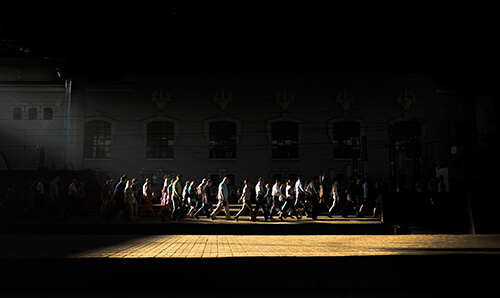
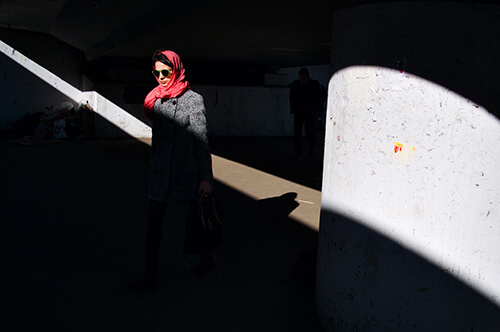
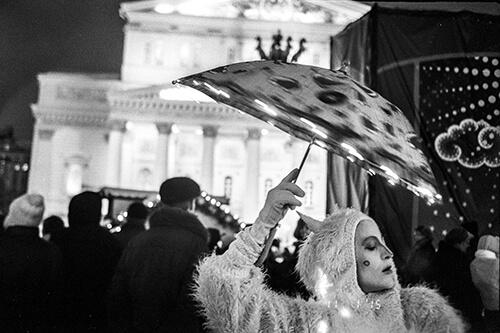
Alexander Anufriev is a Russian photographer, born in Ukhta (Komi Republic, Russia) in 1988. Before photography, Anufriev worked in international advertising agencies. Currently, he is a Moscow-based photographer who works on projects describing and analysing social landscape of contemporary Russia.

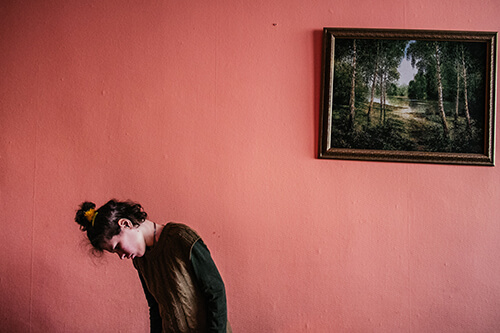
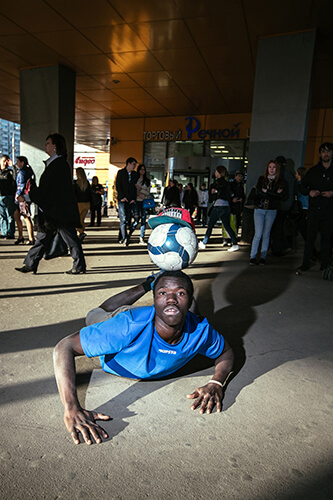
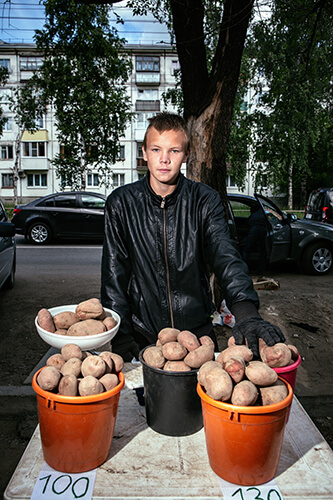
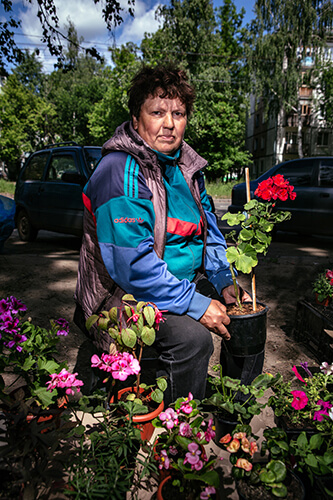
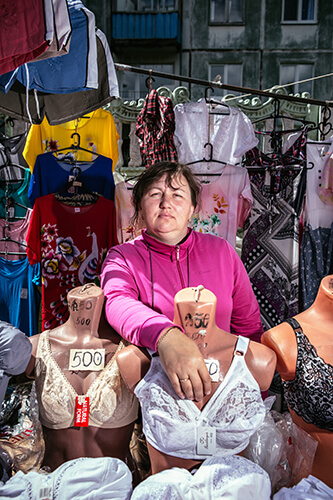
Alexander Anufriev’s Russia Close-Up series is a zoomed-in look at what makes a modern Russia, through a highly subjective lens. He got the idea for it while he was studying at The Rodchenko Art School in Moscow, after becoming disillusioned with documentary photography. “At the time, it was important for me to tell stories and for them to be the truth, but it started to feel like a little bit of a lie,” he explains. “Even if you’re trying to be totally objective, it is always a bit subjective."

“I stopped shooting for six months, and I was about to quit photography, but then I thought, ‘What if I tried to be completely subjective?’ So I cropped the images very tightly, and included only the elements I wanted to show. It was a farewell to convention.” Unconventional it may be, but the series has already had some success, exhibited in Cardiff, Sydney, and Saint Petersburg, and winning third place in the Moscow Photobookfest Dummy book award.

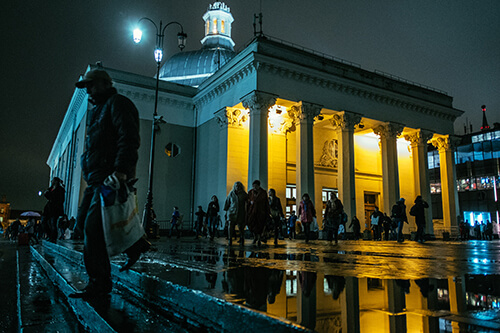
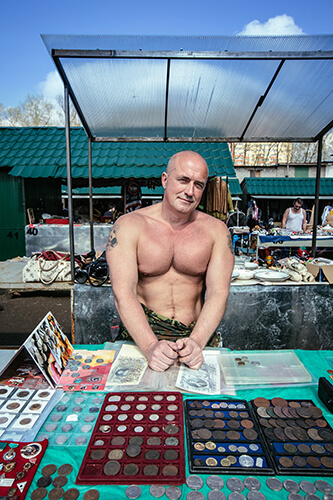
Anufriev’s past projects have included a series on homeless people celebrating New Year’s Eve in a Moscow train station, and portraits of market sellers on the city’s streets. But for this project, he wanted find a way to visualise the mood of a whole country. Born in 1988, he doesn’t remember life in the Soviet Union, behind the Iron Curtain. But over the last few years, against a backdrop of political apathy, he has began to realise the underlying forces of patriotism and nationalism in modern Russia. This series is an attempt to bring the image of Russia up to date, he says.

“There are inner processes that are not obvious to the rest of the world,” he adds, “the strengthening of censorship and propaganda. This series is an attempt to visualise these processes.”

Source: British Journal of Photography


Inspiring Portfolios

Call for Entries
AAP Magazine #58 B&W
Publish your work in our printed magazine and win $1,000 cash prizes
 
Stay up-to-date  with call for entries, deadlines and other news about exhibitions, galleries, publications, & special events.

More Great Photographers To Discover

Carrie Mae Weems
United States
1953
Considered one of the most influential contemporary American artists, Carrie Mae Weems has investigated family relationships, cultural identity, sexism, class, political systems, and the consequences of power. Determined as ever to enter the picture—both literally and metaphorically—Weems has sustained an on-going dialogue within contemporary discourse for over thirty years. During this time, Carrie Mae Weems has developed a complex body of art employing photographs, text, fabric, audio, digital images, installation, and video. In a New York Times review of her retrospective, Holland Cotter wrote, ''Ms. Weems is what she has always been, a superb image maker and a moral force, focused and irrepressible." Weems has participated in numerous solo and group exhibitions at major national and international museums including the Metropolitan Museum of Art, The Frist Center for Visual Art, Solomon Guggenheim Museum in New York, and the Centro Andaluz de Arte Contemporáneo in Seville, Spain. Weems has received numerous awards, grants, and fellowships, including the prestigious Prix de Roma, The National Endowment of the Arts, The Alpert, The Anonymous was a Woman, and The Tiffany Awards. In 2012, Weems was presented with one of the first US Department of State’s Medals of Arts in recognition for her commitment to the State Department’s Art in Embassies program. In 2013 Weems received the MacArthur “Genius” grant as well as the Congressional Black Caucus Foundation’s Lifetime Achievement Award. She has also received the BET Honors Visual Artist award, the Lucie Award for Fine Art photography, was one of four artists honored at the Guggenheim’s 2014 International Gala, a recipient of the ICP Spotlights Award from the International Center of Photography, The WEB Dubois Award from Harvard University, as well as Honorary Degrees from: California College of the Arts, Colgate University, Bowdoin College, the School of Visual Arts and Syracuse University. She is represented in public and private collections around the world, including the Metropolitan Museum of Art, NY; The Museum of Fine Arts, Houston; the Museum of Modern Art, NY; Museum of Contemporary Art, Los Angeles; and The Tate Modern, London. Weems has been represented by Jack Shainman Gallery since 2008, and is currently Artist in Residence at the Park Avenue Armory. She lives in Syracuse, New York, with her husband Jeffrey Hoone who is Executive Director of Light Work.
Beth Moon
United States
1956
San Francisco Bay Area artist, Beth Moon, has gained international recognition for her large-scale, richly toned platinum prints. Since 1999, Moon’s work has appeared in more than sixty solo and group exhibitions in the United States, Italy, England, France, Israel, Brazil, Dubai, Singapore, and Canada. Her work is held in numerous public and private collections, including the Museum of Fine Arts, Houston, the Museum of Photographic Arts in San Diego, and the Fox Talbot Museum in Wiltshire, England. In 2013, Between Earth and Sky, the first monograph of her work, was published by Charta Art Books of Milan. In 2014, Abbeville Press published, Ancient Trees: Portraits of Time, with a third book to follow that same year from Galerie Vevais, La Lange Verte. Moon studied fine art at the University of Wisconsin before moving to England where she experimented with alternative photographic processes and learned to make platinum prints. Source: www.vervegallery.com Beth Moon was born in Neenah, Wisconsin and studied fine art at the University of Wisconsin. Classes in painting, life drawing, sculpture, and design would set the groundwork for her work in photography, which was to come years later. Moving to England, a country with a love for all things arboreal, gave her a fresh look at a land that boasts the largest concentration of ancient trees. Inspired by these trees she decided to make a series of their portraits. Unhappy with the photographic tonality and stability of ink-jet printing, she started to experiment with alternative printing processes, learning platinum/palladium printing, an ideal process for her vision. She concentrated on mastering this printing technique, doing all of her own printing. “By using the longest lasting photographic process, I hope to speak about survival, not only of man and nature’s but to photography’s survival as well. For each print I mix ground platinum and palladium metals, making a tincture that is hand-coated onto heavy watercolor paper and exposed to light. There are many steps involved in creating the final print and these are as important to me as the capturing of the image," said Moon. A platinum print can last for centuries, drawing on the common theme of time and survival, pairing photographic subject and process. Source: www.josephsaxton.com
Elisabeth Sunday
United States
Elisabeth Sunday has been photographing indigenous people across the African continent for the last 26 years. Using a flexible mirror she created for the purpose (and hand carries unaccompanied to some of the most remote and dangerous spots on earth), Sunday has created her own analog process that prefigured Photoshop that she calls "Mirror Photography". Her method of photographing her subjects emphasizes and enhances their grace, elongating the body and the folds of their garments, creating an impressionistic effect one might be used to seeing in painting but which is unexpected in a medium from which we often expect a more literal representation. The effect is closer to that of dance, in which the body has reshaped itself and learned to move in a way that proclaims and exaggerates all its best qualities, while momentarily silencing its flaws, and in which movement itself has an aesthetic, rather than merely practical, purpose. Typically Sunday captures an elongated vertical reflection, rushing and bleeding like a single expressive brush stroke. Although Sunday herself is never visible in the frame, she is as much actor as she is director within the drama of these photographs, as she strives to represent not so much the personal characteristics of her subjects, but an essential gesture that connects a given incarnation with the long history of the soul. In her Anima and Animus series, Sunday mediates on eternal masculine and feminine energies, using warlike Koro men and nomadic Tuareg women as subjects. The Anima women are hidden under flowing garments, slanting to left or right or reaching upward like dark flames against the steady white curve of a dune. The Animus figures rise like tough young trees or spears, rooted somewhere beneath the picture plane. Grace and violence here seem cast together in a solid block, As with so many of Elisabeth Sunday's figures, these seem composed of stone or bone more than living flesh. Elisabeth Sunday has shown in galleries and Museums the world over including the Cleveland Museum of Art, Centre cultural Calouste Gulbenkian, Paris, France, the African American Museum, Los Angeles; International Photography Biennial, Brecsia, Italy, UC Berkeley Art Museum; Salle d' Exposition, Arles, France, Le Maison de la Photographie, Aosta, Italy, Exploratorium Museum, San Francisco, CA Smithsonian Anakostia Museum, Center for African American History and Culture, Washington D.C. The Museum of Fine Arts, Houston, and The Los Angeles County Museum of Art. Her work is included in major collections: The Corcoran Art Gallery, The University Art Museum at Berkeley, The Cantor Art Center at Stanford University, The Los Angeles Museum of Art, The Museum of Fine Art-Houston, Le Bibliothèque Nationale de Paris, France, The San Francisco Museum of Art, and The Eastman Kodak Collection. Her private collectors include Graham Nash, Quincy Jones, Gloria Steinem, Linda Grey, Bill Cosby, Bonnie Raitt and Alice Walker.Source Frank Pictures Gallery
Thomas Hoepker
Germany
1936
Thomas Hoepker is a German photographer and member of Magnum Photos. He is known for stylish color photo features. He also documented the 9/11 World Trade Center destruction. Hoepker originally made a name for himself in the 1960s as a photojournalist with a desire to photograph human conditions. Hoepker was born in Munich, Germany. He first began taking pictures when he was 16 and received an old 9x12 glass plate camera from his grandfather. He developed his prints in his family's kitchen and bathroom, and began to earn a little money by selling pictures to friends and classmates. Hoepker studied art history and archaeology from 1956 to 1959 at Göttingen, in Munich, Germany, where he was taught about understanding images and composition. While in school he continued to photograph and sell images to help finance his education. From 1960 to 1963 he worked as a photographer for Münchner Illustrierte and Kristall, reporting from around the world. Then in 1964 he began working as a photojournalist for Stern. In the 1970s he also worked as a cameraman for German TV, making documentary films. In 1976 he and his wife, journalist Eva Windmoeller, relocated to New York City as correspondents for Stern. From 1978 to 1981 he was director of photography for American Geo. From 1987 to 1989 Hoepker was based in Hamburg, working as art director for Stern. Magnum Photos first began distributing Hoepker's photographs in 1964. He became a full member in 1989. He served as Magnum President from 2003 to 2006. For much of his career Hoepker used Leica cameras. In the 1970s he began to also use single-lens reflex cameras alongside his Leica, using Leicas for wide angle shots and Nikon or Canon cameras with zoom lenses. In 2002 he began using digital SLRs. Today, Hoepker lives in New York City with his second wife Christine Kruchen, with whom he produces TV documentaries.Source: Wikipedia
Stefano Azario
Born in Paris, July 31 1966, Stefano Azario is a photographer and director now living between Milan and New York. Stefano began taking photographs at the age of 11 in 1977, shortly after the loss of his father. His family moved from Italy to London in 1979, where he studied photography at the London College of Printing from 1984 to 1987. Having developed a reputation as one of the best-known commercial photographers of children and babies, Stefano is currently concentrating more in documentary and fine art photography. A turning point in Stefano's career came in 1992 when Vogue Bambini began commissioning him regularly until the magazine's demise in 2018. In 2013, Stefano was asked to plan and photograph an entire issue of the magazine. In 1994, Stefano started shooting Gap Kids and BabyGap global advertising campaigns and continued uninterrupted for over 25 years. Major publications, advertising agencies, and globally known brands have worked with him. Benetton, Uniqlo, and Armani are just a few of the brands he has collaborated with. In his photography, Stefano tries above all to lead from the heart. With the likes of Dorothea Lange, Irving Penn and Luigi Ghirri as inspiration, Stefano is nimble in his working ways; at home directing on large video sets or shooting solo. Whether accessing his intimate and tender vision of children and babies or shooting in the Indonesian forest, he enjoys using a whole gamut of different cameras, films and technology, constantly challenging his way of seeing. His last exhibition "In Cerca Della Retta Via" at the No Gallery in Pontremoli, was put together with the patronage of the Italian Ministry of Culture as part of the Lunigiana Land Art festival in 2022. Statement Through the viewfinder I aim to capture fleeting, heartfelt moments that tell compelling human stories. I seek to make order of the world around me, to share an intuitive perspective, in the hope that my images can evoke emotions and memories, connecting viewer and subject. Throughout my career I have been drawn to projects that explore themes of childhood and relationships, seeking to convey experiences that shape us in these formative years. More recently I have roamed other areas from landscape to portraiture to expand and challenge my photographic practice and storytelling ability. In Search of a Path
Advertisement
AAP Magazine #58 B&W
Win a Solo Exhibition in June
AAP Magazine #58 B&W

Latest Interviews

Exclusive Interview with Carolyn Moore
American photographer Carolyn Moore explores the inner landscape of emotion, memory, and personal transformation through a deeply intuitive photographic practice. Her work unfolds as a quiet dialogue between artist and viewer, where images become a space for reflection, vulnerability, and connection.
Exclusive Interview with Luca Desienna and Laura Estelle Barmwoldt
For over seven years, Of Lilies and Remains has explored the depths of the goth and darkwave underground, unfolding in Leipzig—a city long associated with a vibrant and enduring subcultural scene. Moving between iconic gatherings such as Wave-Gotik-Treffen and more intimate moments on the fringes, the project offers a rare and immersive glimpse into a world often misunderstood, yet rich in expression and community. Created by Luca in collaboration with Laura Estelle Barmwoldt, the work embraces a cinematic and deeply personal approach. Rather than documenting from a distance, it moves within the scene itself, capturing its atmosphere, its codes, and its quiet contradictions. The title Of Lilies and Remains hints at this duality—where beauty and darkness, fragility and strength coexist. As the book prepares for its release, we spoke with both artists about the origins of the project, their process, and what it means to document a subculture that continues to evolve while remaining true to its spirit.
Exclusive Interview with Matthew Finley
American photographer Matthew Finley turns inward, using photography as a way to explore identity, memory, and emotional truth. Based in Los Angeles, his practice moves between performance, gesture, and found imagery, creating a visual language that is both intimate and deeply personal
Exclusive Interview with Jan Janssen
Dutch photographer Jan Janssen explores universal human experiences through his long-term project It Matters, winner of the May 2025 Solo Exhibition. Begun in 2016, the series captures intimate moments of everyday life—love, loss, connection, and belonging—across Central and Eastern Europe. Working in countries such as Turkey, Azerbaijan, and Armenia, Janssen spends extended time within communities, building relationships based on trust and respect. His approach allows him to move beyond observation, revealing deeply human and authentic moments. Rooted in travel and personal discovery, It Matters reflects Janssen’s search for what connects us all in an increasingly divided world. The project is ongoing and will culminate in a photobook scheduled for publication in 2026.
Exclusive Interview with Henk Kosche
German photographer Henk Kosche turns his lens toward the streets of Halle an der Saale, capturing everyday life in the late years of the former German Democratic Republic. At the time, Kosche was studying design and exploring the city with his camera, drawn to the atmosphere of its industrial landscape and the quiet rhythms of daily life. His series Street Photography at the End of the 80s, selected as the Solo Exhibition for July 2025, revisits a body of work created just before a period of profound change. Rediscovered decades later in a small box of 35mm negatives, these photographs offer glimpses of a city and its people at a moment suspended between the familiar and the unknown.
Exclusive Interview with Anastasia Samoylova
Anastasia Samoylova is an American artist whose photographic practice is shaped by close observation and a deep attentiveness to place. Working between documentary and formal exploration, she photographs landscapes, architecture, and everyday scenes with a sensitivity to light, structure, and atmosphere. Since relocating to Miami in 2016, her work has increasingly focused on how environments—both natural and built—carry social, cultural, and emotional traces. We asked her a few questions about her practice and her way of seeing, to better understand the thoughts and experiences that shape her work—while allowing the images themselves to remain open and speak in their own time.
Exclusive Interview with Marijn Fidder
Marijn Fidder is a Dutch documentary photographer whose work powerfully engages with current affairs and contemporary social issues. Driven by a deep sense of social justice, she uses photography to speak on behalf of the voiceless and to advocate for the rights of those who are most vulnerable. Her images have been widely published in major international outlets including National Geographic, CNN Style, NRC Handelsblad, Volkskrant, GUP New Talent, and ZEIT Magazin. Her long-term commitment to disability rights—particularly through years of work in Uganda—culminated in her acclaimed project Inclusive Nation, which earned her the title of Photographer of the Year 2025 at the All About Photo Awards. She is also the recipient of multiple prestigious honors, including awards from World Press Photo and the Global Peace Photo Award. We asked her a few questions about her life and work.
Exclusive Interview with Josh S. Rose
Josh S. Rose is a multidisciplinary artist working across photography, film, and writing. His practice bridges visual and performing arts, with a strong focus on movement, emotion, and the expressive potential of the image. Known for his long-standing collaborations with leading dance companies and performers, Rose brings together authenticity and precise composition—a balance he describes as “technical romanticism.” His work has been commissioned and exhibited internationally, appearing in outlets such as Vogue, at the Super Bowl, in film festivals, and most recently as a large-scale installation for Lincoln Center for the Performing Arts. A sought-after collaborator, he has worked with major artists, cultural institutions, and brands, following a previous career as Chief Creative Officer at Interpublic Group and the founder of Humans Are Social. We asked him a few questions about his life and work.
Interview with Maureen Ruddy Burkhart
Photographer Maureen Ruddy Burkhart brings a quietly attentive and deeply human sensibility to her exploration of the world through images. Shaped by a life immersed in photography, film, and visual storytelling, her work is guided by intuition, observation, and an enduring interest in the emotional undercurrents of everyday life. With a practice rooted in both fine art traditions and documentary awareness, she approaches her subjects with sensitivity, allowing subtle moments to emerge naturally rather than be imposed. Her series Til Death, selected as the Solo Exhibition for February 2025, reflects this long-standing commitment to photography as a space for reflection rather than spectacle. Drawn to moments that exist just outside the expected frame, Burkhart’s images suggest narratives without resolving them, leaving room for ambiguity, humor, and quiet connection. We asked her a few questions about her life and work.
Call for Entries
Win A Solo Exhibition in June
Get International Exposure and Connect with Industry Insiders