All about photo.com: photo contests, photography exhibitions, galleries, photographers, books, schools and venues.
PUBLICATION AND $1,000 CASH PRIZES: Black and White ends Friday
Sabine Weiss
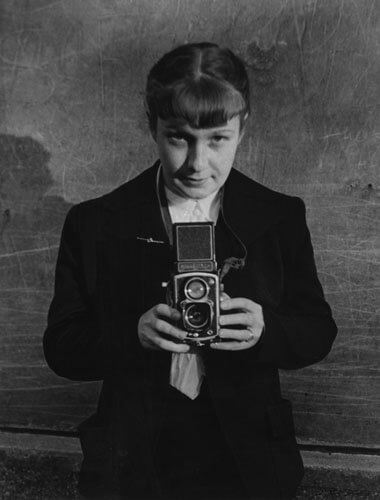
Self portrait 1954
Sabine Weiss
Sabine Weiss

Sabine Weiss

Country: Switzerland
Birth: 1924 | Death: 2021

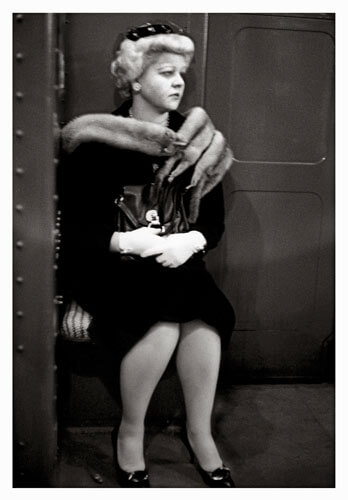
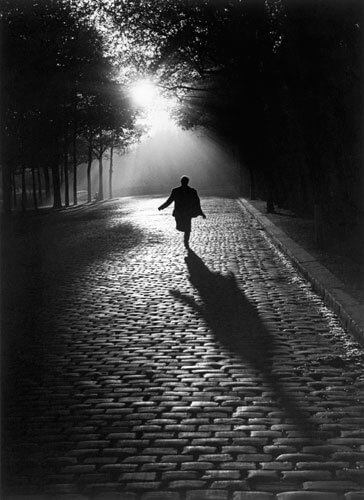
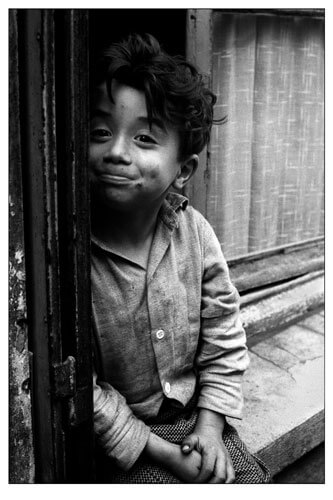
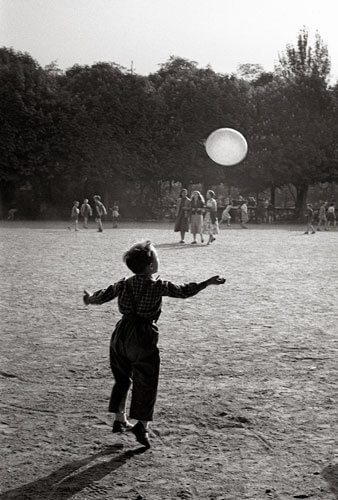
Sabine Weiss was born in Switzerland in 1924. In 1942, she wonders what she will do with her life, and decides that she should become a photographer because it is what she loves to do. She is the daughter of a mother who showed her art galleries and Roman churches at a very young age, and of a researcher chemist father who loved to see her print her little photos with the resources available at the time.

From 1942 until 1945 she was an apprentice at Boissonnas in Geneva, house of a dynasty of photographers that celebrated its 80th birthday.

In 1945 Sabine Weiss moved to a studio in Geneva, but in 1946 she decided to leave the city of her childhood to live in Paris. She knew there was no turning back. She asked Willy Maywald to become her assistant. In 1949, she met the painter Hugh Weiss and realized right away that she would spend her life with him. Sabine Weiss left Maywald, where she mastered her craft and started a long career, experimenting fashion, photojournalism, advertising and everything else she was asked to do.

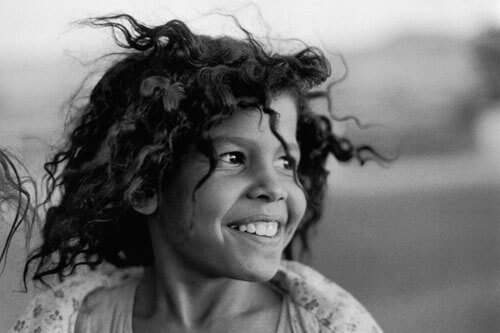
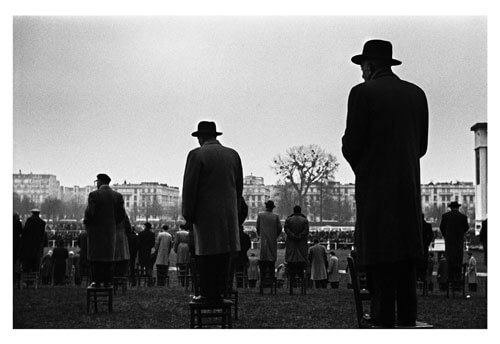
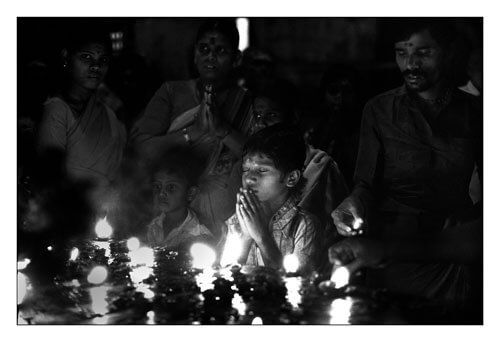
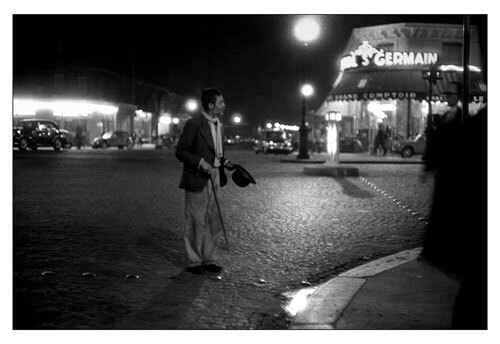
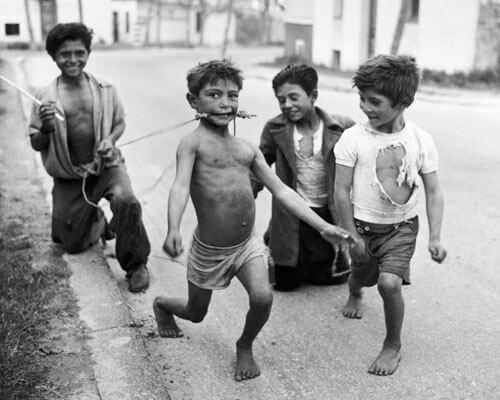
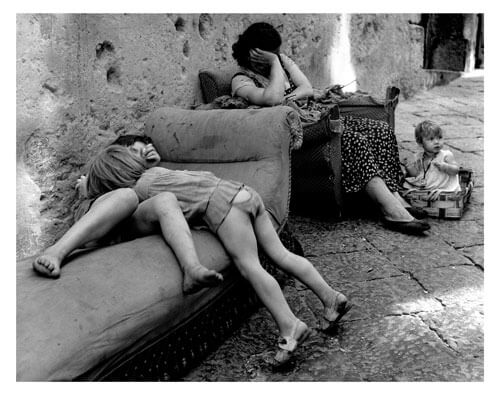
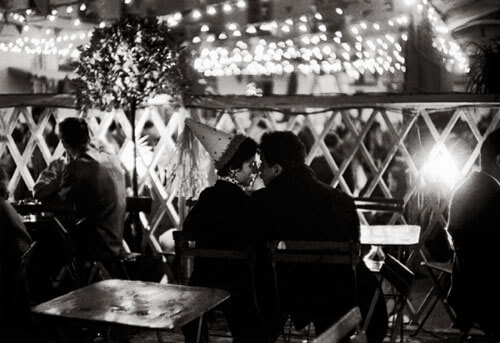
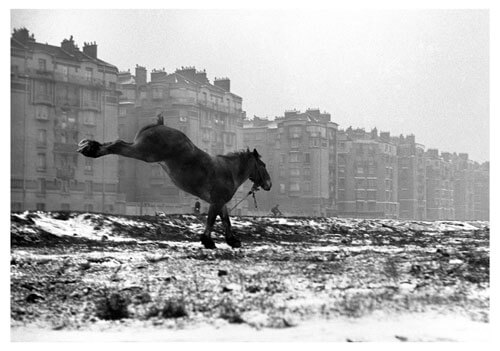
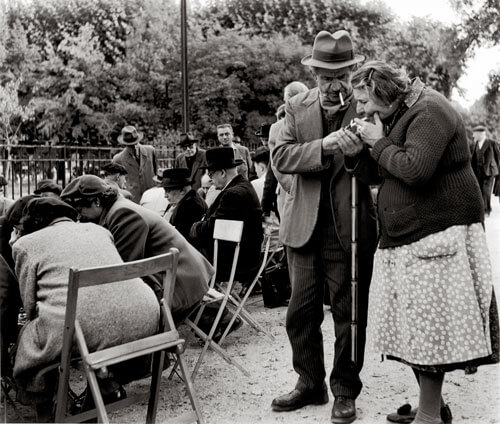
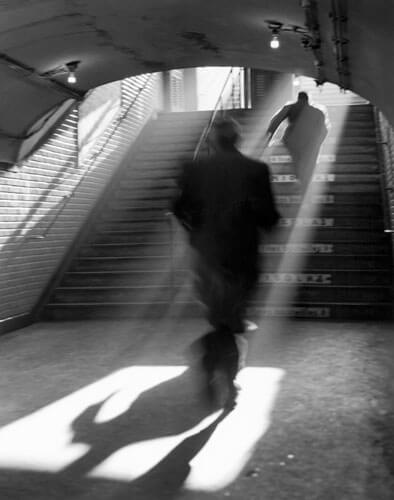
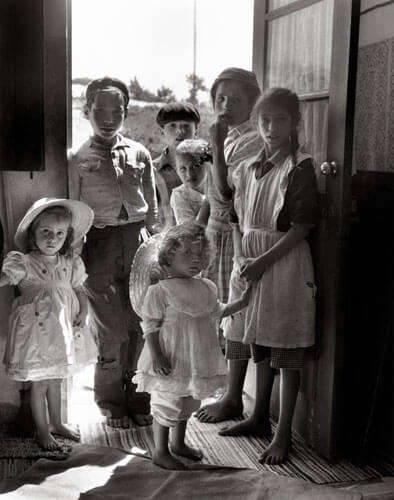
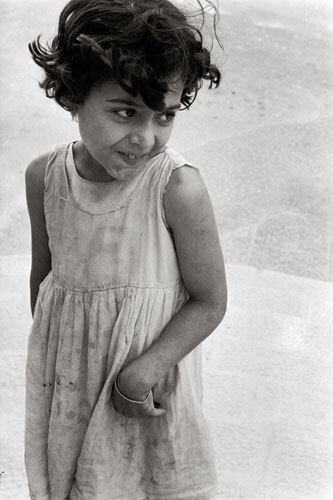
During her free time, she liked to immortalize the depths of man in all simplicity. Her photographs moved Edward Steichen when preparing his major exhibition "The Family of Man" therefore he decided to present three of her images.

In recent years, Sabine Weiss has dedicated her time to exhibitions that showcase the humanist side of her work because it meant a lot to her.

Key dates
1924 July 23rd Birth at Gingolph in Switzerland, Naturalized French in 1995.
1942-45 Apprentice at Boissonas in Geneva
1945 Swiss diploma of photography
1946 Settles permanently in Paris
1946-50 Assistant of Willy Maywald
1950 Weds the American artist Hugh Weiss
1951 Works for several advertising agencies
1952-61 Contract with Vogue Magazine (Fashion and Assignments)
1952 Enters the Agency Rapho
1952 Free-lance for major magazines in the USA and in Europe like Paris Match, Life, Time, Newsweek, Town And Country, Fortune, Holiday, European Travel And Life, Esquire... covering countries in Europe, Africa, North America and Asia.

Most recent exhibitions:
2014 Vannes, Festival de la Photo de Mer "Portugal, 1954"
2014 Zürich, Photobastei, Rétrospective
2014 Genève, Galerie Patrick Cramer, Portraits d’artistes (Giacometti et Miro)
2014 Salon de la Photo, Paris, Porte de Versailles, rétrospective « Chère Sabine » (Tribute to the photographer's 90th birthday)

Decorations
1987 Chevalier des Arts et des Lettres (Knight of Arts and Letters)
1999 Officier des Arts et des Lettres (Officer of the Ordre des Arts et des Lettres)
2010 Ordre national du Mérite (French National Order of Merit)

Discover Sabine Weiss' Interview

 

Sabine Weiss's Video

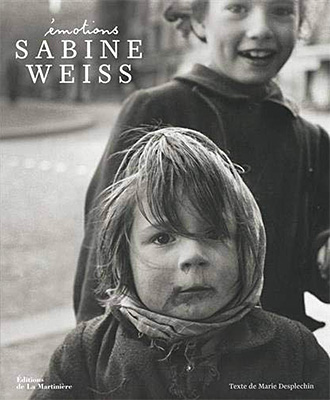
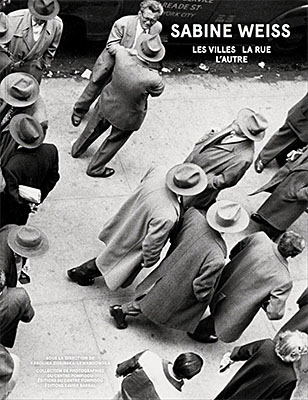
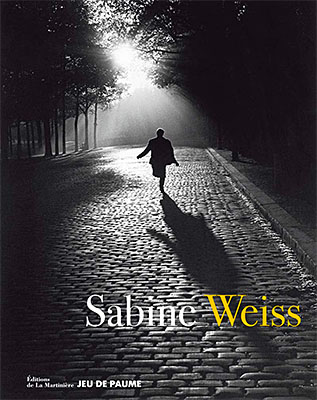
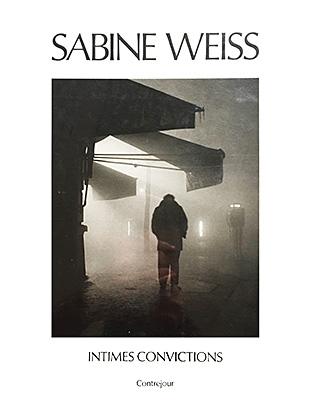
Selected Books

Inspiring Portfolios

Call for Entries
AAP Magazine #58 B&W
Publish your work in our printed magazine and win $1,000 cash prizes
 
Stay up-to-date  with call for entries, deadlines and other news about exhibitions, galleries, publications, & special events.

More Great Photographers To Discover

Pol Viladoms
Spain
1981
As an artist, his work is based on the documentation of the territory in its broadest sense. Showing a special interest in the representation of landscape and architecture as symbols of territorial and cultural identity, his photographs show a delicate attention to the desolate and inhospitable space. Peripheries, forgotten and obsolete places, ruins... all of them testimony and memory of human activity. His work, halfway between the past and the present, tries to reformulate the intentions of the documentary image, trying to balance form and content. Through a personal approach, he shows the relationship between human beings and nature in a world with a disturbing and uncertain future. In 2010 he self-published the book of photographs “Home” exhibited at the Centro de Arte Reina Sofía in Madrid, and which is currently part of its Library. The government of the Canary Islands awarded him the first prize in the Septenio International photographic competition “El suelo” (2012). Between 2014 and 2024 he has been awarded 6 LUX prizes from the AFP (Association of Professional Photographers of Spain). His work on Casa Bloc was exhibited at the Fundació Miró (2016) and he participated in the group exhibition “El Gran Tour” (Finalist at Joan Casablancas Award 2017). In 2018 he received the second prize in the photographic contest “Paisajes cuotidianos” of the Urban Landscape Institute of Catalonia. Among others, he has participated in the art fairs Art Fair Cologne and Affordable Art Fair Amsterdam (2019). In 2020 he was a finalist for the Vila Casas Photography Award. In 2021 he was awarded in the Photography Exhibition of the XV Spanish Biennial of Architecture and Urbanism as well as finalist of the ENAIRE Foundation Award. In 2022 he was finalist of the International Photography Award ECA Espai d’Art Contemporani in Riba-Roja de Túria. He has participated in several collective and individual art exhibitions in Spain as well as in France and the USA (New York and Detroit).
Gabriele Viertel
German fine art photographer, born near Cologne, Gabriele Viertel now lives and works in Eindhoven, Netherlands. She grew up as the youngest of 3 children in a rural area with an extended family of aunts, uncles and cousins. Inspired by her father, an avid filmmaker and amateur photographer, she took for the first time at the age of 14 his analogue camera to photograph the children of the family. During the education in technical design, she worked as a model to fund the studie. Completed the degree, Gabriele decided to move on to pursue the international career as a model and worked more than a decade for designers such as Dior and Karl Lagerfeld. Since 2008 she dedicated herself entirely to the art of photography as a freelance artist. Conceptually, Viertel's images play with the dialog between the mediums of painting and photography. The magical, often surreal pictorial language and the chiaroscuro light are characteristic means of expression. The major part of her works is staged underwater. Gabriele has received numerous awards, most recently the platin award of Graphis New York, the gold medal of the International Color Award, the silver medal of Prix de la Photographie Paris as well as the Merit Award of Best of Contemporary Photography, Fort Wayne Museum of Art. Her work has been featured in international exhibitions and publications in Europe and North America, notably the Museum of Art Fort Wayne and the Heritage Municipal Museum Malaga. One book on her work has been published by Associazione Artistico Culturale Cameraraw.it. Gabriele's works are in the public collections of the Fort Wayne Museum of Art, Indiana USA and the University of Art, Rotterdam NL as well as in various private collections.
Werner Bischof
Switzerland
1916 | † 1954
Bischof was born in Zürich, Switzerland. When he was six years old, the family moved to Waldshut, Germany, where he subsequently went to school. In 1932, having abandoned studies to become a teacher, he enrolled at the Kunstgewerbeschule in Zürich, where he graduated cum laude in 1936. From 1939 on, he worked as an independent photographer for various magazines, in particular, du, based in Zürich. He travelled extensively from 1945 to 1949 through nearly all European countries from France to Romania and from Norway to Greece. His works on the devastation in post-war Europe established him as one of the foremost photojournalists of his time. He was associated into Magnum Photos in 1948 and became a full member in 1949. At that time Magnum was composed of just five other photographers, its founders Robert Capa, Henri Cartier-Bresson, George Rodger, David Seymour, and Ernst Haas. The focus of much of Bischof's post-war humanist photography was showing the poverty and despair around him in Europe, tempered with his desire to travel the world, conveying the beauty of nature and humanity. In 1951, he went to India, freelancing for Life, and then to Japan and Korea. For Paris Match he worked as a war reporter in Vietnam. In 1954, he travelled through Mexico and Panama, before flying to Peru, where he embarked on a trip through the Andes to the Amazonas on 14 May. On 16 May his car fell off a cliff on a mountain road in the Andes, and all three passengers were killed. Source: Wikipedia Werner Bischof was born in Switzerland. He studied photography with Hans Finsler in his native Zurich at the School for Arts and Crafts, then opened a photography and advertising studio. In 1942, he became a freelancer for Du magazine, which published his first major photo essays in 1943. Bischof received international recognition after the publication of his 1945 reportage on the devastation caused by the Second World War. In the years that followed, Bischof traveled in Italy and Greece for Swiss Relief, an organization dedicated to post-war reconstruction. In 1948, he photographed the Winter Olympics in St Moritz for LIFE magazine. After trips to Eastern Europe, Finland, Sweden and Denmark, he worked for Picture Post, The Observer, Illustrated, and Epoca. He was the first photographer to join Magnum with the founding members in 1949. Disliking the ‘superficiality and sensationalism’ of the magazine business, he devoted much of his working life to looking for order and tranquility in traditional culture, something that did not endear him to picture editors looking for hot topical material. Nonetheless, he found himself sent to report on the famine in India by Life magazine (1951), and he went on to work in Japan, Korea, Hong Kong and Indochina. The images from these reportages were used in major picture magazines throughout the world. In the autumn of 1953, Bischof created a series of expansively composed color photographs of the USA. The following year he traveled throughout Mexico and Panama, and then on to a remote part of Peru, where he was engaged in making a film. Tragically, Bischof died in a road accident in the Andes on 16 May 1954, only nine days before Magnum founder Robert Capa lost his life in Indochina. Source: Magnum Photos
Lello Fargione
Photographer for passion and empathetic traveler, I was born in Sicily where I live and have fun with photography. I continue to photograph, to tell things as they happen, as if I were not there, but at the same time remaining deeply inside the image, a "journey" for the desire to know new cultures and penetrate the most remote and inaccessible places by identifying with situations that I meet, to '' narrate '' through images. I remained, by nature and conviction, a freelance "photographer", who likes to "photograph" to tell stories, not to forget, not to stop "dreaming"... Asia, a woman's life Work, fatigue, the unhealthy environment in which women in Asia live, are the theme of my photographic journey in the Burmese and Vietnamese lands. A theme that has imposed itself with all the drama of the apparently impassive gazes of women who seem to be eternal figures in an exotic and enigmatic mosaic. Often in the shadows, as if to underline an obscure and forgetful role of the past, the gesture is repeated with the automatism forged in the labor of days that have consumed the face and limbs. It is known that once these women enjoyed a very different social status and one cannot help but know that what I see today is the result of a "commercialization" of the society that commodifies individuals. The anguish as the sense of guilt intervenes in a second moment: seeing oneself as a privileged observer of the condition of others. But reviewing and showing beyond glossy aesthetics is also a way (the photographer's only way) of going beyond the observer's impotence.
Kantaya New
Singapore
Kantaya New is a Thai–Singaporean photo artist based in Singapore. Her works span conceptual and street photography. Her street photography work focuses on overlooked, serendipitous moments in daily life, while her conceptual work uses staged scenes and objects to invite reflection. She is currently working on A Modern Day Affair among other work. Notable awards and recognition include SONY Alpha: MX Street Photo Contest (1st Prize, 2025), LensCulture Critics’ Choice (Winner, 2023), Fujifilm Moment Street Photo Awards (2nd Prize, 2024), Women Street Photographers Artist Residency (Shortlist, 2025) and the Sony World Photography Awards (Shortlist, 2022 — Open Competition and Alpha Female Awards). Media features include LENSCRATCH (2025). A Modern Day Affair (2023–ongoing) This series began at home: my husband was with me, but always on his phone. I felt the screen had stolen my place. That feeling began A Modern Day Affair. The work looks at how the phone reshapes our relationship. Many images are self- portraits; others focus on small details—a cracked screen protector on a cake, or notes on a door. Some are drawn from real moments; others are imagined, but the emotions are real. In a surreal and staged style, the photographs mix a myriad of emotions such as humor, sadness, and anger to show how two people drift apart even when sitting side by side. I am not blaming phones; rather, I am asking how often we choose screens over connection without noticing. The Little Prince (2021–ongoing) This series started out as a chance meeting between me, the mural artist Yip Yew Chong, and a little boy named Akkun. I trace crossings—between being and performance, between child and character, between the art of one person and the dream of another. These photographs are fleeting windows into how a child moves through imagination—how play becomes reality, and how the ordinary becomes unforgettable. It is both play and portrait, and I document how a child steps into the art of another person and makes it his own. ARTICLE: Uncovering the hidden gems in Life through the lens of Photography
Fabian Muir
Australia
Fabian Muir is an award-winning Australian photographer based in Sydney. The principal motivation behind his projects and practice is visual storytelling with a focus on humanist issues. He is an Eddie Adams alumnus (USA) and represented by Michael Reid in Sydney and Berlin. He speaks fluent German, French and Spanish, while his Russian sputters with the determination of a Lada on a rather steep incline. His images have featured in major solo and group exhibitions and festivals around the world and have been acquired by numerous significant collections. His fine art series addressing social challenges and injustice confronting refugees, entitled 'Blue Burqa in a Sunburnt Country' (2014) and 'Urban Burqa' (2017), as well as his two-year survey of daily life in the DPRK (North Korea) have attracted global press, television and radio coverage. He has also spent years surveying the legacy of the Soviet Union in the aftermath of its disintegration. Outlets include The Guardian / The Atlantic / VICE / BBC World TV / CNN International TV / LensCulture / SPIEGEL / Frankfurter Allgemeine Zeitung / BBC Asian Network / BBC Digital / FotoEvidence / PDN / Vogue Entertaining + Travel / Sueddeutsche Zeitung / Channel 9 Australia / BuzzFeed / World Photography Organisation Blog / Leica Magazine / Vision (China) / ZEISS Lenspire / France Culture (Radio France) / Photographic Museum of Humanity (PHmuseum) / Marie Claire / CNU (China) / El Observador (Portugal) / The Sydney Morning Herald / Fotoblogia (Poland) / LIFO / Bird in Flight / FAHRENHEITº Magazine / MindFood Magazine / Ampersand Magazine / Studio Magazine / Bios Monthly (Taiwan) / La Repubblica / Lenta.ru / The Age / Black + White Magazine / Konbini / Capture Magazine / Photojournalink / Expert-Russkiy Reporter / Street Photography Magazine / Feature Shoot / Gulf News (UAE) / The National (UAE) / PhotogrVphy Magazine / Musée Magazine New York / Forbes Magazine / London Telegraph / Lenscratch / Aesthetica Magazine / Portrait of Humanity book published by Hoxton Mini Press, London / The Independent / London Times / Huck Magazine / British Journal of Photography
Brigitte Carnochan
United States
1941
Brigitte Carnochan's photographs are represented nationally and collected globally by museums, corporate and private collectors. She has had solo exhibitions in Latvia, Italy, Chile, and Hong Kong as well as in New York, Houston, Boston, Palo Alto, Los Angeles, Santa Fe, Ketchum, Woodstock, Albuquerque, Carmel and San Francisco. In addition to the publication of three monographs (Bella Figura 2006, Shining Path 2006, Floating World 2012), The German publisher, Edition Galerie Vevais, launched a monograph of her images in 2014 at Paris Photo. For many years she taught workshops and classes through the Extension Program at UC Santa Cruz and Stanford's Continuing Studies Program. She is on the Advisory Councils of Center, in Santa Fe and The Center for Photographic Art in Carmel. Statement: Despite the debates over "honesty" and "truth" in photography, it is an intrinsically subjective art and form of communication. The photographer has chosen, from a huge range of images, certain ones - or pieces - from a certain perspective, with the light at a certain angle and at a unique moment in time. And the "story" in the photograph begins with the photographer's decision of when to click the shutter and isn't completed until each viewer interprets that image in his or her own way. The qualities that have fascinated me and led me to make a particular photograph are usually quite intuitive. I generally don't have a completed concept in my mind when I begin--I move things around, change angles, lighting--until everything seems right. To further complicate issues of "truth," I often add color to a black and white image in order to bring out, most convincingly, the impression it has made on me--and I have no concern about whether the colors are the "real" colors. In documentary photography the same subjective issues apply--but realizing and recording the "right" moment requires quicker reflexes and a different kind of intuition. Sensing a moment coming by keenly observing the scene--and always being ready for that moment--is the excitement in that kind of photography. All of my images begin as straight gelatin silver prints, but in my nudes and floral still lifes, I am often drawn to hand coloring on several counts. First in literature and now in photography, I have been interested in the power of the imagination--how it colors everyday life - creates, in fact, private views of experience, whether revealed in words or in images. Even though most people see the world in color, they do not see everything in the same exact colors. From an optical point of view, the colors we see depend on where we stand in relation to the object, where the sun is on the horizon, what color the walls are, or the tint of our glasses (or contact lenses), and so on. From a psychological point of view--everything depends on whether we are worried, elated, anxious, in love, lonely, distracted, or fully alert. For this reason, I often hand color my work, because the process allows me to interpret the essence of my subject according to my own imagination. Whether it is nudes and flowers or the black and white images in my series from Cuba, Africa, or Mexico, imagination colors--literally and figuratively--not only what I see initially, but what the viewer sees, ultimately. And seeing, of course, is everything in photography: seeing--and light and shadow. Beginning in 2007, I am continuing to paint gelatin silver images, but I am also scanning the first copy in each new painted edition (now limited to 25) and creating small limited editions of archival pigment prints* in three sizes. The level of current technology makes me confident that these digitally printed images will not only render the original painted photograph faithfully, but will, like the original, last over time. Discover Brigitte Carnochan's Interview
Gregory Spaid
United States
1946
Gregory Spaid (born, 1946) is an American artist who works in many modes and styles of photography, which are linked by a common thread of illuminating the commonplace. Whether it is the daily movement of pedestrians on the streets of New York City or the leaves that fall in his yard in rural Ohio, it is photography’s potential to transform our common experiences to reveal meaning and beauty that is the hallmark of his work. Spaid’s recent work includes a photography project that explores the importance trees play in our lives and for the health of the planet titled Reading Trees. His work on trees includes Cliché Verre photographs that incorporate actual leaves and other materials on negatives he makes by hand. For this project he traveled throughout the United States and has been awarded artist residencies at the Brush Creek Foundation in Wyoming, Mesa Verde National Park in Colorado, Congaree National Park in South Carolina and the Sonoran Arts Residency in Ajo, Arizona. During the Covid-19 pandemic, he focused on the natural world much closer to home, within footsteps of where he lives, to produce a series of videos to share with friends, titled The Machine in the Garden, that take a close look at nature for the beauty and inspiration still to be found there. Since 2009, Spaid has photographed the dance-like movement of people on the street of New York City for a series of abstract images titled Pedestrians. His photography on the changing landscape of rural America was included in a major group exhibition at The J. Paul Getty Museum in Los Angeles titled Where We Live. As well as the Getty Museum, his work is in other major collections including the Museum of Modern Art, the International Museum of Photography at the George Eastman House, and the Smithsonian American Art Museum. He received a Fulbright Research Fellowship to Italy and is the recipient of eight grants from the Ohio Art Council. Spaid has published two monographs: Grace: Photograph of Rural America and On Nantucket. In 2010, the Getty Museum published his work in an historical survey titled The Tree in Photography. Spaid taught studio art at Kenyon College where he served for nine years in academic administration including six years as the college’s provost. About Leaf Cutting Series "Leaves occur in such abundance where I live in rural Ohio as to seem worthless, and yet each one is astoundingly complex and beautiful both in its form and function. I think of the leaves in this series as visual representations of wildness, while the alterations I make to them -- the cutting -- is a form of rational human intervention. These images from my leaf cutting series are camera-less photographs made from negatives I make by hand -- a process known by the French term Cliché Verre. Cliché Verre is one of the earliest uses of light-sensitive, photographic materials. In the mid-19th century, it was used by a few French landscape painters, including Corot, Delacroix, Millet and Rousseau, to reproduce drawings they made on glass plates. My process is a hybrid one and an experimental contemporary version of that early process. After making a negative by hand, I scan it, process it digitally, and then print it as an archival ink jet print. Because there is no right or wrong way to make Cliché Verre images, I invent my technique as I work and let chance and discovery shape my approach. The subject of this work is leaves that I collect, make translucent, cut in unique shapes, and then combine with other materials (including maple syrup, blueberry juice, glue, India ink) to make hand-made 'negatives.'” -- Gregory Spaid
Adam Neuba
Germany
Natural scientist, photographer, artist. Adam's artistic style and photographic sensibility have emerged from his inquisitive and exploratory creative process, whereby the medium of light and its effect on the motif is always at the focus of his artistic work. Through hours of planning and manual work, with the greatest care and attention to detail, he creates macroscopic artworks of living creatures in unity with technical components, of motifs from inanimate nature and, for some time now, he has been interested in compositions of metals with their unusual interplay with the medium of light. Numerous of his pictures have been published in national and international magazines in recent years, presented at festivals and awarded photography prizes worldwide. When nature meets technics - A macroworld beyond everyday experience This seemingly insurmountable contrast between nature and human technology has occupied me as a photographer for several years. Especially the mutual influence of stainless steel and other materials on small creatures fascinates me. With my photography i try to present this ‘nature versus technology’ contrast to the beholder and dissolve it photographically at the same time, so that the ultimate result of every composition is an aesthetically harmonious unity. With every image the beholder steps into a visionary space, in which a short story about a living being from our engineered environment is told and where, in the end, the two worlds merge into a unique entity. During this process, images arise which possess an aesthetic and a manner of expression of a novel kind, and thereby enable the beholder to partake in a novel emotional experience. Awarded Photographer of the Week - Week 26
Advertisement
AAP Magazine #58 B&W
Win a Solo Exhibition in July
AAP Magazine #58 B&W

Latest Interviews

Exclusive Interview with Trevor Cole: Pastoral Peoples and Practices
For this interview, we wanted to focus specifically on The Face of the Mundari and the wider Pastoral Peoples and Practices series. We spoke with Trevor about his long-term work among the Mundari, what continues to draw him back to their cattle camps, and the experience of documenting a culture whose identity remains deeply connected to livestock, tradition, and the natural environment.
Exclusive Interview with Frank Meo
In our latest exclusive feature for All About Photo, I speak with veteran photography representative Frank Meo about what it truly takes to build a sustainable creative career today. Frank brings decades of experience working with Fortune 500 companies, major agencies, and documentary photographers to the table. We dive into the critical business skills often left out of art school curriculums, the power of mentorship, and the inspiring evolution of PROJECTIONS—his international salon platform for visual storytellers. It’s an essential read for anyone navigating the commercial or editorial photography landscape today.
Exclusive Interview with Carolyn Moore
American photographer Carolyn Moore explores the inner landscape of emotion, memory, and personal transformation through a deeply intuitive photographic practice. Her work unfolds as a quiet dialogue between artist and viewer, where images become a space for reflection, vulnerability, and connection.
Exclusive Interview with Luca Desienna and Laura Estelle Barmwoldt
For over seven years, Of Lilies and Remains has explored the depths of the goth and darkwave underground, unfolding in Leipzig—a city long associated with a vibrant and enduring subcultural scene. Moving between iconic gatherings such as Wave-Gotik-Treffen and more intimate moments on the fringes, the project offers a rare and immersive glimpse into a world often misunderstood, yet rich in expression and community. Created by Luca in collaboration with Laura Estelle Barmwoldt, the work embraces a cinematic and deeply personal approach. Rather than documenting from a distance, it moves within the scene itself, capturing its atmosphere, its codes, and its quiet contradictions. The title Of Lilies and Remains hints at this duality—where beauty and darkness, fragility and strength coexist. As the book prepares for its release, we spoke with both artists about the origins of the project, their process, and what it means to document a subculture that continues to evolve while remaining true to its spirit.
Exclusive Interview with Matthew Finley
American photographer Matthew Finley turns inward, using photography as a way to explore identity, memory, and emotional truth. Based in Los Angeles, his practice moves between performance, gesture, and found imagery, creating a visual language that is both intimate and deeply personal
Exclusive Interview with Jan Janssen
Dutch photographer Jan Janssen explores universal human experiences through his long-term project It Matters, winner of the May 2025 Solo Exhibition. Begun in 2016, the series captures intimate moments of everyday life—love, loss, connection, and belonging—across Central and Eastern Europe. Working in countries such as Turkey, Azerbaijan, and Armenia, Janssen spends extended time within communities, building relationships based on trust and respect. His approach allows him to move beyond observation, revealing deeply human and authentic moments. Rooted in travel and personal discovery, It Matters reflects Janssen’s search for what connects us all in an increasingly divided world. The project is ongoing and will culminate in a photobook scheduled for publication in 2026.
Exclusive Interview with Henk Kosche
German photographer Henk Kosche turns his lens toward the streets of Halle an der Saale, capturing everyday life in the late years of the former German Democratic Republic. At the time, Kosche was studying design and exploring the city with his camera, drawn to the atmosphere of its industrial landscape and the quiet rhythms of daily life. His series Street Photography at the End of the 80s, selected as the Solo Exhibition for July 2025, revisits a body of work created just before a period of profound change. Rediscovered decades later in a small box of 35mm negatives, these photographs offer glimpses of a city and its people at a moment suspended between the familiar and the unknown.
Exclusive Interview with Anastasia Samoylova
Anastasia Samoylova is an American artist whose photographic practice is shaped by close observation and a deep attentiveness to place. Working between documentary and formal exploration, she photographs landscapes, architecture, and everyday scenes with a sensitivity to light, structure, and atmosphere. Since relocating to Miami in 2016, her work has increasingly focused on how environments—both natural and built—carry social, cultural, and emotional traces. We asked her a few questions about her practice and her way of seeing, to better understand the thoughts and experiences that shape her work—while allowing the images themselves to remain open and speak in their own time.
Exclusive Interview with Marijn Fidder
Marijn Fidder is a Dutch documentary photographer whose work powerfully engages with current affairs and contemporary social issues. Driven by a deep sense of social justice, she uses photography to speak on behalf of the voiceless and to advocate for the rights of those who are most vulnerable. Her images have been widely published in major international outlets including National Geographic, CNN Style, NRC Handelsblad, Volkskrant, GUP New Talent, and ZEIT Magazin. Her long-term commitment to disability rights—particularly through years of work in Uganda—culminated in her acclaimed project Inclusive Nation, which earned her the title of Photographer of the Year 2025 at the All About Photo Awards. She is also the recipient of multiple prestigious honors, including awards from World Press Photo and the Global Peace Photo Award. We asked her a few questions about her life and work.
Call for Entries
AAP Magazine #58 B&W
Publish your work in our printed magazine and win $1,000 cash prizes