Publisher: Steidl
Publication date: July 2026
Print length: 112 pages
Language: English
Price Range:
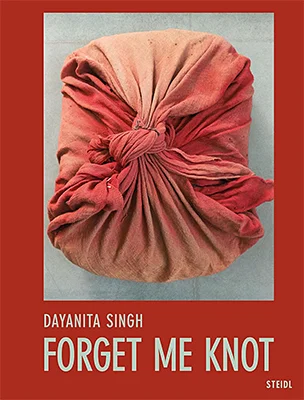
Dayanita Singh: Forget Me Knot continues Dayanita Singh’s long-standing exploration of archives, memory, and the physical life of photographs. Known for transforming the photobook into an object that can be handled, rearranged, and experienced like a portable exhibition, Singh approaches the archive not simply as a repository of information, but as a poetic structure shaped by absence, repetition, and time. In this new volume, she turns her attention to the cloth-bound bundles that fill India’s public and private archive rooms, objects that quietly hold histories while revealing almost nothing of their contents.
The first body of work, Pothi Khana—Hindi for “archive room”—presents black-and-white photographs of these spaces in all their restrained monumentality. Shelves stretch endlessly, stacked with tied packages wrapped in faded cloth, their original colors nearly erased by dust, age, and sunlight. The people responsible for maintaining these records remain absent from the frame, yet their presence is strongly felt through empty desks, chairs, and corridors. Singh’s images transform these rooms into contemplative landscapes, where order and mystery coexist, and where silence becomes part of the visual language.
In Time Measures, Singh shifts from the architectural view to an intimate portrait scale. For the first time, the archive bundles are photographed individually, isolated against a neutral stone background. Here, folds, knots, and stains become expressive details. Each bundle carries the marks of decades of handling—sun-bleached reds, frayed edges, cloth retied countless times by unseen hands. Without revealing the documents inside, the photographs suggest that the exterior itself has become a form of biography. These packages begin to resemble portraits, their worn surfaces holding the emotional weight of lived experience.
Singh, whose work has been exhibited internationally at institutions including Tate Modern and the Museum of Modern Art, has long questioned how photographs are stored, displayed, and remembered. Forget Me Knot extends that inquiry through an understated but deeply tactile visual language. The book invites slow looking and patient reflection, asking viewers to consider what remains hidden, what survives, and how objects themselves become custodians of memory. In Singh’s hands, the archive is not static—it breathes, ages, and quietly resists disappearance.