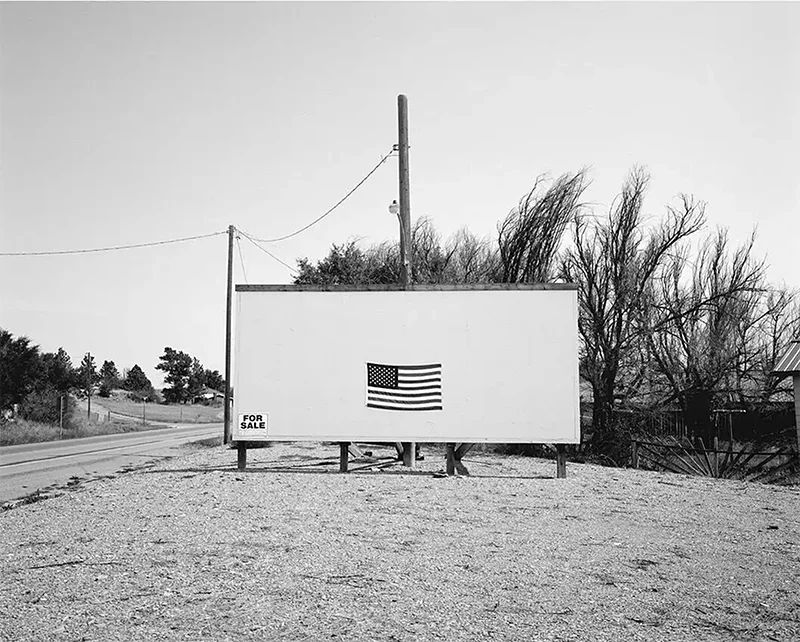
Manifest Destiny at The Griffin Museum presents a thoughtful reevaluation of America’s landscape — not as an open frontier, but as a layered archive of memory, displacement, and resilience. By highlighting photographers who document present-day terrain rather than romanticized myth, the exhibition challenges the old narratives of conquest and erasure, revealing how land can hold traces of histories often left unseen. It asks us to look at what remains, what is recovering, and what continues to resist.
The show brings together powerful voices such as Scott Conarroe, Craig Easton,
Lisa Elmaleh, Rich Frishman, Drew Leventhal, and Vicky Sambunaris. Each artist offers a distinct lens: Conarroe travels between places and climates, tracking patterns of change; Easton merges documentary realism with emotional subtlety; Elmaleh explores migration and borderlands through haunting large-format photographs; Frishman investigates the built environment’s social fabric; Leventhal uses his anthropological background to trace ritual, history, and human presence; and Sambunaris documents industrial and ecological transformation across wide expanses.
Through these varied practices, Manifest Destiny reframes the American landscape as contested terrain — one shaped by dislocation, environmental disruption, cultural resistance, and ongoing renewal. What appears at first like empty space often reveals itself to be a site of layered histories and urgent human stories. The photographs serve as visual testimonies, capturing what has been lost, changed, or abandoned — while also preserving what endures.
As part of the larger “State of Our Union” series, this exhibition participates in a national reflection on identity, legacy, and environment, timed with the country’s 250th anniversary. In doing so, it offers not nostalgia but reckoning: a call to see landscape not as background for myth, but as record of experience, human agency, and ecological consequence.
Manifest Destiny invites viewers to reconsider place — to acknowledge that every hill, every field, every empty building once carried lives, labor, and memory. It suggests that the work of recovery and remembrance is ongoing, carried out not only by archives, but by those willing to look, to question, and to hold the land accountable to its history.
Image:
© Craig Easton