All about photo.com: photo contests, photography exhibitions, galleries, photographers, books, schools and venues.
FINAL DAYS TO WIN A SOLO EXHIBITION IN MAY 2026
Yves Marchand & Romain Meffre
© Jules Hidrot
Yves Marchand & Romain Meffre

Yves Marchand & Romain Meffre

Country: France

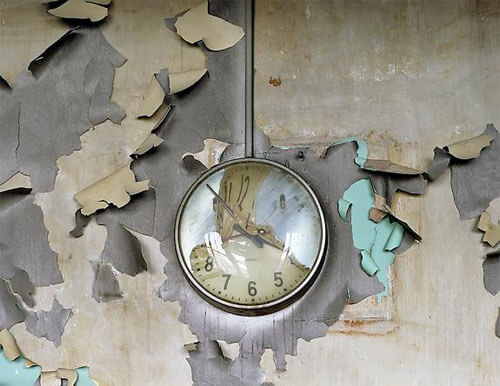
Marchand (b.1981) and Meffre (b.1987) live and work in Paris. Initially pursuing photography individually, they met online in 2002 and started working together with the beginning of their Detroit project in 2005. Steidl published The Ruins of Detroit in 2010. A second printing is planned for later this year.

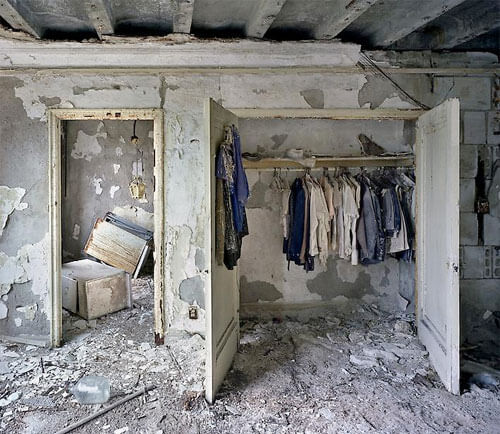
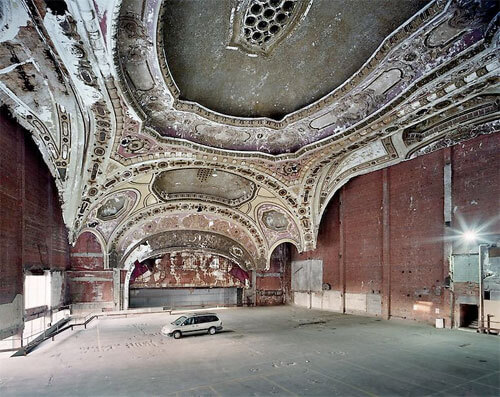
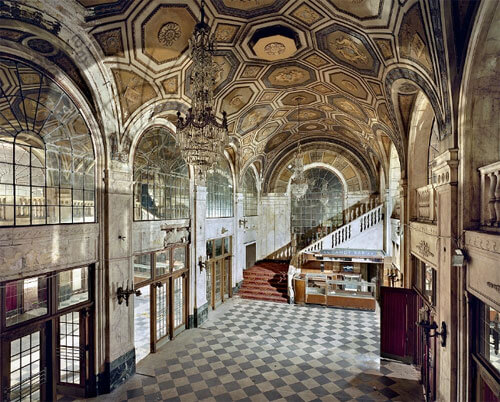
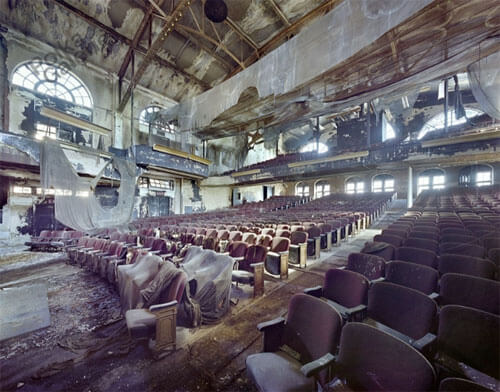
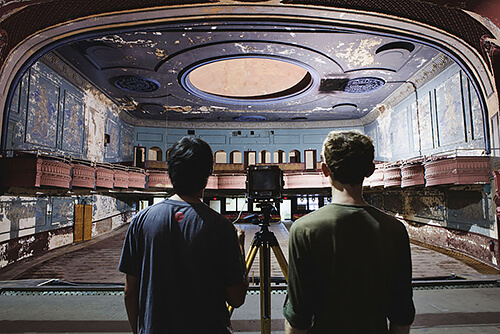
They are currently completing their Gunkanjima book, also to be published by Steidl, and they continue to work on a project documenting American theaters that have either fallen into decay or been transformed entirely. Their work has been exhibited extensively throughout Europe and has been featured in the New York Times, The Guardian, The British Journal of Photography, TIME Magazine, amongst others.

Source: Edwynn Houk Gallery


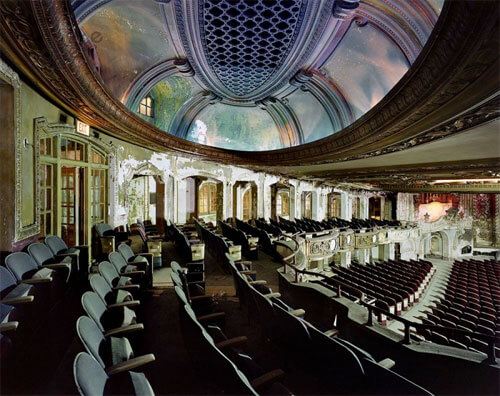
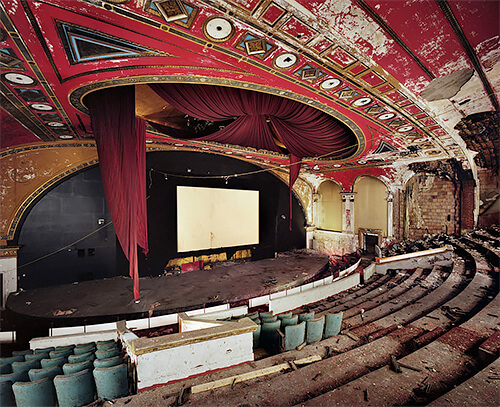
About Theaters (2005-Ongoing)
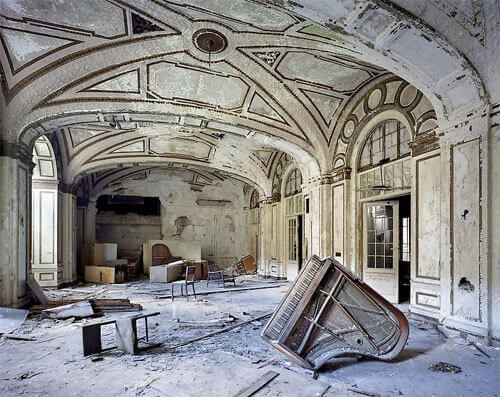
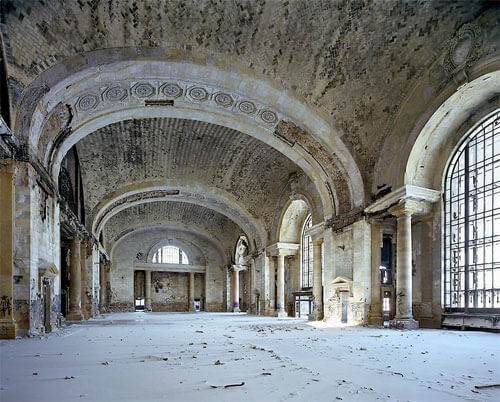
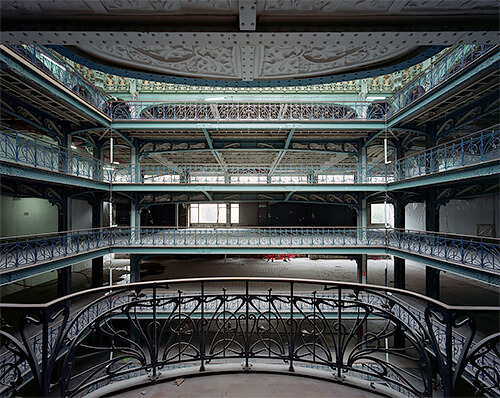
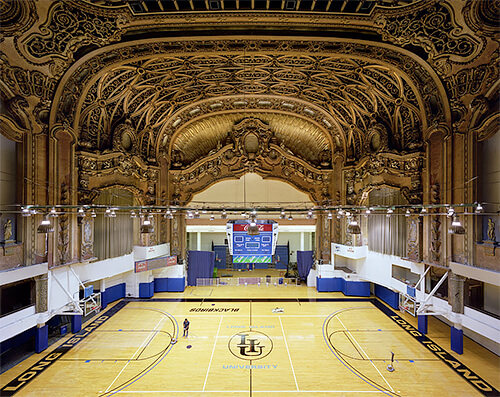
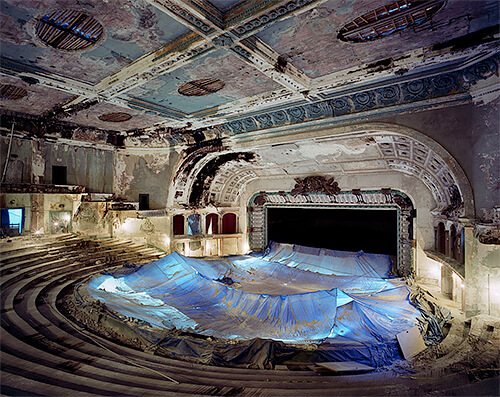
In the early 20th century, following the development of the entertainment industry, hundreds of theaters were built across North America. Major entertainment firms and movie studios commissioned specialized architects to build grandiose and extravagant auditoriums.

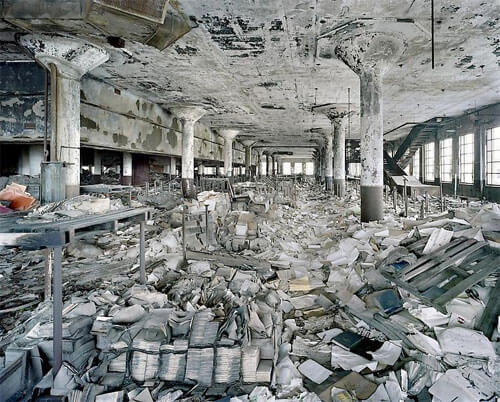
From the 60's, TV, multiplexes and urban crisis made them obsolete. During the following decades, these theaters were either modernized, transformed into adult cinemas or they closed, one after the other; many of them were simply demolished.


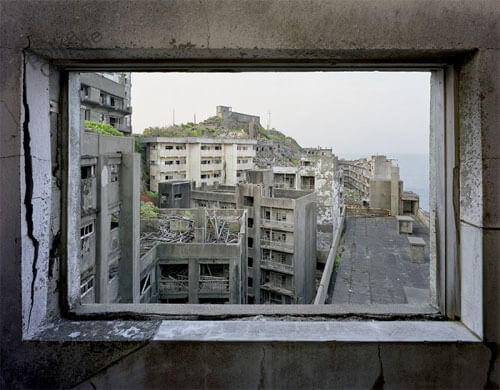
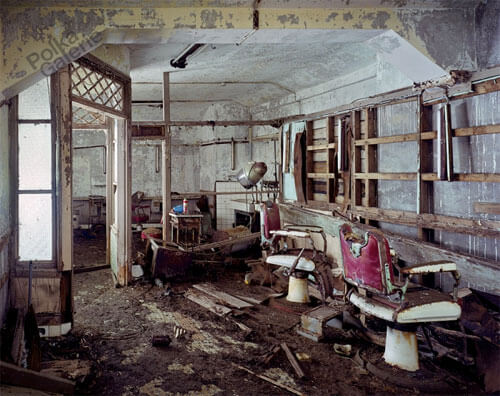
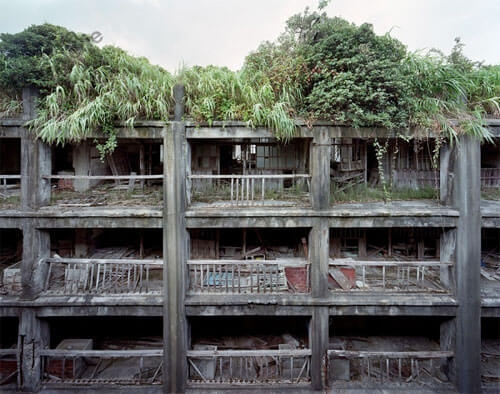
About Gunkanjima (2008-2012)
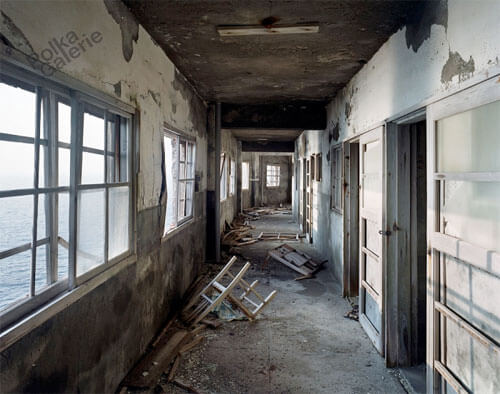
In the South China Sea, 15 kilometers off the southwest coast of Nagasaki among the thousands of verdant landmasses that surround Japan, lies a mysterious island. With the geometric silhouette of a dark gray hull, perforated by hundreds of small windows, the island resembles a battleship. As one moves closer, approaching by sea, the figure takes shape again and the ghost ship turns into a block of concrete surrounded by a high wall on which waves crash - the island looks like a Japanese version of Alcatraz. Only 40 years ago, this tiny island was home to one of the most remarkable mining towns in the world and maintained the highest population density in the world.

During the wave of industrialisation in the nineteenth century, a coal seam was discovered on the tiny Hashima island. In 1890 the Mitsubishi Corporation opened a mine on the island. For decades coal production sustained Japan's modernisation and helped establish its position as an industrialised nation and imperial power. Workers settled on the island and the population increased. Mine slag was used to expand the surface of the colony; piling up on itself like an ant hill. The small mining town quickly became an autonomous modern settlement (with apartment buildings, a school, hospital, shrine, retail stores and restaurants) which mimicked the other settlements on the Nippon archipelago. One multi-storied concrete apartment block with its brutal and rational style followed another, until the tiny island became the most densely populated place in the world per square meter with over 5,000 inhabitants in the 1950s.


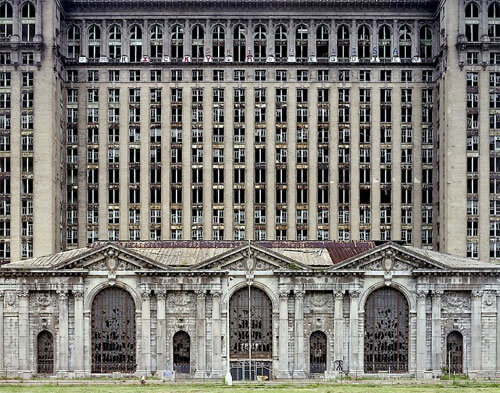
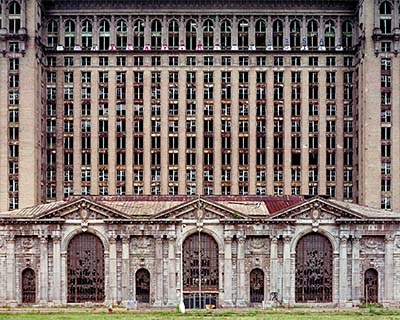
About The Ruins of Detroit (2005-2010)
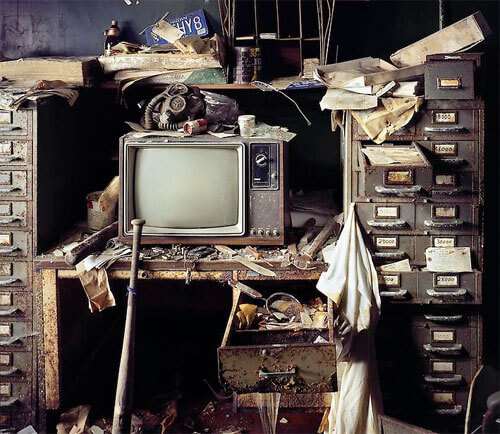
At the end of the XIXth Century, mankind was about to fulfill an old dream. The idea of a fast and autonomous means of displacement was slowly becoming a reality for engineers all over the world. Thanks to its ideal location on the Great Lakes Basin, the city of Detroit was about to generate its own industrial revolution. Visionary engineers and entrepreneurs flocked to its borders.

In 1913, up-and-coming car manufacturer Henry Ford perfected the first large-scale assembly line. Within few years, Detroit was about to become the world capital of automobile and the cradle of modern mass-production. For the first time of history, affluence was within the reach of the mass of people. Monumental skyscapers and fancy neighborhoods put the city's wealth on display. Detroit became the dazzling beacon of the American Dream. Thousands of migrants came to find a job. By the 50's, its population rose to almost 2 million people. Detroit became the 4th largest city in the United States.
 

Selected Books

Inspiring Portfolios

Call for Entries
AAP Magazine #57 Portrait
Publish your work in our printed magazine and win $1,000 cash prizes
 
Stay up-to-date  with call for entries, deadlines and other news about exhibitions, galleries, publications, & special events.

More Great Photographers To Discover

Guido Klumpe
Germany
1971
Guido Klumpe was born in 1971 in Germany. He's been taking photographs since he was sixteen years old. After graduating from high school, he traveled through Southeast Asia. From then on he was infected by street photography, without knowing that this genre even existed. He discovered the magic of the decisive moment. After his studies in social work, other art forms became interesting for him. He danced and acted in theatre. But in 2016 he rediscovered his passion for street photography. Since then, there is not a day when he is not involved in (street) photography. He is almost blind since birth on the left and have 25% vision on the right because the optic nerves don't pass on as much information to the brain. You can imagine it like an internet video with a low data rate. Through photography he go to and beyond the limits of his vision. Guido Klumpe won several awards, among others at the Paris Street Photography award, the German Streetfotografie Festival and the Minimalist Photography award. His work has been published in various international online and print magazines. My work combines three genres that influence each other: street photography, minimal photography and abstract photography. I see my city as an urban landscape. A landscape made up of shapes, colors, reflections and light. I can dissolve and reassemble these elements, limited only by the laws of optics, the possibilities of the camera and my imagination. The overarching theme is the tension between urban architecture and its inhabitants. In my ongoing series 'Loosing one dimension' I playfully explore the fragile moment of transition where three-dimensional architecture dissolves and abstracts into the two-dimensional. When the viewer loses orientation and can't tell for sure what they see, which parts of the image are in front, and which are behind, they experience a bit of how I sometimes lose my bearings in the world. To achieve this effect, I photographically superimpose different parts of the building. I often find my motifs on arterial roads, industrial areas or suburbs.
Bruce Barnbaum
United States
1943
Bruce Barnbaum, of Granite Falls, WA, entered photography as a hobbyist in the 1960s, and after four decades, it is still his hobby. It has also been his life's work for the past 30 years. Bruce's educational background includes Bachelor's and Master's degrees in mathematics from UCLA. After working for several years as a mathematical analyst and computer programmer for missile guidance systems, he abruptly left the field and turned to photography. Bruce has authored several books, some of which have become classics. The Art of Photography was first published in 1994 and remained in print until 2007. Bruce has been self-publishing the book ever since, but with limited distribution. Bruce is a frequent contributor to several photography magazines. His series The Master Printing Class is featured in each issue of Photo Techniques, and his articles are published regularly in LensWork. Through his workshops, articles, lectures, books, and innovative photography, Bruce has become a well-known and highly respected photographer, educator, and pioneer. Bruce is recognized as one of the finest darkroom printers on this planet, both for his exceptional black-and-white work, as well as for his color imagery. He understands light to an extent rarely found, and combines this understanding with a mastery of composition, applying his knowledge to an extraordinarily wide range of subject matter. His work is represented by more than ten galleries throughout the United States and Canada, and is in the collections of museums and private collectors worldwide.Source: O’Reilly Bruce has been an active environmental advocate for more than three decades, both independently and through organizations such as the Sierra Club (where he served on the Board of Directors of the Angeles Chapter from 1976-80, and the California Regional Conservation Committee), Audubon, the Stillaguamish Citizens’ Alliance (which he co-founded in 1991) now renamed the Mountain Loop Conservancy, 1000 Friends of Washington, and the North Cascades Conservation Council (where he has served on the Board of Directors since 1994). As a photographer he has seen the changes in our land and our landscape—almost all of them for the worse—that have taken place in the 35 years he has actively been photographing our planet. He points out that we all live on this one magical globe called “Earth,” and unless we love it, revere it, and protect it, we’ll all perish with it. Currently, we are exploiting planet earth at an unprecedented rate, saddling ourselves with many self-inflicted problems: human overpopulation, global warming, an increasing ozone hole, deforestation, overfishing of the oceans, overuse of fresh water resources, pollution of the air, land, and waters (lakes, rivers, and oceans), and many others too numerous to detail. But humanity is doing little to correct any one of these problems. We have enough knowledge to recognize the steps that should be taken to turn from our destructive ways to more intelligent, productive, and sustainable means, but we may not have the wisdom or political will to implement that knowledge.Source: Fahey/Klein Gallery
Slim Aarons
United States
1916 | † 2006
Slim Aarons was an American photographer noted for his images of socialites, jet-setters, and celebrities. At 18 years old, Aarons enlisted in the United States Army, worked as a photographer at the United States Military Academy, and later served as a combat photographer in World War II and earned a Purple Heart. Aarons said combat had taught him the only beach worth landing on was "decorated with beautiful, seminude girls tanning in a tranquil sun." After the war, Aarons moved to California and began photographing celebrities. In California, he shot his most praised photo, Kings of Hollywood, a 1957 New's Year's Eve photograph depicting Clark Gable, Van Heflin, Gary Cooper, and James Stewart relaxing at a bar in full formal wear. Aaron's work appeared in Life, Town & Country, and Holiday magazines. Aarons never used a stylist, or a makeup artist. He made his career out of what he called "photographing attractive people doing attractive things in attractive places." An oft-cited example of this approach is his 1970 Poolside Gossip shot at the Kaufmann Desert House designed by Richard Neutra, with owner Nelda Linsk as one of the models in the photo. "I knew everyone," he said in an interview with The (London) Independent in 2002. "They would invite me to one of their parties because they knew I wouldn't hurt them. I was one of them." Alfred Hitchcock's film, Rear Window (1954), whose main character is a photographer played by Jimmy Stewart, is set in an apartment reputed to be based on Aarons' apartment. When you photograph a lot of women, you get to know things. -- Slim Aarons In 1997, Mark Getty, the co-founder of Getty Images, visited Aarons in his home and bought Aarons' entire archive. In 2017, filmmaker Fritz Mitchell released a documentary about Aarons, called Slim Aarons: The High Life. In the documentary, it is revealed that Aarons was Jewish and grew up in conditions that were in complete contrast to what he told friends and family of his childhood. Aarons claimed that he was raised in New Hampshire, was an orphan, and had no living relations. After his death in 2006, his widow and daughter learned the truth that Aarons had grown up in a poor immigrant Yiddish-speaking family on the Lower East Side of Manhattan. As a boy his mother was diagnosed with mental health issues and admitted to a psychiatric hospital, which caused him to be passed around among relatives. He resented and had no relationship with his father and had a brother, Harry, who would later commit suicide. Several documentary interviewees postulate that if Aarons's true origins had been known, his career would have been unlikely to succeed within the restricted world of celebrity and WASP privilege his photography glamorized.Source: Wikipedia Slim Aarons was a celebrated American photographer who chronicled the leisurely lifestyle of the rich and famous in his captivating shots of beguiling figures in luxurious environments. The glamorous world of his photographs, in which effortlessly beautiful and wealthy people lounge poolside, became an iconic series that allowed Aarons access to shoot some of the most candid portraiture of the 20th century. We love how Aarons worked without any need for stylists or elaborate lighting, instead preferring to photograph celebrities just as they were, creating alluring scenes that are a window into a different lifestyle. In presenting glimpses of the rich and famous engrossed in leisurely pursuits, the artist exposes elements of a life that would otherwise not be on view, allowing his audience to live the high life - vicariously. Born and raised in New York, Aarons began taking pictures at the age of eighteen, after enlisting in the US Army, where he served as an official combat photographer during WWII. In a career that spanned six decades, Aarons’ camera lens moved from soldiers to stars and celebrities, and the self-proclaimed realisation that the only beaches worth photographing were "decorated with beautiful, seminude girls tanning in a tranquil sun." Over the course of his 50 year career, Aarons was a regular contributor to magazines such as Life, Town & Country, Vogue and Holiday and received an exclusive look into the lives of figures such as the Kennedys, Marilyn Monroe and Grace Kelly. In 1997, Mark Getty of Getty Images bought Aarons’ entire archive of photographs, and published a book of his work Poolside with Slim Aarons a decade later. Aarons’ intimately candid scenes have given him an era-defining legacy as one of the most influential photographers of his generation. Source: Art Republic
Stephen Albair
United States
1942
Stephen Albair was born in Massachusetts and raised in New Hampshire. He currently lives and works in San Francisco. Educated at Illinois State University in Design, he is a self-taught photographer, lecturer and a college teacher, for over 40 years. His work in tableau photography began in 1974 with the purchase of a 35mm Nikkormat, which has remained the only camera for his work. Numerous exhibitions and installations have been staged in the US and Thailand. He has authored three books with a fourth book currently in progress. The images are mostly rooted in memoir built on found objects with Art Historical references. The focus is not so much on a series of images but rather a board range of subject matter, from early memories, to the current political landscape. His photos represent intuitive responses to ideas through self-reflection. By mastering the techniques of tableaux photography he has created a significant body of work that have enhanced his skill as an artist and storyteller. Statement Photography is a unique way of seeing the world. Life's ambiguities, love, loss, and longing, are my subject matter. These ideas evolve through a meaningful search for content, with no specific audience in mind. Ultimately, an audience perceives all content based on their own personal experiences. Familiar objects trigger our memory, reminding us of how we understand the world. I constantly search for unique objects that speak to me. My set-ups are arranged to illustrate an intention, an action that something has just happened -or is about to. Tableau photography provides the stage, much like actors in a play. The procedure of building a photograph creates an air of playfulness that allows for a different way of thinking about common human experiences. The audience is delivered thought-provoking ideas tinged with humor in a fabricated world. This process playfully exposing the surreal nature of reality and questions what is real or simply realistic—leaving the viewer to decide. Articles: Hidden Gardens - Secret Views SPECTACLES: A Memoir of Jewelry and Photography Miss Nude World For the Love of DOGS
Kamil Vojnar
Czech Republic
1962
Kamil Vojnar was born in the former Czechoslovakia in 1962. He studied at the School of Graphic Arts in Prague and began his career as a Graphic Designer. He left the country illegally (still Communist at the time) and moved to Vienna, and then eventually became a US citizen and finished his studies at the Art Institute of Philadelphia. He continued his career in Graphic Design which later led to illustration and imagery based on photography, working mostly for book and music publishing houses in New York City. At the same time, he continued to make his own imagery. After meeting his partner and having children, going back and forth between France and New York, they finally settled in St. Remy de Provence in South France where Vojnar has concentrated on his own work since 2005. He opened up an Atelier in St. Remy and then one in Paris in 2009, both of which carry his own work.His work consists of images digitally layered from many different photographs and textures. They are mixed-media archival prints on fine art paper or mounted on canvas. Some of his images are layered pictures printed on semitransparent Thai paper. These unique photomontages are then varnished with oil and wax, and on occasion painted with oil paints. Kamil, as a painter, points out, “In a painting, you can paint anything you want. In the photographic [medium], it must, on some level, exist first. That tension between what exists and what is made up is what interests me.” Thus, his images are often subject to very different interpretations (Source: Verve Gallery) About ElsewhereWell, … why … why "e l s e w h e r e"…?Because, … not really here, because not there or … over there, because … somewhere else, … "e l s e w h e r e"!!!In thousand years old small town in south France, I have little studio, tiny Gallery, up on the main street.People from all around the world come to this town. They walk it's ancient streets. Some see my place, some walk in and look around.And they ask … why, … the sky outside is blue, … the buildings ochre yellow, the olive trees pale green, … why are those pictures musty, sepia, dark. Why is their soul heavy? What happened? What has happened to me!And I say … I don't know, … they come to me that way. They are not really from here, they are not so much from there. They arrive from ..."elsewhere". I am just a pair of hands making them happen.I didn't look for them, I didn't choose them. They came to me, … they choose me!Artist? No. … Common' I am no Artist! I just make those little pictures. Just because they happen to me.And because … I cannot do anything else. I cannot do anything else, at least, until every last of them is out, … done.Just a pair of hands I am. Always struggling to let the image out. Always behind in my ability to execute on the paper what pours from ..."elsewhere", via my mind, my heart.It feels like, … really I have no personal connection to those pictures. I am not guilty.Don't ask me what they are, … what they mean. I don't know.Like orphaned kids, I collect them, feed them to grow.They have to be done. They have to get out there.If not me, … then who?Some are easy. Impatiently they bursting out into the openOthers play hide and seek. They leave a hint, they take me all over wrong paths, all around. They let me sweat, they let me freeze. They drag me through dry, dusty deserts, soak me in deepest seas. My shirt is bloody. My face is wet. Sometimes … sometimes I cry. Pure impossibility overwhelms me. Impossibility to make them happen as they appear to me. In their translucent light, through the tears, I see them, … I almost see them.No, I am no Artist. I just … I am just trying to do, … what I … almost … see.Yes, it's true! … I am making one picture over and over again.The same sofa, the same dress, the same image of Jesus on the wall in the background, as I have had throughout my childhood.Wings? … Yes, sometimes, there are wings. But those who carry them, they are no angels.They just want to be free. Pair of wings is like a passport to get away. To get to … elsewhere.E l s e w h e r e, … they say, it's not the destination, it's the journey, that counts.Therefore my little pictures are the humble documentation of that journey.They are the journey!Journey to … e l s e w h e r e!
Samantha VanDeman
United States
1982
Samantha was born in Chicago, IL. She received a BFA in Fine Art from Columbia College Chicago and an MFA in Visual Arts from The Art Institute of Boston at Lesley University. During the summer of 2003, Samantha studied drawing at Santa Repararta International School of Art in Florence, Italy. Her work has been published and exhibited in the United States and abroad. Samantha lives and works in Chicago, IL. Born in 1982, Samantha VanDeman grew up in the suburbs of Chicago. She studied fine arts at Columbia College Chicago, receiving a BFA in 2005. During her last year in college, she took a B+W photography class and found her passion. From that point on, she started to actively documenting everything around her. In 2007, she returned to college, this time to earn a MFA in photography from the Art Institute of Boston at Lesley University in 2009. It was during her time at the low residency program at AIB, that she was able to have independent studies with artists such as Anne Wilson, Mayumi Lake, Jeanne Dunning, and Laura Letinsky. Samantha has exhibited her work nationally. Her work has been exhibited at Emory Visual Arts Gallery, Atlanta, GA; Finch and Ada, NY; New Orleans Photo Alliance Gallery, New Orleans, LA; Las Manos Gallery, Chicago, IL; Gallery 263, Cambridge, MA; Midwest center for Photography, Wichita, KS; Gallery 808, Boston, MA; Change Artist Space, San Francisco, CA; Perspective Gallery, Evanston, IL; Barrett Art Center Galleries, Poughkeepsie, NY; Fourth Wall Projects in Boston, MA; The Center for Fine Art Photography in Fort Collins, CO; Newspace Center for Photography in Portland, OR; Black Box Gallery, Portland, OR; Texas Photographic Society, San Antonio, TX ; Wright Museum of Art in Beloit, WI and Review Santa Fe 100. Samantha VanDeman is adjunct faculty at The Art Institute of Illinois in Tinley Park, IL. All about Samantha VanDeman:AAP: When did you realize you wanted to be a photographer?My last year as an undergraduate at Columbia College Chicago, I took a Black and white photography class. It was then I knew I wanted to be a photographer. Up until that point, I wanted to be a painter. AAP: Where did you study photography? I studied photography at The Art Institute of Boston at Lesley University. During my time at The Art Institute of Boston, I had independent studies with Laura Letinsky, Jeanne Dunning, Anne Wilson and Mayumi Lake.AAP:Do you have a mentor?Laura Letinksy has been a friend/mentor since 2008 AAP: How long have you been a photographer?10 yearsAAP: Do you remember your first shot? What was it?My first shot was of rotten fruit.AAP: What or who inspires you?I’m inspired by silence, decay, kindness and long road trips. Artists who inspire me are Jenny Saville, Edward Hopper, Sally Mann and Fiona Apple.AAP: What kind of gear do you use? Camera, lens, digital, film?Canon 5DAAP: Do you spend a lot of time editing your images?I do minimal editing.AAP: Favorite(s) photographer(s)?Sally Mann, Angela Strassheim, Nan Goldin and Corrine DayAAP: What advice would you give a young photographer?Find your own voice and follow your gut. Your best work will come from the projects you are most passionate about.AAP: What mistake should a young photographer avoid?Trying too hard to be different or copying another photographer’s styleAAP: An idea, a sentence, a project you would like to share?I’m currently working on a project called “Died Alone”. This project explores abandoned living spaces of people that died alone in their home.AAP: Your best memory has a photographer?My fondest memory: The first time I explored the abandoned – now demolished Michael Reese Hospital in Chicago. I had never explored an abandoned place before Michael Reese Hospital, so it opened up a whole new world for me.AAP: If you could have taken the photographs of someone else who would it be?Weegee or Walker Evans
Advertisement
AAP Magazine #57 Portrait
Win a Solo Exhibition in May
AAP Magazine #57 Portrait

Latest Interviews

Exclusive Interview with Matthew Finley
American photographer Matthew Finley turns inward, using photography as a way to explore identity, memory, and emotional truth. Based in Los Angeles, his practice moves between performance, gesture, and found imagery, creating a visual language that is both intimate and deeply personal
Exclusive Interview with Jan Janssen
Dutch photographer Jan Janssen explores universal human experiences through his long-term project It Matters, winner of the May 2025 Solo Exhibition. Begun in 2016, the series captures intimate moments of everyday life—love, loss, connection, and belonging—across Central and Eastern Europe. Working in countries such as Turkey, Azerbaijan, and Armenia, Janssen spends extended time within communities, building relationships based on trust and respect. His approach allows him to move beyond observation, revealing deeply human and authentic moments. Rooted in travel and personal discovery, It Matters reflects Janssen’s search for what connects us all in an increasingly divided world. The project is ongoing and will culminate in a photobook scheduled for publication in 2026.
Exclusive Interview with Henk Kosche
German photographer Henk Kosche turns his lens toward the streets of Halle an der Saale, capturing everyday life in the late years of the former German Democratic Republic. At the time, Kosche was studying design and exploring the city with his camera, drawn to the atmosphere of its industrial landscape and the quiet rhythms of daily life. His series Street Photography at the End of the 80s, selected as the Solo Exhibition for July 2025, revisits a body of work created just before a period of profound change. Rediscovered decades later in a small box of 35mm negatives, these photographs offer glimpses of a city and its people at a moment suspended between the familiar and the unknown.
Exclusive Interview with Anastasia Samoylova
Anastasia Samoylova is an American artist whose photographic practice is shaped by close observation and a deep attentiveness to place. Working between documentary and formal exploration, she photographs landscapes, architecture, and everyday scenes with a sensitivity to light, structure, and atmosphere. Since relocating to Miami in 2016, her work has increasingly focused on how environments—both natural and built—carry social, cultural, and emotional traces. We asked her a few questions about her practice and her way of seeing, to better understand the thoughts and experiences that shape her work—while allowing the images themselves to remain open and speak in their own time.
Exclusive Interview with Marijn Fidder
Marijn Fidder is a Dutch documentary photographer whose work powerfully engages with current affairs and contemporary social issues. Driven by a deep sense of social justice, she uses photography to speak on behalf of the voiceless and to advocate for the rights of those who are most vulnerable. Her images have been widely published in major international outlets including National Geographic, CNN Style, NRC Handelsblad, Volkskrant, GUP New Talent, and ZEIT Magazin. Her long-term commitment to disability rights—particularly through years of work in Uganda—culminated in her acclaimed project Inclusive Nation, which earned her the title of Photographer of the Year 2025 at the All About Photo Awards. She is also the recipient of multiple prestigious honors, including awards from World Press Photo and the Global Peace Photo Award. We asked her a few questions about her life and work.
Exclusive Interview with Josh S. Rose
Josh S. Rose is a multidisciplinary artist working across photography, film, and writing. His practice bridges visual and performing arts, with a strong focus on movement, emotion, and the expressive potential of the image. Known for his long-standing collaborations with leading dance companies and performers, Rose brings together authenticity and precise composition—a balance he describes as “technical romanticism.” His work has been commissioned and exhibited internationally, appearing in outlets such as Vogue, at the Super Bowl, in film festivals, and most recently as a large-scale installation for Lincoln Center for the Performing Arts. A sought-after collaborator, he has worked with major artists, cultural institutions, and brands, following a previous career as Chief Creative Officer at Interpublic Group and the founder of Humans Are Social. We asked him a few questions about his life and work.
Interview with Maureen Ruddy Burkhart
Photographer Maureen Ruddy Burkhart brings a quietly attentive and deeply human sensibility to her exploration of the world through images. Shaped by a life immersed in photography, film, and visual storytelling, her work is guided by intuition, observation, and an enduring interest in the emotional undercurrents of everyday life. With a practice rooted in both fine art traditions and documentary awareness, she approaches her subjects with sensitivity, allowing subtle moments to emerge naturally rather than be imposed. Her series Til Death, selected as the Solo Exhibition for February 2025, reflects this long-standing commitment to photography as a space for reflection rather than spectacle. Drawn to moments that exist just outside the expected frame, Burkhart’s images suggest narratives without resolving them, leaving room for ambiguity, humor, and quiet connection. We asked her a few questions about her life and work.
Exclusive Interview with Peter Ydeen
Winner of AAP Magazine #45 Travels, his series reflects this unique vision—capturing the spirit of place through subtle layers of light, color, and emotion. Whether traveling abroad or observing the rhythms of his own surroundings, Ydeen creates images that feel both grounded and enchanted, inviting viewers into a world where reality and reverie meet.
Exclusive Interview with Julie Wang
Chinese-born photographer Julie Wang brings a poetic, contemplative sensitivity to her visual exploration of the world. Having lived for nearly equal parts of her life in China, Europe, and the United States, she approaches her subjects with the nuanced perspective of someone shaped by many cultures. This blend of distance, curiosity, and emotional resonance infuses her work with a quiet depth, allowing her to reveal the fragile beauty and subtle tensions that often pass unnoticed.
Call for Entries
Win A Solo Exhibition in May
Get International Exposure and Connect with Industry Insiders