All about photo.com: photo contests, photography exhibitions, galleries, photographers, books, schools and venues.
FINAL CALL TO ENTER AAP MAGAZINE SHADOWS: PUBLICATION AND $1,000 CASH PRIZES
Platon (Antoniou)
Platon (Antoniou)
Platon (Antoniou)

Platon (Antoniou)

Country: United Kingdom
Birth: 1968

Born in London in 1968, Platon was raised in the Greek Isles until his family returned to England in the 1970's. He attended St. Martin's School of Art and after receiving his BA with honors in Graphic Design, went on to receive an MA in Photography and Fine Art at the Royal College of Art. After working for British Vogue for several years, he was invited to NY to work for the late John Kennedy Jr. and his political magazine, 'George'. After shooting portraits for a range of international publications including Rolling Stone, the New York Times Magazine, Vanity Fair, Esquire, GQ and the Sunday Times Magazine, Platon developed a special relationship with Time magazine, producing over 20 covers.

In 2007 Platon photographed Russian Premier Vladimir Putin for Time Magazine's Person Of The Year Cover. This image was awarded 1st prize at the World Press Photo Contest. In 2008 he signed a multi-year contract with the New Yorker. As the staff photographer, he has produced a series of large-scale photo essays, two of which won ASME Awards in 2009 and 2010. Platon's New Yorker portfolios have focused on many themes including President Obama's Inauguration, the U.S Military, portraits of world leaders and the Civil Rights Movement.

The following year, Platon teamed up with the Human Rights Watch to help them celebrate those who fight for equality and justice in countries suppressed by political forces. These projects have highlighted human rights defenders from Burma as well as the leaders of the Egyptian revolution. Following his coverage of Burma, Platon photographed Aung San Suu Kyi for the cover of Time - days after her release from house arrest.

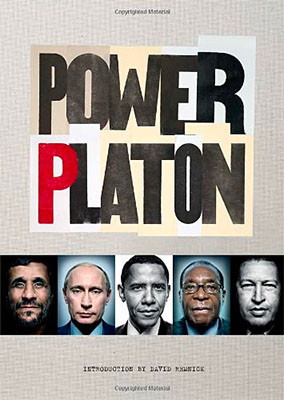
In 2011, Platon was honored with a prestigious Peabody Award for a collaboration on the topic of Russia's Civil Society with The New Yorker Magazine and Human Rights Watch. Platon's first monograph 'Platon's Republic', was published in 2004 by Phaidon Press. To coincide with its publication, the work was exhibited internationally, in London at the ex-Saatchi Gallery as well as the Milk Gallery in New York. His second book, 'Power' - a collection of portraits of over 100 world leaders - was published in 2011 by Chronicle and following its success was selected by Apple to be released as an app. The book includes portraits of Barack Obama, Mahmoud Ahmedinejad, Dmitry Medvedev, Benjamin Netanyahu, Hugo Chavez, Mahmoud Abbas, Tony Blair, Robert Mugabe, Silvio Berlusconi, and Muammar Qaddafi.

In recent years, public speaking has progressively played a major role in Platon's career as communicator and storyteller. He has been invited to be a keynote speaker at the World Economic Forum in Davos, Yale, the London School of Economics, the National Portrait Gallery in London and the International Center of Photography in NY. He has also appeared on a range of television media including Charlie Rose (PBS), Morning Joe (MSNBC), Fareed Zakaria's GPS (CNN) and the BBC World News.

Between 2011-2013, Platon's work has been exhibited in galleries both domestically and abroad. He has exhibited in New York at the Matthew Marks Gallery and the Howard Greenberg Gallery, as well as internationally at the Colette Gallery in Paris, France. The New York Historical Society also exhibited a solo show of Platon's Civil Rights photographs, which remain as part of the museum's permanent collection. Other permanent collections holding Platon's photography include The Florida Museum of Photographic Arts in Tampa, Florida and The Westlicht Museum for Photography in Vienna, Austria. Platon's advertising credits include the United Nations Foundation, Credit Suisse Bank, Exxon Mobil, Diesel, the Wall Street Journal, Motorola, Nike, Converse, Verizon, Vittel, Levi's, IBM, Rolex, Ray-Ban, Tanqueray, Kenneth Cole, Issey Miyake, Moschino, Timex and Bertelsmann among others. Platon lives in New York with his wife, daughter and son.

(Source: www.platonphoto.com)
 

Selected Books

Inspiring Portfolios

Call for Entries
AAP Magazine #56 Shadows
Publish your work in our printed magazine and win $1,000 cash prizes
 
Stay up-to-date  with call for entries, deadlines and other news about exhibitions, galleries, publications, & special events.

More Great Photographers To Discover

Sohrab Hura
India
1981
Sohrab Hura (born 17 October 1981) is an Indian photographer based in New Delhi. He is a full member of Magnum Photos. Hura's self-published trilogy Sweet Life comprises the books Life is Elsewhere (2015), A Proposition for Departure (2017) and Look It's Getting Sunny Outside!!! (2018); the latter was shortlisted for Photobook of the Year in the Paris Photo–Aperture Foundation PhotoBook Awards. He has also self-published The Coast (2019) and The Levee (2020). His work has been shown in solo exhibitions in London and in Kolkata, India. Hura was born in Chinsurah, West Bengal, India. He attended The Doon School in Dehradun, Uttarakhand and has a masters in economics from the Delhi School of Economics, University of Delhi. He began making photographs during college with a Nikon FM10 given to him by his father. He is now based in New Delhi, India. Hura's Sweet Life trilogy of books focuses on his relationship with his mother, who was diagnosed with paranoid schizophrenia in 1999, when he was 17 years old. The trilogy's Life Is Elsewhere was made between 2005 and 2011, and Look It's Getting Sunny Outside!!! was made between 2008 and 2014. In 2011 The British Journal of Photography included Hura in its "Ones to Watch." He became a nominee member of Magnum Photos in 2014 (the second Indian photographer to become a nominee member) an Associate member in 2018, and a full member in 2020. Sean O'Hagan, writing in The Guardian, included Hura's The Lost Head and the Bird exhibition in his "The top 10 photography exhibitions of 2017".Source: Wikipedia Sohrab Hura’s vivid, sometimes surreal photography explores his position with the world that he exists in. Though Hura initially worked through the prism of social documentary, he soon turned his strong vision inward, creating visual journals of his life and personal relationships as a means to “find his own logic”. Hura was born on 17th October 1981 in a small town called Chinsurah in West Bengal, India. He grew up with many varied career ambitions but eventually settled on photography, after completing his Masters in Economics at the Delhi School of Economics. His first projects, The River (a series that explores three cities along the river Ganges and its tributary) and Land of a Thousand Struggles (which followed a grassroots movement in rural India that led to an important social security act), were made simultaneously in 2005-06. Though both were made with auspicious intentions, Hura later decided to turn his back on this kind social documentary work and instead focus on issues which reflected his personal experience. Hura’s work has been shown in exhibitions around the world. Upcoming exhibitions include The Levee at Cincinnati Art Museum, The Lost Head & The Bird at True/False Film Festival: Columbia Missouri and La Fete Du Slip, Lausanne and Snow at Kettle’s Yard, Cambridge UK—all in 2019. He has published three books to date: Life is Elsewhere (2015), A Proposition For Departure (2017), Look It’s Getting Sunny Outside!!! (2018) with the fourth, The Coast (2019). He is currently working on a series called SNOW, which looks at Kashmir through the prism of the arrival and melting of snow across the three phases of winter. Hura is currently based in New Delhi, India. He joined Magnum Photos as a nominee in 2014 and became an associate in 2018.Source: Wikipedia
Joël Tettamanti
Switzerland
1977
Joël Tettamanti was born in 1977 in Efok, Cameroon, and grew up in Lesotho and Switzerland. He studied photography at ECAL, Lausanne, where his teachers were Pierre Fantys and Nicolas Faure. Following his studies, he worked as an assistant to the photographer Guido Mocafico in Paris. Tettamanti is established as a commercial and media photographer for clients such as Wallpaper*, Kvadrat, and international architects. His work has been featured in solo and group exhibitions in Europe, and has been the subject of several monographs, including Local Studies (2007) and Davos (2009). He lives in Lausanne. The Swiss photographer Tettamanti creates works that focus on the impact of human settlement on the landscape, from Asia to the Arctic Circle. The images are often without people, examining instead the contradiction of human frailty and resilience, and the relationships people form with the land. His work is a vast archive of the structures, villages, and cities people create, and of the landforms and climates that shape them. Like many photographers who have been drawn to archive the world, Tettamanti’s interest lies beyond collecting artifacts of the human imprint on the land. The questions he asks of a place – why things look the way they do, and how they came about – lead to profoundly social narratives about the people who are uplifted and sometimes defeated by the land they inhabit. Tettamanti gravitates toward inhospitable environments where these relationships play out in spectacle: the juxtaposition of sublime natural beauty and buildings of startling banality, or ingenuity, or of land seemingly without limit and the meager architecture put upon it. The story can be one of use and misuse, where urban sprawl or industrial incursions have degraded the land and corrupted its beauty, as well as one of human adaptability and resourcefulness. The land is shaped by people as much as it shapes them. His quest as an artist recalls the expeditionary photography of the American West in the nineteenth century, when territories previously unexplored by Americans were opened to visual imagination by the camera. Today, when technology and globalization make distant cultures accessible, there is still a sense of revelation in Tettamanti’s work. For this artist, much like the nineteenth-century pioneers of the medium, photography remains a means of understanding the world, and retains the power to astonish with images of places that exist beyond the imagination. Source: MIT Museum
Burt Glinn
United States
1925 | † 2008
Born in Pittsburgh, Pennsylvania, Burt Glinn served in the United States Army between 1943 and 1946 before studying literature at Harvard University where he edited and photographed for the Harvard Crimson college newspaper. From 1949 to 1950, Glinn worked for Life magazine before becoming a freelancer. Glinn became an associate member of Magnum in 1951 along with Eve Arnold and Dennis Stock - the first Americans to join the young photo agency - and a full member in 1954. He made his mark with spectacular color series on the South Seas. Japan, Russia, Mexico and California. In 1959 he received the Mathew Brady Award for Magazine Photographer of the Year from the University of Missouri. In collaboration with the writer Laurens van der Post, Glinn published A Portrait of All the Russias and A Portrait of Japan. His reportages have appeared in Esquire, Geo, Travel and Leisure, Fortune, Life and Paris-Match. He has covered the Sinai War, the US Marine invasion of Lebanon and Fidel Castro's takeover of Cuba. In the 1990's he completed an extensive photo essay on the topic of medical science. Versatile and technically brilliant, Glinn was one of Magnum's great corporate and advertising photographers. He received numerous awards for his editorial and commercial photography, including the Best Book of Photographic Reporting from Abroad from the Overseas Press Club and the Best Print Ad of the Year from the Art Directors Club of New York. Glinn served as president of ASMP from 1980 - 1981. Between 1972 and 1975 he was president of Magnum, and was re-elected to the post in 1987. In 1981, Burt married Elena Prohaska and their son Samuel Pierson Glinn was born in 1982. Source: burtglinn.com
Nikos Economopoulos
Nikos Economopoulos (b.1953) is a Greek photographer known for his photography of the Balkans and of Greece in particular. Born in Kalamata, Economopoulos studied law at university and worked as a journalist. He only started taking photographs at 25 when a friend in Italy showed him a book of the work of Henri Cartier-Bresson, which had an impact that was both instant and lasting. Cartier-Bresson "showed me a new way to see things... What I saw in his work was not only geometry and composition, but a kind of ambiguity." Economopoulos recalls that even then he did not start photography for over two years but instead bought photography books. Then he started photography: "I never photographed sunrises or made souvenir pictures of my children. For about eight or nine years I photographed at weekends and during my holidays, always in a serious way, working from morning to night." As early as 1984, Economopoulos says, "it bothered me ideologically that Greeks and Turks were enemies", and he visited Turkey to take photographs. "No Greek at that time would go to Turkey on holiday", he writes, and his Greek friends were incredulous; but Economopoulos quickly felt at home in Turkey, where the atmosphere "was exactly the same as when I was a kid in the 1960s." (Much later, he would add that Greece and western Turkey had replaced tavernas with McDonald's, while east Turkey still preserved the values of the past.) In 1988, Economopoulos finished work as a journalist and set off on a two-year photographic survey of Greece and Turkey. Nikos Economopoulos was encouraged to join Magnum Photos by the Greek-American photographer Costa Manos, and became an associate member in 1990 and, after his work in Albania, Bulgaria, Romania and the former Yugoslavia, a full member in 1994. His early work won him the 1992 Mother Jones Award for Documentary Photography. In 1993, Frank Viviano, who had first met Economopoulos in Timișoara just after the fall of Nicolae Ceauşescu, wrote that: "Economopoulos says his intention is to document the existence of what he calls the 'Balkan Man': to knit together the skeins of a collective identity in a region whose historical convulsions have made its name a synonym for implacable differences. It would appear to be a fool's errand. But almost anyone who has crossed the madman's web of frontiers and borders that stretches over the Balkans, from Istanbul to the Italian border, is likely to agree with Economopoulos's premise — and to recognize, in his work, the contradictions that sum up Balkan truth." With support from the Little Brothers of the Poor, in 1994 Economopoulos photographed gypsies in Greece, and in 1995–96 lignite miners and Muslims in Greece. In 1997–98 he concentrated on people living on the "Green Line" separating Northern Cyprus, illegal migration across the Albanian–Greek border, and young people in Tokyo; and for the next two years Albanians fleeing Kosovo. He also worked on a commission from the University of the Aegean on storytelling in the region. Economopoulos was dissatisfied with the assignment in Japan, as he felt unable to communicate with people and was just as estranged after three weeks of work as he had been on his arrival. By contrast, he writes that "I prefer to spend my time in my corner of the world, south Europe and west Asia, where I understand the codes and can make connections." This does not mean that the Balkans are an open book to him: Economopoulos has also written of the paradoxes apparent in Albania; and also across the Balkans, where faces can be sad even in wedding parties. Economopoulos's photography of Turkey won him the 2001 Abdi İpekçi Award for promoting friendship between Turkey and Greece. Painfully aware of the bitterness often encouraged in both Greece and Turkey toward the other, he has written appreciatively of the personal welcome given to him by the Turks that he meets. "There are no real differences [between Greeks and Turks]. I love Turkey and I can live there. I can't live in Paris or in London. But Istanbul — I can live there." Economopoulos's photographs have been published in The Guardian, The Independent, Le Monde, Libération, The New York Times, El País, and Die Zeit. He feels that there is no future in photojournalism. There is a loss of quality in photographs in newspapers, and Robert Capa would not take photographs if he were living today. But he concedes that Abbas and James Nachtwey would be among those who disagree.Source: Wikipedia In the mid-1990s, he started photographing the Roma and other minorities. In 2000, he completed a book project on the Aegean islands storytellers, commissioned by the University of the Aegean. A retrospective of his work titled Economopoulos, Photographer was published in 2002 and later exhibited at the Benaki Museum, Athens. Returning to Turkey, he pursued his long-term personal project, where he received the Abdi Ipektsi award (2001), for peace and friendship between Greek and Turkish people. He has recently turned to the use of color. Currently, he is spending most of his time away from Greece, traveling, teaching and photographing around the world, in the context of his long-term On The Road project.Source: Magnum Photos
Kenneth Josephson
United States
1932
Kenneth Josephson is an American photographer, born on July 1, 1932 in Detroit, Michigan. He completed his elementary education in Detroit. In 1953 after being sent in Germany by the United States Army he was trained in photolithography and aerial reconnaissance photography. In 1957 he earned a Bachelor of Fine Arts from the Rochester Institute of Technology, located in New York. There he studied under Minor White. In 1960 he earned a master's degree from the Institute of Design of the Illinois Institute of Technology. While studying there he was influenced by Aaron Siskind and Harry Callahan. After earning his master's degree in 1960 Kenneth Josephson worked at the School of the Art Institute of Chicago from 1960 to 1997, when he retired. In 1963 he co-founded the Society for Photographic Education with thirty other notable photographers. His works in the 1960s and 1970s which were focused on conceptual photography placed him at the forefront of conceptual photography. In 1972 he was awarded with the Guggenheim Fellowship grant by the John Simon Guggenheim Memorial Foundation. In 1975 and in 1979 he was awarded with the NEA grant by the National Endowment for the Arts agency. Many of his collections are found in museums such as the Metropolitan Museum of Art of New York City, the Museum of Contemporary Art, Chicago, the Smithsonian Institution in Washington, the National Museum of American Art and The Bibliothèque nationale de France in Paris. In 1977 and 1983 many of his works became part of exhibitions in Austria, the United Kingdom, Germany, the Netherlands, Sweden, Switzerland, and France.Source: Wikipedia Kenneth Josephson is recognized as one of the pioneers of conceptual photography. He has explored the concepts of photographic truth and illusion throughout his career, producing a varied oeuvre that utilizes a range of techniques from collage and construction to multiple exposures and single negative photographs. Focusing on what it means to make a picture, Josephson’s work playfully highlights the illusive nature of photography. New York State (1970) is one of Josephson’s most well known photographs, and one of a much larger series incorporating pictures within pictures. We see the artist’s arm, stretching over a body of water, and just above the horizon line he holds a picture of a ship. Positioning this ship so that it appears proportionally equal to a full-sized ship in the distance, the photograph is deliberately composed to draw attention to its artifice. Source: Yancey Richardson In 1963 he became a founding member of the Society for Photographic Education, and in 1964 his work was included in John Szarkowski’s exhibition, “The Photographer’s Eye,” which traveled internationally to forty venues from 1964 to 1972. Josephson received his first museum retrospective in 1999–2000 at the Art Institute of Chicago and the Whitney Museum. His work is featured in numerous collections around the world and his monographs include: Kenneth Josephson Museum of Contemporary Art, Chicago, 1983; Kenneth Josephson: A Retrospective The Art Institute of Chicago, 1999; Kenneth Josephson: The First Fifty Years Stephen Daiter Gallery, 2008; Kenneth Josephson: Matthew 2054 Press and Stephen Daiter Gallery, 2012; Kenneth Josephson: Selected Photographs Only Photography, 2013; and The Light of Coincidence: The Photographs of Kenneth Josephson University of Texas Press, 2016.Source: Gitterman Gallery
Ralph Eugene Meatyard
United States
1925 | † 1972
Ralph Eugene Meatyard (May 15, 1925 – May 7, 1972) was an American photographer from Normal, Illinois, U.S. Meatyard was born in Normal, Illinois and raised in the nearby town of Bloomington. When he turned 18 during World War II, he joined the United States Navy, though he did not serve overseas before the war ended. After leaving the force he briefly studied pre-dentistry, before training to become an optician. He moved with his new wife Madelyn to Lexington, Kentucky to continue working as an optician for Tinder-Krausse-Tinder, a company which also sold photographic equipment. The owners of the company were active members of the Lexington Camera Club, for which the Art Department of the University of Kentucky provided exhibition space. Meatyard purchased his first camera in 1950 to photograph his newborn first child, and subsequently worked primarily with a Rolleiflex medium-format camera. He joined the Lexington Camera club and the Photographic Society of America in 1954. At the Lexington Camera Club he met Van Deren Coke, who exhibited work by Meatyard in an exhibition for the university entitled Creative Photography in 1956. During the mid-1950s, Ralph Eugene Meatyard attended a series of summer workshops run by Henry Holmes Smith at Indiana University, and also with Minor White, who fostered Meatyard's interest in Zen Philosophy. An autodidact and voracious reader, Meatyard worked in productive bursts, often leaving his film undeveloped for long stretches, then working feverishly in the makeshift darkroom in his home. "His approach was somewhat improvisational and very heavily influenced by the jazz music of the time." He used his children in his work addressing the surreal "masks" of identity. Much of his work was made in abandoned farmhouses in the central Kentucky bluegrass region during family weekend outings and in derelict spaces around Lexington. Some of his earliest camera work was made in the traditionally African-American neighborhood around Lexington's Old Georgetown Street. Meatyard was a close acquaintance of several well-known writers in the Kentucky literary renaissance of the 1960s and 1970s, including his neighbor Guy Davenport, who later helped compile a posthumous edition of his photos. In 1971, Meatyard co-authored a book on Kentucky's Red River Gorge, The Unforeseen Wilderness, with writer Wendell Berry. The two frequently traveled into the Appalachian foothills. Berry and Meatyard's book contributed to saving the gorge from destruction by a proposed Army Corps of Engineers dam. Meatyard's ashes were scattered in the gorge after his death. Meatyard was also a friend and correspondent of Catholic monk and writer Thomas Merton, who lived at the Abbey of Gethsemani, a Trappist monastery just west of Bardstown, Kentucky. Merton appeared in a number of Meatyard's experimental photographs taken on the grounds of the monastery, and they shared an interest in literature, philosophy, and Eastern and Western spirituality. Meatyard wrote Merton's eulogy in the Kentucky Kernel shortly after his death in Bangkok, Thailand, in December 1968. Meatyard died four years later, in 1972, of cancer. Though Lexington was not a well-established center of photography, Meatyard did not consider himself a "Southern" or regional photographer. His work was beginning to be recognized nationally at the time of his death, shown and collected by some prominent museums and published in magazines. He exhibited with photographers including Edward Weston, Ansel Adams, Minor White, Aaron Siskind, Harry Callahan, Robert Frank, and Eikoh Hosoe. By the late 1970s, his photographs appeared mainly in exhibitions of 'southern' art, but have since attracted renewed interest. His best-known photography featured dolls and masks, or family, friends and neighbors pictured in abandoned buildings or in ordinary suburban backyards.Source: Wikipedia Ralph Eugene Meatyard lived in Lexington, Kentucky, where he made his living as an optician while creating an impressive and enigmatic body of photographs. Meatyard’s creative circle included mystics and poets, such as Thomas Merton and Guy Davenport, as well as the photographers Cranston Ritchie and Van Deren Coke, who were mentors and fellow members of the Lexington Camera Club. Meatyard’s work spanned many genres and experimented with new means of expression, from dreamlike portraits—often set in abandoned places—to multiple exposures, motion-blur, and other methods of photographic abstraction. He also collaborated with his friend Wendell Berry on the 1971 book The Unforeseen Wilderness, for which Meatyard contributed photographs of Kentucky’s Red River Gorge. Meatyard’s final series, The Family Album of Lucybelle Crater, are cryptic double portraits of friends and family members wearing masks and enacting symbolic dramas. Museum exhibitions of the artist’s work have recently been presented at Art Institute of Chicago; The Philadelphia Museum of Art; the de Young Museum, San Francisco; The International Center of Photography, New York; Cincinnati Museum of Art, Ohio; the Center for Creative Photography, Tucson; and Blanton Museum of Art, Austin, Texas. His works are held in the collections of the Metropolitan Museum of Art, San Francisco Museum of Modern Art, J. Paul Getty Museum, The Eastman Museum, and Yale University Art Gallery, among others. Monographs include American Mystic, Dolls and Masks, A Fourfold Vision, and The Family Album of Lucybelle Crater and Other Figurative Photographs.Source: Fraenkel Gallery
Flip Schulke
United States
1930 | † 2008
Flip Schulke was an American photographer, born Graeme Phillips Schulke. He grew up in New Ulm, Minnesota. Schulke's nickname "Flip" came about from his interest in gymnastics. He graduated from Macalester College, then moved to Miami. He taught briefly at the University of Miami, then began working as a freelance photographer. He worked for Life , and covered a variety of events, including the Cuban revolution. In 1962, he visited and photographed the Berlin Wall. Schulke began photographing the civil rights movement in the American south as early as 1956. He formed a bond with civil rights activist Martin Luther King, Jr. after an all-night conversation in 1958, and began photographing him. King invited Schulke to photograph secret planning meetings of the Southern Christian Leadership Conference, though not all of the activists trusted him being there. He also photographed the 1963 March on Washington and the 1965 Selma to Montgomery March. They traveled together until King's death in 1968, which upset Schulke so much that he stopped covering the civil rights movement and began to work on more commercial projects. In all, he took around 11,000 photographs of King, including some of his funeral. Schulke photographed Muhammad Ali, Jacques Cousteau, Fidel Castro and John F. Kennedy. He also was a photographer for the Environmental Protection Agency's Documerica program in the early 1970s. Schulke died on May 15, 2008 at age 77. The Dolph Briscoe Center for American History at the University of Texas at Austin holds 300,000 of his photographs. His photographs are also held in a variety of museums, including the Harvard Art Museums, the Cleveland Museum of Art, the National Museum of American History, the University of Michigan Museum of Art, the Minneapolis Institute of Art, and the Lehigh University Art Galleries.Source: Wikipedia My biggest problem with young photographers is that they don't think about context. They think about drama. You've got to know where to point your camera. -- Flip Schulke When the Berlin Wall came down, thousands of people from around the world converged to celebrate the end of over 40 years of a divided Europe. Among them was American photojournalist Flip Schulke, who had visited the wall many times since it was erected in 1961 in an attempt to document what he described as "man's physical ability to build a bastion between himself and his own dignity, if he tries hard enough". As he mingled with the crowd, he heard on their lips not a German protest song, but the famous American civil rights anthem "We shall overcome". It was a song he knew well. As a photojournalist in the 1950s and 1960s, Schulke captured many significant moments in the nation's struggle for civil rights in the 1960s, such as the marches to end segregation from Selma to Montgomery, Alabama, and Martin Luther King's funeral in 1968. After the Berlin Wall went up in 1961, Schulke brought his civil rights experiences with him as he attempted to capture the wall's symbolic and physical power. "This is the wall that fear built," Schulke wrote in notes during his visit to the wall in 1962. "This was the wall where hate stood guard, and men stooped much lower than angels. On one side it was bright and clean from the sun of freedom. (On) the other dark and bitter - the rot of slavery." Comprised of bricks, mortar, steel wire and jagged glass fragments to deter climbers, the wall both appalled and shocked Schulke, who described it as having a "jerry built" look. "It just can't be real," he noted, adding that the wall was a "monument to human misery" that "splits the world in half like a melon". He recalled how on the western side German children played tag in the shadows of tank traps while on the other side children stood "dull-eyed and pinch-faced in darkened doorways - wondering how one learns to laugh". As East German guards looked at him through their binoculars, Schulke observed recent East German escapees in West Berlin standing near the wall and signaling to friends and relatives back in East Berlin or waiting for relatives to appear. "One woman waited five hours to see her mother who never turned up," Schulke wrote. "Another couple stood by the River Spree, the girl crying softly, trying to catch a glimpse of her mother across the river." During Schulke's early coverage of the civil rights movement, he had a relatively balanced journalistic outlook and tried to see both sides, says Gary Truman, a long-time friend and former colleague. "But that faded quickly because he said that sometimes there is no other reasonable opposite view, there was only right and wrong," Truman says. "I think his coverage of the Berlin Wall stated immediately: this simply is wrong." Schulke saw both the wall and the civil rights movement as part of "a greater conflict over universal human freedoms," says Truman, who became the archivist of Schulke's photo collection after the photographer's death in 2008. "Similarities always exist in the artist's eyes." Schulke was far from alone in seeing the parallels between division in America and in Berlin. Even before the famous "Ich bin ein Berliner" speech by President John F Kennedy, his brother Robert Kennedy came to Berlin as US Attorney General in February 1962. "For a hundred years, despite out protestations of equality, we had, as you know, a wall of our own - a wall of segregation erected against Negroes," Kennedy said. "That wall is coming down."Source: BBC
Advertisement
AAP Magazine #56 Shadows
Win a Solo Exhibition in May
AAP Magazine #56 Shadows

Latest Interviews

Exclusive Interview with Matthew Finley
American photographer Matthew Finley turns inward, using photography as a way to explore identity, memory, and emotional truth. Based in Los Angeles, his practice moves between performance, gesture, and found imagery, creating a visual language that is both intimate and deeply personal
Exclusive Interview with Jan Janssen
Dutch photographer Jan Janssen explores universal human experiences through his long-term project It Matters, winner of the May 2025 Solo Exhibition. Begun in 2016, the series captures intimate moments of everyday life—love, loss, connection, and belonging—across Central and Eastern Europe. Working in countries such as Turkey, Azerbaijan, and Armenia, Janssen spends extended time within communities, building relationships based on trust and respect. His approach allows him to move beyond observation, revealing deeply human and authentic moments. Rooted in travel and personal discovery, It Matters reflects Janssen’s search for what connects us all in an increasingly divided world. The project is ongoing and will culminate in a photobook scheduled for publication in 2026.
Exclusive Interview with Henk Kosche
German photographer Henk Kosche turns his lens toward the streets of Halle an der Saale, capturing everyday life in the late years of the former German Democratic Republic. At the time, Kosche was studying design and exploring the city with his camera, drawn to the atmosphere of its industrial landscape and the quiet rhythms of daily life. His series Street Photography at the End of the 80s, selected as the Solo Exhibition for July 2025, revisits a body of work created just before a period of profound change. Rediscovered decades later in a small box of 35mm negatives, these photographs offer glimpses of a city and its people at a moment suspended between the familiar and the unknown.
Exclusive Interview with Anastasia Samoylova
Anastasia Samoylova is an American artist whose photographic practice is shaped by close observation and a deep attentiveness to place. Working between documentary and formal exploration, she photographs landscapes, architecture, and everyday scenes with a sensitivity to light, structure, and atmosphere. Since relocating to Miami in 2016, her work has increasingly focused on how environments—both natural and built—carry social, cultural, and emotional traces. We asked her a few questions about her practice and her way of seeing, to better understand the thoughts and experiences that shape her work—while allowing the images themselves to remain open and speak in their own time.
Exclusive Interview with Marijn Fidder
Marijn Fidder is a Dutch documentary photographer whose work powerfully engages with current affairs and contemporary social issues. Driven by a deep sense of social justice, she uses photography to speak on behalf of the voiceless and to advocate for the rights of those who are most vulnerable. Her images have been widely published in major international outlets including National Geographic, CNN Style, NRC Handelsblad, Volkskrant, GUP New Talent, and ZEIT Magazin. Her long-term commitment to disability rights—particularly through years of work in Uganda—culminated in her acclaimed project Inclusive Nation, which earned her the title of Photographer of the Year 2025 at the All About Photo Awards. She is also the recipient of multiple prestigious honors, including awards from World Press Photo and the Global Peace Photo Award. We asked her a few questions about her life and work.
Exclusive Interview with Josh S. Rose
Josh S. Rose is a multidisciplinary artist working across photography, film, and writing. His practice bridges visual and performing arts, with a strong focus on movement, emotion, and the expressive potential of the image. Known for his long-standing collaborations with leading dance companies and performers, Rose brings together authenticity and precise composition—a balance he describes as “technical romanticism.” His work has been commissioned and exhibited internationally, appearing in outlets such as Vogue, at the Super Bowl, in film festivals, and most recently as a large-scale installation for Lincoln Center for the Performing Arts. A sought-after collaborator, he has worked with major artists, cultural institutions, and brands, following a previous career as Chief Creative Officer at Interpublic Group and the founder of Humans Are Social. We asked him a few questions about his life and work.
Interview with Maureen Ruddy Burkhart
Photographer Maureen Ruddy Burkhart brings a quietly attentive and deeply human sensibility to her exploration of the world through images. Shaped by a life immersed in photography, film, and visual storytelling, her work is guided by intuition, observation, and an enduring interest in the emotional undercurrents of everyday life. With a practice rooted in both fine art traditions and documentary awareness, she approaches her subjects with sensitivity, allowing subtle moments to emerge naturally rather than be imposed. Her series Til Death, selected as the Solo Exhibition for February 2025, reflects this long-standing commitment to photography as a space for reflection rather than spectacle. Drawn to moments that exist just outside the expected frame, Burkhart’s images suggest narratives without resolving them, leaving room for ambiguity, humor, and quiet connection. We asked her a few questions about her life and work.
Exclusive Interview with Peter Ydeen
Winner of AAP Magazine #45 Travels, his series reflects this unique vision—capturing the spirit of place through subtle layers of light, color, and emotion. Whether traveling abroad or observing the rhythms of his own surroundings, Ydeen creates images that feel both grounded and enchanted, inviting viewers into a world where reality and reverie meet.
Exclusive Interview with Julie Wang
Chinese-born photographer Julie Wang brings a poetic, contemplative sensitivity to her visual exploration of the world. Having lived for nearly equal parts of her life in China, Europe, and the United States, she approaches her subjects with the nuanced perspective of someone shaped by many cultures. This blend of distance, curiosity, and emotional resonance infuses her work with a quiet depth, allowing her to reveal the fragile beauty and subtle tensions that often pass unnoticed.
Call for Entries
AAP Magazine #56 Shadows
Publish your work in our printed magazine and win $1,000 cash prizes