All about photo.com: photo contests, photography exhibitions, galleries, photographers, books, schools and venues.
FINAL DAYS TO WIN A SOLO EXHIBITION IN MAY 2026
Aleksander Rodchenko
1935, Mrazkowa, Remes
Aleksander Rodchenko

Aleksander Rodchenko

Country: Russia
Birth: 1891 | Death: 1956

Aleksander Rodchenko was a Russian and Soviet artist, sculptor, photographer, and graphic designer who emerged following the Russian Revolution. He was one of the founders of Russian Constructivist and a Productivist artist, married to artist Varvara Stepanova. He began his career as a painter and graphic designer before moving on to photomontage and photography. His photography was socially involved, formally creative, and anti-painting. Concerned about the necessity for analytical-documentary picture series, Aleksander Rodchenko frequently shot his subjects from unusual angles—usually high above or low below—in order to shock the viewer and delay recognition. "One has to shoot several distinct photos of a subject, from diverse points of view and in varied settings, as though one viewed it in the round rather than looking through the same key-hole over and over," he wrote.

Only the camera seems to be really capable of describing modern life.

-- Aleksander Rodchenko


Aleksander Mikhailovich Rodchenko was born in St. Petersburg to a working-class family that relocated to Kazan when his father died in 1909. He became an artist without any prior exposure to the art world, relying mostly on art periodicals for inspiration. Aleksander Rodchenko began studies at the Kazan Art School in 1910, under Nicolai Fechin and Georgii Medvedev, when he met Varvara Stepanova, whom he eventually married.
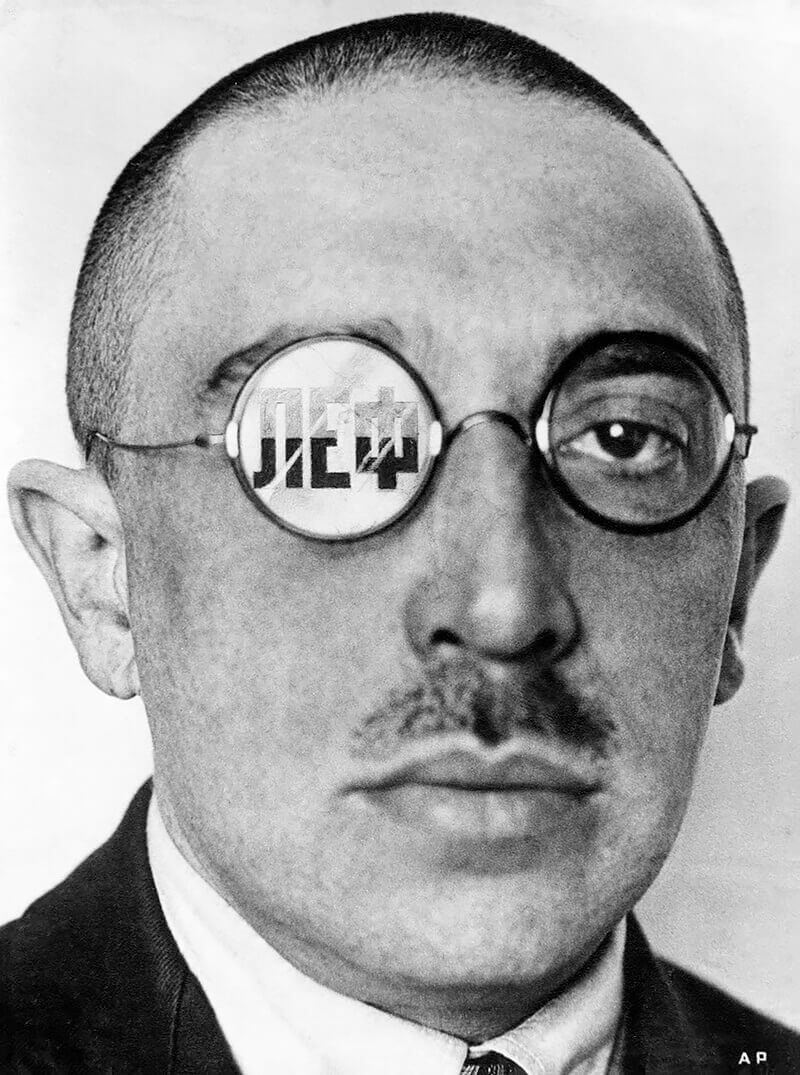
The critic Osip Brik, 1924 - Aleksander Rodchenko
The critic Osip Brik, 1924
© Aleksander Rodchenko
Following 1914, he continued his artistic education at the Stroganov Institute in Moscow, where he created his first abstract drawings in 1915, influenced by Kazimir Malevich's Suprematism. The following year, he took part in The Store, an exhibition organized by another formative influence, Vladimir Tatlin.

Rodchenko's work was influenced heavily by Cubism and Futurism, as well as Malevich's Suprematist compositions, which featured geometric forms deployed against a white background. Aleksander Rodchenko was Tatlin's student and assistant, and the interest in figuration that characterized Rodchenko's early work faded as he experimented with design elements. He created his paintings with a compass and ruler, with the goal of eliminating expressive brushwork.

Rodchenko worked for Narkompros and was one of the RABIS organizers. RABIS was founded between 1919 and 1920. In 1920, the Bolshevik government appointed Rodchenko as Director of the Museum Bureau and Purchasing Fund, with responsibility for the reorganization of art schools and museums. He became the secretary of the Moscow Artists' Union, established the Fine Arts Division of the People's Commissariat for Education, and assisted in the establishment of the Institute for Artistic Culture. From 1920 to 1930, he was a teacher at the Higher Technical-Artistic Studios, a Bauhaus organization with a "checkered career." It ceased operations in 1930.

In 1921, Aleksander Rodchenko joined the Productivist group, along with Stepanova and Aleksei Gan, to advocate for the incorporation of art into everyday life. He abandoned painting to focus on graphic design for posters, books, and films. He was profoundly influenced by the ideas and practice of filmmaker Dziga Vertov, with whom he collaborated extensively in 1922. Impressed by the German Dadaists' photomontage, Rodchenko began his own experiments in the medium, first using found images in 1923, and then shooting his own photographs from 1924 on. In 1923, his first published photomontage illustrated Mayakovsky's poem About This. Rodchenko created his most famous poster in 1924, an advertisement for the Lengiz Publishing House titled Books, which features a young woman with a cupped hand shouting "Books in all branches of knowledge," printed in modernist typography.

Photography has all the rights, and all the merits, necessary for us to turn towards it as the art of our time.

-- Aleksander Rodchenko
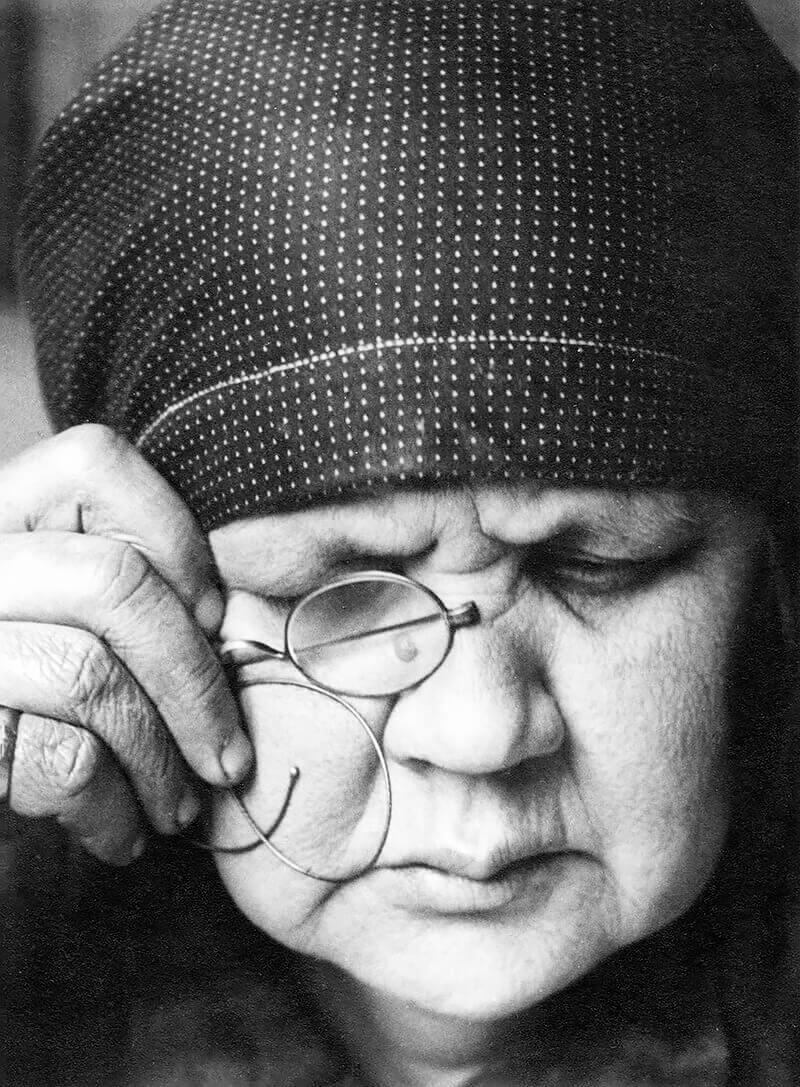

Portrait of the Artist’s Mother, 1924 - Aleksander Rodchenko
Portrait of the Artist’s Mother, 1924
© Aleksander Rodchenko
From 1923 to 1928, Rodchenko worked closely with Mayakovsky (of whom he took several portraits) on the design and layout of LEF and Novy LEF, Constructivist artists' publications. Many of his photographs were published in or used as covers for these and other publications. His images were concerned with the placement and movement of objects in space, as well as the elimination of unnecessary detail. During this time, he and Stepanova painted the well-known panels of Moscow's Mosselprom building. Varvara Rodchenko, their daughter, was born in 1925.

Rodchenko's work was very abstract throughout the 1920s. He joined the October Group of artists in 1928, but was expelled three years later after being accused of "formalism," an accusation first leveled in the pages of Sovetskoe Foto in 1928. In the 1930s, as the Party's guidelines governing artistic practice shifted in favor of Socialist realism, he focused on sports photography and images of parades and other choreographed movements. In the late 1930s, Aleksander Rodchenko returned to painting, stopped photographing in 1942, and produced abstract expressionist works in the 1940s. Throughout these years, he continued to organize photography exhibitions for the government. In 1956, he died in Moscow.

 

Aleksander Rodchenko's Video

Selected Books

Inspiring Portfolios

Call for Entries
AAP Magazine #57 Portrait
Publish your work in our printed magazine and win $1,000 cash prizes
 
Stay up-to-date  with call for entries, deadlines and other news about exhibitions, galleries, publications, & special events.

More Great Photographers To Discover

Édouard Baldus
France
1813 | † 1889
Édouard Baldus was a French landscape, architectural and railway photographer, born on June 5, 1813 in Grünebach, Prussia. He was originally trained as a painter and had also worked as a draughtsman and lithographer before switching to photography in 1849. In 1851, he was commissioned for the Missions Héliographiques by the Historic Monuments Commission of France to photograph historic buildings, bridges and monuments, many of which were being razed to make way for the grand boulevards of Paris, being carried out under the direction of Napoleon III's prefect Baron Georges-Eugène Haussmann. The high quality of his work won him government support for a project entitled Les Villes de France Photographiées, an extended series of architectural views in Paris and the provinces designed to feed a resurgent interest in the nation's Roman and medieval past. In 1855, Baron James de Rothschild, President of Chemin de Fer du Nord, commissioned Baldus to do a series of photographs to be used as part of an album that was to be a gift to Queen Victoria and Prince Albert as a souvenir of their visit to France that year. The lavishly bound album is still among the treasures of the Royal Library at Windsor Castle. In 1856, he set out on a brief assignment to photograph the destruction caused by torrential rains and overflowing rivers in Lyon, Avignon, and Tarascon. He created a moving record of the flood without explicitly depicting the human suffering left in its wake. Baldus was well known throughout France for his efforts in photography. One of his greatest assignments was to document the construction of the Louvre museum. He used wet and dry paper negatives as large as 10x14 inches in size. From these negatives, he made contact prints. To create a larger image, he put contact prints side by side to create a panoramic effect. He was renowned for the sheer size of his pictures, which ranged up to eight feet long for one panorama from around 1855, made from several negatives. Despite the documentary nature of many of his assignments, Baldus was inventive in overcoming the limitations of the calotype process (described here). He often retouched his negatives to blank outbuildings and trees, or to put clouds in white skies; in his composite print of the medieval cloister of St. Trophime, in Arles (1851), he pieced together fragments of 10 different negatives to capture focus in-depth in a panoramic view of the interior space and also render detail in the brightly lit courtyard outside. He died in 1889 in Arcueil, France.Source: Wikipedia Baldus was one of the great calotypists of the 1850s, producing works of an unprecedented range and scale. He moved to Paris in 1838 to study painting alongside other future photographers such as Le Gray, Le Secq, and Nègre. He frequently retouched his paper negatives, adding pencil and ink, to add clouds or clarify details, then printing his own large-scale negatives. He was also adept at stitching several negatives together to re-create architectural views, most famously in his views of the cloisters of Saint Trophime. Famed especially for his depiction of architecture, Baldus not only documented the modernization of Paris but also traveled widely through France recording modernity and new construction - including new railways and aqueducts, as well as the building of the new Louvre. In 1851 the Commission des Monuments Historiques cited Baldus as one of the five best architectural photographers and he was commissioned to record the monuments of France for what became known as the Mission heliographic. His beginnings in photography are not well documented before his participation in the Mission héliographique, although it is known that he took photographs of Montmajour in 1849.Source: James Hyman Gallery "Everyone knows Mr. Baldus," a reviewer wrote in 1859. By the mid-1850s, Édouard-Denis Baldus was the most successful photographer in France and at the height of his career. He began as a painter, turning to photography in 1849 when paper negatives were just becoming popular. Throughout much of his life, he listed himself in city directories as "peintre photographe" (painter photographer), in reference more to his training than to his practice. In 1851 Baldus became one of the forty founding members of the Société Héliographique, the first photographic organization in the world. Baldus specialized in images of the landscape, architecture, and railways. In 1851 the Commission des Monuments Historiques (Historic Monuments Commission) asked Baldus to document architecture in France. These assignments, which were awarded to several photographers, were called missions héliographiques. In 1855 Baldus received his largest commission to document the construction of the Musée du Louvre. Photographic enlargements were not yet possible in the 1850s, so Baldus's photographs were contact prints from negatives as large as 10 x 14 inches. He often joined together several negatives to produce panoramas, creating images on an even grander scale.Source: The J. Paul Getty Museum
Joe Vitone
United States/Italy
1954
Joe Vitone is a documentary fine art photographer and educator living in Austin, Texas. His work consists of large format portraiture and landscape in the United States as well as panoramic and other views examining cultures abroad. He is Professor of Photocommunications at St. Edward's University in Austin, Texas where he has lived with his family since 1991. He teaches traditional as well as digital photography and electronic media. He has received a National Endowment for the Arts fellowship in photography and been a Fulbright scholar in Costa Rica as well as a Fulbright Specialist in the Apulia region of southern Italy. In both Costa Rica and Italy, Vitone’s work centers around small-scale family based agriculture. In addition to presentations given in the United States, he has lectured on his photography in Australia, China, France, Germany, Hungary, Italy, Japan, Malaysia, Thailand, and Vietnam. Involved in international education, he has led American students on study abroad programs in China, France, Japan, and Thailand. With a focus on documentary photography, he has worked with students outside of the U.S. in Australia, Costa Rica, France, Italy, and Thailand. His work has been exhibited at a number of venues including one-person exhibitions at the Hungarian Museum of Photography, the Akron Art Museum, and the Instituto Cultural Peruano-Norteamericano. His work is held in a number of collections including the Cleveland Museum of Art, the Center for Creative Photography, the Museum of Fine Art, Houston, Hungarian Museum of Photography, and the Smithsonian Institution National Museum of American History. About Family Records: These photographs have been drawn from an ongoing series of 4x5 and 8x10 inch (10x12.5 and 20.3x25.4 cm) negative portraits called Family Records which was begun in 1998 to document members of immediate and extended families of the photographer and his wife. 2017 marked 20 years of work on the pictures. The majority of the portrait subjects live in an orbit around the Rust Belt city of Akron, Ohio, former home to the country's major rubber and tire producers including Goodyear, Goodrich, and Firestone. Doylestown, Barberton, and other rural communities neighboring Akron serve as locations for many of these images along with Akron proper. The photographs generate dialogues between one another at a number of levels, some directly, as in lineage and interpersonal relation of mother to daughter, father to son, or brother to sister, and some at less specific and more universal places as well. Comment is made on finding purpose or respite in what can be a painful life, on time and aging, on moving from childhood to adulthood, on relations sustained or lost through the years, on masculinity and femininity, on sensuality and beauty seen not only in youth but in age, and on our valuing of ourselves and others not only because of our strengths but, perhaps even more so, by reason of our vulnerabilities.
Peter Sekaer
Denmark
1901 | † 1950
Peter Sekaer was a Danish photographer and artist. Born in Copenhagen, Denmark, Sekaer came to New York in 1918 to seek freedom and opportunity. By 1922 he had a reputation as a master sign painter and had his own successful business producing posters. Several years later he began to take classes at The Art Student's League. Sekaer soon became acquainted with Ben Shahn, who may have been the one to introduce him to photography and who later introduced him to Walker Evans. After 1933, he devoted himself exclusively to photography, studying with Berenice Abbott at the New School for Social Research, and assisting Walker Evans on the project of photographing the Museum of Modern Art's African sculpture collection. In 1936 Sekaer accompanied Evans, who was hired by the Resettlement Administration (RA, later to become the FSA) on a photographic journey throughout the South, often shooting the same subject. Like many of his contemporaries, Sekaer sought to capture the real world with photographs that combined artistic expression with a personal commitment to social change. From 1936 to 1942 Sekaer became a professional photographer and was hired by the federal government agency, the Rural Electrification Administration (REA), and later became the head of the REA's graphic department. In 1938 the REA sent Sekaer to the United States Housing Authority (USHA). The photographs Sekaer made for the USHA, an agency primarily concerned with the removal of city slums and sponsorship of public urban housing, reveal his continued interest in the richness of human experience and environment. Transferred again in 1940 Sekaer photographed Navajo and Pueblo Indians for the Office of Indian Affairs. That same year, he worked as photographic researcher and still photographer for the REA film Power and the Land. After 1942 he continued working for other federal agencies photographing briefly for the Office of War Information (OWI), and the American Red Cross-agencies whose agendas conflicted with his own, and limited his freedom in artistic expression. Continually frustrated by this, Sekaer left Washington, DC for New York where he freelanced for several years, doing fashion and editorial assignments until he died of a heart attack at the age of 49 in 1950. Although Sekaer's photographs were widely published and exhibited during his lifetime, his work largely became forgotten after his death until an exhibition held in 1980 at the Witkin Gallery in New York and later in 1990 at the Royal Library in Copenhagen for which a catalog was published. Many of Sekaer's photographic prints can be seen in the public collection of the Royal Library in Copenhagen. The High Museum of Art in Atlanta acquired a trove of more than seventy rare vintage prints by Sekaer, the largest holding of its kind in any American art museum. Many of these works have never been on public view. From June 2010 until January 2011, the museum staged an exhibition of Sekaer's work titled Signs of Life.Source: Wikipedia
Laura Berson
France
1987
Laura Gwenaëlle Berson was born in Paris in 1987. She studies Applied Arts, then comedy,script-wrinting and cinema. It is a few years later that she is moving towards a more intuitive photographic, plastic and writing work, enabling her to express everything she doesn't know just as much as the others, with the aim of finding the essence of something. Her conceptualized artistic practice allows her to play on forms, bodies whatever they are, by diving into the heart of the infinitely large and the infinitely small, to try to connect the sensitive but not palpable part that binds the two . Her work oscillates between everything and nothing, here and there, where she moves, like an atom (or electron it depends) free, among others. It is through her raw and spontaneous hypersensitivity that she directs her work towards an intimate questioning, playing on the different strata of reality that accompany it to identify a multi-variable essence. She exhibited solo in 2015 at the Maison de la Mixité in Paris and was present at Fotofever Emerging Talent in November 2016. She got an honorable mention for the Chromatics Photography awards in the landscape section. In 2018, she appeared publicly in a Science Shakers - Mixology session - around the imaging of science, organized by the Institute of Complex Systems in partnership with the CNRS, and won the Moscow Foto awards silver price for her serie Some Seeds. In her series The Intolerante, she tries to highlight the effect of food intolerance on the body, its destructuring of the body see its modification, via its own body damaged and tired by daily pain. Through the Myth of the Endometrium, she traces the course of the disease of endometriosis from which it is reached, passing painful menstruation and infertility to the possibilities of operations in order to be able to transmit life. In her series Silentium, she tries to transcribe relationships to others, difficult, tempestuous, whose links fade or weave over time, in a carnal and organic way.
Stuart Franklin
United Kingdom
1956
Stuart Franklin is a British photographer. He is a member of Magnum Photos and was its President from 2006 to 2009. Franklin was born on June 16 1956 at Guys Hospital in London. He studied drawing under Leonard McComb in Oxford and Whitechapel, London, and from 1976 to 1979 photography at West Surrey College of Art and Design, where he graduated with a BA. Moreover, between 1995 and 1997, he studied geography at the University of Oxford, first receiving a BA and the Gibbs Prize for geography. He received a doctorate in Geography from the University of Oxford in 2000. Stuart Franklin was awarded a professorship in documentary photography in 2016. He teaches photography and visual storytelling at Volda University College, Norway. From 1980 until 1985, Franklin worked with Sygma in Paris. During that time he photographed the civil war in Lebanon, unemployment in Britain, famine in Sudan and the Heysel Stadium disaster. Joining Magnum Photos in 1985, he became a full member in 1989. In the same year, Franklin photographed the uprising in Tiananmen Square and shot one of the Tank Man photographs, first published in TIME Magazine, as well as widely documenting the uprising in Beijing earning him a World Press Photo Award. In 1989 Franklin traveled with Greenpeace to Antarctica. He worked on about twenty stories for National Geographic between 1991 and 2009, subjects including Inca conqueror Francisco Pizarro and the hydro-struggle in Quebec and places such as Buenos Aires and Malaysia. In addition, he worked on book and cultural projects. In October 2008, his book Footprint: Our Landscape in Flux was published by Thames & Hudson. An ominous photographic document of Europe’s changing landscape, it highlights Franklin's ecological concern. During 2009 Franklin curated an exhibition on Gaza - Point of No Return for the Noorderlicht Photo Festival. Since 2009 he has focused on a long-term landscape project in Norway published as Narcissus in 2013. More recently he has worked on documentary projects on doctors working in Syria, and immigration in Calais. Franklin's most recent book, The Documentary Impulse was published by Phaidon in April 2016. It investigates the nature of truth in reporting and the drive towards self-representation beginning 50,000 years ago with cave art through to the various iterations and impulses that have guided documentary photography along its differing tracks for nearly 200 years. Franklin was the general chair of the World Press Photo jury 2017.Source: Wikipedia How Stuart Franklin took his Tank Man photograph In our book, The Documentary Impulse, the acclaimed photographer Stuart Franklin explores the human drive behind documentary photography, whether it's the passion to record the moments we experience, or the need to bear witness to forces that we want to change. The second of those two drives spurred Franklin in the summer of 1989, when he shot Tank Man, the unnamed, and to-this-day still unknown pro-democracy protestor who stood in the way of the Chinese army’s tanks, as they tried to clear Tiananmen Square. Franklin's film was smuggled out of Beijing to Magnum's Paris office by a French student in a box of tea, and, following its development and distribution, his picture moved world leaders across the globe, including the then US president George H W Bush. Here’s how he got that photograph. “I remember lying prone on a balcony on the sixth floor of the Beijing Hotel with the Newsweek photographer Charlie Cole, photographing the event around noon on 4 June,” Franklin recalls. “Earlier that day Tiananmen Square had been cleared by the Chinese Army. However, a group of civilians lined up to face a double row of soldiers who themselves stood in firing positions in front of a column of tanks. These civilians were shot at repeatedly, leaving at least twenty casualties. As the bodies were carried away the standoff died down and a column of tanks broke through, moving slowly eastwards. Waiting for them a few hundred metres down the road was a man in a white shirt and dark trousers, carrying two shopping bags. Alone he blocked the path of the tanks, watched by groups of nervous bystanders and perhaps fifty journalists, camera crews and photographers on balconies on almost every floor of the hotel." Franklin captured the most widely distributed image of the event. Yet, after the taking the shot, he wasn’t convinced of the image’s power. “On the balcony after the event, which lasted less than three minutes, a conversation ensued with a writer for Vanity Fair, T.D. Allman. Allman insisted on the significance of the spectacle,” Franklin writes. “I recalled images from 1968 in Prague and Bratislava where protesters stood up bare-chested against Russian tanks, and similar accounts from China during the Japanese invasion. Tank man felt very distant by comparison." Thankfully, once his film was out of the country, the world looked favourably on the photograph. “My rolls of film were smuggled out of China the following day packed in a small box of tea and carried to Paris by a French student,” he recalls. “The transparencies were later processed, duplicated and distributed from Magnum’s office in Paris." “Images and reports of the tank man incident emerged slowly. The first the world saw of the tank man was on television on 5 June. Television drew the world’s attention to the incident. George Bush Senior referenced it after watching CNN. ‘I was very moved today’, Bush said at a news conference on the morning of 5 June, ‘by the bravery of that one young individual that stood alone in front of the tanks, rolling down the avenue there.’”Source: Phaidon
Thomas Dworzak
Germany
1972
Thomas Dworzak (born 1972) is a German photographer. He became a Magnum Photos nominee in 2000 and a full member in 2004. He was elected President of Magnum in 2017. Dworzak won a World Press Photo award in 2001 and in 2018 received the Hood Medal from the Royal Photographic Society in the UK. Dworzak was born in Kötzting, Germany. He decided to become a photographer from an early age, travelling to Northern Ireland, Israel, Palestine and to Yugoslavia while still in high school. Dworzak lived in Tbilisi, Georgia from 1993 until 1998 where he documented the conflicts in Chechnya, Karabakh and Abkhazia. Whilst there he worked on a project about the Caucasus region and its people, the impact years of brutal war had on the region, and the interplay between Russian literature and the typical imagery of the Caucasus. This was published as the book Kavkaz.Source: Wikipedia In the years following the 9/11 attacks, he spent time covering the wars in Afghanistan and Iraq as well as their impact on the U.S. During a several-months assignment in Afghanistan for The New Yorker, he discovered studio portraits of the Taliban; these images would form his first book, Taliban. The images that were taken during his many assignments in Iraq, most of which were shot for TIME Magazine, were used to create his next book: M*A*S*H* IRAQ. From 2005 to 2008, as a TIME magazine contract photographer, Dworzak covered many major international news stories including: Macedonia, Pakistan, Chechnya, Sri Lanka, Nigeria, Lebanon, Haiti, Chad, C.A.R., the London attacks, Ethiopia, Iran, U.S. presidential campaigns, Hurricane Katrina, and the revolutions in the former Soviet republics of Georgia, Kyrgyzstan, and Ukraine. During breaks from conflict areas and war zones he regularly photographed Fashion Weeks in major cities. In 2006, Thomas photographed the New York Marathon while participating himself. Thomas remained in Georgia after the 2008 war with Russia. This would lead to the Magnum Group project Georgian Spring, which was a starting point for a new, several-year-long engagement with the "New Georgia" under President M. Saakashvili. In 2012, Thomas photographed Nowrooz celebrations in Georgia. Dworzak spent 2009-2010 in Afghanistan, documenting the deployment of ISAF troops and their return home. In 2009, he also visited Iran to photograph Ashura. A National Geographic assignment on the Sochi Olympics became later the book Beyond Sochi. In 2013, a commission for the Bruges Museum led him to photograph the memory of WWI. This has since become an ongoing project concerning the legacy of the First World War around the world, which he planned to finish in 2018, 100 years after the end of the conflict. Always an avid collector, Thomas started gathering Instagram screenshots of a variety of subjects and has been grouping them together into ever-growing collections of Instagram artist scrapbooks. A final set of 20 of these books has been presented at the International Center of Photography, ICP, in New York from February 2017. Besides his personal stories, Thomas Dworzak continues to cover international stories, including the 2015 Paris terror attacks, Pokemon Go!, the 2016 U.S. elections, and the run-up to the 2017 French presidential elections. When covering the escalation of the refugee crisis in 2015, he conceived the idea of "Europe - a photographic guide for refugees," which was produced and distributed free of charge to migrants with the support of a Magnum Foundation Emergency Grant and AFAC in 2016. Dworzak has also been teaching a number of workshops.Source: Pulitzer Center With an unflinching eye and depth of vision, Thomas Dworzak has documented many of this century’s most important news stories since the 1990s. Dworzak started travelling aged 16 to photograph conflicts in Northern Ireland, Israel/Palestine and the disintegrating Yugoslavia. Since then, he has gone on to photograph wars in Afghanistan and Iraq post 9/11, the revolutions in the former Soviet republics of Georgia, Kyrgyzstan and Ukraine. After graduating from Robert-Schuman Gymnasium, Cham (specializing in English, French, History and Russian Literature) he left Germany, always combining his travels and attempts to become a photographer with studying languages: Spanish in Avila, Czech in Prague, Russian in Moscow. During the Nineties, Dworzak lived in Georgia, exploring the people, culture and conflicts in the Caucasus, which resulted in the book, Kavkaz in 2010. Significant projects include a several-month assignment in Afghanistan for The New Yorker, where he discovered studio portraits of the Taliban. This became his first book, Taliban. Meanwhile, images taken during his many assignments in Iraq, most of which were shot for TIME Magazine, were used to create his next book:M*A*S*H* IRAQ. In his most recent project, Feldpost (2013 – 2018), he photographed the ‘memory’ of WWI in more than 80 countries, producing 1568 ‘postcards’ (one for every day of the war). It was completed on 11/11/2018, 100 years after the end of the conflict. Dworzak is also a keen curator, with a particular interest in digital culture. His work mining Instagram memes under various hashtags—ranging from animals dressed as the pope to the aftermath of the Boston marathon bombing‚—has resulted in 20 sketchbooks compiled of his findings.Source: Magnum Photos Since 2011 he is also represented by Gallery Clair in Munich and St.Paul.
Shuwei Liu
China
1985
Shuwei Liu (b.1985) was born in Tangshan and currently lives in Shanghai, China. He received his Bachelor of Engineering in Guangdong University of Technology in 2009, then he decided to do what he really love such as photography, design and writing. He's a finalist of LensCulture Portrait Awards 2016. His works got exhibited internationally include Power Station of Art, the State Hermitage Museum, Artefiera Bologna, JIMEI × ARLES Photo Festival Three Shadows Photography Art Centre, Vu Photo. He was an residency artist in Vermont Studio Center, Red Gate residency and granted by them, and was awarded Fine Art "First Place" by PDN, and he was a finalist of LensCulture Portrait Awards, Three Shadows Photography Awards, Barcelona International Photography Awards, British Journal of Photography, described as "Ones to Watch" talents and Photovogue Festival.All about Childhood Revisited"Childhood is a human water, a water which comes out of the shadows. This childhood in the mists and glimmers, this life in the slowness of limbo gives us a certain layer of birth... " Gaston Bachelard "Childhood is not a thing which dies within us and dries up as soon as it has completed its cycle. It is not a memory. It is the most living of treasures, and it continues to enrich us without our knowing it." Franz Hellens All about Visible Darkness "Visible darkness" is a part of my "Blue" trilogy. When I discovered 4 moon-like crescents at the base of my corneas, I thought I was going to lose sight. The anxiety reminded me of Derek Jarman's "Blue is darkness made visible." , blue was the only thing he could see before he went blind. Meanwhile I was hiding in my own corner, chasing the color blue, turned out to be adjusting the distance between the world and me. Blue itself is just like distance, not reachable.
Mark Seliger
Unites States
1959
Mark Alan Seliger (born May 23, 1959) is an American photographer noted for his portraiture. Seliger was born in Amarillo, Texas, the son of Maurice and Carol Lee. The family moved to Houston in 1964. He attended the High School for the Performing and Visual Arts in Houston, and East Texas State University (now Texas A&M University Commerce). He moved to New York City in 1984. Seliger began working for Rolling Stone in 1987, and served as its chief photographer from 1992 to 2002, and shot more than 100 covers for the magazine. As of 2010, Seliger lives in New York City and works for Conde Nast Publications. He has shot a number of covers for GQ and Vanity Fair. Seliger has also published several books; created a number of CD covers for Burning Spear, Diana Krall, and other bands; and directed short films. The celebrities whose portraits Seliger has made include Susan Sarandon, David Byrne, Matthew Barney, Willie Nelson, Mick Jagger, Keith Richards, Kurt Cobain, Lenny Kravitz, Rob Thomas, Brand Nubian, and Tony Bennett.Source: Wikipedia Seliger now shoots frequently for Vanity Fair, Italian Vogue, Harper’s Bazaar, Elle, and many other magazines. In addition, he shoots advertising work for Adidas, Anheuser-Busch, Levi’s, McDonald’s, Netflix, Ralph Lauren, Ray-Ban, and many more. Seliger is the recipient of such esteemed awards as the Alfred Eisenstaedt Award, Lucie Award, Clio Grand Prix, Cannes Lions Grand Prix, The One Show, ASME, SPG, and the Texas Medal of Arts Award. Seliger’s work has been exhibited in museums and galleries around the world. His photographs are part of the permanent collection of the National Portrait Gallery at the Smithsonian Institution in Washington, D.C., the Museum of Fine Arts in Houston, and the National Portrait Gallery in London.Source: www.markseliger.com
Advertisement
AAP Magazine #57 Portrait
Win a Solo Exhibition in May
AAP Magazine #57 Portrait

Latest Interviews

Exclusive Interview with Matthew Finley
American photographer Matthew Finley turns inward, using photography as a way to explore identity, memory, and emotional truth. Based in Los Angeles, his practice moves between performance, gesture, and found imagery, creating a visual language that is both intimate and deeply personal
Exclusive Interview with Jan Janssen
Dutch photographer Jan Janssen explores universal human experiences through his long-term project It Matters, winner of the May 2025 Solo Exhibition. Begun in 2016, the series captures intimate moments of everyday life—love, loss, connection, and belonging—across Central and Eastern Europe. Working in countries such as Turkey, Azerbaijan, and Armenia, Janssen spends extended time within communities, building relationships based on trust and respect. His approach allows him to move beyond observation, revealing deeply human and authentic moments. Rooted in travel and personal discovery, It Matters reflects Janssen’s search for what connects us all in an increasingly divided world. The project is ongoing and will culminate in a photobook scheduled for publication in 2026.
Exclusive Interview with Henk Kosche
German photographer Henk Kosche turns his lens toward the streets of Halle an der Saale, capturing everyday life in the late years of the former German Democratic Republic. At the time, Kosche was studying design and exploring the city with his camera, drawn to the atmosphere of its industrial landscape and the quiet rhythms of daily life. His series Street Photography at the End of the 80s, selected as the Solo Exhibition for July 2025, revisits a body of work created just before a period of profound change. Rediscovered decades later in a small box of 35mm negatives, these photographs offer glimpses of a city and its people at a moment suspended between the familiar and the unknown.
Exclusive Interview with Anastasia Samoylova
Anastasia Samoylova is an American artist whose photographic practice is shaped by close observation and a deep attentiveness to place. Working between documentary and formal exploration, she photographs landscapes, architecture, and everyday scenes with a sensitivity to light, structure, and atmosphere. Since relocating to Miami in 2016, her work has increasingly focused on how environments—both natural and built—carry social, cultural, and emotional traces. We asked her a few questions about her practice and her way of seeing, to better understand the thoughts and experiences that shape her work—while allowing the images themselves to remain open and speak in their own time.
Exclusive Interview with Marijn Fidder
Marijn Fidder is a Dutch documentary photographer whose work powerfully engages with current affairs and contemporary social issues. Driven by a deep sense of social justice, she uses photography to speak on behalf of the voiceless and to advocate for the rights of those who are most vulnerable. Her images have been widely published in major international outlets including National Geographic, CNN Style, NRC Handelsblad, Volkskrant, GUP New Talent, and ZEIT Magazin. Her long-term commitment to disability rights—particularly through years of work in Uganda—culminated in her acclaimed project Inclusive Nation, which earned her the title of Photographer of the Year 2025 at the All About Photo Awards. She is also the recipient of multiple prestigious honors, including awards from World Press Photo and the Global Peace Photo Award. We asked her a few questions about her life and work.
Exclusive Interview with Josh S. Rose
Josh S. Rose is a multidisciplinary artist working across photography, film, and writing. His practice bridges visual and performing arts, with a strong focus on movement, emotion, and the expressive potential of the image. Known for his long-standing collaborations with leading dance companies and performers, Rose brings together authenticity and precise composition—a balance he describes as “technical romanticism.” His work has been commissioned and exhibited internationally, appearing in outlets such as Vogue, at the Super Bowl, in film festivals, and most recently as a large-scale installation for Lincoln Center for the Performing Arts. A sought-after collaborator, he has worked with major artists, cultural institutions, and brands, following a previous career as Chief Creative Officer at Interpublic Group and the founder of Humans Are Social. We asked him a few questions about his life and work.
Interview with Maureen Ruddy Burkhart
Photographer Maureen Ruddy Burkhart brings a quietly attentive and deeply human sensibility to her exploration of the world through images. Shaped by a life immersed in photography, film, and visual storytelling, her work is guided by intuition, observation, and an enduring interest in the emotional undercurrents of everyday life. With a practice rooted in both fine art traditions and documentary awareness, she approaches her subjects with sensitivity, allowing subtle moments to emerge naturally rather than be imposed. Her series Til Death, selected as the Solo Exhibition for February 2025, reflects this long-standing commitment to photography as a space for reflection rather than spectacle. Drawn to moments that exist just outside the expected frame, Burkhart’s images suggest narratives without resolving them, leaving room for ambiguity, humor, and quiet connection. We asked her a few questions about her life and work.
Exclusive Interview with Peter Ydeen
Winner of AAP Magazine #45 Travels, his series reflects this unique vision—capturing the spirit of place through subtle layers of light, color, and emotion. Whether traveling abroad or observing the rhythms of his own surroundings, Ydeen creates images that feel both grounded and enchanted, inviting viewers into a world where reality and reverie meet.
Exclusive Interview with Julie Wang
Chinese-born photographer Julie Wang brings a poetic, contemplative sensitivity to her visual exploration of the world. Having lived for nearly equal parts of her life in China, Europe, and the United States, she approaches her subjects with the nuanced perspective of someone shaped by many cultures. This blend of distance, curiosity, and emotional resonance infuses her work with a quiet depth, allowing her to reveal the fragile beauty and subtle tensions that often pass unnoticed.
Call for Entries
Win A Solo Exhibition in May
Get International Exposure and Connect with Industry Insiders