Publisher: MACK
Publication date: August 2025
Print length: 224 pages
Language: English
Price Range:
Reviews:
Fragments of Fietas offers a haunting, deeply human portrait of loss, memory, and resilience — a work that finally brings to light the full scope of a community erased by force, but preserved through the kindness of one photographer’s eye.
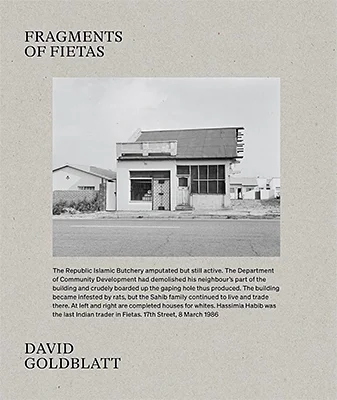
Between 1948 and 2016, David Goldblatt returned repeatedly to Fietas (also known as Pageview), a vibrant, multiracial suburb west of Johannesburg. Once alive with shops, mosques, schools, and busy streets, Fietas was home to a diverse community: Indian, Black, “Coloured,” Chinese — people of many backgrounds living side by side, sharing daily life, commerce, and culture.
But under the regime of apartheid and the enforcement of the Group Areas Act, Fietas was marked for destruction. The area was declared a “white area,” and for decades residents resisted eviction, fought legal battles, and clung to their houses and shops. In the late 1970s, demolitions began in earnest. Homes, shops, entire streets were razed, families uprooted, and a community dispersed.
Goldblatt’s photographs trace this arc with compassion and precision. Early images show shopfronts crowded with goods, family portraits behind counters, children playing in narrow streets — scenes of everyday dignity and belonging. Later frames capture demolition, empty plots, rubble, and the silence that replaced what once was. Portraits of former shopkeepers and residents confronting loss further give voice to a community whose physical presence was erased but whose memories endure.
Accompanied by interviews with past and present residents, as well as contextual essays situating Fietas within broader racial and political history, the book becomes more than a photo album. It is a social document — an elegy, a testimony, a testament to resistance and memory. Through Goldblatt’s empathetic gaze and the voices of those who lived through displacement, we are invited to remember not just loss, but also what once flourished: diversity, community, humanity.
In its quiet pages, Fragments of Fietas does more than mourn what was lost — it preserves it. It offers future generations a chance to see, to understand, to feel. And in doing so, it reclaims dignity for people and a place many tried to erase from history.