324 Worth Avenue
Palm Beach, FL 33480
'There's a phrase I always use. It's better to be angry and active than angry and passive.'
For the past two decades, photographer Nick Brandt has created a body of work that underlines the critical grounds for conservation. Brandt questions that, if we as humans continue to endanger the environment through a relentless pursuit of frequently short term, short-sighted "economic progress," the natural world we proudly proclaim as Earth's endowment to humanity will cease to exist.
Nick Brandt began his journey working in Africa by way of filmmaking, then after being fascinated with the environment Brandt turned to photography in 2001 to capture the depth and vast richness of the African landscape. In his prescient career, Brandt has created powerful imagery that transmits the immediacy for action, but that also transcends bleak undertones of hopelessness with the majestic and captivating beauty of wildlife and the total environment, conveying a sense of empathy and urgency towards conserving the natural world.
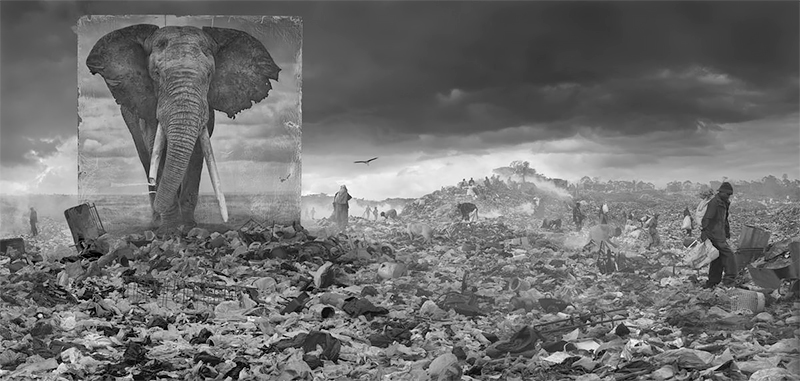
In his series, Inherit the Dust, Brandt places portraits of animals, printed life-size and glued to large panels in Kenya, in areas indigenous to those animals, but that now have been displaced by the urbanization of the modern world. In this series, the intrinsic allure of wildlife is juxtaposed against stark, gloomy environments like quarries, underpasses, and wastelands. These images demarcate the boundaries of progress, posing the question, is urbanization yielding the best results for the world, or is it crippling the home of the wildlife that thrived in those locations and destroying the habitat's delicate balance?
"It's a cliché, but we must act urgently. If we continue to do nothing, future generations will be inheriting the sad remnants of a once-vibrant living planet. They will be inheriting dust."
In his latest series entitled This Empty World, Nick Brandt combines two moments from images captured weeks apart but almost all from the exact same camera position.
"This Empty World addresses the escalating destruction of the natural world at the hands of humankind, showing a world where, overwhelmed by runaway development, there is no longer space for animals to survive. The people in the photos are also often helplessly swept along by the relentless tide of "progress." "Initially, a partial set is built and lit. Sometimes, such as with a dead forest, it is actually a complete set. Weeks, even months follow, whilst the animals that inhabit the region become comfortable enough to enter the frame. Once the animals are captured on the camera, the full sets – bridge and highway construction sites, a petrol station, a bus station and more – are built by the art department team. A second sequence is then photographed with a full set, and a large cast of people are drawn from local communities and beyond."
In his first series photographed in color, Brandt presents gritty, neon-lit landscapes where humans and animals alike seem to be relegated to encroaching concrete environments that are ultimately disconnected from nature and any organic purpose. The work displays a sense of melancholy, depicting cold bus stations, crowds transfixed onto their handheld devices, and the sparks of welding fire during the construction of a bridge. The images are weighty, almost post-apocalyptic and suggest a future where wildlife no longer has habitable land as a reality. Brandt's latest series highlights the diminishing space that contemporary society is creating for nature. Cinematic panoramas that tug at the empathy of the viewer through scenes presenting animals and human beings that are alone but together, sharing a sense of loss and displacement, in environments entirely out of natural equilibrium.
This work is made with as small a footprint as possible, conscious of the effect his work could cause on the environment. His latest series was set on populated, eroded Maasai community land, without protective reserve status, close to Amboseli National Park in Kenya. After the sets were removed and all their elements recycled with almost zero waste, no evidence of the shoot now remains in the landscape. In 2010, Nick Brandt also co-founded a conservation foundation, Big Life Foundation, that now protects over 1.6 million acres of wilderness and employs hundreds of local Maasai rangers, that has resulted in a dramatic reduction in the killing of all animals and increase in populations of some key species like elephant and lion.
Nick Brandt's photographs examine the consequences of urbanization in a literal as well as poetic manner, presenting a highly creative and determined approach that underscores the need to protect both wildlife and its environment. Brandt creates a profoundly moving body of work that ultimately aims to remind the viewer that human life will be sorely diminished by the transformation of a landscape that fails to align our needs with those of the broader ecosystem.
"Nick Brandt's ravishing portraits of African animals are like premonitory memorials, taken to aid the cause of staving off extinction. In Inherit the Dust, his astonishing panoramas of those portraits – installed as life-size panels in industrial and urban wastelands that have trampled the animal's habitats – are a jolting combination of beauty, decay, and admonishment. The result is an eloquent and complex "J'accuse", for the people are as victimized by "development" as the animals are. The breadth, detail, and incongruity of Brandt's panoramas suggest a collision between Bruegel and an apocalypse in waiting." – Vicki Goldberg, Art Critic, Author
"Extraordinary work… This Empty World is a truly smart way of raising awareness, for it forces us to rethink our expectations, our take on photography, and ultimately, the destruction of our planet."
– F-Stop Magazine