At the Renaissance Society,
Palomar (Part 2) continues a wide-ranging group exhibition that turns attention upward, treating the sky as both subject and framework. Bringing together works by more than two dozen artists, from
Eadweard Muybridge to Trevor Paglen and
Alec Soth, the exhibition unfolds as a meditation on observation—how it is shaped by technology, history and perception. The second chapter shifts the emphasis toward contemporary conditions, where looking at the sky increasingly involves systems of control as much as wonder.
The exhibition takes its title from the Palomar Observatory in California, once home to the world’s most powerful optical telescope, as well as from Italo Calvino’s fictional observer Mr. Palomar. This dual reference situates the project between scientific inquiry and introspection. Across the galleries, works explore the act of looking as something both precise and uncertain, where images do not simply reveal but also obscure. Photography plays a central role, often operating at a distance—capturing what is remote, inaccessible or deliberately hidden.
In this second installment, attention turns to the infrastructures that now occupy the sky: satellites, surveillance systems and the expanding reach of military and corporate technologies. Artists such as Paglen and Lawrence Abu Hamdan examine these invisible networks, tracing how power extends into orbital space. Other contributions approach the sky more obliquely, through light, duration or absence, suggesting that what remains unseen can be as significant as what appears.
Running through the exhibition is a broader reflection on time. Celestial cycles have long structured human life, yet contemporary experience increasingly fragments and accelerates these rhythms. References to lunar missions, astronomical measurement and even the diminishing visibility of stars in urban environments situate the sky within a shifting cultural landscape. The act of looking up, once tied to navigation or contemplation, now carries different implications.
Palomar (Part 2) does not offer a single perspective but assembles a field of inquiries. Between scientific precision and poetic speculation, the exhibition considers the sky as a shared space marked by contradiction—at once constant and contested, distant and deeply entangled with life on the ground.
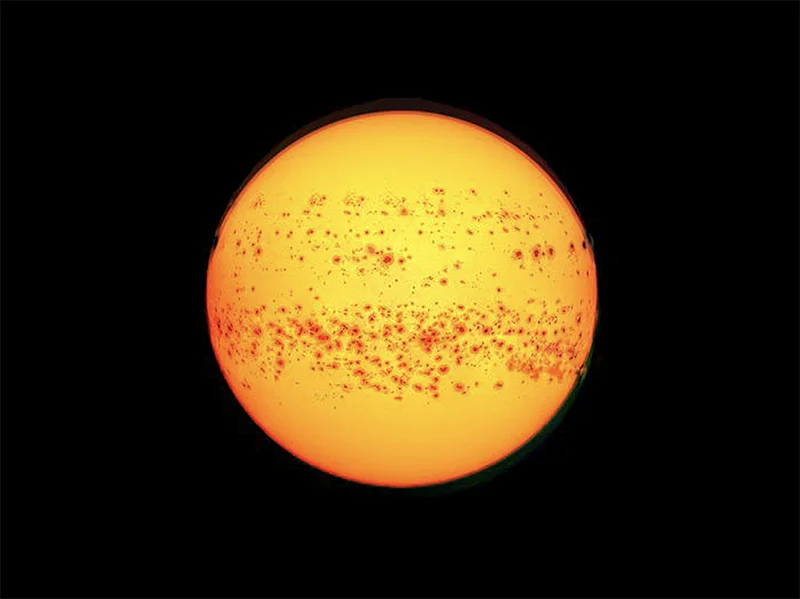
Image:
Sarah and Joseph Belknap, 12 Months of the Sun, 2024