Gold Standards: The Art of the Orotone transforms Robert Mann Gallery into a chamber of reflected light, where photography shimmers between image and object. Gathering nearly one hundred rare works, the exhibition revisits a little-known process that turns photographs into luminous artifacts. Each orotone glows from within, its surface infused with gold, creating a visual warmth that feels both intimate and theatrical. These works resist the neutrality often associated with photography, instead embracing a heightened, almost dreamlike register where reality appears gently burnished.
Emerging at the turn of the twentieth century, the orotone process reflects a moment when photographs exist as precious, handcrafted items rather than infinitely reproducible images. Thin layers of gold are applied behind the photographic emulsion, producing a radiant effect that shifts with the viewer’s movement. Popularized by figures such as Edward Curtis, these images often depict the landscapes and peoples of the American West, filtered through an aesthetic that merges documentation with myth. The resulting pictures offer not only a record of place, but also a carefully composed vision shaped by light, desire, and cultural imagination.
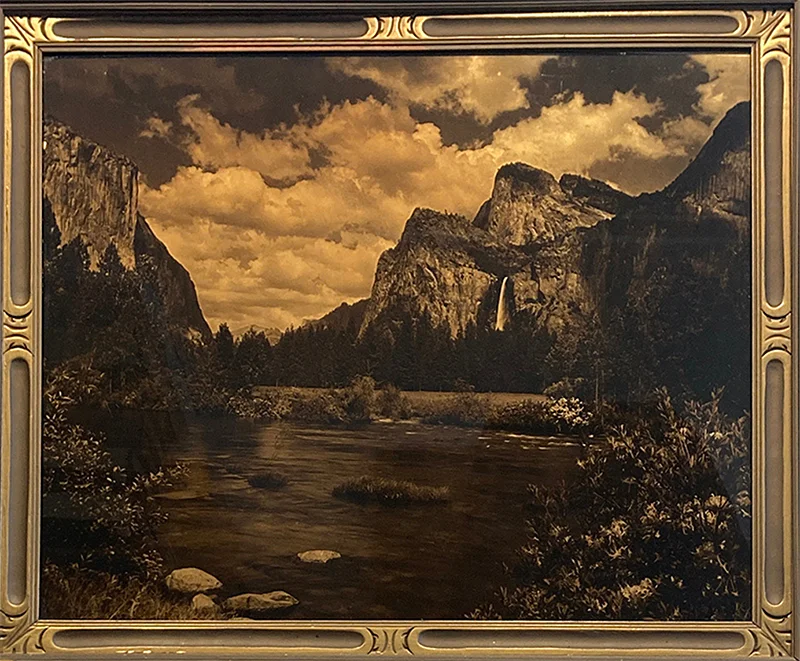
Within the exhibition, the American West appears as both real and constructed. Tourist destinations such as Yosemite become stages for a perpetual golden hour, their cliffs and waterfalls rendered with a reverence that borders on the sublime. Arthur Clarence Pillsbury’s photographs stand out for their attentiveness to natural phenomena, capturing shifting light with a near-scientific precision. Yet even these images participate in a broader visual language that frames the landscape as something to be admired, possessed, and remembered.
Gold Standards ultimately invites reflection on the meaning of value in photography. Gold, as both material and metaphor, elevates these works while also complicating their status as souvenirs. Suspended between artistry and ornament, they suggest that every image carries layers of intention—what is shown, what is omitted, and what is transformed into something enduringly radiant.
Image:
A.C. Pillsbury
The Gates of Yosemite, ca. 1900-1910
Orotone, courtesy of Robert Mann Gallery