At Artists Space in New York,
David Armstrong: Portraits offers the first comprehensive survey of a photographer whose work has long circulated at the margins of both fashion and fine art. Bringing together more than 90 images from the 1990s to the 2010s, the exhibition draws largely from vintage prints, tracing a practice shaped by intimacy, loss and a persistent rethinking of what portraiture can encompass.
Armstrong first gained recognition in late 1970s New York, photographing friends and fellow artists within a downtown scene marked by experimentation and fragility. His early black-and-white portraits, depicting figures such as Nan Goldin and Cookie Mueller, carry a quiet intensity. Composed with precision yet grounded in closeness, these images convey a sense of stillness that contrasts with the volatility of the era. Portraiture, for Armstrong, never functions as mere likeness; it becomes a way of registering emotional presence.
The devastation of the AIDS crisis marks a turning point in his work. In the late 1990s, Armstrong turns toward landscapes and still lifes, producing deliberately out-of-focus color photographs. Gardens, pathways and urban scenes appear softened, almost dissolving into light and atmosphere. Though absent of figures, these images retain a human charge, suggesting memory and absence through their diffuse forms and saturated tones.
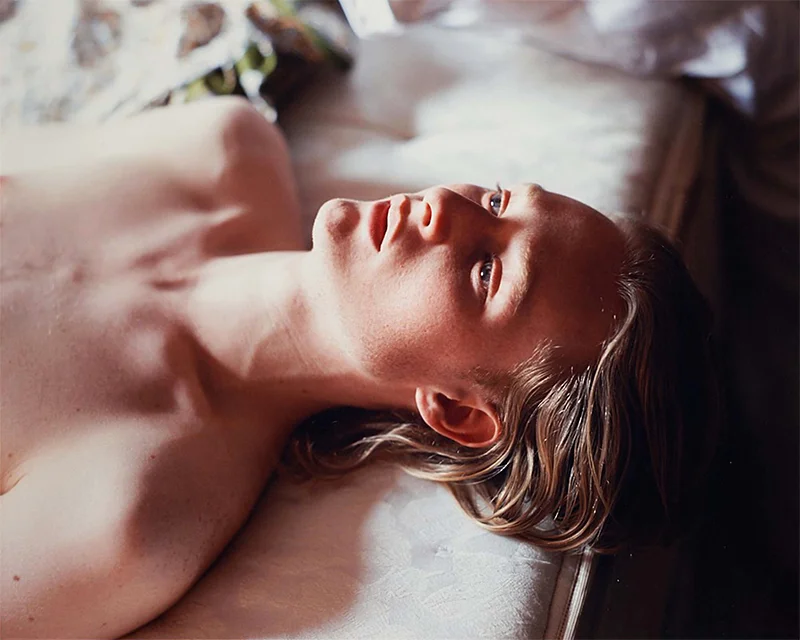
By the early 2000s, Armstrong returns to photographing people, often within the layered interiors of his Brooklyn brownstone. These portraits, frequently centered on male subjects, draw on references to Renaissance painting and Dutch still life, blending historical sensibilities with contemporary immediacy. Natural light and carefully arranged settings create scenes that resist clear temporal or spatial markers, reinforcing a sense of ambiguity.
Later experiments with digital processes extend this inquiry. Armstrong reworks his own images into composite arrangements, photographing and rephotographing them to collapse distinctions between original and reproduction. Across three decades,
Portraits reveals a sustained engagement with photography as both medium and question—an exploration of how images hold, distort or release the presence of those they depict.
Image:
David Armstrong, Koos, 2003, C-print
© David Armstrong. Courtesy of the Estate of David Armstrong
[A figure lays face up on a white mattress. His expression is languid and his hair falls over the edge of the mattress.]