Family Forms, presented in the Winter Gallery at the Tang Museum from November 15, 2025 through April 12, 2026, brings together art and archival photography to consider one of the most intimate and enduring structures of human life: the family. Drawing largely from the museum’s own holdings, the exhibition reflects on kinship, caregiving, and belonging, inviting visitors to look beyond convention and recognize the many ways people come together to create support systems and shared histories.
While the nuclear household has long dominated American cultural narratives, the works assembled here propose a broader and more nuanced understanding. Photographs by artists such as
Milton Rogovin and Mike Disfarmer capture multigenerational bonds and working-class resilience, emphasizing continuity across time. In contrast, staged and conceptual approaches by Laurie Simmons and Yinka Shonibare CBE probe the constructed nature of domestic ideals, revealing how identity, race, gender, and power shape the image of family in both subtle and overt ways.
The exhibition also highlights collaborative and collective practices. Works by For Freedoms underscore the political dimensions of care and community, while projects by Jesse Freidin foreground chosen families and LGBTQ+ kinship networks. Historical materials, including pieces by the mid-century collective PaJaMa, situate contemporary conversations within a longer lineage of artists who have reimagined domestic space as a site of experimentation and solidarity.
Curated by Corinne Moss-Racusin, Skidmore Professor of Psychology, alongside Rebecca McNamara, the Frances Young Tang ’61 Associate Curator,
Family Forms bridges scholarship and visual culture. By placing documentary images, vernacular photographs, and contemporary artworks in dialogue, the exhibition encourages reflection on how families are shaped—by choice, by circumstance, and by care—and how these evolving forms continue to define personal and collective experience.
Image:
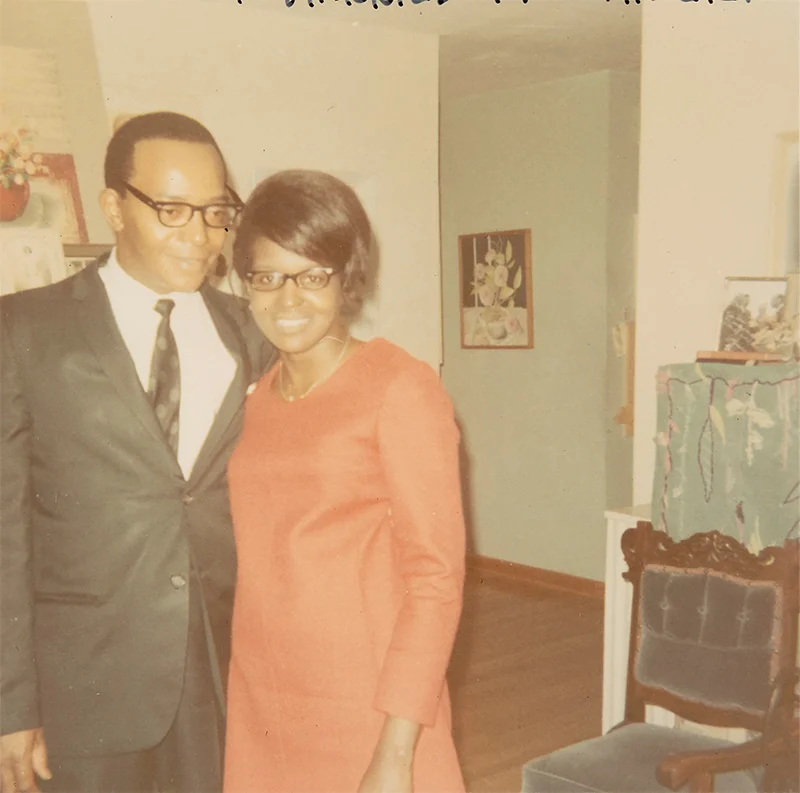
contributors: Stanley Acosta ’27, Unrecorded artist, title unknown, 1970. This photograph shows a very quiet yet powerful moment. A Black newly married couple’s closeness, matching outfits, and casual attitude draw the audience into the private moment of two people who are just about to start their lives together. The image seems to be simple, but it also gives the opportunity to think more deeply about the concepts of place and belonging. In the 1970s, towns with the name Stillwater were, for the most part, inhabited by White people and thus this couple and their home take on a greater significance. They may have faced hardships in building a stable life in a neighborhood where daily life could be determined by race or class barriers both visible and hidden. The living room is no longer just a setting; it is proof of strength, pride, and silent persistence in the struggle to create a life in an area that might have been discriminatory.
Psychological studies on social justice tell us that family life has the power to shield people from discriminatory stress, but, at the same time, social boundaries can have great influence on daily life. The couple’s love story may be one such case. Their apparent bond implies emotional stabilization and assistance while the environment (Stillwater) drives us to think about how families cope with racially segregated places and assert their right of belonging there. The photograph does not provide one unambiguous meaning, however: in what ways does this scene reflect on the interplay of love, home, and identity within the world of social inequality?