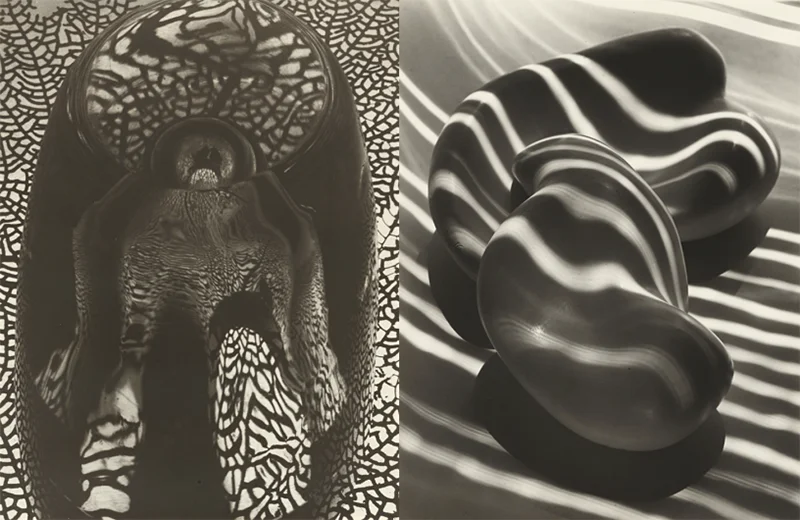
Carlotta Corpron: Light Is a Plastic Medium, presented at the Smithsonian’s Hirshhorn Museum and Sculpture Garden from February 27, 2026 to January 31, 2027, offers a long-overdue survey of a pioneering figure in American abstract photography. Spanning work produced primarily in Texas between the late 1930s and early 1950s, the exhibition traces Corpron’s sustained inquiry into light as both subject and material. Through six major bodies of work, the show reveals an artist who treated photography not as a tool of description, but as a means of shaping perception itself.
Working far from the established centers of the art world, Corpron developed a practice deeply aligned with modernist experiments in form, technology, and vision. Her photographs demonstrate an early and rigorous understanding of light as an active, malleable force—capable of defining space, dissolving objects, and creating new visual realities. Whether modulated through blinds, reflected by glass, or set into motion through camera movement, light becomes the organizing principle of her images, transforming everyday materials into dynamic abstractions.
The exhibition charts Corpron’s evolution from early
Nature Studies, where organic forms are filtered through patterned illumination, to increasingly complex investigations such as
Light Drawings and
Light Patterns, which embrace gesture, rhythm, and repetition. As her work progressed, series like
Light Follows Form and
Space Compositions expanded the dialogue between photography and sculpture, using reflection and refraction to challenge conventional notions of depth and volume. In her later
Fluid Light Designs, light itself appears liberated from any fixed source, becoming the sole subject of the image.
Featuring significant recent gifts alongside key loans,
Light Is a Plastic Medium positions Carlotta Corpron as a central contributor to the history of modern photography. The exhibition not only restores visibility to an overlooked artist, but also affirms photography’s capacity for abstraction, experimentation, and intellectual rigor. Seen today, Corpron’s work feels remarkably contemporary—rooted in modernist tradition, yet endlessly forward-looking in its vision of light as a medium without limits.
Image:
Left: Carlotta Corpron, A Figure Arose from Coral and Glass,1949. Right: Carlotta Corpron, Light Follows Form, 1945–1946. Gelatin silver photographs. Gift of Herbert Lust, 2019. Courtesy of the Hirshhorn Museum and Sculpture Garden. © Carlotta Corpron