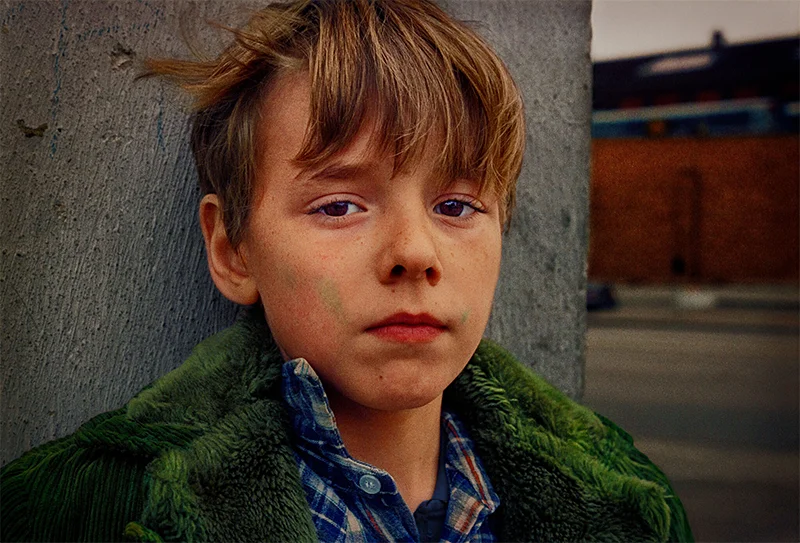
The Lost Beauty of Humankind: Robert Bergman’s Portraits in the Hill Collection brings together photography and painting to reconsider one of art’s oldest questions: who deserves to be seen. Presented at the Hill Art Foundation, this exhibition offers a rare opportunity to encounter Robert Bergman’s large-scale portraits alongside works drawn from centuries of portraiture, creating a dialogue that spans time, medium, and tradition.
Robert Bergman’s photographs, made on American streets between the mid-1980s and early 1990s, depict people encountered by chance—individuals whose lives are often overlooked or unrecorded. Rendered in rich color and close framing, these portraits possess a quiet intensity that recalls the gravity of Old Master painting. Faces emerge from dark grounds with clarity and restraint, inviting sustained attention rather than quick consumption. Each subject appears suspended outside of a specific moment, anchored instead in presence and inner life.
By placing Bergman’s work in conversation with paintings by artists such as Rubens and Bassano, as well as modern figures including Warhol and Auerbach, the exhibition reveals a shared commitment to human dignity. Across centuries, these artists approach portraiture not as idealization, but as recognition. Like earlier painters who turned to people from the margins as models for sacred or monumental works, Bergman directs his lens toward those rarely afforded the honor of being closely observed.
What distinguishes Bergman’s portraits is their insistence on engagement. The viewer is not positioned as a distant observer but as an active participant in an encounter. The subjects meet our gaze with openness, reserve, or quiet resolve, creating a charged space of empathy and reflection. These images do not offer narratives or explanations; instead, they ask for patience, humility, and attention.
The Lost Beauty of Humankind ultimately proposes that beauty is neither fashionable nor idealized, but rooted in presence, vulnerability, and shared humanity. Through Bergman’s unwavering gaze and the historical echoes surrounding it, the exhibition reminds us that portraiture can still function as a meeting point between the visible and the unseen—where recognition becomes an ethical act and looking becomes a form of care.
Image:
Robert Bergman. [untitled], 1987 Archival pigment print © Robert Bergman