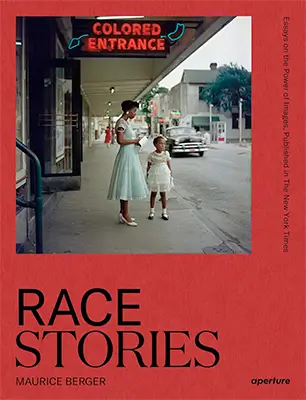
The first title in Aperture’s Vision & Justice Book Series—featuring a collection of award-winning short essays by Maurice Berger that explore the intersections of photography, race, and visual culture. Created and coedited by Drs. Sarah Lewis, Leigh Raiford, and Deborah Willis, the series reexamines and redresses historical narratives of photography, race, and justice.
Race Stories: Essays on the Power of Images examines the transformational role photography plays in shaping ideas and attitudes about race and how photographic images have been instrumental in both perpetuating and combatting racial stereotypes. Written between 2012 and 2019 and first presented as a monthly feature on the New York Times Lens blog, Berger’s incisive essays help readers see a bigger picture about race through storytelling. By directing attention to the most revealing aspects of images, Berger makes complex issues comprehensible, vivid, and engaging. The essays illuminate a range of images, issues, and events: the modern civil rights movement; African American–, Latinx–, Asian American–, and Native American photography; and pivotal moments in the nineteenth and twentieth centuries when race, photography, and visual culture intersected. They also examine the full spectrum of photographic imaging: from amateur to professional pictures, from snapshots to fine art, from mugshots to celebrated icons of photojournalism.
Race Stories collects together Berger’s reader-friendly essays in their breadth and brilliance to encourage a broad range of readers to look at and think about photographs in order to better understand themselves and the diverse world around them.
Publisher : MFA Publications, Museum of Fine Arts, Boston
2022 | 311 pages
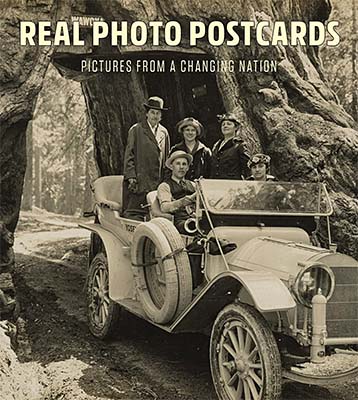
Postcards of a nation embracing a new democratic technology.
The ubiquity of photography and social media today makes it hard to imagine a time when it was not possible for ordinary people to take their own pictures and send them with short messages over long distances. But it was revolutionary when the Eastman Kodak Company, in 1903, unveiled a new postcard camera that produced a postcard-size negative that could print directly onto a blank card. Suddenly almost anyone, amateurs and entrepreneurial photographers alike, could take a picture―of neighbors at home and at work, local celebrations, newsworthy disasters, sightseeing trips―and turn it into a postcard.
This book captures this moment in the history of communications―from around 1900 to 1930―through a generous selection of what came to be known as “real photo postcards” from the extensive Leonard A. Lauder Postcard Archive. As the formality of earlier photography falls away, these postcards remind us that the past was occupied by people with distinct and individual stories, dramatic, humorous, puzzling and surprising.
After World War II, the American road trip began appearing prominently in literature, music, movies and photography. As Stephen Shore has written, "Our country is made for long trips. Since the 1940s, the dream of the road trip, and the sense of possibility and freedom that it represents, has taken its own important place within our culture." Many photographers purposefully embarked on journeys across the U.S. in order to create work, including Robert Frank, whose seminal road trip resulted in The Americans. However, he was preceded by Edward Weston, who traveled across the country taking pictures to illustrate Walt Whitman's Leaves of Grass; Henri Cartier-Bresson, whose 1947 trip through the American South and into the West was published in the early 1950s in Harper's Bazaar; and Ed Ruscha, whose road trips between Los Angeles and Oklahoma formed the basis of Twentysix Gasoline Stations. Hundreds of photographers have continued the tradition of the photographic road trip on down to the present, from Stephen Shore to Taiyo Onorato, Nico Krebs, Alec Soth and Ryan McGinley. The Open Road considers the photographic road trip as a genre in and of itself, and presents the story of photographers for whom the American road is muse. The book features David Campany's introduction to the genre and 18 chapters presented chronologically, each exploring one American road trip in depth through a portfolio of images and informative texts. This volume highlights some of the most important bodies of work made on the road, from The Americans to the present day.
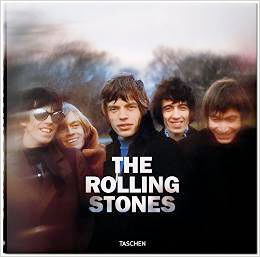
"We were lucky enough to work with some of the greatest photographers in the world who captured many magical moments of our career. This volume brings together some incredible pictures spanning the past fifty years."
Mick Jagger
In October, when we were down in Bristol for the Foundation’s BOP event, Martin, Caroline and I got together to select the edit for this new 2026 edition of Small World.
It had become almost a tradition that with every reprint of the book we would change the cover and add in a number of new photos that Martin had rediscovered or taken recently. Over the years, Martin and I made six different editions of the book – each subtly different and each with a new cover. For this edition we added in eight new images, five taken in 2025 and three earlier images. Back in Stockport over the following weeks I adjusted the sequence to accommodate these new images, sent it over to Martin for his approval and then sent it off to EBS, our printers in Italy.
SNAP COLLECTIVE presents the first book by photographer Asako Naruto, who has received numerous international awards. Through her lens, the artist explores the contours of “what is present” while
tracing the silent echoes of “what is absent.” Divided into ten chapters, the
book gathers fragments of “untold stories” that float through the streets of
Madrid, reflecting the fleeting nature of memory and the delicate fragility of
existence.
Anna Atkins: Photographer, Naturalist, Innovator offers a clear and well-documented introduction to one of the most important yet long-overlooked figures in photographic history. Corey Keller places Atkins’s cyanotypes within their scientific, technical, and social context, showing how her work contributed to the early development of photographic publishing while navigating the constraints faced by women in the nineteenth century. Concise, carefully illustrated, and accessible to non-specialists, the book provides both visual pleasure and historical insight. It is an essential reference for readers interested in early photography, photobooks, and the intersection of science and image-making.
Archipelago, a debut photobook by Yolanda del Amo, explores the tension between the inner and exterior realities of human life. Through staged tableaus featuring friends and family, Del Amo constructs moments that expose the social frameworks shaping identity, class, family, and gender. Her photographs illustrate how closeness and separation coexist within the same space and reveal the fragile balance between connection and solitude.
Photographed in London, Near Dark ventures into a mysterious territory, reflecting a less harmonious city mood, a fever dream of anxiety and unpredictability. London is just as alluring as ever but now everyone is taking shelter, keeping out of sight.
I constantly wonder where I truly belong. This series explores the psychological impact of
relocation and emigration that I have experienced throughout my life. The title is inspired by the
keyboard shortcut I frequently use when typing in Japanese, and it serves as an indirect
representation of my national background.
Agony in the Garden is the second monograph by Magnum Photographer, Lúa Ribeira, created
in her native country of Spain between 2021 to 2023 in the peripheries of Madrid, Málaga,
Granada and Almería. Inspired by the revealing potential of contemporary counter-culture,
she has collaborated with young people to make images that reflect on the alienation and
uncertainty of the present era, evoking a dystopian landscape suspended in time, one that
appears both contemporary and ancient while reflecting the signs of contemporary youth
movements and how they convey the alienation and uncertainty of the present-era
This series of black-and-white portraits depicts the people around whom Denis Dailleux grew up, between love and hate. Created when he was 25 years old and full of doubt, the project marked a turning point in the photographer’s work.
Anastasia Samoylova’s Atlantic Coast is more than a photography book—it is a journey through the evolving landscape of the United States, both literal and metaphorical. Retracing U.S. Route 1 from Key West, Florida, to Fort Kent, Maine, seventy years after Berenice Abbott first documented the road, Samoylova offers a meditation on the tensions between nostalgia and progress, myth and reality, that define the American experience.