The Vandals opens at Gladstone on 24th Street with a premise that is literary, but sharply current: what happens to art when looking turns into possession. Running from June 24 to August 8, 2026, the group exhibition brings together more than thirty artists around a question that has unsettled writers, collectors and viewers for generations.
Inspired by Edith Wharton’s
The House of the Dead Hand and Honoré de Balzac’s
The Unknown Masterpiece, the show treats the hidden artwork as a charged object, one made more powerful by distance and secrecy. In both stories, revelation carries risk. What is withheld gains intensity; what is seen can lose its force. Gladstone takes that tension seriously, bringing it into a contemporary register where display, ownership and desire remain tightly linked.
The exhibition does not approach vandalism only as destruction. It broadens the term to include a quieter form of damage: the urge to consume, explain or dominate what resists full access. That idea runs through the selection, which spans artists including Weegee, Joseph Cornell, Huguette Clark, George Platt Lynes, Robert H. Colescott,
Vivian Maier, Alex Katz,
Lee Friedlander, David Hammons, Pope.L, Celia Paul, Arthur Jafa, Mark Leckey and many others. Across generations and mediums, the works suggest that an image can be altered by attention alone.
Organized by Alissa Bennett and Julian Ehrlich,
The Vandals places the viewer in an uneasy position. The act of seeing is not presented as neutral or innocent. It becomes part of the work’s meaning, and at times part of its damage. That framing gives the exhibition its edge: art appears not as a fixed treasure behind glass, but as something alive to pressure, secrecy and the costs of exposure.
In that sense, the exhibition reads less like a survey than an argument. It asks whether some works survive best when protected from the very desire that defines their value.
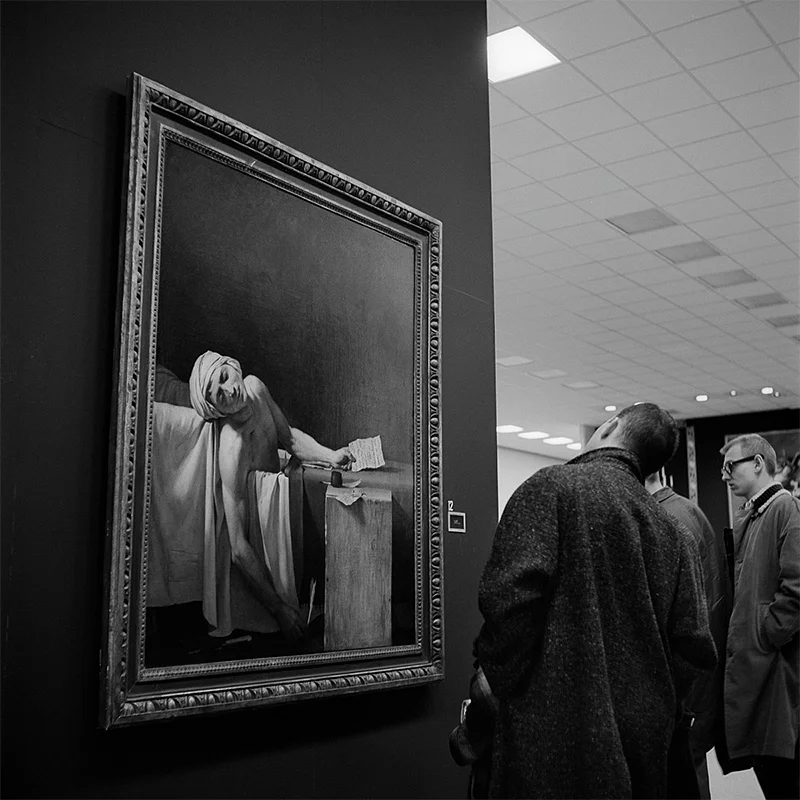
Image:
Vivian Maier, Chicago, IL, 1962
Silver gelatin print
20 x 16 inches (50.8 x 40.6 cm)