Jay Wolke’s
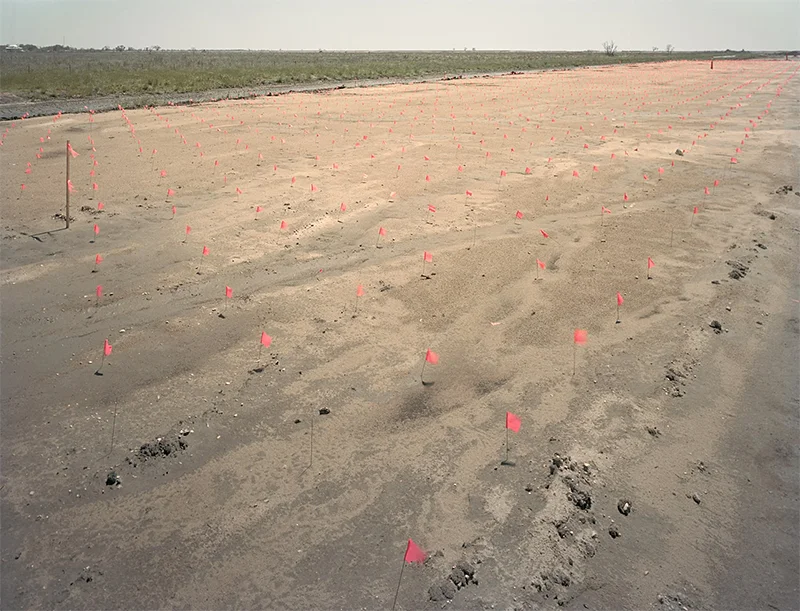
Big Boat Little Pond examines how human ambition reshapes the natural world through altered landscapes and improvised structures. On view at Blue Sky Gallery from June 4 to 27, 2026, the exhibition presents photographs that highlight the friction between nature, architecture and industrial development within the built environment. Wolke’s images focus on assemblages that emerge from institutional decisions and adaptive reuse, often leaving behind uneasy visual consequences.
The photographs reveal scenes where the natural and the constructed intersect in unexpected ways. Bodies of water, shorelines and open spaces appear modified by construction, infrastructure or temporary interventions. Wolke frames these environments to emphasize their improvised quality, showing how landscapes are continually remade through planning, neglect or necessity. The title itself suggests a mismatch between scale and setting, reinforcing the tension at the core of the work.
Wolke, based in Chicago, has built a long-term practice around documenting social and architecturalconditions in the United States and abroad. His earlier monographs include
All Around the House, which examined American-Jewish communal life,
Along the Divide on the Dan Ryan Expressway, and
Architecture of Resignation, focused on the Mezzogiorno region of Italy. His work appears in major museum collections including the Whitney Museum, MoMA, the Art Institute of Chicago and SFMOMA.
In addition to his photographic practice, Wolke has worked extensively as an educator. He earned degrees from Washington University in St. Louis and the Institute of Design at the Illinois Institute of Technology, and taught for many years at Columbia College Chicago, where he served as Chair of the Art and Design Department. His photographs have been published in
The New York Times Magazine,
Guardian Magazine,
Financial Times Magazine,
Newsweek and other outlets.
Big Boat Little Pond continues Wolke’s interest in how landscapes bear the marks of human intervention. The exhibition presents a body of work that remains observational rather than editorial, allowing the altered environments to speak for themselves through composition, scale and detail.
Image:
Trent Davis Bailey, Lilly (Picking Apricots), Paonia, Colorado, 2012 © Trent Davis Bailey