An unsettling question anchors Ruby Rumié’s exhibition
¿How are the children? at Nohra Haime Gallery, where childhood emerges not as a sentimental theme but as a measure of collective condition. Borrowed from a Maasai expression that assesses the well-being of a community through its youngest members, the title frames the work as an ethical inquiry rather than a rhetorical gesture. Here, childhood is treated as a site where social fractures, neglect and resilience become visible.
The project originates from a fragment: a newspaper clipping recounting the disappearance of children on a distant island. This minimal trace sets the tone for an investigation that resists narrative closure. Instead of reconstructing events, Rumié builds a symbolic journey. Eleven children move through a charged landscape, departing from environments shaped by pressure and instability. Their trajectory leads to Colombia’s Totumo Mud Volcano, a site long associated with both healing and unease.
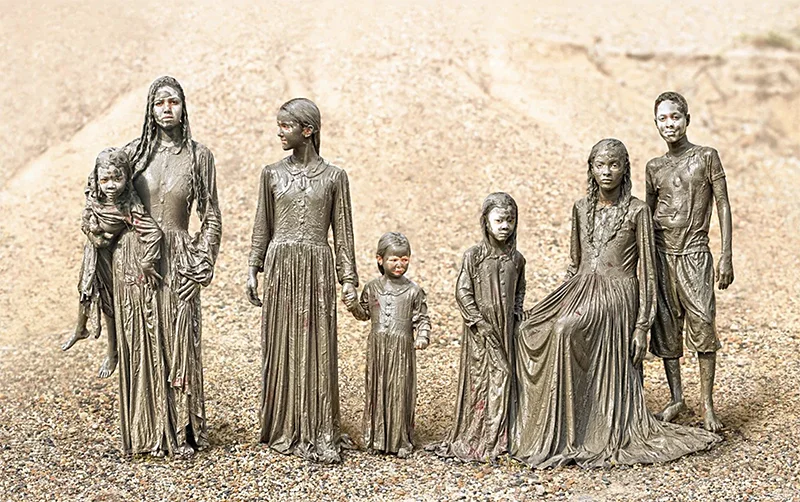
Within this setting, mud operates as both material and metaphor. Thick, enveloping and unstable, it evokes the sensation of sinking while paradoxically allowing the body to float. This suspended state becomes central to the work’s visual language. Covered in mud, the children appear stripped of social markers, their identities reduced to presence and gesture. The surface conceals and reveals at once, interrupting conventional readings of the body without aestheticizing it.
The images avoid dramatization. The children gather around the volcano, each holding a red ribbon that connects them to its summit, forming a quiet, collective structure. The volcano itself shifts from a site of threat to one of origin, a shared point from which meaning radiates outward. Rumié’s approach remains deliberately restrained, privileging stillness over spectacle.
Rather than offering resolution, the exhibition sustains a sense of tension. It positions the viewer in relation to a question that cannot be dismissed or easily answered. In doing so,
¿How are the children? reframes photography as a space of ethical attention, where looking becomes inseparable from responsibility.
Image:
Familia 1 (Family), 2025 © Ruby Rumié