At Harper’s East Hampton,
Maryam Eisler: Summer of 69 unfolds as a carefully staged meditation on glamour, memory and the visual codes of late twentieth-century leisure. The exhibition brings together a new series of photographs that draw on the imagery of the late 1960s and early 1970s, revisiting an era often framed through its surfaces—sunlit bodies, designer fabrics, and the promise of freedom—while introducing subtle disruptions beneath that sheen.
Eisler, a London-based photographer known for her exploration of femininity and representation, constructs scenes that feel both immediate and distanced. Though produced in the present, the images evoke a stylized past shaped by fashion photography and cinema. References to Emilio Pucci textiles, Palm Beach settings and European erotic film culture appear throughout, creating a visual language that oscillates between homage and reinterpretation. The compositions remain deliberate, with each prop and gesture contributing to a narrative that never fully resolves.
What distinguishes this body of work is its interplay between refinement and artifice. Scenes of apparent ease—poolside gatherings, intimate interiors, languid afternoons—are punctuated by incongruous details: discarded objects, traces of excess, or moments that suggest emotional disconnection. The juxtaposition of luxury and banality, from champagne glasses to cereal boxes, introduces a quieter commentary on consumption and desire. Figures within the images appear aware of their own visibility, caught between performance and introspection.
Eisler’s practice has often been situated within a lineage of photographers associated with images of the “good life,” yet
Summer of 69 complicates that inheritance. Rather than simply reproducing a visual ideal, the work probes its construction, asking how such images shape perceptions of beauty, identity and belonging. The result is a series that operates on multiple levels: as a sensorial evocation of a cultural moment and as a reflection on the enduring power of its myths.
In this setting, summer itself becomes less a season than a condition—one defined by light, projection and the fragile boundary between lived experience and its image.
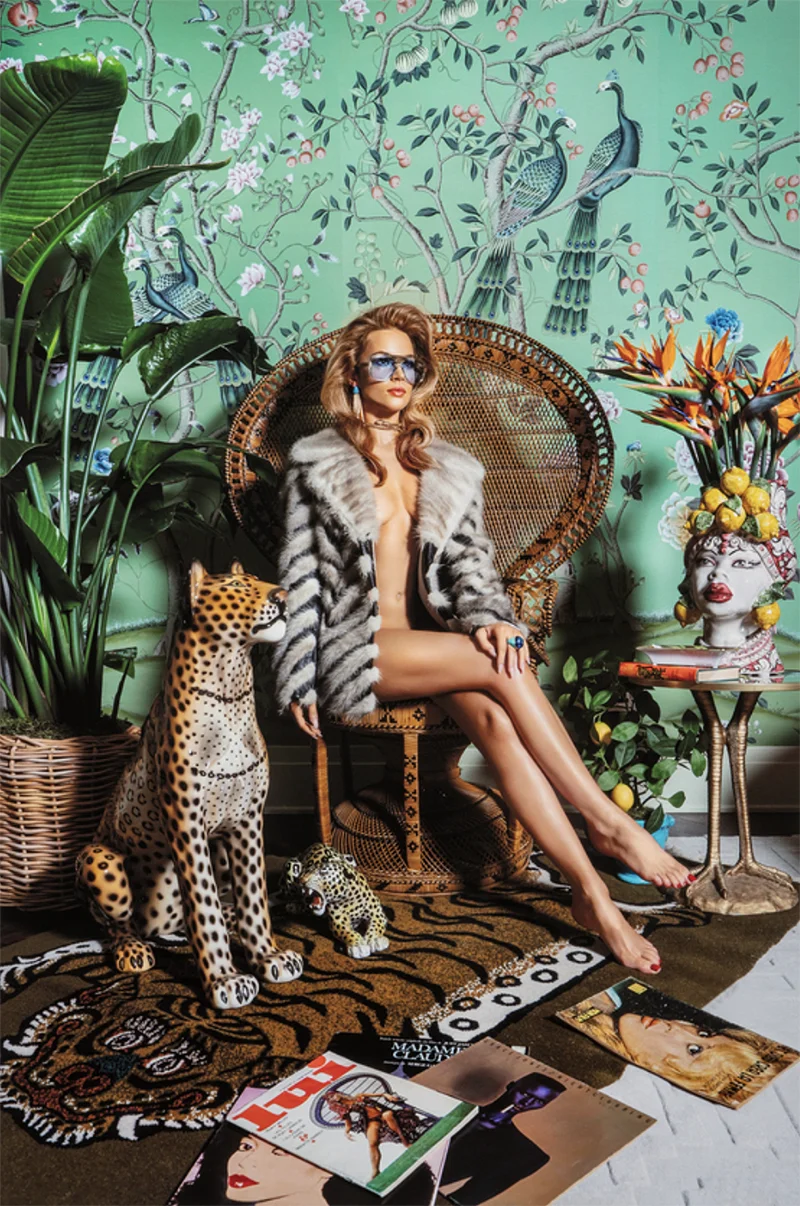
Image:
Fur, Ferns, & Feline Turns, 2026 © Maryam Eisler, courtesy of Harper’s East Hampton Gallery