At San Francisco Museum of Modern Art,
Feel the Beat: Dance in Photographs explores the charged relationship between movement and stillness through nearly a century of photographic practice. On view from May 16, 2026, to January 31, 2027, the exhibition gathers roughly eighty works drawn primarily from the museum’s permanent collection, tracing how photographers have approached dance not simply as documentation, but as a visual language of rhythm, emotion, and physical presence. Across multiple generations and continents, the exhibition asks how a single image can hold the energy of motion.
The presentation begins in the Bay Area with the work of dancer and choreographer Anna Halprin, whose experimental philosophy reshaped postwar dance by grounding movement in ordinary gestures and daily life. Her influence is reflected in a group of photographs by
Irving Penn, who captured the San Francisco Dancers' Workshop in the 1960s with a balance of discipline and spontaneity. These images reveal bodies that appear both composed and unguarded, echoing Halprin’s belief that dance could emerge from the most familiar actions. Archival materials further connect this history to SFMOMA’s own role in supporting experimental performance during the 1970s.
The second gallery expands outward, centering on
Kamaitachi (1968), the landmark collaboration between
Eikoh Hosoe and Butoh founder Tatsumi Hijikata. Set in the rural Japanese landscape of their childhood, the series transforms the countryside into a surreal stage where movement feels mythic and unsettling. Alongside works by
Imogen Cunningham,
Richard Avedon, and others, this section reveals how photography helped define the visual identity of twentieth-century dance across cultures.
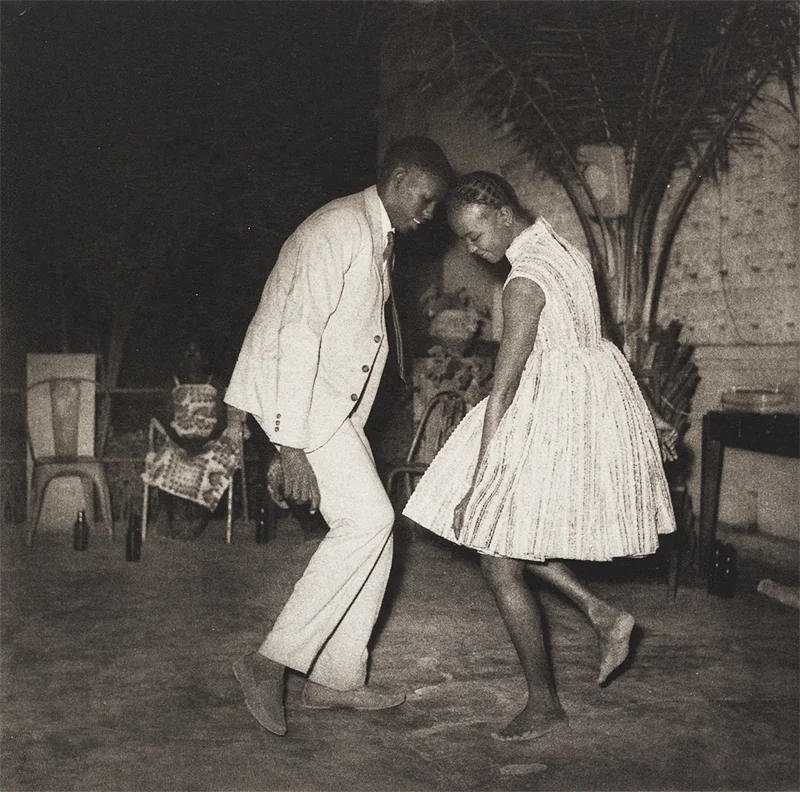
The final gallery shifts from formal performance to the social dance floor, anchored by Malick Sidibé’s celebrated
Mali Twist. His photographs of youth culture in 1960s Bamako capture the joy and freedom of music as a shared social force. In dialogue with works by
Nan Goldin and others, these images affirm dance as a space of intimacy, rebellion, and collective expression. At SFMOMA,
Feel the Beat reveals photography not as an observer of dance, but as an active participant in its rhythm and memory.
Image:
Malick Sidibé, Nuit de Noël (Happy-Club), from the portfolio Mali Twist, 1963, printed 2014; collection SFMOMA, gift of Stefan Kirkeby; © Estate of Malick Sidibé, courtesy the family of Malick Sidibé and Jack Shainman Gallery, New York