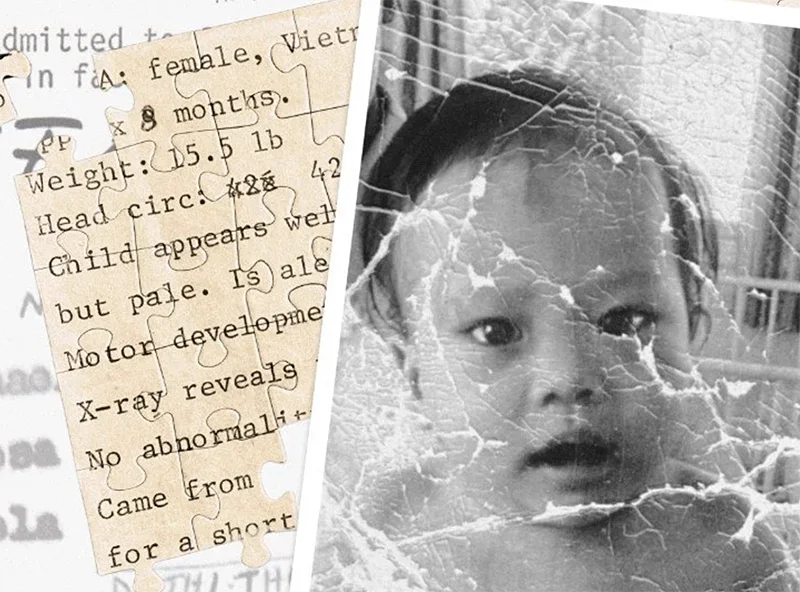
Devaki Murch: My Name Is Mimosa unfolds as both an intimate excavation and a collective act of remembrance. Presented at East Window gallery from April 4 to 25, 2026, the exhibition traces a life shaped not by family albums or official documents, but by fragments of public record and historical rupture. The date of April 4, 1975 echoes throughout the work, marking the tragic crash of the first evacuation flight of Operation Babylift, a moment suspended between loss and survival. From this event emerges a voice that has taken decades to fully form, now expressed through a careful weaving of image, text, and recovered memory.
Murch’s practice navigates the unstable terrain between personal history and institutional archives. Newspaper clippings, flight manifests, and bureaucratic traces become visual anchors, yet they never settle into certainty. Instead, they flicker with absence, suggesting the many lives and identities left undocumented or misrecorded. In this space of ambiguity, Murch positions herself not only as a subject but also as a custodian, reassembling narratives that were once scattered across continents and systems. Her work invites viewers to consider how identity is constructed when origins remain obscured or mediated by external forces.
Beyond autobiography, the exhibition resonates as a broader call to reconnect a dispersed community. Through research and participatory storytelling, Murch extends her inquiry outward, creating encounters that bridge individual memory and shared experience. The materials on display do not merely recount the past; they activate it, allowing stories to circulate מחדש among those who carry similar histories. The exhibition becomes a living archive, one that acknowledges both the fragility and resilience of memory.
Situated between artistic expression and ethical responsibility, Murch’s work reflects a sustained engagement with the politics of care, representation, and historical accountability.
My Name Is Mimosa stands as a testament to the enduring power of storytelling when silence finally gives way to articulation, and when the act of looking back becomes a way of moving forward.
Image:
© Devaki Murch