University Foundation Arts Building - 1664 N. Virginia Street
Home Truth: Image-making in absence, presented at the Lilley Museum of Art from January 27 to May 23, 2026, brings together three interconnected bodies of work by Steven Seidenberg that examine what remains when people move on. Across Italy, Japan, and the margins of contemporary Europe, Seidenberg turns his attention to overlooked environments shaped by economic rupture, migration, and quiet abandonment. His photographs do not seek spectacle; instead, they linger on the material traces of lives once embedded in these places, inviting viewers to read absence as a form of presence.
Central to the exhibition is
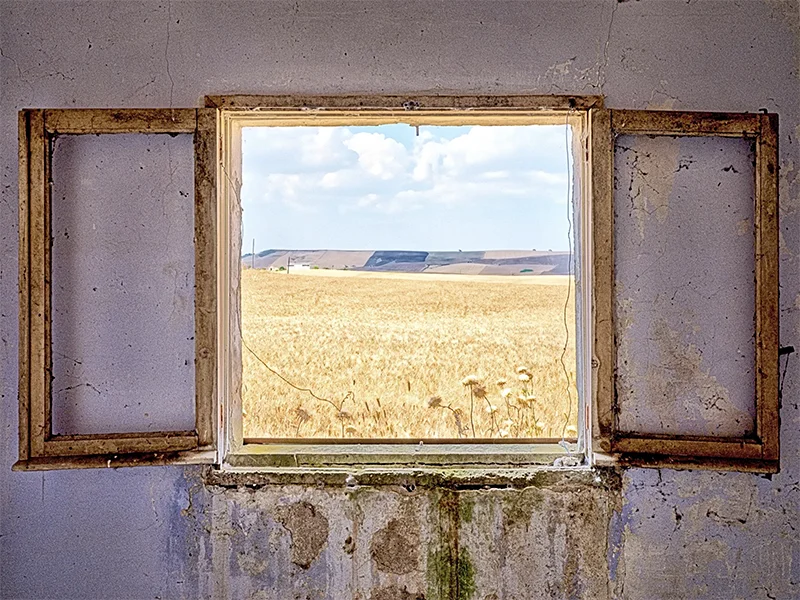
The Architecture of Silence, a series rooted in the remnants of Italy’s postwar land reform initiative. Scattered across the agricultural regions of Basilicata and Puglia, concrete farmhouses and infrastructure stand isolated in fields now shaped by machines rather than families. Seidenberg’s images approach these structures with restraint and sensitivity, allowing light, weather, and framing to reveal their fragile dignity. The photographs move beyond documentation, transforming political failure into a visual meditation on displacement, unrealized promises, and the human cost of systemic planning without sustainability.
The exhibition expands outward to other geographies shaped by transience. In Rome, Seidenberg observes the impermanent architecture of a migrant tent city, capturing provisional shelters that speak to resilience under constraint. In
Kanazawa Vacancy, he turns to Japan’s growing landscape of akiya and akichi—vacant homes and empty lots embedded within long-established neighborhoods. These quiet voids interrupt the urban fabric, revealing a city slowly hollowed by demographic change, yet still rich with architectural memory and cultural continuity.
Throughout
Home Truth, Seidenberg’s photographs resist easy narratives of decay or nostalgia. Instead, they ask how space absorbs human movement and how landscapes remember what societies forget. By focusing on structures shaped by absence, the work proposes a slower, more attentive way of seeing—one that acknowledges loss while honoring the subtle beauty found in what remains.
Image:
© Steven Seidenberg