All about photo.com: photo contests, photography exhibitions, galleries, photographers, books, schools and venues.
FINAL CALL TO ENTER AAP MAGAZINE B&W: PUBLICATION AND $1,000 CASH PRIZES

Big Tent

From May 29, 2026 to August 22, 2026
Share
Big Tent
228 East Liberty Street
Cincinnati, OH 45202
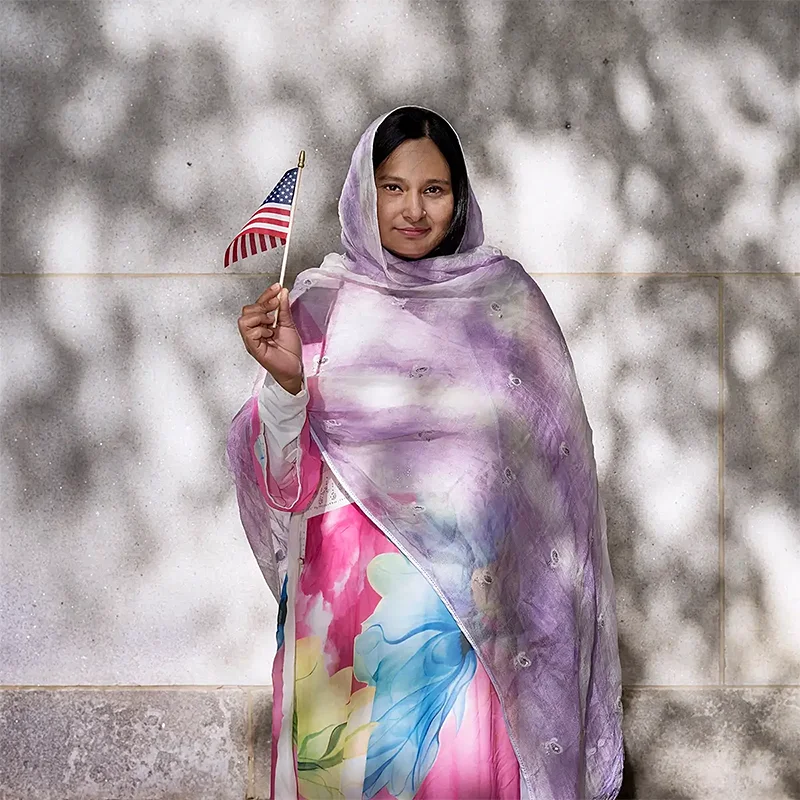
Big Tent, on view from May 29 through August 22, 2026, inaugurates the new FotoFocus Center in Cincinnati’s Mount Auburn neighborhood. Conceived as a 14,700 square foot hub dedicated to photography and year-round public programming, the Center opens its doors with an ambitious group exhibition that considers the condition of American democracy and the enduring role of the photographic image in shaping civic consciousness. Bringing together more than fifty artists, the exhibition unfolds as both a celebration and a sober reflection on national life.

Taking inspiration from Amanda Gorman’s poem In This Place (An American Lyric), Big Tent borrows a political metaphor associated with broad coalitions and competing viewpoints. Rather than proposing a single thesis, the exhibition embraces plurality. Documentary images, intimate portraits, conceptual interventions, and formally rigorous studies hang in productive tension. Across decades of practice, the works trace how photographers have grappled with questions of belonging, protest, labor, race, gender, and freedom—core elements of the democratic experiment.

The roster spans generations, pairing historical figures such as Robert Frank and Paul Strand with contemporary voices including Dawoud Bey, Catherine Opie, Trevor Paglen, An-My Lê, Sheila Pree Bright, Alec Soth, Robert Mapplethorpe, Judy Dater, and Elliott Jerome Brown JR. Together, their images reveal the friction and vitality inherent in a society built on ideals that are continually contested and reimagined.

Designed by JOSE GARCIA DESIGN + CONSTRUCTION, the Center itself reflects photography’s language: gridded forms recall a viewfinder, shifting materials echo tonal gradations, and generous windows flood public spaces with light. In this purpose-built setting, Big Tent sets the course for FotoFocus’s future—affirming photography as both witness and participant in democratic life, capable of illuminating contradictions while sustaining dialogue across difference.

Image: First American Portrait: Rogina, Bangladesh 2018 © Marco Anelli

Our printed edition showcases the winners of AAP Magazine call of entries
All About Photo Magazine
Issue #56
Stay up-to-date  with call for entries, deadlines and other news about exhibitions, galleries, publications, & special events.

Exhibitions Closing Soon

Jakian Parks: The Black Land
Oklahoma Contemporary Arts Center | Oklahoma City, OK
From November 06, 2025 to June 01, 2026
The Black Land unfolds as a layered meditation on memory, inheritance, and the enduring strength of Black equestrian culture in Oklahoma. Drawing upon a long arc of history, the exhibition traces a path from the hardships of captivity to the powerful expressions of independence embedded in today’s Black rodeo communities. The images presented form a living continuum, where past and present meet on the open terrain of the American West, a place that becomes both repository and stage for stories too often overlooked. In this narrative, the land itself becomes a vital character. It carries the weight of ancestral labor, the resilience of sharecropping families, and the complicated struggle for sovereignty that has shaped African American life for generations. Yet it also holds a legacy of knowledge—farming, herding, and healing practices sustained across centuries. Within the photographs, subtle gestures and visual rhythms hint at voices from earlier eras, guiding contemporary riders and ranchers toward deeper understanding of their connection to the earth. Rituals, blending African and Christian traditions, move quietly through the scenes, offering pathways toward restoration. These customs reinforce a sense of belonging that counters historical erasure and affirms community strength. The works in The Black Land challenge reductive narratives, presenting subjects not as symbols but as fully present individuals grounded in purpose and identity. Through Jakian Parks’s lens, riders, caretakers, and families are depicted with agency and reverence. Their presence marks a reclamation of heritage: a return to the soil that once constrained them, now transformed into a space of pride, fellowship, and cultural affirmation. Parks’s approach—deeply rooted in portraiture and community storytelling—builds an archive of continuity and remembrance, celebrating the beauty, resilience, and significance of Black equestrian life as a living tradition that carries forward with dignity and unwavering spirit. Image: Jakian Parks, Porch Principals, 2025. Digital photograph. © Jakian Parks
Glue Traps
Baxter Street | New York, NY
From April 16, 2026 to June 03, 2026
Glue Traps presents Spencer Vazquez’s first solo exhibition as a tactile meditation on grief, family, and the unstable life of photographs. At BAXTER ST, the artist treats images not as fixed records but as vulnerable objects that age, crack, shift, and absorb the traces of daily life. The exhibition gathers tape transfers, scans, family photographs, and digital fragments into a body of work that feels at once intimate and materially restless. Vazquez’s process grows from a personal archive shaped by his late father, a housepainter, and by the sheer abundance of images left behind in prints, negatives, and files. Rather than separating nostalgia from experimentation, he lets them coexist. His tape transfer method, revisited after first learning it in high school, turns a humble craft material into a vehicle for memory. The resulting surfaces carry a reversed image, a visible labor, and a sense of fragility that echoes the unstable way personal histories are preserved. Several works also draw from the artist’s phone, scanned directly onto a flatbed surface so that screen time becomes physical matter. The phone’s pixels, motion, and refresh rates leave behind moiré patterns, bands, and distortions, translating the digital image into something uneven and bodily. In these works, technology does not erase touch; it reveals another kind of touch, one shaped by repetition, friction, and delay. Blue painter’s tape, borrowed from the visual world of his father’s trade, threads through the exhibition as both material and metaphor. It links housework to image-making, ordinary labor to mourning, and repair to residue. Glue Traps holds all of this in tension: the photographs act as keepsakes and artifacts, but also as things still becoming, still vulnerable to time. Vazquez gives form to an archive of love and loss, where pixels, dust, hair, and memory remain inseparable. Image: © Spencer Vazquez
Hannah Smith Allen: On Broken Ground
Baxter Street | New York, NY
From April 16, 2026 to June 03, 2026
Hannah Smith Allen: On Broken Ground takes the border landscape as both subject and system, showing how territory can be shaped as much by images and interfaces as by fences and roads. At BAXTER ST, Allen assembles photographs, collages, screen prints, a video installation, and the accordion book Borderlands into a layered investigation of the U.S.-Mexico border, where physical division meets digital distortion and national myth. The work begins with the landscape, but it never stays there for long; it moves into the codes, glitches, and projections that help define how the border is seen and imagined. Allen’s project grows out of close attention to Google Earth, where she noticed software glitches that made the border wall seem fractured, opened, or unstable. Those visual errors became a starting point for a broader body of work rooted in direct visits to the borderlands. In her images, the desert carries a charged stillness, while the wall appears less like a permanent solution than a brittle surface under pressure. Concrete, steel, sky, and scrub are rendered with precision, yet each frame suggests that the landscape also contains interruption, doubt, and rupture. The exhibition deepens that tension through collage. By combining original photographs with screen prints, Allen echoes the segmented logic of the border wall itself, turning fragmentation into both form and meaning. New works also place the desert in conversation with imagery from military spectacle, underscoring the distance between ceremonial power and the quiet endurance of the land. In Dream States, stop-motion sequences derived from Google Earth add another register, projecting an unsettled border into newspaper clippings and target stands. Across these works, Allen treats the border not as a fixed line but as a contested space where history, infrastructure, and imagination collide. Her images do not resolve that conflict; they hold it in suspension, asking how borders are built, how they fray, and how looking itself can reveal their instability. Image: © Hannah Smith Allen
Lynn Adler: And So We Moved To Petaca
Obscura Gallery | Santa Fe, NM
From May 08, 2026 to June 06, 2026
Lynn Adler: And So We Moved To Petaca, on view from May 8 through June 6, 2026 at Obscura Gallery, presents a remarkable photographic record of a brief yet meaningful cultural convergence in northern New Mexico. Featuring images made by Lynn Adler between 1970 and 1974, the exhibition accompanies the release of her recent book and offers an intimate look at a rural community undergoing subtle but profound change. Adler arrived in the small village of Petaca at a moment when its long-established Hispano population encountered an influx of newcomers seeking an alternative way of life. Rooted in traditions that stretched back generations, the local community lived with modest means, sustained by agriculture, faith, and close family ties. Into this environment came young families from urban centers such as San Francisco and New York City, drawn by the promise of self-sufficiency and a deeper connection to land and community. Using a simple 35mm camera, Adler documented daily life with clarity and sensitivity. Her black-and-white photographs reveal scenes of labor and routine: tending animals, cultivating fields, building homes, and raising children. At the same time, her images capture moments of encounter between cultures—shared gestures, cautious interactions, and evolving relationships that reflect both curiosity and tension. Rather than imposing a narrative, Adler allows these moments to unfold naturally, creating a nuanced portrait of coexistence. The modest scale of the prints reinforces their intimacy, encouraging close viewing and quiet reflection. Faces, gestures, and landscapes emerge with a sense of immediacy, preserving a way of life that might otherwise have faded from memory. Over time, the village has changed, and many of those pictured have passed on, giving the photographs an added resonance as documents of both presence and absence. Curated by Bill Shapiro, the exhibition situates Adler’s work within a broader tradition of documentary photography while highlighting its singular perspective. And So We Moved To Petaca stands as a testament to the enduring power of photography to record fragile histories and to illuminate the complexities of community, identity, and belonging. Image: Lynn Adler. Louella at Sundown, 1971 © Lynn Adler
Robert Giard: Particular Voices, Portraits of LGBTQ+ Writers & Artists, 1985 - 2002
Daniel Cooney Fine Art | Santa Fe, NM
From May 09, 2026 to June 06, 2026
Robert Giard: Particular Voices, Portraits of LGBTQ+ Writers & Artists, 1985–2002, on view from May 9 to June 6, 2026 at Daniel Cooney Fine Art, brings renewed attention to a landmark photographic project that documented a vital chapter in cultural history. Presented in conjunction with the Santa Fe International Literary Festival, the exhibition gathers approximately 40 portraits selected from Giard’s extensive archive, offering a focused view into a much larger body of work created over nearly two decades. Beginning in 1985, Giard embarked on an ambitious effort to photograph LGBTQ+ writers, artists, and activists across the United States. The project emerged at a pivotal moment, shaped by both the aftermath of the Stonewall era and the unfolding AIDS crisis. Rather than approaching his subjects as distant figures, Giard sought to create images grounded in respect and presence. His portraits often situate individuals in environments that reflect their personal or creative lives, allowing each image to function as both representation and conversation. The exhibition highlights figures whose contributions have shaped literary and artistic discourse, while also emphasizing voices that have historically remained underrecognized. Writers such as Margaret Randall, Judy Grahn, and Gloria Anzaldúa appear within a broader constellation of cultural producers whose work expanded the boundaries of identity, language, and community. Giard’s photographs do not impose a singular narrative; instead, they reveal a diverse and evolving network of individuals connected through shared experience and creative expression. Visually, the portraits are marked by clarity and restraint. Giard avoids theatricality, favoring a direct approach that allows subtle gestures and expressions to carry meaning. This consistency across the series underscores his commitment to the project’s documentary dimension, while also acknowledging the individuality of each sitter. The cumulative effect is one of quiet intensity, where the weight of history is conveyed through personal presence rather than overt symbolism. More than a retrospective selection, Particular Voices stands as an enduring record of a community that navigated profound social and political challenges while continuing to produce influential work. In revisiting these images today, the exhibition underscores the importance of visibility and the role of photography in preserving cultural memory across generations. Image: Robert Giard Alison Bechdel, Grand Isle, VT, 1995 Gelatin silver print © Robert Giard, courtesy of Daniel Cooney | Fine Art
Sebastiaan Bremer: Super Modern Things
Edwynn Houk Gallery | New York, NY
From April 16, 2026 to June 06, 2026
Sebastiaan Bremer: Super Modern Things, on view from April 16 to June 6, 2026 at Edwynn Houk Gallery, presents a new body of work that continues the artist’s distinctive dialogue between photography and painting. Known for his meticulous interventions on photographic surfaces, Bremer revisits the still life tradition, using it as a framework to examine enduring questions around beauty, time, and cultural value. The works originate from historical imagery, often drawn from seventeenth-century Dutch botanical catalogues and still life paintings. These sources, already dense with symbolic meaning, are rephotographed by Bremer, who then transforms them through a labor-intensive process of drawing and painting directly onto the surface. Layers of ink and acrylic—dots, lines, and fluid marks—accumulate across the image, creating a visual rhythm that both obscures and reveals. The result is neither purely photographic nor painterly, but a hybrid form that unfolds gradually, inviting prolonged attention. Bremer’s engagement with the Dutch still life tradition brings forward its historical associations with trade, colonial expansion, and the commodification of nature. Flowers, once emblematic of wealth and mortality, are recontextualized here within contemporary concerns about ecology and global exchange. The works suggest that the symbolic language embedded in these images remains active, raising questions about how beauty operates within systems of power and consumption. In this sense, the exhibition bridges past and present, linking early modern visual culture to current debates. At the same time, the artist’s process introduces a deeply personal dimension. Each mark functions as a trace of time and attention, transforming the image into a record of sustained looking. The surfaces carry a sense of intimacy, as if the act of embellishment becomes a form of meditation or annotation. References to language, musical notation, or even celestial patterns emerge through these interventions, expanding the interpretive possibilities of the work beyond its original source material. With Super Modern Things, Bremer offers a contemplative reconsideration of the still life, positioning it not as a static genre but as a living field of inquiry. The exhibition underscores how historical images continue to resonate, shaped by contemporary perspectives and the artist’s own evolving relationship to time, memory, and visual meaning. Image: Cunning stunts, 2025. Unique hand-painted chromogenic print with mixed media © Sebastiaan Bremer
Mao Ishikawa: ROGUE
Alison Bradley Projects | New York, NY
From April 16, 2026 to June 06, 2026
Mao Ishikawa: ROGUE, presented at Alison Bradley Projects from April 16 to June 6, 2026, brings the work of the Okinawan photographer to a United States audience in her first solo exhibition in the country. Gathering more than 30 vintage prints spanning three decades, the exhibition offers a focused look at a practice shaped by proximity, trust, and an unflinching engagement with lived experience. Ishikawa’s photographs emerge from a deeply personal approach that rejects distance between photographer and subject. Her early series Red Flower (Akabanaa), produced in the years following Okinawa’s reversion to Japan in 1972, captures the social environments surrounding U.S. military bases. Rather than observing from the outside, Ishikawa immersed herself in these communities, working alongside women employed in bars and documenting their relationships with African American servicemen. The resulting images convey a sense of immediacy and shared presence, where intimacy and complexity replace simplified narratives of occupation. This relational method continues in Life in Philly, created during her time in Philadelphia. There, Ishikawa photographs the everyday lives of people connected to her earlier experiences in Okinawa, tracing bonds that extend across geography. Scenes of domestic life, gatherings, and quiet moments reveal a continuity of connection shaped by migration and memory. In A Port Town Elegy, her attention returns to Okinawa, focusing on laborers and marginal communities in Naha. These photographs highlight both the precarity of their conditions and the resilience found within shared spaces. Later works, including My Family, shift inward. Following significant medical procedures, Ishikawa turns the camera on herself, producing self-portraits that maintain the same directness present in her earlier work. The body becomes both subject and site, confronting vulnerability without mediation. Across all series, her images resist categorization, moving between documentation and personal narrative while remaining grounded in long-term relationships. Presented alongside her inclusion in the Whitney Biennial, ROGUE underscores Ishikawa’s enduring relevance. Her work offers a perspective rooted in Okinawa’s complex geopolitical reality, while speaking more broadly to themes of identity, power, and human connection that continue to resonate across borders. Image: © Mao Ishikawa. Courtesy of the artist and Alison Bradley Projects
Bruce Weber: Try a Little Tenderness
Fahey/Klein Gallery | Los Angeles, CA
From April 09, 2026 to June 06, 2026
Bruce Weber: Try a Little Tenderness, on view from April 9 through June 6, 2026 at Fahey/Klein Gallery, unfolds as an intimate reflection on the formation of an artist. Bringing together photographs produced across several decades, the exhibition reveals how personal relationships, early experiences, and creative encounters shape the visual language of Bruce Weber. Rather than presenting a chronological survey, the selection moves through moments of influence and memory, offering a portrait of artistic growth rooted in lived experience. Weber’s early years in Greensburg play a defining role in this narrative. Introduced to image-making through family life, he experiments with drawing and filmmaking before receiving his first camera, an Argus C3, at a young age. His later studies at New York University and his encounter with influential figures such as Diane Arbus and Lisette Model deepen his commitment to a photography grounded in emotional immediacy and human connection. By the late 1970s, Bruce Weber establishes a distinctive voice within fashion photography, collaborating with major houses such as Calvin Klein and Ralph Lauren. His images, often bathed in natural light and infused with a sense of nostalgia, depart from the rigid aesthetics of the era. Instead, they evoke a cinematic atmosphere where youth, beauty, and vulnerability coexist. Whether working for magazines or advertising campaigns, Weber maintains a consistent sensitivity to gesture and presence, allowing his subjects to appear both staged and spontaneous. The exhibition also reflects Weber’s engagement with film, notably through Let’s Get Lost, his portrait of jazz musician Chet Baker. This cross-disciplinary practice reinforces the narrative quality of his photography, where each image suggests a fragment of a larger story. His work moves fluidly between commercial and personal contexts, blurring the boundaries between assignment and expression. Accompanying the exhibition, the publication Bruce Weber: My Education gathers images and reflections that echo the themes presented in the gallery. Together, they form a meditation on influence, memory, and the enduring role of tenderness in shaping an artistic vision. Image: Bruce Weber | Kate Moss and friends, Miami, Florida, 2003 © Bruce Weber, courtesy of FaheyKlein Gallery, Los Angeles
Ruth Thorne-Thomsen
Gitterman Gallery | New York, NY
From April 14, 2026 to June 06, 2026
Ruth Thorne-Thomsen, on view at Gitterman Gallery from April 14 through June 6, presents a focused selection of vintage gelatin silver prints that trace the singular vision of an artist who moved fluidly between photography, mythology, and psychological inquiry. Spanning several key series, the exhibition offers a rare opportunity to encounter work that resists straightforward categorization, instead inviting viewers into carefully constructed worlds where reality and imagination converge. Thorne-Thomsen’s practice centers on staging images within landscapes, then rephotographing them to produce seamless, often disorienting compositions. Using techniques such as pinhole apertures and handmade setups, she blurs distinctions between foreground and background, object and environment. The resulting photographs carry a dreamlike coherence, where symbolic elements—figures, stones, water, fragments of architecture—appear suspended in spaces that feel both ancient and internal. Several series included in the exhibition highlight the breadth of her approach. Expeditions draws on the visual language of early archaeological photography, evoking the wonder associated with nineteenth-century encounters with distant civilizations. In Views from the Shoreline, the influence of Renaissance portraiture becomes apparent, though reinterpreted through a surreal lens that compresses space and shifts meaning toward the psychological. Other bodies of work, such as Songs of the Sea and Proverbs, deepen her engagement with myth, combining narrative suggestion with introspective symbolism. Underlying these varied explorations is a consistent interest in the human psyche. Thorne-Thomsen often returns to recurring motifs—particularly the head and the figure—as vessels for universal experience. Her imagery suggests that personal memory and collective mythology remain intertwined, forming a visual language that speaks across time and culture. This sensibility reflects her broader engagement with literature, dream analysis, and symbolic systems. Though her work resides in major museum collections, it has often remained less visible within broader photographic discourse. This exhibition underscores its enduring relevance, presenting an artist who approaches photography not as documentation, but as a means of constructing inner landscapes—spaces where perception, memory, and imagination quietly intersect. Image: Levitating Man, Wisconsin, 1983 © Ruth Thorne-Thomsen, courtesy of the Gitterman Gallery
Robert Maxwell: Visionary
Southeast Museum of Photography | Daytona Beach, FL
From April 22, 2026 to June 06, 2026
At the Southeast Museum of Photography, Robert Maxwell: Visionary assembles more than a hundred images tracing a career shaped by careful observation and a sustained interest in the human figure. The exhibition moves between early work produced in Paris and later commissions for international publications, outlining a trajectory that shifts from intimate, personal studies to highly controlled portraiture associated with the worlds of fashion and culture. Maxwell’s early photographs, many rooted in his immediate surroundings, establish a visual language grounded in restraint. Still life compositions occupy a central place here. In works such as Forêt de Champignons, a cluster of enoki mushrooms appears almost architectural, arranged against a dark field that emphasizes their pale, sculptural surfaces. Across these images, everyday materials—flowers, utensils, organic fragments—are reorganized into precise arrangements where light defines volume and texture. The result sits somewhere between observation and construction, where natural forms take on an almost symbolic charge. Portraiture, however, remains the axis of Maxwell’s practice. The exhibition highlights both early figurative studies and more recent series, including images of women dressed in traditional Japanese kimonos. These photographs focus less on costume as spectacle than on the ritual embedded in its preparation. The layered process of dressing becomes visible through posture, gesture and gaze, with each subject asserting a distinct presence. Maxwell’s approach avoids overt dramatization, relying instead on stillness and attention to detail to convey individuality. Alongside these bodies of work, Visionary includes a wide selection of editorial assignments produced for titles such as Vogue, Vanity Fair and GQ. These commissions, often centered on prominent cultural figures, reveal Maxwell’s ability to navigate between artistic intent and the demands of publication. Seen together, the images suggest a consistent preoccupation: how light, surface and expression can be arranged to construct a lasting image, whether in the studio or on assignment. Image: Forêt de Champignons © Robert Maxwell
Daniel Gordon: Objects at Hand
Olney Gleason | New York, NY
From May 07, 2026 to June 06, 2026
Objects at Hand, on view at Olney Gleason from May 7 through June 6, 2026, presents a new body of photographs by Daniel Gordon that further complicates the relationship between image, object, and illusion. Known for transforming printed source material into handmade sculptural constructions before photographing them, Gordon has spent the last two decades dismantling photography’s claim to realism. In this latest exhibition, however, the artist moves into notably restrained territory, abandoning the vivid color palette that has long defined his work in favor of black-and-white compositions focused on light, shadow, and surface. The exhibition coincides with the release of Gordon’s fifth monograph and arrives at a moment of increasing institutional recognition, including his inclusion in the Guggenheim Museum’s upcoming exhibition Guggenheim Pop: 1960 to Now. Yet rather than expanding outward, Objects at Hand turns inward, concentrating on ordinary domestic items—glasses, scissors, combs, kitchen utensils, and stationery—arranged in tightly framed still lifes that recall the precision of early modernist photography. Gordon’s process remains deliberately transparent. Images sourced online or photographed by the artist himself are printed, cut apart, folded, glued, and reconstructed into fragile three-dimensional objects. Seams, tape marks, and torn edges remain visible, emphasizing the handmade quality of the constructions. Once photographed, however, these imperfect paper assemblages take on an uncanny visual coherence. Some objects appear translucent despite being entirely opaque in reality, creating subtle perceptual contradictions that destabilize the viewer’s trust in the image. The resulting photographs engage a broad lineage of photographic experimentation, echoing the sculptural still lifes of Edward Weston, the surreal arrangements of Man Ray, and the perceptual investigations of artists such as Barbara Kasten and Jan Groover. Yet Gordon’s work remains distinctly contemporary in its negotiation between digital imagery and physical craft. The photographs originate in screens and printers, but arrive as carefully staged objects existing somewhere between sculpture, collage, and illusion. In Objects at Hand, Gordon strips photography down to its essential deceptions. Through the quiet choreography of paper, light, and shadow, he transforms familiar objects into visual puzzles that reward slow, sustained attention. Image: Light Study (Scissors and Hand), 2024 © Daniel Gordon, courtesy of Olney Gleason gallery.
Palomar (Part 1)
The Renaissance Society | Chicago, IL
From May 02, 2026 to June 07, 2026
Palomar (Part 1), presented at The Renaissance Society from May 2 through June 7, 2026, gathers an international group of artists in an expansive meditation on the sky, time, and humanity’s changing relationship to observation. Curated by Karsten Lund, the exhibition borrows its title from California’s historic Palomar Observatory and from Italo Calvino’s fictional character Mr. Palomar, whose attentive reflections on everyday phenomena transformed ordinary moments into philosophical inquiry. Across photography, sculpture, video, and installation, the exhibition considers what it means to look upward in an era shaped simultaneously by scientific discovery, ecological anxiety, surveillance, and technological acceleration. The participating artists approach the sky not as a romantic backdrop, but as a contested and emotionally charged space. Works by photographers and image-makers including Rinko Kawauchi, Myriam Boulos, Heji Shin, and Aspen Mays explore cycles of light, perception, and memory, while historical references such as Eadweard Muybridge’s pioneering motion studies connect older forms of observation to contemporary questions about visibility and time. Celestial rhythms become intertwined with personal experience, political realities, and environmental fragility. Throughout the exhibition, moments of stillness coexist with reminders of instability, extinction, and human intervention. The exhibition arrives during renewed global interest in space exploration following the Artemis II lunar mission, yet Palomar remains grounded in earthly concerns. Rather than celebrating technological conquest, the project reflects on how people continue to orient themselves through natural cycles even as urban light pollution obscures the stars and satellite systems reshape the night sky. The works suggest that looking upward can carry contradictory meanings: wonder and grief, comfort and unease, intimacy and distance. Structured in two parts, the exhibition unfolds gradually, with certain works remaining in place while others rotate throughout the presentation. This shifting format creates an experience akin to a photographic double exposure, where ideas overlap and evolve over time. By combining scientific references with poetic reflection, Palomar (Part 1) examines observation itself as a cultural act. The exhibition ultimately asks how humans measure existence within vast cosmic systems while confronting the increasingly uncertain realities unfolding closer to home. Image: Sarah and Joseph Belknap, 4 Months of the Sun, 2014
Advertisement
AAP Magazine #58 B&W
Win a Solo Exhibition in July
AAP Magazine #58 B&W
Call for Entries
AAP Magazine #58 B&W
Publish your work in our printed magazine and win $1,000 cash prizes

Related Articles

All About Photo Presents ’Fading Shehuo’ by Chris Yan
All About Photo is proud to present Chris Yan as the featured artist of our upcoming solo exhibition with his project Fading Shehuo, showcased exclusively on All About Photo. A project preserving the Spirit of Rural China Through Street Photography.
Belfast Photo Festival 2026: Horizons
The 2026 edition takes visitors towards new ‘Horizons’, a theme that positions photography at a critical threshold in an age of AI-generated imagery, automation and algorithmic seeing. The festival returns as the medium undergoes profound transformation and its claims to truth, trust, authorship and materiality are increasingly being questioned.
Meryl Meisler: Queer-Friendly Nightlife Now
Nearly five decades after documenting disco-era revelry, photographer Meryl Meisler returns with a bold new body of work capturing the pulse of contemporary queer nightlife—its grit, glamour, and enduring sense of community. Meryl Meisler: Queer-Friendly Nightlife Now premieres the CPW's inaugural Upstate Photography Biennial, a new exhibition series featuring 39 artists from across the region, opening May 30, 2026.
Prix Pictet Exhibition Makes U.S. Debut at MoCP
The Museum of Contemporary Photography at Columbia College Chicago (MoCP) will present Prix Pictet Storm from May 29 through August 22, 2026, marking the U.S. debut of the internationally touring exhibition dedicated to photography and sustainability. Organized in partnership with Prix Pictet — widely recognized as the world’s leading award focused on photography and sustainability — the exhibition brings together twelve exceptional contemporary photographers whose work explores environmental instability, political unrest, social tension, and the fragile state of the modern world.
Marilyn Monroe at 100: Landmark Exhibition Opens at National Portrait Gallery
Exploring Monroe’s life, career and legacy , the exhibition will include portraits created by many of the greatest photographers and artists of the 21th and 21st centuries , including Andy Warhol, Pauline Boty and Richard Avedon .
Posto 5: The Renaissance of Committed Photographic Narrative
The birth of an auteur collective dedicated to a sensitive inventory of the world, where the rigor of visual storytelling honors the standards of historical foundations.
Peckham 24: 10th Anniversary, The Eras Edition
Peckham 24, the acclaimed festival of contemporary photography, returns to Copeland Park in Peckham, South London, for its landmark 10th anniversary edition. Over the past decade, the festival has grown into a major cultural highlight, championing innovation while providing a global platform for emerging photographic talent.
The Nature of Hope: A Photo Project Supporting Roots & Shoots and Vital Impacts
Renowned photographer Ami Vitale unveils The Nature of Hope, a global photo project inspired by Jane Goodall. Featuring leading environmental photographers, the initiative supports conservation through Vital Impacts and celebrates storytelling as a force for planetary change and hope.
Tangerine Dreams by Sophie Green
British documentary photographer Sophie Green presents Tangerine Dreams, a vivid portrait of the communities, subcultures and social gatherings that shape contemporary Britain. For over a decade, she has documented how rituals and traditions build connection, belonging and shared identity. This celebratory and emotively kaleidoscopic work will be on show as a free exhibition at the Martin Parr Foundation, Bristol from 4 June - 6 September 2026.
Call for Entries
AAP Magazine #58 B&W
Publish your work in our printed magazine and win $1,000 cash prizes