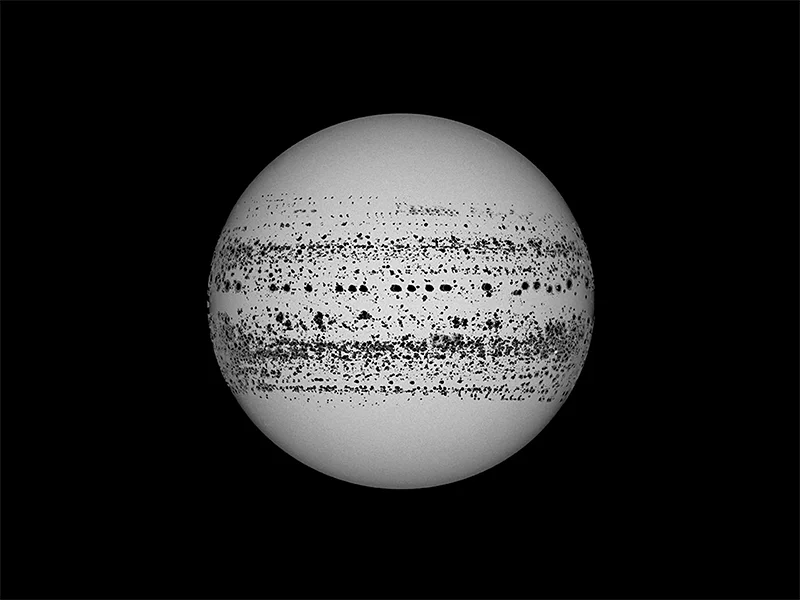
Palomar (Part 1), presented at The Renaissance Society from May 2 through June 7, 2026, gathers an international group of artists in an expansive meditation on the sky, time, and humanity’s changing relationship to observation. Curated by Karsten Lund, the exhibition borrows its title from California’s historic Palomar Observatory and from Italo Calvino’s fictional character Mr. Palomar, whose attentive reflections on everyday phenomena transformed ordinary moments into philosophical inquiry. Across photography, sculpture, video, and installation, the exhibition considers what it means to look upward in an era shaped simultaneously by scientific discovery, ecological anxiety, surveillance, and technological acceleration.
The participating artists approach the sky not as a romantic backdrop, but as a contested and emotionally charged space. Works by photographers and image-makers including
Rinko Kawauchi,
Myriam Boulos, Heji Shin, and Aspen Mays explore cycles of light, perception, and memory, while historical references such as
Eadweard Muybridge’s pioneering motion studies connect older forms of observation to contemporary questions about visibility and time. Celestial rhythms become intertwined with personal experience, political realities, and environmental fragility. Throughout the exhibition, moments of stillness coexist with reminders of instability, extinction, and human intervention.
The exhibition arrives during renewed global interest in space exploration following the Artemis II lunar mission, yet
Palomar remains grounded in earthly concerns. Rather than celebrating technological conquest, the project reflects on how people continue to orient themselves through natural cycles even as urban light pollution obscures the stars and satellite systems reshape the night sky. The works suggest that looking upward can carry contradictory meanings: wonder and grief, comfort and unease, intimacy and distance.
Structured in two parts, the exhibition unfolds gradually, with certain works remaining in place while others rotate throughout the presentation. This shifting format creates an experience akin to a photographic double exposure, where ideas overlap and evolve over time. By combining scientific references with poetic reflection,
Palomar (Part 1) examines observation itself as a cultural act. The exhibition ultimately asks how humans measure existence within vast cosmic systems while confronting the increasingly uncertain realities unfolding closer to home.
Image:
Sarah and Joseph Belknap, 4 Months of the Sun, 2014