Hyphen American: Intersections of Identity, on view from January 24 through July 5, 2026, examines how artists navigate the layered meanings of belonging in the United States. Timed to coincide with the nation’s 250th anniversary, the exhibition resists a singular definition of “Americanness,” instead foregrounding the lived realities of identities shaped by migration, memory, language, and cultural inheritance. Through works drawn from the museum’s collection, the exhibition proposes that the hyphen is not a division, but a generative space of connection and negotiation.
The artists featured in
Hyphen American explore how personal histories intersect with broader social narratives. Portraiture, abstraction, documentary strategies, and symbolic forms become tools for articulating experiences of displacement, resilience, and community-building. These works reveal Americanness as something continually formed—through rituals, shared struggles, and acts of self-definition—rather than a fixed or unified ideal. By emphasizing multiplicity over assimilation, the exhibition highlights how difference itself has long been central to the American story.
A distinctive feature of the project is its multilingual approach. For the first time, the Sheldon presents both the exhibition and its accompanying publication in four languages: English, Spanish, Vietnamese, and Arabic. This decision reflects the linguistic landscape of Lincoln, Nebraska, and underscores the exhibition’s commitment to accessibility and representation. Language here is more than translation; it becomes a curatorial gesture that acknowledges how meaning shifts across communities and how cultural participation expands when barriers are lowered.
Curated by Christian Wurst,
Hyphen American extends beyond the gallery walls through a series of public programs developed in collaboration with local community members. Their voices are woven into the exhibition and catalogue, reinforcing the idea that identity is collective as well as individual. Together, the artworks and programs position the museum as a space of dialogue—one that honors complexity, embraces contradiction, and invites viewers to reconsider what it means to see themselves, and others, as American.
Image:
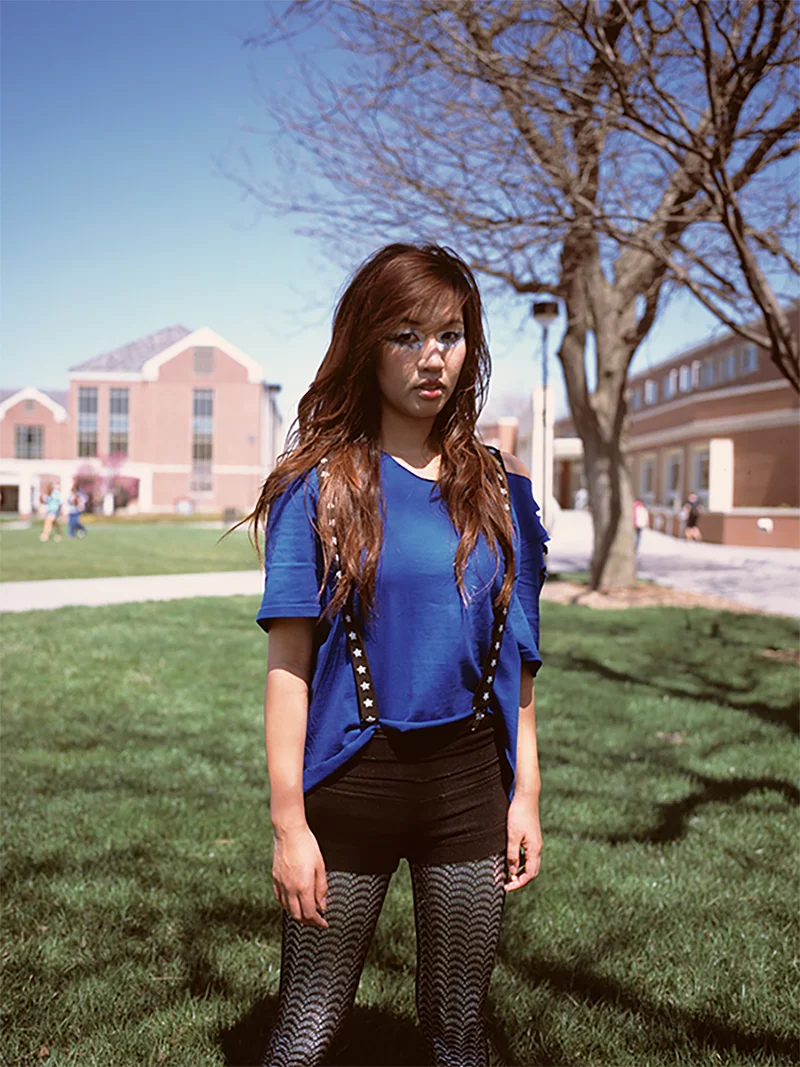
Binh Danh. Vivian Nguyen, Environmental Studies, UNL, Class of 2014
Archival pigmented print, 2011
40 × 30 inches
University of Nebraska–Lincoln, gift of the artist, U-5663.2012