All about photo.com: photo contests, photography exhibitions, galleries, photographers, books, schools and venues.
LAST WEEK TO ENTER AAP MAGAZINE B&W: PUBLICATION AND $1,000 CASH PRIZES

Words & Pictures

From May 07, 2024 to January 31, 2025
Share
Words & Pictures
1400 Remington Street
Fort Collins, CO 80524
Selected Artists: Leah Abrahams, Asiya Al. Sharabi, Federica Armstrong, Darryl Baird, Lowell Baumunk, Steve Bennett, Bonnie Blake, Marisa Brown, Lindsay Buchman, Xtine Burrough, Susan Kaufer Carey, Rebecca Chappelear, Victoria Crayhon, Jane Waggoner Deschner, Brian Fouhy, Leah Frances, Beth Galton, Amy Gaskin, Maryam (Nilou) Ghasempour Siahgaldeh, Rima Grad, Sharon Lee Hart, Charlotta Hauksdottir, Adriene Hughes, Charles Ingham, Candace Jahn, Lauren Johnson, Michael Joseph, Sherry Karver, Valerie Kim, Melissa Kreider, Judith G Levy, Annie Lopez, Jena Love, Jenny Lynn, Mara Magyarosi-Laytner, Ellen Mahaffy, Andy Mattern, Benita Mayo, Eric McCollum, Jenna Meacham, Julie Mihaly, Venessa Monokian, Kris Moore, Lisa Murray, Marni Myers, Lisa Nebenzahl, Cheryl Newman, Jackson Nichols, Charlotte Niel, Robert Nielsen, Rachel Nixon, Catherine Panebianco, Cyd Peroni, Mehregan Pezeshki, Jeff Phillips, Linda Plaisted, Wendy Ploger, Michael Pointer, Steve Prezant, Jennifer Pritchard, Michael Rainey, Brandon Ralph, Victor Ramos, David Richards, Susan Rosenberg Jones, Joel Rotenberg, Don Russell, Robin Salcido, Bill Saltzstein, Beth Sanders, Kris Sanford, Elizabeth Sanjuan, Deborah Saul, Angela Scardigno, Richard Schramm, Robert Schultz, Becca Screnock, Nicolo Sertorio, Rebecca Sexton Larson, Liz Albert and Shane VanOosterhout, Christine Siracusa, Paul Sisson, Jerry Takigawa, Dean Terasaki, Lacey Terrell, Cydney Topol, Hailey Trejo, Mark Troyer, Jim Turner, Brian Van de Wetering, Harry von Stark, Robert Weil, Francine Weiss, Andrea Wenglowskyj, Thomas Whitworth, Eric Williams, Jon Wollenhaupt, Ian Wright, Douglas Yates, Jennifer Zwick

Jurors Statement

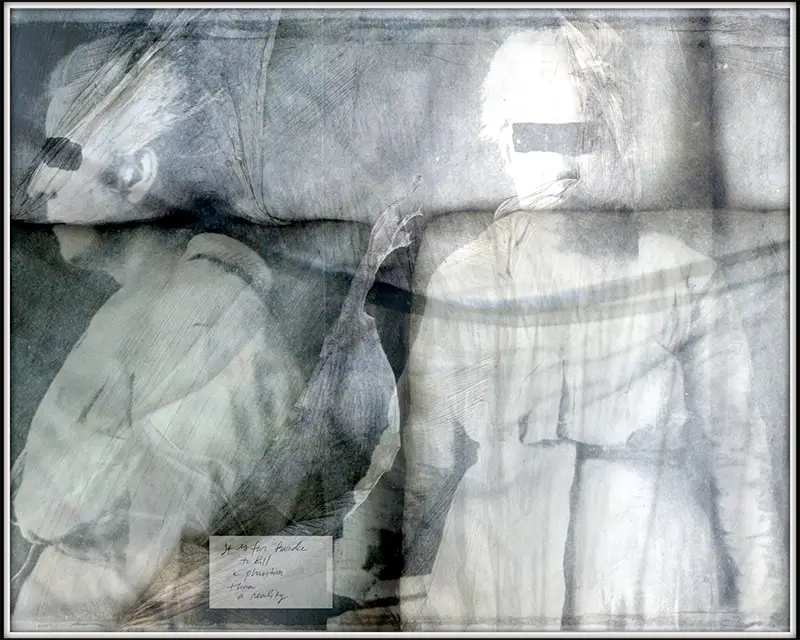
The exhibition, Words & Pictures, is a fantastic representation of how artists are using two mediums to elevate their art making, The narratives featured in this exhibition range from personal and poignant to humorous and creative with words that accompany photographs and appear In and on photographs.

Artists have incorporated text and symbols into their work since the beginning of time, but it was in the 1970’s when text and photography had a significant marriage and was at the forefront of visual culture and semiotic language. Artists such as Duane Michals, Sophie Calle, Jim Goldberg, and Carrie Mae Weems have used text to expand storytelling. Photography has returned to many of the methodologies created half a century ago, and it’s exciting to see the medium become so expansive.

There are qualities that are universal to creating a compelling photograph. The work must have an intangible resonance and a sensitivity that links together images and ideas. The photographs have to be well crafted and have power, sometimes in their simplicity and sometimes in their complexity. Most importantly, the work must have authenticity—it has to convince the viewer that it has come from a genuine place, and it needs to persuade us that there is meaning and purpose behind the effort. The ubiquitousness of photography today requires creative approaches to all genres to shift the norms and reinvigorate the medium, as evidenced by the submissions to this exhibition.

My Juror Selection Award goes to Charles Ingham. He submitted so many stellar images that it was hard to narrow it down. His work in both cinematic and intimate and he is a unique visual storyteller. For Honorable Mentions, I selected works by Angela Scardigno, Lindsay Buchman, Jackson Nichols – each artist elevating and expanding the visual experience with a particular visual persuasion.

A big thank you to all who submitted—it was a pleasure to spent time with your work and though I selected a large number of images, there were still so many photographs that I wish I could have included. Aline Smithson

Our printed edition showcases the winners of AAP Magazine call of entries
All About Photo
Awards 2026
Stay up-to-date  with call for entries, deadlines and other news about exhibitions, galleries, publications, & special events.

Exhibitions Closing Soon

Peter Hujar: The Gracie Mansion Show
Ortuzar | New York, NY
From April 22, 2026 to May 30, 2026
At Ortuzar, Peter Hujar: The Gracie Mansion Show revisits a pivotal moment in the history of American photography. On view from April 22 to May 30, 2026, the exhibition reconstructs the artist’s 1986 presentation at Gracie Mansion Gallery, offering a rare opportunity to encounter the work as it was originally conceived. Organized in collaboration with Fraenkel Gallery and the Peter Hujar Archive and Foundation, the show restores the distinctive two-row grid that defined the earlier installation, allowing viewers to engage with the sequencing that lay at the core of Hujar’s vision. First presented under the title Recent Photographs, the 1986 exhibition brought together seventy images that moved fluidly across genres. Portraits of artists, performers, and writers appeared alongside nudes, animals, landscapes, and scenes of urban decay. In this arrangement, hierarchy dissolved: a cow might face an actor, a coffin portrait might sit beside a quiet landscape. The structure encouraged viewers to move laterally, forming connections that remained open-ended and subjective. By re-staging this layout, Ortuzar foregrounds Hujar’s sensitivity to juxtaposition and rhythm, underscoring how meaning emerges through proximity rather than categorization. Though the original exhibition attracted a vibrant downtown audience, it achieved little commercial success. Yet it stands, in retrospect, as a defining statement by an artist deeply embedded in New York’s cultural milieu. Figures such as David Wojnarowicz and Diana Vreeland appeared within his orbit, reflecting a community bound by experimentation and artistic independence. Hujar’s photographs capture this world with an intensity that balances intimacy and detachment, revealing individuals who, as he noted, “cling to the freedom to be themselves.” Born in 1934, Peter Hujar spent much of his life in New York’s East Village, producing a body of work that gained broader recognition only after his death in 1987. Today, his photographs are held in major institutions including the Metropolitan Museum of Art and the Museum of Modern Art. This reinstallation not only commemorates the fortieth anniversary of a landmark exhibition but also reaffirms Hujar’s enduring influence, presenting his images as a living network of relationships that continues to resonate with clarity and force. Image: David Wojnarowicz: Manhattan-Night (III), 1985 Pigment print by Gary Schneider © Peter Hujar, courtesy of Ortuzar gallery
Todd Gray: Portals
Perrotin Los Angeles | Los Angeles, CA
From March 21, 2026 to May 30, 2026
Todd Gray: Portals, presented at Perrotin Los Angeles from March 21 to May 30, 2026, gathers a new body of photographic assemblages by Todd Gray. The exhibition unfolds as a meditation on the shifting conditions of Black identity across geography and time. Drawing on landscapes, architectural fragments, and historical references, Gray constructs layered compositions that refuse a single viewpoint. Instead, the works evoke a network of relationships linking Europe, West Africa, and the Americas, suggesting that identity and history emerge through movement rather than fixed definition. Gray’s method relies on the assembly of disparate photographic elements into carefully structured tableaux. Formal gardens, Renaissance interiors, coastal landscapes, and remnants of colonial architecture appear within the same frame, sometimes bordered by ornate or improvised frames that extend the visual dialogue. In Paradox of Liberty (Monticello, Elmina, Akwidaa), palm trees photographed in Ghana intersect with a marble likeness of Thomas Jefferson and the entrance to a dungeon at Elmina Castle. Through these juxtapositions, Gray draws attention to the intertwined legacies of Enlightenment ideals, colonial expansion, and the transatlantic slave trade. Landscapes associated with beauty and leisure appear alongside sites marked by violence and displacement, revealing histories that remain embedded within the visual fabric of the Atlantic world. Photography occupies a complicated place in Gray’s practice. The medium emerged in the nineteenth century alongside expanding colonial systems, often serving as a tool for classification and surveillance. Gray approaches the camera with an acute awareness of this legacy. By layering images, shifting scale, and incorporating visual “glitches” drawn from damaged digital files, he transforms the photograph into an unstable field where meaning remains open and relational. These assemblages resist narrative closure, encouraging viewers to navigate visual connections that unfold across continents and centuries. The title Portals reflects this approach. A portal marks a threshold, an opening between different spaces or states of awareness. Gray’s compositions operate in precisely this manner: each image acts as an entry point into overlapping cultural histories, personal memory, and speculative imagination. Rather than isolating a single moment, the works suggest a continuous flow in which past events echo within the present. Landscapes, monuments, and bodies become passages through which multiple stories circulate, forming a dynamic vision of diasporic experience. Image: The Promise (Ghana, Rome, Gorée), detail, 2026. Four UV pigment prints on Dibond in artist’s frames. ©Todd Gray. Courtesy of the artist and Perrotin.
Stuart Allen: Seeing Color
PDNB | Denton, TX
From March 28, 2026 to May 30, 2026
Stuart Allen: Seeing Color, on view at PDNB Gallery from March 28 to May 30, 2026, brings together recent and earlier works that trace the artist’s sustained investigation into the structure and perception of color. Blending photography, digital processes, and painterly approaches, Allen constructs images that move between scientific inquiry and visual delight, revealing how color operates beyond immediate perception. Central to the exhibition is the series Flights, where photographs taken from airplane windows transform into intricate fields of color. Captured at high altitude, these images register subtle atmospheric shifts that often escape the naked eye. Through algorithmic manipulation, Allen translates these fleeting views into grids of colored dots, reminiscent of halftone printing yet retaining the integrity of each hue. The resulting compositions function as both documents of travel and studies of light in motion, anchored by precise references to time and location. In contrast, the series Every Unique Color turns inward, focusing on the chromatic complexity hidden within everyday subjects. By extracting and reorganizing every color found in a single image—often derived from food—Allen creates ordered matrices that map hue and luminosity with methodical clarity. These works reveal unexpected harmonies and tensions, transforming familiar objects into abstract systems governed by visual logic. The exhibition also revisits earlier explorations, including Allen’s pixel-based works and his studies of soap bubbles, where shifting wavelengths produce iridescent surfaces under controlled light. Across these varied series, a consistent thread emerges: a fascination with how technology and observation can uncover dimensions of color that lie just beyond ordinary vision. Seeing Color reflects an approach grounded in experimentation and curiosity, where the boundaries between art and science dissolve. Allen’s images invite close looking, encouraging viewers to consider not only what color is, but how it is experienced, measured, and ultimately reimagined. Image: Stuart Allen, Bubble No. 12, 2014 © Stuart Allen
Cheryl Clegg: The Endangered Lobstermen
Griffin Museum of Photography | Winchester, MA
From March 02, 2026 to May 30, 2026
Cheryl Clegg: The Endangered Lobstermen, on view at the Griffin Museum from March 2 to May 30, 2026, is a poignant photographic meditation on labor, heritage, and survival along the coast of Maine. Sparked by the red-listing of the American lobster, Clegg’s project shifts the focus from environmental statistics to lived experience, asking what happens when an ecosystem under threat places an entire way of life at risk. The exhibition centers the people whose identities are inseparable from the sea they work. Rather than documenting boats and traps alone, Cheryl Clegg turns her lens toward families and individuals embedded in Maine’s lobstering communities. Her portraits reveal pride passed down through generations, along with the quiet anxiety of an uncertain future. Weathered hands, steady gazes, and intimate domestic scenes speak to resilience forged through daily dependence on tides, seasons, and fragile marine balance. These photographs honor a culture that has endured through cooperation, skill, and an unspoken pact with nature. Clegg’s background in photographic illustration lends the series a careful balance of clarity and empathy. The images are visually striking yet grounded, avoiding romanticization while acknowledging the dignity of hard-won tradition. Viewers encounter not an industry in abstraction, but neighbors, parents, and children whose livelihoods are shaped by policy decisions, environmental change, and forces far beyond the harbor. The work gently underscores how ecological crises ripple outward, touching human communities in deeply personal ways. With The Endangered Lobstermen, Clegg continues a long-standing commitment to socially engaged storytelling. Her career, spanning decades of commercial and personal work, informs a visual language that is both accessible and deeply felt. This exhibition stands as a testament to the strength of Maine’s lobstering families while inviting reflection on what is at stake when tradition, environment, and economic survival collide. It is a reminder that preservation is as much about people as it is about species. Image: The Barrett Family, Addison, ME. © Cheryl Clegg
Lewis Baltz: The Deaths in Newport
Gallery Luisotti | Los Angeles, CA
From April 01, 2026 to May 30, 2026
Lewis Baltz: The Deaths in Newport returns to public view at Gallery Luisotti as a rare reconsideration of one of the artist’s most enigmatic and experimental projects. Originally presented in the mid-1990s, the work emerges again after more than three decades, revealing a pivotal moment when Baltz expanded beyond the strict formal language that defined his early career. Known for his role in New Topographics, where he redefined landscape photography through an austere and analytical lens, Baltz here turns toward narrative, assembling fragments of history into a complex visual investigation. At the center of the project lies the infamous 1947 Overell murder case, a sensational trial that captured national attention and transformed a local tragedy into a prolonged media spectacle. Baltz approaches this event not as a storyteller seeking resolution, but as an archivist of uncertainty. Drawing from court documents, press clippings, and photographic evidence, he constructs a layered sequence that resists closure. The narrative unfolds through accumulation and repetition, where each detail complicates rather than clarifies, echoing the instability of truth within public memory. Presented in an early digital video format, the work reflects a moment when photographic practice begins to shift under the influence of emerging technologies. Baltz moves away from the singular image toward a time-based structure, where sequencing, duration, and juxtaposition shape meaning. This transition aligns with his broader interest in systems of control and mediation, extending his earlier examinations of industrial and suburban spaces into the realm of information and representation. A subtle but significant thread runs through the project in the form of personal connection. Baltz’s father, who served as a mortician and witness in the trial, introduces an intimate dimension that unsettles the apparent distance of the work. This proximity does not resolve the narrative; instead, it deepens its ambiguity. In The Deaths in Newport, Baltz transforms a historical घटना into a meditation on evidence, memory, and the persistent afterlife of images, where documentation becomes inseparable from interpretation. Image: Lewis Baltz, The Deaths in Newport (Video Still) 1995
Michael Kenna: Confessionali
Joseph Bellows Gallery | La Jolla, CA
From April 25, 2026 to May 30, 2026
Michael Kenna: Confessionali, presented at Joseph Bellows Gallery from April 25 to May 30, 2026, gathers a quietly powerful body of work shaped over nearly a decade in the Italian city of Reggio Emilia. Curated by Lile Kvantaliani, the exhibition centers on a subject both humble and profound: the confessional. Within these enclosed wooden structures, the artist finds a visual language capable of addressing memory, secrecy, and the unseen dimensions of human experience. Kenna’s engagement with confessionals begins in 2007 inside the Chiesa di Santo Stefano, where the architectural rhythm and symbolic weight of these spaces first capture his attention. Over repeated visits through 2016, he develops a sustained meditation on their forms. Each photograph isolates subtle variations in design, light, and texture, transforming a familiar ecclesiastical object into something meditative and enigmatic. The series aligns with a long photographic tradition of typologies, yet avoids rigidity by allowing atmosphere and emotion to guide the work. Working exclusively in gelatin silver prints, Michael Kenna continues to favor traditional processes that emphasize craft and patience. His long exposures—often made in low light—render surfaces with a softness that borders on the dreamlike. Shadows deepen, edges dissolve, and details emerge gradually, echoing the slow unfolding of thought itself. These images do not describe confessionals as functional spaces; instead, they evoke them as vessels of unspoken narratives, holding traces of countless private encounters. Throughout his career, Kenna builds a reputation for photographing landscapes and structures at moments when light feels most elusive—before dawn or deep into the night. In Confessionali, that sensibility turns inward. The focus shifts from open horizons to enclosed interiors, yet the same search persists: a desire to reveal what lies beneath the visible surface. The resulting photographs suggest that even the most ordinary forms can contain a quiet intensity, where absence speaks as clearly as presence. By reducing his subject to its essential variations, Kenna invites sustained looking. The exhibition unfolds slowly, rewarding attention and contemplation, and affirms photography’s enduring capacity to approach what cannot be easily named. Image: Confessional, Study 49, Chiesa di Santa Maria Assunta, Minozzo, Reggio Emilia, Italy, 2015 © Michael Kenna. Courtesy of the Joseph Bellows Gallery
Creative Resistance Captured in Tintype: Immortalizing Art as Activism
Contemporary Arts Center Cincinnati | Cincinnati, OH
From April 23, 2026 to May 31, 2026
Creative Resistance Captured in Tintype: Immortalizing Art as Activism is on view from April 23 through May 31, 2026 at the Contemporary Arts Center. In this focused presentation, large-format photographer Alex Lippert turns to the historic wet plate collodion process to consider how artistic practice operates as a form of civic engagement. The exhibition situates portraiture within a lineage of social documentation while foregrounding the tactile, time-intensive nature of tintype photography. Originating in the mid-nineteenth century, the wet plate collodion method requires the artist to coat, sensitize, expose, and develop each plate by hand in a matter of minutes. The resulting metal images possess a singular presence: luminous highlights, velvety shadows, and surfaces that bear the trace of their making. Lippert embraces this deliberate pace as an analogue to creative resistance itself. Slowness becomes a refusal of disposability, and craft becomes a quiet assertion of value in an accelerated visual culture. The project centers on artists from Cincinnati and surrounding communities whose practices challenge injustice, question entrenched systems, and nurture alternative forms of belonging. Through extended interviews and collaborative sittings, Lippert records not only likeness but conviction. Musicians, performers, visual artists, and organizers appear before the camera with direct gazes and composed gestures, their portraits accompanied by narratives that reveal how personal histories intertwine with collective struggle. Each tintype stands as both document and declaration, merging individual agency with shared purpose. Rather than promising immediate political transformation, the exhibition reflects on art’s quieter capacities: to sustain memory, to cultivate empathy, and to articulate counter-narratives that endure beyond a single moment of protest. Within the galleries of the Contemporary Arts Center, these handcrafted images affirm that activism often begins in intimate spaces—studios, stages, neighborhoods—where imagination confronts constraint and creativity becomes a durable form of resistance. Image: Courtesy of the Contemporary Arts Center
Designing Power: The Black Panther Party
Tang Museum | Saratoga Springs, NY
From February 14, 2026 to May 31, 2026
Designing Power: The Black Panther Party, on view in the Atrium at the Tang Teaching Museum and Art Gallery from February 14 through May 31, explores how a political movement crafted one of the most enduring visual identities of the twentieth century. Emerging in the late 1960s under the leadership of Huey P. Newton and Bobby Seale, the Black Panther Party understood that imagery could mobilize communities as powerfully as rhetoric or policy. The exhibition examines how deliberate design choices helped translate radical ideas into a bold, accessible public presence. Drawing from archival materials in the museum’s collection, the presentation features newspapers, photographs, flyers, and printed ephemera that reveal a sophisticated visual strategy. The Party’s striking panther logo, strong graphic layouts, and commanding typography established a recognizable brand of resistance. Equally significant were embodied aesthetics: leather jackets, berets, natural hairstyles, and disciplined group portraits communicated unity, dignity, and self-determination. Through these choices, the Party forged a visual language that amplified its calls for community programs, self-sufficiency, and protection against systemic injustice. Photography played a central role in shaping this public image. Carefully staged portraits and documentary images circulated widely, projecting strength and solidarity while countering hostile media narratives. The interplay between image and message created a feedback loop in which design reinforced ideology and ideology informed design. By situating these materials within a museum context, the exhibition invites viewers to consider how visual culture operates as a form of political agency. Organized as a student-curated project, Designing Power also underscores the continuing relevance of the Party’s aesthetic innovations. Decades after the organization’s dissolution, its iconography endures in contemporary movements for racial justice and social change. The exhibition demonstrates how the deliberate crafting of symbols, language, and images can leave a lasting imprint—shaping not only how a movement is seen, but how it is remembered and reimagined for future generations. Image: Stephen Shames, Panthers line up at a Free Huey rally in DeFremery Park, Oakland, 1968, gelatin silver print, 12 ¼ x 19 inches, Tang Museum collection, The Jack Shear Collection of Photography at the Tang Teaching Museum, 2017.45.12
Photography from The Menil Collection: Curated by Wendy Watriss
The Menil Collection | Houston, TX
From December 12, 2025 to May 31, 2026
The Menil Collection presents Photography from The Menil Collection: Curated by Wendy Watriss, a major exhibition exploring the power of documentary photography to illuminate social realities and provoke dialogue. On view from December 12, 2025, through May 31, 2026, the exhibition gathers works by influential photographers such as Henri Cartier-Bresson, Larry Burrows, Bruce Davidson, Danny Lyon, and Charles Moore—artists who each found extraordinary meaning within the rhythms of everyday life. Curated by Houston-based photographer and photojournalist Wendy Watriss, the exhibition offers a deeply personal interpretation of the Menil’s photographic holdings. Watriss selected images that not only reflect the strength of the collection but also the humanist vision of the museum’s founders, John and Dominique de Menil. “This exhibition,” Watriss notes, “was shaped by three sets of eyes—my own, and the de Menils’. It is a chance to reconnect with their remarkable way of seeing the world and engaging with art.” The de Menils began collecting photographs in the late 1960s, when the medium was still fighting for its place within fine art. They viewed photography as an accessible and essential art form capable of revealing the shared experiences of humanity. Their early acquisitions, which later formed the foundation of the Menil’s collection, were guided by a belief in art’s potential to bridge culture, ethics, and empathy. For Watriss, this project also marks a return to the roots of her own artistic journey. Alongside her late husband Fred Baldwin, she co-founded FotoFest in 1986, an international photography biennial that transformed Houston into a global hub for photographic dialogue. The Menil’s commitment to connecting art and social justice inspired their work, shaping both their practice and their community engagement. Presented in honor of FotoFest’s 40th anniversary, Photography from The Menil Collection celebrates not only the enduring legacy of the de Menils and Watriss but also photography’s unique capacity to bear witness, question, and connect. Image: Bruce Davidson, East 100th Street, 1966. Gelatin silver print. 7 3/16 × 7 3/16 in. (18.3 × 18.3 cm). The Menil Collection, Houston, Anonymous gift. © Bruce Davidson/Magnum Photos. Photo: Paul Hester
Flower City Arts Center: Studio 678 Photo Club 2025/2026
George Eastman Museum | Rochester, NY
From February 28, 2026 to May 31, 2026
This spring, the museum’s community gallery, the Gallery Obscura, presents a selection of photographs and writings created by the 2025–2026 Studio 678 Photo Club at the Flower City Arts Center. The exhibition highlights the distinct perspectives of young artists who have spent months observing their surroundings and translating those impressions into images and words. Each work carries the imprint of personal discovery, revealing how students see their neighborhoods, their relationships, and the everyday moments that shape their lives. Under the steady guidance of mentors and volunteers, twenty middle school participants learned to handle 35mm film cameras with care and intention, developing their own black-and-white prints in the darkroom. The process, rooted in traditional craft, encourages patience and discipline while giving students full control over the final image. They also write poems and short texts to accompany their photographs, deepening the connection between visual storytelling and written expression. The museum’s exhibition team mats and frames these works and gathers them into a collaborative book that reflects the collective spirit of the program. Through photography and writing, Studio 678 encourages young people to look closely at the world and consider their place within it. Their projects support essential learning, from observation and composition to language and analytical thinking. More importantly, the program nurtures confidence, helping students trust their own vision and share it with others. What began in 1999 as a small eight-week experiment has grown into a twenty-five-week after-school tradition that continues to serve the Rochester community. Offered free of charge to students in grades six through eight, Studio 678 stands as a longstanding commitment to youth development, creativity, and the enduring value of giving young people the tools to express themselves. Image: Photo courtesy of Flower City Arts Center.
Zora J Murff: RACE/HUSTLE
MASS MoCA | North Adams, MA
From December 06, 2025 to May 31, 2026
Zora J. Murff’s exhibition offers a searching look at the forces that shape our perceptions, our histories, and the communities we inhabit. Through a blend of photographs, collages, and installation work, he draws attention to the hidden frameworks that structure daily life and the ways those structures perpetuate harm. His images move between stillness and tension: a striking portrait, a flicker of light cutting across a wall, the steady pulse of a crowded street, or a quiet gesture of persistence. Each element reflects his belief that no issue exists in isolation, and that the consequences of global crises inevitably echo close to home. In this exhibition, Murff examines how the pursuit of freedom often collides with a desire for symbols rather than genuine change. A distorted reinterpretation of a familiar presidential portrait becomes a pointed reminder of how representation can be manipulated or misread. In another work, the exchange of a folded bill becomes a commentary on the weight of history and the persistence of unequal systems. His collages, built from fragments of language and imagery, expose the contradictions that shape public narratives. For the first time, Murff extends his practice into installation, encouraging visitors to confront the role of cultural institutions in reinforcing broader systems of control. These participatory elements underscore the idea that liberation requires not just awareness but active engagement with the forces one hopes to undo. Murff, an Oregon-based artist and educator, approaches his practice with clarity and intention. Born in 1987, he uses photography as a flexible medium, expanding it across disciplines to create works that question how images shape our understanding of race, power, and value. His work speaks directly to the ongoing struggle against anti-Blackness and invites viewers to consider what it means to resist, and to desire resistance, in a world shaped by entrenched hierarchies. Image: Zora J Murff, Fronting (Affirmation #4), 2020, Archival pigment print, 48 x 30 inches, Courtesy of the artist. © Zora J Murff
Good Fire: Tending Native Lands
Oakland Museum of California | Oakland, CA
From November 07, 2025 to May 31, 2026
Good Fire: Tending Native Lands offers a thoughtful look into the long-standing fire practices of Native communities in Northern California, presenting fire not as an agent of destruction but as a carefully guided force for renewal. For generations, cultural burning has shaped landscapes, revived ecosystems, and supported community traditions. By centering Native fire practitioners, artists, ecologists, and cultural leaders, the exhibition brings attention to these enduring relationships between people and place, relationships often overlooked in mainstream environmental narratives. Visitors encounter a wide range of materials that reveal how deeply intertwined cultural burning is with ecological health. Fire-dependent plants, ceremonial regalia, basketry, and filmed cultural burns provide insight into how purposeful fire supports both biodiversity and cultural continuation. Archival photographs and charred tree sections stand alongside contemporary works by artists such as Saif Azzuz, Renée Leann Castro-Ring, and Brian D. Tripp. Together, these elements trace the impact of land dispossession while underscoring the environmental consequences that followed the suppression of Native fire practices. The exhibition also highlights present-day efforts to heal landscapes and restore sovereignty. Initiatives such as prairie renewal projects, Land Back movements, and the work of groups like the Cultural Fire Management Council illustrate how Native-led stewardship is bringing balance back to ecosystems long disrupted by colonial policies. These initiatives demonstrate the resilience of communities who continue to advocate for their ancestral knowledge and its role in shaping the future. By reframing fire as a tool shaped through experience, respect, and generational learning, Good Fire: Tending Native Lands invites viewers to reconsider long-held assumptions. It asks us to imagine a landscape where fire is once again used with intention, where cultural knowledge is honored, and where ecological well-being is understood as inseparable from the wisdom of those who have tended the land since time immemorial. Image: Margo Robbins (Yurok), of the Cultural Fire Management Council, leads a beneficial burn on Yurok homelands. The group starts the burn using me-chaa-nep (wormwood) torches. Photo by Kiliii Yuyan.
Advertisement
AAP Magazine #58 B&W
Win a Solo Exhibition in July
AAP Magazine #58 B&W
Call for Entries
AAP Magazine #58 B&W
Publish your work in our printed magazine and win $1,000 cash prizes

Related Articles

Belfast Photo Festival 2026: Horizons
The 2026 edition takes visitors towards new ‘Horizons’, a theme that positions photography at a critical threshold in an age of AI-generated imagery, automation and algorithmic seeing. The festival returns as the medium undergoes profound transformation and its claims to truth, trust, authorship and materiality are increasingly being questioned.
Meryl Meisler: Queer-Friendly Nightlife Now
Nearly five decades after documenting disco-era revelry, photographer Meryl Meisler returns with a bold new body of work capturing the pulse of contemporary queer nightlife—its grit, glamour, and enduring sense of community. Meryl Meisler: Queer-Friendly Nightlife Now premieres the CPW's inaugural Upstate Photography Biennial, a new exhibition series featuring 39 artists from across the region, opening May 30, 2026.
Prix Pictet Exhibition Makes U.S. Debut at MoCP
The Museum of Contemporary Photography at Columbia College Chicago (MoCP) will present Prix Pictet Storm from May 29 through August 22, 2026, marking the U.S. debut of the internationally touring exhibition dedicated to photography and sustainability. Organized in partnership with Prix Pictet — widely recognized as the world’s leading award focused on photography and sustainability — the exhibition brings together twelve exceptional contemporary photographers whose work explores environmental instability, political unrest, social tension, and the fragile state of the modern world.
Marilyn Monroe at 100: Landmark Exhibition Opens at National Portrait Gallery
Exploring Monroe’s life, career and legacy , the exhibition will include portraits created by many of the greatest photographers and artists of the 21th and 21st centuries , including Andy Warhol, Pauline Boty and Richard Avedon .
Posto 5: The Renaissance of Committed Photographic Narrative
The birth of an auteur collective dedicated to a sensitive inventory of the world, where the rigor of visual storytelling honors the standards of historical foundations.
Peckham 24: 10th Anniversary, The Eras Edition
Peckham 24, the acclaimed festival of contemporary photography, returns to Copeland Park in Peckham, South London, for its landmark 10th anniversary edition. Over the past decade, the festival has grown into a major cultural highlight, championing innovation while providing a global platform for emerging photographic talent.
The Nature of Hope: A Photo Project Supporting Roots & Shoots and Vital Impacts
Renowned photographer Ami Vitale unveils The Nature of Hope, a global photo project inspired by Jane Goodall. Featuring leading environmental photographers, the initiative supports conservation through Vital Impacts and celebrates storytelling as a force for planetary change and hope.
Tangerine Dreams by Sophie Green
British documentary photographer Sophie Green presents Tangerine Dreams, a vivid portrait of the communities, subcultures and social gatherings that shape contemporary Britain. For over a decade, she has documented how rituals and traditions build connection, belonging and shared identity. This celebratory and emotively kaleidoscopic work will be on show as a free exhibition at the Martin Parr Foundation, Bristol from 4 June - 6 September 2026.
Brussels Street Photography Festival honors Josef Koudelka with Lifetime Achievement Award
The Brussels Street Photography Festival (BSPF) is pleased to announce that Josef Koudelka, one of the most iconic photographers of our time, will be the guest of honor at this year’s 10th-anniversary celebration. Koudelka will receive the festival’s Lifetime Achievement Award in recognition of his extraordinary contributions to photography during a special evening at Brussels City Hall on May 30, 2026. The event will also feature an interview with the photographer and the announcement of this year’s competition winners.
Call for Entries
Win A Solo Exhibition in June
Get International Exposure and Connect with Industry Insiders