All about photo.com: photo contests, photography exhibitions, galleries, photographers, books, schools and venues.
All About Photo Awards 2026: $5,000 Cash Prizes. Juror Steve McCurry!

The Empire State Building

From June 23, 2021 to August 13, 2021
Share
The Empire State Building
41 East 57th Street
New York, NY 10022
Keith de Lellis Gallery celebrates the 90th anniversary of New York City's magnificent Art Deco skyscraper in its summer exhibition. After demolishing the famous original Waldorf Astoria Hotel on Fifth Avenue in 1929, the Bethlehem Engineering Corporation took on the world's most ambitious building project to date: the construction of the Empire State Building, the first 100+ story building. The Chrysler Building, with 77 stories, briefly held the title of the world's tallest building before being unseated by the Empire State a mere 11 months later. Dwarfing all surrounding buildings, the Empire State stands at 1,454 feet tall. Construction began on March 17th, 1930 and was completed in record time, opening on May 1, 1931. As a tourist attraction, the site found immediate success, collecting a ten-cent fee for a bird's eye view of New York City from telescopes atop the observatory.

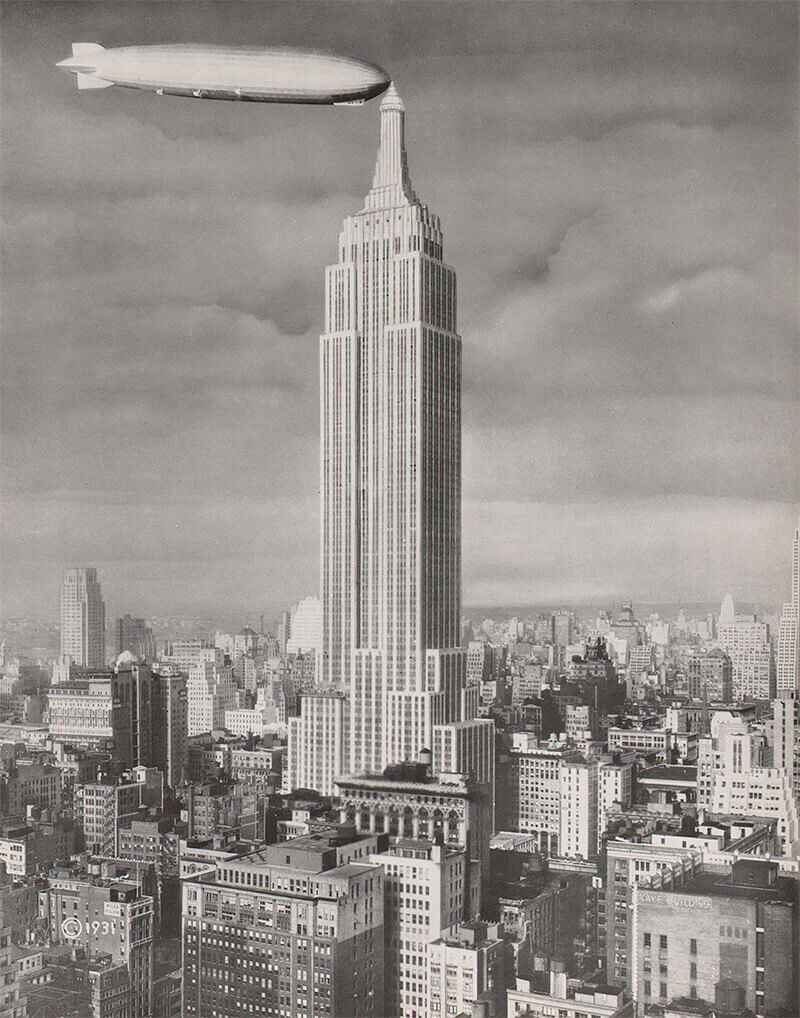
The record-breaking height was said to serve a special purpose: for its tower to act as a mooring mast for dirigibles, positioning the building and its developers at the cutting edge of air travel in its infancy. In reality, the ambitious docking station plan was not at all practical: “the notion that passengers would be able to descend an airport-style ramp from a moving airship to the tip of the tallest building in the world, even in excellent conditions, beggars belief.” (Christopher Gray, New York Times, Sept. 23, 2010). The gallery exhibition features an impressive image of the dirigible Los Angeles docked at the tip of the Empire State Building (1931), but this scene did not come to pass, and is in fact a composite photograph. The tower would ultimately be used for radio and television broadcasting.

A day of note in the building's early history is July 28th, 1945, when an aircraft collided with the 78th floor, resulting in a four-alarm fire and fourteen deaths. The U.S. Army B-25 bomber was en route to Newark, New Jersey when the pilot was disoriented by dense fog conditions. A group of five photographs show a street view of the smoking building, the plane wreckage, and spectator reactions to the crash - the latter captured by infamous street photographer Weegee.

A mere two years after its unveiling, the building was featured in its first of many films: King Kong (1933), sealing its position as a cultural monument. In 1964, Andy Warhol set his lens on the structure to create an eight-hour slow motion silent film. Shot facing southeast from the 41st floor of the Time-Life Building, the film simply documents a fixed view of the Empire State from 8:06PM to 2:42AM the night of July 24-25, 1964. Due to its length and experimental nature, the film was met with mixed reviews.

As the most photographed building in the world (Cornell University, 2011), there are countless images of the Empire State Building's recognizable façade. Selected exhibition photographs range from aerial surveys to street views, distorted reflections to detailed studies, and news photographs to artistic compositions, capturing the seminal building from every perspective.
Our printed edition showcases the winners of AAP Magazine call of entries
All About Photo Magazine
Issue #52
Stay up-to-date  with call for entries, deadlines and other news about exhibitions, galleries, publications, & special events.

Exhibitions Closing Soon

Picture Party: Celebrating the Collection at 50
Center for Creative Photography | Tucson, AZ
From May 03, 2025 to December 20, 2025
The Center for Creative Photography (CCP) celebrates fifty years of collecting with a vibrant exhibition titled Picture Party: Celebrating the Collection at 50. The exhibition brings together over 100 photographs and archival objects, drawn from the CCP’s extraordinary holdings, to create visual “conversations” across time and place. The exhibition invites visitors to explore the many ways photography has been used to capture, interpret, and transform our understanding of the world. From the earliest days of the medium to contemporary practices, Picture Party presents iconic works by photographers such as Ansel Adams, Harry Callahan, Susan Meiselas, Graciela Iturbide, Tseng Kwong Chi, Minor White, and Carrie Mae Weems. Alongside these images, the show features archival objects that illuminate the history of photography and the artists who shaped it, including Adams’ darkroom tools, Hume Kennerly’s Vietnam-era helmet, Edward Weston’s wedding ring, and even historical daguerreotypes from the 19th century. Curated by Rebecca Senf, Emilia Mickevicius, and Emily Una Weirich, the exhibition emphasizes the richness of the CCP’s collection, which includes over 300 archival collections and more than 120,000 photographs. Rather than following a linear chronology, Picture Party encourages visitors to engage with the works in open-ended ways, discovering unexpected connections and dialogues between images, objects, and moments across history. This approach allows the exhibition to act as a dynamic celebration of photography’s evolving language and its power to inspire, educate, and provoke thought. Free to the public and held in the Alice Chaiten Baker Interdisciplinary Gallery, Picture Party transforms the CCP’s fiftieth anniversary into a festive, participatory experience. Visitors, students, scholars, and artists alike are invited to join the celebration, gaining insights and inspiration from one of the world’s most remarkable photographic collections while exploring how photography continues to shape the ways we see and interpret our world. Image: ​Barbara Bosworth, Christmas Solar Eclipse in My Father's Hands, Sanibel, 2000, Gift of the artist. © Barbara Bosworth
Backroom || John Chiara & William Dassonville
Marshall Gallery | Los Angeles, CA
From November 01, 2025 to December 20, 2025
Marshall Gallery presents Backroom || John Chiara & William Dassonville, an intimate installation that places two artists in conversation across a century of photographic practice. Though separated by time and technological possibility, William Edward Dassonville and John Chiara share a profound commitment to materials, process, and the expressive potential of landscape. By bringing their work together, the exhibition invites visitors to consider how artistic vision endures even as methods evolve. Dassonville, working in the early twentieth century, crafted images that hover between photography and drawing. His richly toned silver prints—soft, atmospheric, and reminiscent of charcoal—capture the eucalyptus groves and rolling hills of the San Francisco Bay Area with a sense of quiet reverence. Known for his mastery of the gum-platinum process and his dedication to pictorialist ideals, Dassonville shaped light into something almost tactile. His works in the exhibition offer a glimpse into a California that feels both familiar and dreamlike, shaped by patience, craft, and a deep respect for the natural world. In contrast, John Chiara approaches similar terrain with a contemporary boldness that pushes the medium to its physical limits. Using hand-built cameras and a process that involves exposing large sheets of Ilfochrome paper directly, Chiara transforms landscapes into vivid, sculptural objects. His colors bloom with intensity, and his surfaces carry traces of their creation—marks, shifts, and imperfections that reveal the artist’s physical engagement with the land and the photographic material. Presented in collaboration with Rose Gallery and The McIntosh Collection, this focused group of eight works highlights how both artists, each in their own era, reimagined photographic technique to reflect their personal response to place. Together, Dassonville and Chiara reveal how San Francisco’s hills, trees, and shifting light continue to inspire renewed ways of seeing. Image: Carolina : Coral : Starr King, 2021 Ilfochrome Paper, Unique Photograph Print: 50 x 40 inches / Framed: 55 x 45 inches Unique © John Chiara
An Introduction to Shadows – Photography from Japan
Marshall Gallery | Los Angeles, CA
From November 01, 2025 to December 20, 2025
Marshall Gallery presents An Introduction to Shadows, an evocative group exhibition that brings together a diverse selection of photographs made in Japan over the past twenty-five years, showcasing both celebrated masters and innovative emerging voices. The presentation unfolds with a quiet intensity, echoing Tanizaki’s belief that what is only partially revealed can leave the strongest impression. Here, subtlety becomes a kind of illumination, guiding viewers through a world shaped by restraint, atmosphere, and a profound sensitivity to the passage of time. The exhibition gathers the work of Kenji Aoki, Chieko Shiraishi, Miho Kajioka, Masao Yamamoto, Mika Horie, Toshio Shibata, Masahisa Fukase, Kenro Izu, Daido Moriyama, and Kensuke Koike. Across these artists, a shared spirit emerges—one that embraces minimalism, tactile beauty, and a muted visual language. Aoki’s meticulously arranged studio compositions reveal a disciplined elegance, while Koike’s inventive collages bend and reimagine photographic form. Kajioka and Yamamoto offer poetic fragments of memory, their small prints carrying the weight of dreams. Shiraishi’s shadow-filled images from the series Shimakage, shown in the United States for the first time, envelop the viewer in a world defined as much by what is unseen as by what is shown. Adding a vibrant counterpoint, Mika Horie’s cyanotypes—printed on handmade gampi paper—pulse with color and texture, while Kenro Izu’s celebrated Blue Nudes extend a lineage of contemplative beauty. Shibata’s stark studies of infrastructure highlight the interplay of nature and human intervention. From an earlier generation, works by Fukase and Moriyama remind viewers of the radical experimentation that shaped modern Japanese photography. Inspired by a recent journey to Japan, the exhibition reflects a renewed appreciation for the country’s deep photographic heritage. By presenting rarely seen works and intimate objects, Marshall Gallery invites visitors to engage with Japan’s distinct visual sensibility and to discover the quietly resonant approaches that continue to define its photographic landscape. Image: Kenji Aoki Japan, b. 1968 Civilizational Collapse No. 1, 2020 Toned Gelatin Silver Print 20 x 16 in. Edition of 10 © Kenji Aoki
Huracán Architectures: Ruben Natal-San Miguel
The Hemispheric Institute at New York University | New York, NY
From May 01, 2025 to December 20, 2025
The Hemispheric Institute at New York University presents Huracán Architectures, a new exhibition by Puerto Rican photographer Ruben Natal-San Miguel. For almost a decade, Natal-San Miguel has situated his practice at the intersection of the island’s devastating financial crisis and the deterioration and disappearance of its vernacular architecture as a result of neglect, mass migration, and the catastrophic weather events that define climate change in the region. Beginning with his photographic series Paradise Ruined (2016), the artist has sought to capture the process through which Puerto Rico, in his own words, “already strained to the breaking point by financial woes, population exodus, widespread addiction, and two natural disasters, is entering a pivotal time in its history.” In Huracán Architectures, Natal-San Miguel, a trained architect, captures this pivotal moment through his focus on the island’s vernacular architecture as both a hallowed marker of nationhood and an amalgam of traditions brought together through adaptations to the island’s environment and weather. The island’s vulnerability to climate events—hurricanes, floods, landslides, and the encroaching rising seas—is captured by Natal-San Miguel, whose photographs document the devastating effects of a misplaced economic austerity that has subjected the Puerto Rican population, as well as the built environment through which its cultural history has been expressed, to acute dislocation and loss. His images juxtapose the island’s luminous beauty, exuberant nature, and riotous colors, with the destruction wrought by a climate change generated in a first-world elsewhere. The exhibition is part of “Hurricane Worlds,” a multi-year initiative led by Institute Director Ana Dopico that seeks to gather the epistemologies, world-making, and art-making of people who live and have lived in hurricane worlds. We look beyond environmental and climatological surveillance, state emergency management, and crisis capitalism to consider the ways of life and ways of knowing that hurricanes inaugurate. We consider how hurricanes build modes of sovereignty and care, and we seek to preserve the vernacular histories and communal archives that survive in hurricane time.
Stephanie Shih: Little Eats
Candela Books + Gallery | Richmond, VA
From November 07, 2025 to December 20, 2025
Candela announces Little Eats 小吃, a solo exhibition by Los Angeles–based artist Stephanie Shih that reframes the still life through the textures of daily life and migration. In these new works, familiar foodstuffs and their packaging are not mere props but carriers of memory, care, and cultural conversation—rendered with a delicate attention to light and surface that makes the ordinary feel quietly monumental. Shih (史欣雲), a second-generation Taiwanese-Chinese American, brings a personal lexicon to the tradition of still life, balancing playful invention with rigorous formal control. She photographs and constructs tableaus that pair tins of Spam, ramen packets, mochi, fried eggs, peaches, and boxed goods in compositions that read as family albums and cultural inventories. Each object holds a history of travel, necessity, celebration, and adaptation, allowing everyday snacks and small dishes to speak to broader narratives of belonging. The exhibition’s title, Little Eats 小吃 (xiǎo chī), gestures toward street food, late-night morsels, and the small comforts that sustain communities. Shih’s arrangements transform that vernacular into a layered record of migration: shadows fall like memory, reflections flatten time, and packaging becomes a skin that maps shifts in taste and identity. Her photographs insist that the artifacts of daily eating are also archives—intimate, portable, and politically resonant. By placing these compositions in dialogue with art-historical precedents, Shih both honors and redirects the canon. Her fruit studies—peaches and citrus among them—evoke earlier American still lifes while reframing the field through diasporic perspectives. The work functions as homage and critique: it expands what the American table can contain and asks who gets to define the visual language of belonging. In Little Eats 小吃, the small and the everyday become vessels for remembrance, resilience, and a reimagined tradition. Image: Rooster, 2023. Archival pigment print, cradled wood panel, PVA, acrylic, varnish, 30 x 22.5 inches. Edition #2 of 5. © Stephanie Shih
Self and Others: Japanese Photography after 1968
The Art Museum at the University of Kentucky | Lexington, KY
From August 19, 2025 to December 20, 2025
The first issue of Provoke magazine, published in Tokyo in November 1968, declared that “we as photographers must capture with our own eyes the fragments of reality that can no longer be grasped through existing language.” With this manifesto, Provoke encapsulated the energy of a time in which established conventions were discarded, and a new generation experimented with fresh outlooks and new technologies that shattered assumptions of what a photograph could be. Photobooks became the primary vehicle for transmitting radical approaches to visuality, and photographers transformed the fields of design, sculpture, installation, and film. This exhibition focuses on three innovations developed in Japan in the 1970s—are-bure-boke (grainy-blurry-out of focus), konpora (contemporary), and I-photography (first-person). These intertwined concepts profoundly impacted late-twentieth-century Japanese culture and art around the world.    Photographers featured include Shōtarō Akiyama, Nobuyoshi Araki, Shigeo Gocho, Yasuhiro Ishimoto, Kosuke Kimura, Jun Morinaga, Daido Moriyama, Masatoshi Naito, Takuma Nakahira, Tamiko Nishimura, Yutaka Takanashi, and Shomei Tomatsu. Special thanks to Hirsch Library and the Manfred Heiting Book Collection at the Museum of Fine Arts Houston, Anton Kern Gallery, and Alison Bradley Projects for generously loaning artworks for this exhibition, which is presented in conjunction with the 2025 Louisville Photo Biennial.  Image: Masatoshi Naito, [a street performer swallowing a snake], in Ken, no. 2 (pp. 22-23), October 1970, magazine, 9 x 7 ½ x 1/2 inches (23 x 18.9 x 1.3 cm). Courtesy of The Museum of Fine Arts, Houston, The Manfred Heiting Book Collection. Photo: Paul Hester, Hester + Hardaway Photographers. .
Channeling: body <-Image-> viewer
Museum of Contemporary Photography (MOCP) | Chicago, IL
From September 02, 2025 to December 20, 2025
Channeling: body viewer features works by eleven international artists who communicate through and with the body. The featured artists draw on diverse approaches and means to deliberately activate direct connections with the viewer. These communications position the viewer to experience a heightened awareness of their self and body, or to explore how bodies channel and confront societal malaise and oppression. Varied gestures—crawling, lying, climbing, kneeling, pointing, running, walking backwards—evoke memory, history, and rhetoric. These actions also call attention to the senses and physicality of skin, touch, voice, hearing, and sight. Situating the body politic and ways in which histories imprint upon us, and as a counter to the disembodiment of remote screen culture, these works remind us that we humans are both in, and of, the body. Channeling: body viewer includes photography, video, and installations that memorialize, witness, and bear tribute to our humanity. Curated by Joan Giroux (US) and Alice Maude-Roxby (UK), Channeling: body viewer includes works from the 1970s to the present by Laura Aguilar, Pia Arke, EJ Hill, Susan Hiller, Ketty La Rocca, Shari Rothfarb Mekonen, Gustav Metzger, Paulo Nazareth, Anna Oppermann, Gina Pane, and Bridget Smith. MoCP is supported by Columbia College Chicago, MoCP Advisory Board, Museum Council, individuals, private and corporate foundations, and government grants. The 2024–2025 exhibition season is sponsored in part by the Efroymson Family Fund, Henry Nias Foundation, The Rowan Foundation, Phillip and Edith Leonian Foundation, Pritzker Traubert Foundation, Comer Family Foundation, and Venable Foundation. This project is partially supported by a CityArts grant from the City of Chicago Department of Cultural Affairs and Special Events. MoCP acknowledges support from the Illinois Arts Council. Image: Wendy Ewald, Self-portrait reaching for the Red Star sky –Denise Dixon, from the “Portraits and Dreams” series, 1975-1982
Larry Sultan: Homeland
Yancey Richardson Gallery | New York, NY
From October 30, 2025 to December 20, 2025
Yancey Richardson is pleased to present Homeland, an exhibition featuring Larry Sultan’s series of the same name, marking the artist’s third collaboration with the gallery. In this body of work, Sultan turns his lens to Latino day laborers positioned within the suburban landscapes of California, capturing moments suspended between movement and stillness. Drawing inspiration from the tradition of landscape painting, his images evoke order while simultaneously emphasizing ambiguity and uncertainty, revealing the latent possibilities that emerge in quiet intervals. The exhibition will be on view in the project gallery from October 30 through December 20, 2025, with an opening reception on Thursday, October 30 from 6–8PM. Over two years, Sultan visited lumber yards and hardware stores in the Bay Area and Simi Valley, where men congregated daily seeking temporary work. Rather than photographing them simply as laborers, he invited them to perform within the landscape, choreographing their postures and expressions across suburban margins. The resulting tableaux are neither dramatic nor dynamic but deliberate, capturing the tension of waiting and the rhythms of daily life. Each image explores the interplay between longing, melancholy, and possibility, suggesting that even the mundane holds unexpected potential. Sultan’s attention to overlooked spaces—fields behind strip malls, borderlands along the LA River—reflects a lifelong fascination with the places that shaped his childhood in the San Fernando Valley. By revisiting these environments, Homeland interrogates notions of suburban identity, blending the ordinary with subtle layers of anticipation and quiet reflection. The series challenges assumptions about domesticity, labor, and the landscapes we inhabit, creating images that feel both specific and universal. Throughout his career, Sultan merged documentary and staged photography to examine the psychological and physical contours of suburban life. From Pictures From Home to The Valley and Katherine Avenue, his work interrogated reality, fantasy, and desire, embedding cultural meaning within everyday spaces. Homeland continues this exploration, offering a poetic vision of people, place, and the subtle interplay between presence and possibility in the Californian landscape. Image: Larry Sultan, Antioch Creek, 2008. © Larry Sultan
Robert Calafiore: As My Eyes Open and You Disappear
Clamp | New York, NY
From November 07, 2025 to December 20, 2025
CLAMP presents As My Eyes Open and You Disappear, the second solo exhibition by Robert Calafiore, bringing together a new series of nude studies conceived as theatrical compositions. Drawing inspiration from Greek and Roman sculpture, the sensuality of odalisques, and the expressive photography of George Platt Lynes and Duane Michals, Calafiore arranges each image like a staged performance. Within these luminous scenes, light and gesture unfold a drama of presence and fragility, rendering the human body both sculptural and fleeting—illuminated as if through stained glass. Working entirely with analogue methods, Calafiore constructs handmade pinhole cameras that expose light directly onto chromogenic paper. Each image is the result of long exposures lasting several minutes or hours, requiring his models to remain still as time accumulates across the frame. The faint movements that occur—small tremors of breath or shift of limb—become layered traces that collapse time into a single image, transforming the figure into a radiant, spectral form suspended between solidity and dissolution. By presenting these photographs as negatives, Calafiore inverts darkness and light, creating a world that must be slowly deciphered. This inversion invites viewers to look closely and reconstruct what they see, countering the immediacy of digital consumption. His work asks for patience and contemplation, encouraging an encounter with photography as both process and revelation. Calafiore’s practice, deeply rooted in material craft and ritual discipline, reflects his upbringing in a traditional Italian Catholic household, where devotion and labor intertwined. The glowing hues and inverted palettes of his prints evoke the sacred atmosphere of stained glass and devotional painting. In turning away from digital technologies, Calafiore reclaims photography as a tactile art of endurance and wonder—a meditation on how we see, remember, and inhabit the luminous traces of time. Image: Exhausted, At the End 2024 Signed and dated, verso Chromogenic print (Unique) 16 x 20 inches © Robert Calafiore
Richard Misrach: Rewind
Fraenkel Gallery | San Francisco, CA
From October 30, 2025 to December 20, 2025
Richard Misrach: Rewind at Fraenkel Gallery offers an expansive view of one of America’s most celebrated photographers, presenting a journey backward through five decades of artistic evolution. Organized in reverse chronology, the exhibition moves from Misrach’s recent series Cargo—a meditation on global trade and its environmental and human costs—to his early 1970s project Telegraph 3 A.M., which captured Berkeley’s street culture in the aftermath of the counterculture movement. Together, the works form a compelling portrait of an artist who has continually balanced social engagement with formal and aesthetic inquiry. Across film, digital, and large-scale prints, Misrach’s photography embraces both technical experimentation and emotional resonance. His images of freighter ships illuminated by sunrise hues of pink and violet in San Francisco Bay reflect a fascination with beauty as a vehicle for deeper reflection. As Misrach has stated, beauty can compel viewers to confront issues they might otherwise turn away from. This balance between allure and unease runs throughout his practice—from his haunting documentation of the U.S.–Mexico border wall and Louisiana’s polluted Cancer Alley to his meditative seascapes and desert landscapes. Each image captures a world suspended between stillness and consequence. Since his early experiments with night photography in the American West, Misrach has pursued the intersection of the sublime and the political. Series such as Desert Cantos explore humanity’s complex relationship with nature, while later works like Golden Gate and On the Beach translate natural phenomena into near-abstractions of light, color, and form. His ongoing engagement with abstraction reaches a new dimension in Notations, where inverted negatives reveal ethereal patterns and textures otherwise unseen. Through five decades, Misrach has remained steadfast in his exploration of photography’s capacity to illuminate both the beauty and the fragility of the world we inhabit. Image: Self Portrait, 1975 gelatin silver print, 16 x 20 inches (sheet) [40.6 x 50.8 cm] © Richard Misrach
John M. Valadez: A Two Second Gaze —Street Photography from the 1970s and 80s
Luis De Jesus Los Angeles | Los Angeles, CA
From November 08, 2025 to December 20, 2025
John M. Valadez: A Two Second Gaze—Street Photography from the 1970s and 80s offers an intimate portrait of East Los Angeles through the keen eye of an artist who walked his neighborhood with a camera and curiosity. Valadez’s images stop time for a beat—two seconds, perhaps—to reveal gestures, fashions, storefronts, and faces that together map a vibrant community. These photographs are at once documentary and tender: they honor everyday life without flattening it into stereotype. Working with Kodachrome film and a practiced instinct for timing, Valadez captured neighbors, friends, and strangers in moments of self-expression and quiet dignity. The streets, theaters, and markets of East L.A. become more than backdrop; they are active characters that shape and reflect the people who inhabit them. Against a landscape marked by social change and political struggle, the images assert presence and pride, making visible the textures of a Chicano experience often overlooked by mainstream narratives. Valadez’s practice—walking, photographing, returning to the images as notes for later paintings—reveals a sustained commitment to seeing. His photographs read like a living sketchbook: spontaneous compositions that later informed his pastels and oils, and that continue to resonate as cultural testimony. Humor, style, vulnerability, and resilience appear together in frames that reward slow looking and attentive listening. More than a historical record, this body of work is an act of recognition. A Two Second Gaze invites viewers to witness a community on its own terms, to appreciate how identity is performed and preserved in public life, and to acknowledge the ordinary gestures that make a neighborhood into home. In Valadez’s photographs, appearing is an assertion—and being seen matters. Image: John M. Valadez Highland, Circa 1978 - 1982 Archival inkjet print © John M. Valadez
Anxiety of Amnesia
CEPA Gallery | Buffalo, NY
From November 07, 2025 to December 20, 2025
Anxiety of Amnesia brings together the intertwined visions of Andrea Wenglowskyj and her late father, Bohdan, through a dialogue that spans more than six decades. Combining original imagery, found archival photographs, and text, the exhibition explores how memory and photography overlap to shape identity, belonging, and grief. The project delves into the quiet power of vernacular photography—those intimate, everyday images that often outlast their creators—and questions who owns the stories they preserve. Through this layered conversation between past and present, Wenglowskyj reimagines her father’s absence as a space for connection, creating a tender exchange that bridges generations. The genesis of the project lies in a trunk her father left behind after his death in 2000—filled with photographs, negatives, and their worn packaging. Once an attorney and a young Ukrainian immigrant, Bohdan photographed his surroundings with curiosity and care, documenting a life of adaptation and memory. By juxtaposing his images with her own, Andrea constructs an imagined dialogue, written directly on the gallery walls, where she and her father converse as peers—as artists, parents, and companions in loss. The result is both personal and universal, inviting viewers to reflect on how photography transforms recollection into presence. Andrea Wenglowskyj, based in Buffalo, New York, is a photo-based artist and commercial photographer. A Fulbright Grant recipient, she spent time in Ukraine exploring the country’s cultural identity through its artists and institutions. Her work has been featured in publications such as The New York Times and NPR, and exhibited at venues including Silver Eye Center for Photography in Pittsburgh, Galerie Amu in Prague, and The Colorado Photographic Arts Center in Denver. Anxiety of Amnesia is supported by Arts Services Inc., the New York State Council on the Arts, and Erie County. Image: Anxiety of Amnesia By Andrea Wenglowskyj © Andrea Wenglowskyj
Advertisement
All About Photo Awards 2026
Win a Solo Exhibition in February
All About Photo Awards 2026
Call for Entries
All About Photo Awards 2026
$5,000 Cash Prizes! Juror: Steve McCurry

Related Articles

Alia Ali
Gilman Contemporary presents a striking introduction to the work of Alia Ali, an artist whose multicultural background spanning Yemen, Bosnia, and the United States deeply informs her visual language. Her photographs, rich in pattern and color, navigate the complex terrain of identity, migration, and belonging. Rather than offering conventional portraiture, Ali envelops her subjects in boldly patterned textiles, allowing fabric itself to become both veil and voice. These coverings obscure familiar markers of identity, inviting viewers to question how much of what we think we know about a person is shaped by what we see—or what we assume.
Bigaignon x rhinoceros gallery - Act 2/3: Col Tempo
In Rome, rhinoceros gallery, the art space founded by Alessia Caruso Fendi within Palazzo Rhinoceros, presents “Act 2/3: Col Tempo (With Time)”,the second chapter of a trilogy of exhibitions developed in collaboration with the Paris-based gallery Bigaignon. On view from November 26, 2025 to January 14, 2026, this new exhibition is dedicated to the essential element of time,marking the continuation of a three-part project that will unfold through March 2026.
Yamamoto Masao
Robert Koch Gallery unveils a rare and essential exhibition dedicated to Japanese photographer Yamamoto Masao, bringing together works from several of his most celebrated series, including A Box of Ku, Nakazora, Kawa=Flow, Bonsai, and Tomasu. This presentation offers a profound immersion into one of contemporary photography’s most poetic and contemplative voices—an artist whose practice invites viewers to slow down, breathe, and rediscover the hidden beauty embedded in everyday life.
All About Photo Presents ’Notes From The Edge’ by Antonio Denti
All About Photo is proud to announce Antonio Denti as the winner of the December Solo Exhibition Contest, selected by internationally acclaimed photographer Ed Kashi. His long-term project, “Notes from the Edge,” offers a striking and poetic exploration of what it means to live in a world caught between collapse and rebirth.
My Circus by Ellen von Unwerth
Fotomuseum aan het Vrijthof in Maastricht presents an exhibition by famous Paris-based German fashion and fine art photographer Ellen von Unwerth from 31 January until 13 September 2026. The high-profile exhibition My Circus features 160 iconic photographs of models and pop musicians in which femininity, playfulness, eroticism, and fashion take center stage. The stylish images were created for fashion brands, publications, and her own inspiring VON magazine and books.
Sayuri Ichida and Tomasz Laczny at IBASHO and IN-DEPENDANCE
IBASHO and its sister gallery IN-DEPENDANCE by IBASHO proudly present parallel solo exhibitions by UK-based Japanese artist Sayuri Ichida and her life partner, Polish-British artist Tomasz Laczny. Their works will be on view in tandem from 22 November 2025 to 11 January 2026 in Antwerp.
Joel Meyerowitz, Outstanding Contribution to Photography 2026
Meyerowitz to be recognised at the annual Awards ceremony in London on 16 April 2026. A special presentation of Meyerowitz’s work, including new video and audio installations, to be shown at Somerset House, London from 17 April - 4 May 2026
70 Prints for 70 Years: World Press Photo Print Sale
70 Prints for 70 Years, from 17 November 2025 until 26 November, is a limited-time sale that invites the public to own a piece of visual history through a curated selection of 70 images from the World Press Photo archive.
iLCP´s 20th Anniversary Print Sale: Prints for the Planet
Prints for the Planet, taking place from 6 - 27 November, 2025, is a limited-edition sale that offers a curated selection of fine art nature and wildlife prints by some of the world’s leading conservation photographers.
Call for Entries
All About Photo Awards 2026
$5,000 Cash Prizes! Juror: Steve McCurry