All about photo.com: photo contests, photography exhibitions, galleries, photographers, books, schools and venues.
FINAL CALL TO ENTER AAP MAGAZINE SHAPES: PUBLICATION AND $1,000 CASH PRIZES

3 Points of View: Kamoinge Photographers

From November 23, 2020 to February 26, 2021
Share
3 Points of View: Kamoinge Photographers
41 East 57th Street
New York, NY 10022
Keith de Lellis Gallery presents the work of three early Kamoinge photographers for this winter exhibition. The name "Kamoinge" comes from the Kikuyu language of Kenya and means a group of people acting together. The Kamoinge mission statement: To HONOR, document, preserve, and represent the history and culture of the African Diaspora with integrity and respect for humanity through the lens of Black photographers." (Kamoinge.com).

Beginning in 1963 and continuing into the present day, Anthony Barboza (b. 1944 New Bedford, MA) has enjoyed a long career in photography, capturing his subjects both on the street and in the studio. Perhaps best known for his photographs of singers and jazz musicians in the 1970s and '80s, Barboza's subjects span a wide range, from high-profile celebrities to anonymous children on the street of New York City. Barboza's photographs have appeared in numerous publications, including The New Yorker, Sports Illustrated, Newsweek, LIFE Magazine, and Vogue. In the early days of Barboza's interest in photography, he was introduced to Kamoinge, and served as president of the organization from 2005-2016.

Founder of Cesaire Photo Agency and cofounder of the Black Photographer's Annual, Beuford Smith (American, b. 1941) has enjoyed a diverse and celebrated career in image-making. His clients include Black Star, AT&T, Emory University, Merrill Lynch, Avon, and GE. He received a New York Foundation for the Arts Fellowship in 1990 and 2000, a Light Work Artist-in-Residence Fellowship in 1999, and an Aaron Siskind Foundation Fellowship in 1998. Smith was a founding member, and later served as president, of Kamoinge. Among Smith's work is an emotional set of photographs exploring the Black community's anguish the day after the assassination of Martin Luther King, Jr.

Harlem native Shawn Walker (American, b. 1940) was invited to Kamoinge in 1963, having been interested in photography since childhood. "I knew this was going to be a life-saving event for me. I was the youngest and least knowledgeable in the group. [Kamoinge members] Louis Draper and Adger Cowans had degrees in art. I was a high school dropout, but fortunately, I had been exposed to stuff so I wasn't out of my league. It was a mentor/big brother kind of thing. You always had somebody to talk to. That's a rare thing. Imagine having 12 guys you could rely on for information," Walker says (Document Journal). Walker has taught photography for decades now, first at Queensboro College, then York College, and finally Columbia University Teacher's College. At the beginning of 2020, his archive of nearly 100,000 photographs, negatives, and transparencies was acquired by the Library of Congress.

The photographs of these three distinguished artists can be found in the collections of the Museum of Modern Art, the New York Public Library, Princeton University, the Virginia Museum of Fine Arts, the Studio Museum in Harlem, the Brooklyn Museum of Art, the Library of Congress, and more.
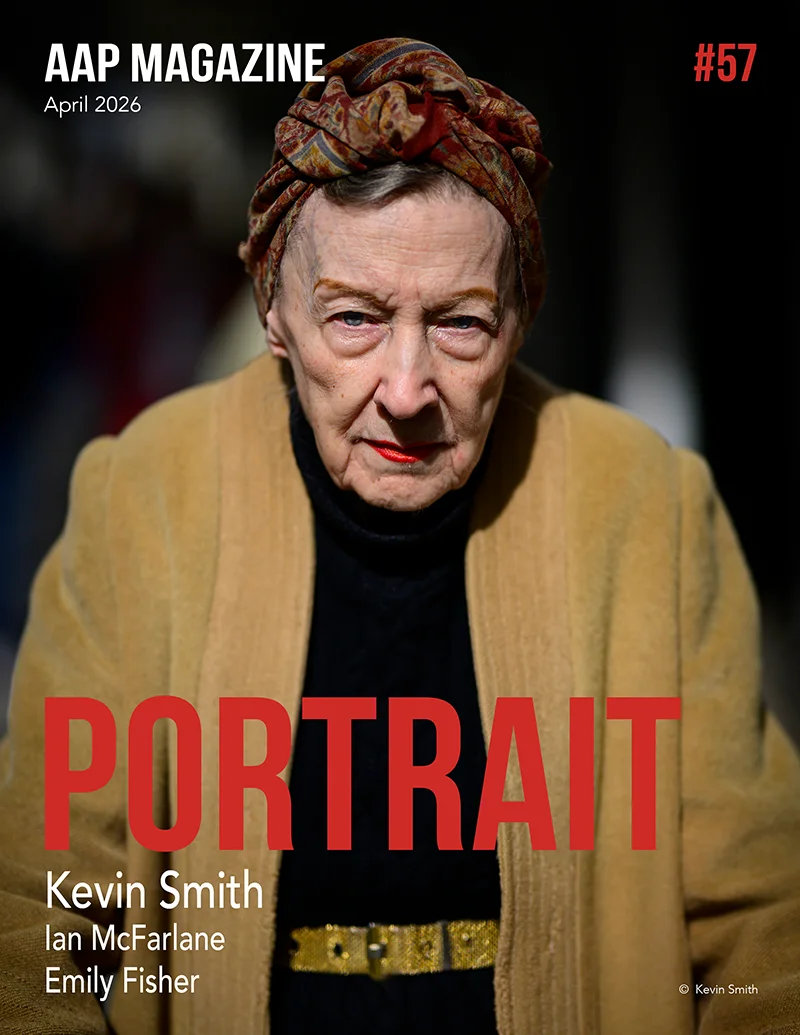
Our printed edition showcases the winners of AAP Magazine call of entries
All About Photo Magazine
Issue #57
Stay up-to-date  with call for entries, deadlines and other news about exhibitions, galleries, publications, & special events.

Exhibitions Closing Soon

Edie 66: Andy Warhol, Jerry Schatzberg, Gerard Malanga, Adam Ritchie
Ki Smith Gallery | New York, NY
From May 28, 2026 to July 05, 2026
Edie 66: Andy Warhol, Jerry Schatzberg, Gerard Malanga, Adam Ritchie brings together film, photography and archival images to revisit one of the most recognizable figures of 1960s New York. On view from May 28 to July 5, 2026, the exhibition centers on Warhol’s Outer and Inner Space, a rare 1966 double-projected film built around Edie Sedgwick and her own image on a television monitor. The setup remains strikingly simple and oddly modern. Sedgwick appears in conversation with a prerecorded version of herself, split across two screens so that her presence is both immediate and fragmented. The effect turned her into one of the Factory’s defining faces, while also anticipating later work in video and mediated portraiture. Warhol’s Cow wallpaper and alternate screen tests of Sedgwick extend that focus, showing how he returned again and again to repetition, surface and image-making as forms of portraiture. Jerry Schatzberg’s photographs shift the tone. Drawn from sessions in 1965 and 1966, they show Sedgwick with a more intimate sense of character, balancing glamour with vulnerability and spontaneity. Where Warhol often kept his distance, Schatzberg’s camera lingers on expression and mood. The result is a fuller picture of Sedgwick not just as a Warhol subject, but as a figure whose style and presence helped define the downtown scene around the Factory. Gerard Malanga’s photobooth images add another layer, capturing Sedgwick in a loose, playful register that reflects the improvisational energy of the circle around Warhol. Adam Ritchie’s photographs of The Velvet Underground, including material from their first Ludlow Street apartment and performances with Sedgwick and Malanga, complete the picture of a tight creative world where music, film and style moved through the same rooms. Together, the works present Sedgwick less as a myth than as a working presence inside a scene that still shapes how the 1960s are remembered. Image: Edie Sedgwick, Super Star, 1966 © Jerry Schatzberg
The Museum of the Old Colony: An Art Installation by Pablo Delano
New Britain Museum of American Art | New Britain, CT
From March 14, 2026 to July 05, 2026
The Museum of the Old Colony: An Art Installation by Pablo Delano, on view at the New Britain Museum of American Art from March 14 to July 5, 2026, is an ambitious, immersive work that challenges how history is constructed, displayed, and absorbed. Conceived as a fictional yet unsettlingly familiar institution, the installation invites visitors to step inside a museum that mirrors the authoritative language of official archives while quietly unraveling their assumptions. Through this layered environment, Delano confronts the enduring realities of colonial power and cultural memory as they relate to Puerto Rico and its complex relationship with the United States. Rather than presenting discrete artworks, Delano assembles a dense constellation of archival photographs, printed matter, moving images, and found objects that function together as a single evolving artwork. Drawing on the visual strategies of ethnographic and historical museums, the installation reveals how narratives are framed, legitimized, and preserved. Humor and irony play a crucial role, softening the surface while sharpening the critique, as familiar museological devices become tools for questioning authority rather than reinforcing it. The title’s double meaning underscores the work’s conceptual depth, referencing both Puerto Rico’s political status as a long-standing colony and a locally produced soft drink embedded in everyday life. This blend of the personal and the political reflects Delano’s own biography and lived experience, grounding broader historical analysis in individual memory. At the New Britain Museum of American Art, the project expands to include materials connected to Connecticut’s Puerto Rican diaspora, weaving regional stories into a global history of displacement, resistance, and cultural persistence. As the largest presentation of the project to date, this installation transforms multiple galleries into a space for reflection and dialogue. It resists closure, encouraging viewers to linger with ambiguity and reconsider what museums choose to show, and what they omit. In doing so, Delano positions art as an active form of historical inquiry—one that does not merely document the past, but interrogates how it continues to shape the present. Image: Previous Installation of 'The Museum of the Old Colony: An Art Installation by Pablo Delano'
Black Photojournalism
Amon Carter Museum of American Art | Fort Worth, TX
From March 15, 2026 to July 05, 2026
Black Photojournalism celebrates the vision, courage, and artistry of more than sixty Black photographers who transformed American visual culture between 1945 and the mid-1980s. Bringing together over 250 images, the exhibition illuminates the essential role of Black photojournalists in chronicling not only the nation’s pivotal social and political changes but also the quiet, profound moments of everyday life. Through their lenses, they captured the depth, dignity, and diversity of Black experience—stories often overlooked or misrepresented in mainstream narratives. Organized by the Carnegie Museum of Art in Pittsburgh, the exhibition draws from a wide network of archives and collections across the United States, including the museum’s own Charles “Teenie” Harris Archive. These photographs highlight the power and creativity of Black-owned and operated media outlets such as the Afro American News, Atlanta Daily World, Chicago Defender, Ebony, and Pittsburgh Courier. In their pages, photojournalists gave visibility to the triumphs and challenges of their communities, using photography as a form of resistance, pride, and cultural preservation. Black Photojournalism honors the photographers who documented the civil rights movement, public celebrations, neighborhood gatherings, and moments of personal strength. Their work reveals a profound understanding of photography not just as documentation but as storytelling—an art that shapes collective memory and reclaims authorship over representation. Designed by artist David Hartt and co-organized by Dan Leers and Charlene Foggie-Barnett, the exhibition embodies a collaborative spirit that bridges past and present voices. Supported by the Terra Foundation for American Art and the National Endowment for the Humanities, this landmark exhibition affirms that the legacy of Black photojournalism is not confined to history—it continues to inspire how we see, remember, and imagine the world today. Image: Charles “Teenie” Harris (1908–1998), A Pittsburgh Courier press operator, possibly William Brown, printing newspapers, possibly for a Midwestern edition, 1954, inkjet print, Carnegie Museum of Art, Heinz Family Fund, 2001.35.3136, © Carnegie Museum of Art, Pittsburgh
MOMENTS IN TIME: Defining Moments in the History of Photography
Museum of Contemporary Art (MOCA) Jacksonville | Jacksonville, FL
From December 13, 2025 to July 05, 2026
Moments in Time: Defining Moments in the History of Photography invites viewers to explore the evolution of photography through highlights from the Museum of Contemporary Art Jacksonville’s permanent collection. This rotating exhibition reveals the depth and diversity of MOCA’s photographic holdings, which now encompass more than 250 works. Tracing key shifts across more than a century, the exhibition celebrates how photography has continually redefined itself—moving from documentary tool to expressive art form, and ultimately to a dynamic language of image-making that reflects our digital age. The exhibition begins in the early twentieth century, when visionaries such as Imogen Cunningham, Edward Curtis, André Kertész, and Edward Weston expanded the possibilities of the medium. Their experiments with light, form, and subject matter helped establish photography as a fine art, bridging realism and abstraction. Their work captures both the texture of daily life and the timeless beauty of composition, marking photography’s first great turning point. The journey continues through the 1970s, a decade of profound transformation when artists embraced photography as a conceptual practice. This period witnessed bold experimentation, challenging the idea of what a photograph could be and how it might communicate. The camera became not just an instrument of observation but a means of personal and political expression. The narrative then extends to the present, where digital technologies, manipulated imagery, and stylistic plurality dominate contemporary practice, reflecting the boundless visual culture of the 21st century. Complementing the museum’s collection are works on loan from local collectors and from the distinguished Sondra Gilman and Celso Gonzalez-Falla Collection. Together, these pieces form a vibrant dialogue across generations, revealing how photography continues to shape—and be shaped by—the ever-changing ways we see, remember, and define our world. Image: Lauren Jack, 'The Colonial Era (the Age of Plastic Series)', 2008, Digital C print, ed. of 20. Gift of Michael and Michele Cavendish, 2013.04.02 © Lauren Jack
Hyphen American: Intersections of Identity
Sheldon Museum of Art | Lincoln, NE
From January 24, 2026 to July 05, 2026
Hyphen American: Intersections of Identity, on view from January 24 through July 5, 2026, examines how artists navigate the layered meanings of belonging in the United States. Timed to coincide with the nation’s 250th anniversary, the exhibition resists a singular definition of “Americanness,” instead foregrounding the lived realities of identities shaped by migration, memory, language, and cultural inheritance. Through works drawn from the museum’s collection, the exhibition proposes that the hyphen is not a division, but a generative space of connection and negotiation. The artists featured in Hyphen American explore how personal histories intersect with broader social narratives. Portraiture, abstraction, documentary strategies, and symbolic forms become tools for articulating experiences of displacement, resilience, and community-building. These works reveal Americanness as something continually formed—through rituals, shared struggles, and acts of self-definition—rather than a fixed or unified ideal. By emphasizing multiplicity over assimilation, the exhibition highlights how difference itself has long been central to the American story. A distinctive feature of the project is its multilingual approach. For the first time, the Sheldon presents both the exhibition and its accompanying publication in four languages: English, Spanish, Vietnamese, and Arabic. This decision reflects the linguistic landscape of Lincoln, Nebraska, and underscores the exhibition’s commitment to accessibility and representation. Language here is more than translation; it becomes a curatorial gesture that acknowledges how meaning shifts across communities and how cultural participation expands when barriers are lowered. Curated by Christian Wurst, Hyphen American extends beyond the gallery walls through a series of public programs developed in collaboration with local community members. Their voices are woven into the exhibition and catalogue, reinforcing the idea that identity is collective as well as individual. Together, the artworks and programs position the museum as a space of dialogue—one that honors complexity, embraces contradiction, and invites viewers to reconsider what it means to see themselves, and others, as American. Image: Binh Danh. Vivian Nguyen, Environmental Studies, UNL, Class of 2014 Archival pigmented print, 2011 40 × 30 inches University of Nebraska–Lincoln, gift of the artist, U-5663.2012

People Make This Place: SFAI Stories
San Francisco Museum of Modern Art - SFMOMA | San Francisco, CA
From July 26, 2025 to July 05, 2026
Exploring moments from the rich history of the San Francisco Art Institute (SFAI) — before its closure, the West Coast’s oldest fine art school — this exhibition spotlights works by more than 50 SFAI alumni and former faculty included in the museum’s collection. The presentation underscores the school’s crucial role in fostering creativity and experimentation, featuring works across media since the post–World War II era by artists like Ansel Adams, Joan Brown, Miguel Calderón, Imogen Cunningham, Mike Henderson, Candice Lin, and Carlos Villa, among others. The exhibition also includes a dynamic and quirky range of archival materials drawn from the SFMOMA Library and the SFAI Archive. These encompass ephemera from the founding of the school’s photography department, posters for 1950s Beat-era galleries run by artist alumni, student newspapers, and flyers from the punk and new wave music scenes of the 1970s. Taking its title from a line in the final 2022 commencement speech by faculty member and alumnus Dewey Crumpler, People Make This Place is a collaborative effort across the museum in partnership with the SFAI Legacy Foundation + Archive.
Gestures of Care, Resilience, and Connection
CPW - Center for Photography at Woodstock | Kingston, NY
From May 30, 2026 to July 05, 2026
The Community Gallery at CPW opens with Gestures of Care, Resilience, and Connection, a group exhibition by the Women Photographers Collective of the Mid-Hudson Valley that brings together sixteen artists working across different photographic approaches. On view from May 30 to July 5, 2026, the show frames photography as a way to register support, attention and shared experience at a time when many people feel isolated or divided. The exhibition focuses on ordinary but revealing moments: family life, local surroundings, small acts of solidarity and collective action. Rather than presenting a single theme or visual style, it brings together distinct voices that speak to one another through common concerns. The result is a portrait of community as something active and unfinished, built through relationships rather than fixed identity. The participating artists include Joan Barker, Ana Bergen, Shari Diamond, Jill Enfield, Judit German-Heins, Karen Ghostlaw, Lori Grinker, Morgan Gwenwald, Maria Fernanda Hubeaut, Kay Kenny, Dana Matthews, Meryl Meisler, Adina Scherer, Carla Shapiro, Kate Warren and Ruth Wetzel. Their work reflects a range of perspectives and subjects, from intimate domestic scenes to broader social observations. Some images are rooted in personal life, while others look outward toward shared spaces and public gestures. The exhibition also marks an important step for CPW’s Community Gallery, a new space dedicated to local groups, artist collectives and nonprofit projects. The gallery is designed as a rotating venue for short-run exhibitions, giving room to voices from different parts of the region. That structure fits the spirit of the show, which places emphasis on exchange, visibility and the value of making work together. By gathering these photographs under one roof, Gestures of Care, Resilience, and Connection presents community not as a slogan, but as a set of everyday actions and relationships that continue to hold shape under pressure. Image: © Kate Warren, courtesy of the Center for Photography at Woodstock
Beyond Boundaries: Three Decades of Contemporary Chinese Art at the Smart
Smart Museum of Art | Chicago, IL
From March 29, 2026 to July 05, 2026
Beyond Boundaries: Three Decades of Contemporary Chinese Art at the Smart traces a layered history of artistic experimentation and critical inquiry at the Smart Museum of Art from March 29 to July 5, 2026. Rooted in the University of Chicago’s longstanding engagement with contemporary Chinese art, the exhibition reflects a sustained effort to position these practices within a global conversation. Since the late 1990s, curatorial initiatives led by Wu Hung have reshaped how such work is studied and understood, opening new perspectives on transnational artistic exchange. Drawing from the museum’s collection as well as archival material and recent acquisitions, the exhibition unfolds as both a retrospective and a living archive. Early moments of experimentation resonate alongside more recent works, revealing an ongoing negotiation between continuity and change. The reference to Transience, the influential 1999 exhibition, lingers throughout, emphasizing the importance of ephemerality, process, and conceptual risk in shaping the field. What emerges is not a fixed narrative but a constellation of practices that resist singular definition. The artists gathered here engage with boundaries in multiple forms—geographical, political, and material. Figures such as Ai Weiwei and Xu Bing interrogate systems of authority and language, while others like Song Dong and Xing Danwen turn toward personal memory and urban transformation. Across media ranging from installation to photography and video, these works explore how individuals move through rapidly shifting environments. Their approaches often embrace fragmentation, repetition, and displacement, reflecting broader conditions of uncertainty and adaptation. Rather than presenting contemporary Chinese art as a unified category, Beyond Boundaries highlights its internal diversity and its capacity for reinvention. The exhibition invites viewers to consider how artistic practices respond to constraint not only by resisting it, but by transforming it into new forms of expression. In this space, boundaries appear less as limits than as sites of tension and possibility, where meaning remains in flux and history continues to unfold. Image: Wang Wei, 1/30th of a Second Underwater, 1999, chromogenic transparencies on translucent polyester base. Smart Museum of Art, The University of Chicago, Purchase, Gift of Carl Rungius, by exchange, 2001.121d ©Wang Wei
Nature of Nordic Woman
Isabel Sullivan Gallery | New York, NY
From June 18, 2026 to July 09, 2026
Nature of Nordic Woman at iS—G in Tribeca brings together photography, performance and conversation to examine what lies beneath the familiar image of Nordic calm. On view from June 18 to July 9, 2026, the exhibition is presented by Isabel Sullivan Gallery and developed by photographer Meeri Koutaniemi, psychologist Iida Mäkikallio and performance artist Ida-Maria Martela. The project starts from a sharp question: if Finland is repeatedly ranked among the world’s happiest countries, what does that say about the emotional lives of women living there? The exhibition does not settle for easy answers. Instead, it looks at the cost of self-suppression, and at the ways cultural expectations around composure, kindness and restraint can shape the body as much as the mind. Koutaniemi’s black-and-white photographs give the subject a direct visual frame, while Mäkikallio’s work brings a psychological reading to questions of embodiment, desire and emotional release. Martela’s performances add another layer, turning the exhibition into a live encounter rather than a static display. Together, the three practices create a setting where vulnerability is not treated as weakness, but as a site of pressure and possibility. The show’s central argument is clear: anger, eros and desire can function as forms of recovery rather than disruption. That idea gives the exhibition its edge, especially at a moment when women’s emotional labor remains widely normalized and rarely examined with this degree of specificity. The title points to a broader tension between nature as landscape and nature as condition. Nordic identity often carries associations of stillness, distance and balance, yet Nature of Nordic Woman looks at the human costs of maintaining that image. It offers a study of emotional freedom framed through photography, but rooted in psychology and performance. The result is a compact exhibition with a strong through line: not a portrait of serenity, but a closer look at what that serenity can conceal. Image: Feral, 2026 © Meeri Koutaniemi
Marie Tomanova: Three Empty Weeks in July
Harkawik | New York, NY
From June 12, 2026 to July 11, 2026
Marie Tomanova: Three Empty Weeks in July opens at Harkawik on June 12 and runs through July 11, 2026, marking the gallery’s first exhibition with the Czech-born, New York-based artist. The series grew out of a project Tomanova began on January 1, 2022, and it settles into a body of work that is both intimate and carefully built, using self-portraiture to test the limits of documentary language. The photographs show Tomanova repeatedly turning the camera on herself, often in crouched or folded poses that make the body look guarded, hidden or interrupted. The images are set against landscapes, buildings and fragments of interior space, but the settings rarely read as straightforward backdrops. Instead, they blur into the figure through double exposure and layered instant film, making it hard to separate person from place. Shot with a Fujifilm Instax Square SQ6, the pictures use the small format’s imperfections and overlaps as part of their structure. Fruit, flowers and foliage appear often, sometimes covering the body and sometimes adding a blunt, almost theatrical charge to the frame. Those elements give the work a visual echo of older ideas about purity, beauty and femininity, while also pushing against them. The resulting pictures are not polished confessions. They are posed, repeated and self-aware, built as a daily practice rather than a single statement. Tomanova’s work sits close to the history of artists such as Francesca Woodman, Nan Goldin, Melissa Shook, Friedl Kubelka and Yurie Nagashima, but it keeps its own sharp edge. What matters here is not only the image itself, but the uneasy feeling it creates: closeness mixed with distance, exposure mixed with concealment. That tension gives Three Empty Weeks in July its force, making the series less a record of facts than a study in how the self is staged, repeated and revised. Image: January 3, 2022. Unique Fujifilm Instax Square print © Marie Tomanova
Elger Esser: My Days at Ray’s
Rose Gallery | Santa Monica, CA
From May 09, 2026 to July 11, 2026
My Days at Ray's marks a subtle but decisive turn in Elger Esser’s practice, where landscape, memory, and material presence meet in a single luminous field. Presented at ROSEGALLERY, the exhibition brings together recent works on silvered copper and introduces painted photographs on silver-plated copper, a format that pushes his images beyond reproduction and into the realm of singular objects. The result feels less like a conventional photograph than a surface in suspension, alive to light, touch, and time. Esser has long been drawn to the quiet authority of water, sky, and horizon, but here that sensibility extends inward, toward domestic space and private memory. The exhibition takes its point of departure from a 2008 residency in the mid-century modern pool house of songwriter Ray Evans, where Esser photographed rooms, corners, and the view over Los Angeles with the same patient attention he brings to open terrain. Those interior images carry the calm of a diary entry, registering atmosphere as much as architecture. They are shaped by the influence of Edward Weston’s travel notebooks, yet they remain unmistakably Esser’s: restrained, reflective, and steeped in a sense of duration. The new copper works deepen that material intelligence. Dry ink, hand-applied oil paint, shellac, and varnish alter the photographic surface until it reads as both image and artifact. The metal does not simply support the picture; it participates in it, catching and returning light in ways that make each work feel contingent on the viewer’s movement. Landscape becomes less a view than a condition, a place where description slips into emotion. In My Days at Ray's, Esser refines his long-standing interest in the poetics of stillness. The works hold together the vastness of the American West and the intimacy of a lived interior, suggesting that memory survives not only in places we cross, but also in the rooms where light lingers and time leaves its trace. Image: Elger Esser, Capbreton II, 2025 Elger Esser Capbreton II, 2025 Mixed Media: silver-plated copper plate, direct print, shellac 60 x 80 x 5 cm © Elger Esser, courtesy of the ROSE Gallery
Callahan, Gowin and Sommer
Etherton Gallery | Tucson, AZ
From April 14, 2026 to July 11, 2026
Callahan, Gowin and Sommer, presented at Etherton Gallery from April 14 through July 11, 2026, brings together three defining figures of twentieth-century American photography in a tightly focused exhibition built on dialogue, influence, and shared inquiry. Centered on the work of Emmet Gowin, the presentation traces a lineage that connects his formative years under Harry Callahan with his enduring friendship with Frederick Sommer, offering a rare opportunity to consider their practices in direct conversation. Harry Callahan’s contribution anchors the exhibition in the rigor of photographic modernism. Largely self-taught, Callahan developed a disciplined, daily approach to image-making that transformed familiar subjects into sites of formal experimentation. Whether photographing his wife and daughter or the streets of Chicago, he pursued variations in light, framing, and repetition, building a visual language rooted in precision and restraint. His influence extended beyond his own work through decades of teaching, where pedagogy and practice remained closely intertwined. Emmet Gowin’s photographs reflect both continuity and divergence. His early images of his wife Edith and her family in Virginia reveal an intimate, attentive gaze shaped by personal connection and spiritual reflection. This sensibility later expanded into aerial views of altered landscapes across the United States, where patterns of agriculture, industry, and environmental disruption unfold with quiet intensity. Gowin’s work holds a tension between beauty and unease, suggesting that careful observation can reveal both harmony and fracture within the same frame. Frederick Sommer introduces a more experimental and interdisciplinary dimension. Working largely in the Arizona desert, he navigated between documentation and invention, producing images that range from stark desert studies to intricate assemblages of found materials. His engagement with Surrealism and his broader artistic practice—encompassing drawing, collage, and writing—infuse his photographs with a sense of intellectual and visual curiosity that resists categorization. Together, the three photographers demonstrate how the medium evolves through sustained attention, exchange, and reinterpretation. Callahan, Gowin and Sommer reveals photography not as a fixed language, but as a continuous process of looking, questioning, and transforming the ordinary into something enduring. Image: © Emmet and Edith Gowin, Nancy, Danville, Virginia, 1969
Advertisement
AAP Magazine #59 Shapes
Win a Solo Exhibition in Aug
AAP Magazine #59 Shapes
Call for Entries
AAP Magazine #59 Shapes
Publish your work in our printed magazine and win $1,000 cash prizes

Related Articles

All About Photo Presents ’Where the Earth Remembers’ by Oliver Klink
All About Photo is pleased to present Where the Earth Remembers, a powerful new online solo exhibition by award-winning fine art photographer Oliver Klink. Through intimate black-and-white photographs created across rural communities in Central and Eastern Europe, Klink explores the enduring relationship between people, memory, faith, and the land.
Huxley-Parlour Presents ‘Select Works, 1962-2019’ by Joel Meyerowitz
Huxley-Parlour Gallery is thrilled to announce Select Works, 1962-2019, a major exhibition celebrating the enduring legacy of world-renowned photographer Joel Meyerowitz. Marking the artist’s fourth solo show with the gallery, this carefully curated collection brings together twenty-five seminal photographs. Spanning a remarkable six-decade career, the exhibition tracks the evolution of Meyerowitz's influential photographic voice and his pioneering approach to the medium, offering viewers an intimate look at how one of masters of modern photography transformed the way we view the world.
CPW Upstate Photography Biennial
This summer, CPW (Center for Photography at Woodstock) will debut the inaugural Upstate Photography Biennial, a major new exhibition celebrating the thriving photographic arts scene across upstate New York. Bringing together the work of 39 artists, the landmark exhibition offers a compelling snapshot of the region’s creative vitality and its growing influence on contemporary photography.
Beneath the Surface: Mining and American Photography
Beneath the Surface to feature some 150 photographs by 100 artists spanning 185 years of society and industry in the United States
photo basel 2026 Celebrates the Expanding Language of Photography
Switzerland’s Premier Photography Event Returns for Its 11th Edition. Shifting Frames: Photo Basel 2026 Redefines the Limits of Fine Art Photography A Convergence of Legends: Curating 450 Masterworks
All About Photo Presents ’Fading Shehuo’ by Chris Yan
All About Photo is proud to present Chris Yan as the featured artist of our upcoming solo exhibition with his project Fading Shehuo, showcased exclusively on All About Photo. A project preserving the Spirit of Rural China Through Street Photography.
Belfast Photo Festival 2026: Horizons
The 2026 edition takes visitors towards new ‘Horizons’, a theme that positions photography at a critical threshold in an age of AI-generated imagery, automation and algorithmic seeing. The festival returns as the medium undergoes profound transformation and its claims to truth, trust, authorship and materiality are increasingly being questioned.
Meryl Meisler: Queer-Friendly Nightlife Now
Nearly five decades after documenting disco-era revelry, photographer Meryl Meisler returns with a bold new body of work capturing the pulse of contemporary queer nightlife—its grit, glamour, and enduring sense of community. Meryl Meisler: Queer-Friendly Nightlife Now premieres the CPW's inaugural Upstate Photography Biennial, a new exhibition series featuring 39 artists from across the region, opening May 30, 2026.
Prix Pictet Exhibition Makes U.S. Debut at MoCP
The Museum of Contemporary Photography at Columbia College Chicago (MoCP) will present Prix Pictet Storm from May 29 through August 22, 2026, marking the U.S. debut of the internationally touring exhibition dedicated to photography and sustainability. Organized in partnership with Prix Pictet — widely recognized as the world’s leading award focused on photography and sustainability — the exhibition brings together twelve exceptional contemporary photographers whose work explores environmental instability, political unrest, social tension, and the fragile state of the modern world.
Call for Entries
AAP Magazine #59 Shapes
Publish your work in our printed magazine and win $1,000 cash prizes