All about photo.com: photo contests, photography exhibitions, galleries, photographers, books, schools and venues.
FINAL CHANCE to enter All About Photo Awards: $5,000 Cash Prizes - Juror Steve McCurry

Evy Huppert: Wild Spirits

From January 03, 2020 to March 01, 2020
Share
Evy Huppert: Wild Spirits
49 Flat Street
Brattleboro, VT 5301
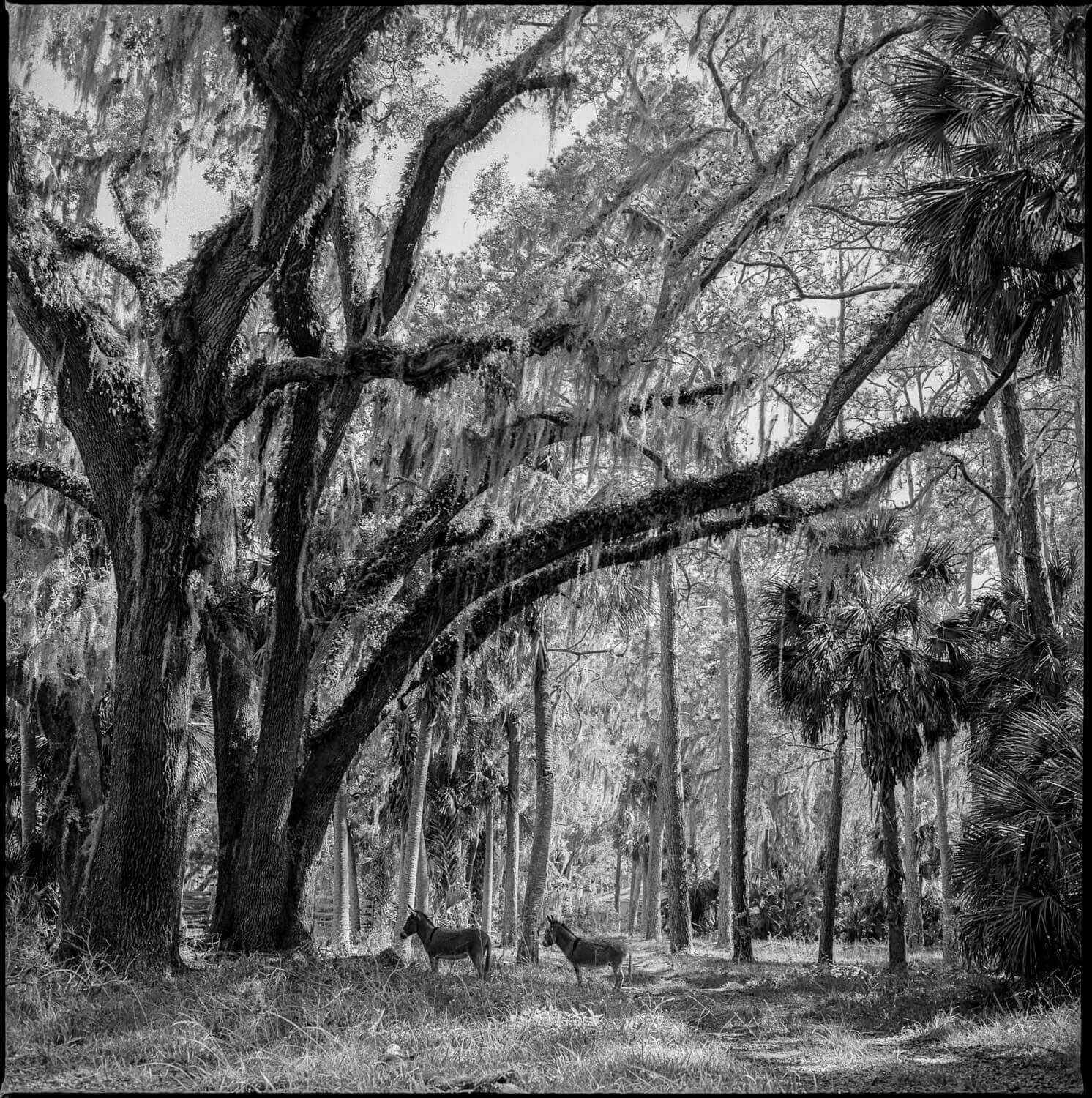
I made this work on journeys south to untamed places in the Sea Islands of Georgia with a tribe of like-minded artists. The images and characters come from dreams and memories the land drew out from my personal mythology. Timeless, yet inhabited for millennia, the islands carry a spiritual presence of deep wildness palpable in the light and shadows; the ancient alligators and birds, the feral pigs and donkeys, and the artifacts of their existence lying everywhere. My photographs explore the emotions and spiritual experiences that the land and the light evoked: vulnerability, captivity, lost-ness, sanctuary, and wildness set free.

Photographing in collaboration with the other artists, I conceived of these images made on black and white film as stills taken from a movie. Each is an instant of a longer feature, of a fuller picture not seen but understood to exist. There is a narrative between the frames and a soundtrack within us that I aim to invoke. What we imagine might be the rest of the story is as much a part of the photograph as what we believe we are seeing.
Our printed edition showcases the winners of AAP Magazine call of entries
All About Photo Magazine
Issue #53
Stay up-to-date  with call for entries, deadlines and other news about exhibitions, galleries, publications, & special events.

Exhibitions Closing Soon

Of the Earth: Connections
Queens Museum | Queens, NY
From October 19, 2025 to February 02, 2026
Drawing together photographs and installations from both his celebrated and lesser-known series, Lyle Ashton Harris: Our first and last love charts new connections across the artistic practice of Lyle Ashton Harris (b. 1965, Bronx, NY). The exhibition explores Harris’s critical examination of identity and self-portraiture while tracing central themes and formal approaches in his work of the last 35 years. The artist’s recently-completed Shadow Works anchor the exhibition. In these meticulous constructions, photographic prints are set within geometric frames of stretched Ghanaian funerary textiles, along with shells, shards of pottery, and cuttings of the artist’s own hair. Our first and last love follows the cues of the Shadow Works’ collaged and pictured elements—which include earlier artworks and reference materials, personal snapshots, and handwritten notes—to shed light on Harris’s layered approach to his practice. Harris’s work engages with broad social and political dialogues while also speaking with revelatory tenderness to his own communities, and to personal struggles, sorrows, and self-illuminations. Groupings centered around singular Shadow Works will expand upon these multiple throughlines, including Harris’s continued examination of otherness and belonging; the framing and self-presentation of Black and queer individuals; violence as a dark undercurrent of intimacy and desire; tenderness and vulnerability; and notions of legacy—both inherited and self-defined. Lyle Ashton Harris: Our first and last love is co-organized by the Queens Museum and the Rose Art Museum, Brandeis University, and is co-curated by Lauren Haynes, Director of Curatorial Affairs and Programs, Queens Museum and Caitlin Julia Rubin, Associate Curator, Rose Art Museum. Image: Shane Weeks, "Retention", 2024. Photograph. Courtesy the artist. © Shane Weeks
In a Social Landscape: Photography in the United States after 1966
The Art Museum at the University of Kentucky | Lexington, KY
From September 09, 2025 to February 07, 2026
Toward a Social Landscape revisits a landmark moment in American photography, tracing the evolution of the medium as a tool for personal and social expression. Originally curated by Nathan Lyons in 1966 at the George Eastman House in Rochester, New York, the exhibition highlighted photographers who transformed everyday moments into charged, emotionally resonant images. As Duane Michals noted, “when a great photographer does infuse the snapshot with his personality and vision, it can be transformed into something truly moving and beautiful.” This perspective remains at the heart of the current presentation. The UK Art Museum’s installation draws from a rich collection of works by photographers included in or inspired by Lyons’s original exhibition, including Ruth Bernhard, Bruce Davidson, Lee Friedlander, Danny Lyon, Alen MacWeeney, Ralph Eugene Meatyard, Duane Michals, Peter Turnley, and Garry Winogrand. Their images go beyond simple documentation, capturing dynamic relationships between the photographer and the observed world. Each frame is a negotiation between subject, context, and the artist’s own presence, revealing deeply personal and often poignant narratives within everyday scenes. Installed on the floor above Self and Others: Japanese Photography after 1968, the exhibition offers a dialogue between American and Japanese photographic practices in the 1970s. Visitors can explore how photographers across the Pacific responded to comparable social, cultural, and artistic currents, each developing distinct yet parallel visual languages. This juxtaposition underscores the emergence of an international contemporaneity in photographic practice, highlighting shared concerns in portraiture, street photography, and documentary work. Presented in conjunction with the 2025 Louisville Photo Biennial, Toward a Social Landscape celebrates photography as both a personal and collective lens. It invites viewers to consider how photographers shape meaning, infuse emotion, and create enduring images that continue to resonate decades later. By juxtaposing intimate vision with social context, the exhibition reaffirms the enduring power of photography to illuminate human experience. Image: Duane Michals, Untitled from Alice’s Mirror, 1974, gelatin silver print. Collection of the UK Art Museum, purchase: The Robert C. May Photography Fund.
Looking at LIFE
Staley-Wise Gallery | New York, NY
From December 11, 2025 to February 07, 2026
LIFE Magazine, founded in 1936 by Henry Luce, transformed the way Americans experienced the world through the power of photography. With a pioneering focus on photojournalism, LIFE devoted more space to images than words, capturing both monumental events and the subtleties of everyday life. From political upheavals and scientific breakthroughs to theater, art, and fashion, the magazine chronicled the defining moments of the 20th century with a visual immediacy that resonated with readers nationwide. Beyond covering global affairs, LIFE also celebrated ordinary life through features such as LIFE goes to a …, which documented high school graduations, debutante balls, and other milestones familiar to its readership. In an era before instant digital communication, LIFE provided a window into both the extraordinary and the commonplace, connecting audiences to distant events and to the rhythms of their own communities. Each issue offered a carefully curated narrative of culture, identity, and history, told primarily through the lens of its photographers. This exhibition draws from LIFE’s archives, as well as the personal collections of the magazine’s legendary photographers, including Margaret Bourke-White, Alfred Eisenstaedt, Harry Benson, Nina Leen, Andreas Feininger, Loomis Dean, Abe Frajndlich, Carl Mydans, and John Dominis. Their work reflects the magazine’s dual mission: to document history and to illuminate the human experience with both artistry and authenticity. The photographs on view reveal LIFE’s ability to capture fleeting moments, whether a quiet domestic scene or a historic political event, and to convey them with enduring impact. Although weekly publication ceased in 1972, LIFE continued as a monthly magazine until 2000, releasing occasional special editions thereafter. In 2024, the rights to LIFE were acquired with plans to resume regular print issues, reaffirming its relevance in the contemporary media landscape. The magazine’s legacy endures as a landmark in photographic storytelling and as a cultural mirror reflecting the depth and diversity of 20th century American life. Image: Alfred Eisenstaedt VJ Day, Times Square, NY, August 14, 1945 © Alfred Eisenstaedt
Radial Survey Vol.4
Silver Eye Center for Photography | Pittsburgh, PA
From November 06, 2025 to February 07, 2026
Silver Eye Center for Photography presents Radial Survey Vol.4, the organization’s flagship biennial exhibition, showcasing a group of artists redefining contemporary photography with experimental, thought-provoking approaches. This fourth edition emphasizes urgent, innovative practices that speak to the concerns and conditions of our current moment. The exhibition brings together six artists working within 300 miles of Pittsburgh, each nominated by participants from the previous edition and selected by Silver Eye’s curatorial team. Their work reflects a commitment to process, inquiry, and ongoing exploration, rather than predetermined outcomes, allowing photography to become a site of both personal and collective investigation. Featured artists include Amelia Burns from Detroit, McNair Evans from Richmond, Christine Lorenz from Pittsburgh, Juan Orrantia from Rochester, Ian John Solomon from Detroit, and SHAN Wallace from Baltimore. Each brings a distinctive perspective to the medium, exploring themes that range from identity and memory to environment, social structures, and the intersections of daily life with broader cultural narratives. Through their varied practices, the artists demonstrate how photography can interrogate the familiar, reimagine experience, and challenge traditional notions of representation. The exhibition celebrates risk-taking, experimentation, and the ways in which photographic work can remain open-ended and generative, reflecting the dynamism of contemporary artistic practice. Radial Survey Vol.4 is accompanied by an extensive catalog featuring original essays by Tara Fay Coleman, Jessica Lynne, Matthew Newton, Silver Eye Executive Director Leo Hsu, and Deputy Director & Director of Programs Helen Trompeteler. This publication further contextualizes the artists’ work and offers insight into the evolving landscape of experimental photography, emphasizing the exhibition’s commitment to dialogue, discovery, and the future of the medium. Image: Christine Lorenz, KS-5862, 2025. Courtesy of the artist. © Christine Lorenz
Polo Silk: 2025 MLK Club Detour 2
MARCH | New York, NY
From December 11, 2025 to February 07, 2026
Polo Silk 2025 MLK Club Detour 2, on view from December 11 to February 7, 2026, brings together a vibrant selection of photographs by New Orleans–based artist Selwhyn Sthaddeus Terrell, widely known as Polo Silk. Drawn from images made inside the legendary nightclub Club Detour 2 during the mid-1990s, the exhibition revives the exuberant spirit of a formative moment in the city’s cultural history. These photographs pulse with the energy of a so-called “Golden Era,” when music, fashion, and community converged in spaces built for collective release and self-invention. Rooted in the visual language of family albums and fashion magazines, Polo Silk’s photography occupies a space between personal memory and cultural documentation. Friends, relatives, musicians, and regular club-goers step confidently before the camera, adorned in Adidas tracksuits, Polo Ralph Lauren ensembles, Coogi sweaters, football jerseys, and polished loafers. Style operates as both armor and expression, signaling belonging, aspiration, and pride. The images reveal a community acutely aware of its own visibility, using dress and posture to claim presence and individuality within a shared social scene. Club Detour 2 emerges as more than a nightclub; it is portrayed as a crossroads where generations, neighborhoods, and creative forces intersected. Airbrushed backdrops referencing hip-hop lyrics, current events, and local iconography frame the subjects, offering a theatrical stage for personal myth-making. Within these scenes, future stars of New Orleans’ music landscape appear alongside neighborhood legends, capturing a moment before broader recognition, when talent circulated freely within the room itself. The exhibition also underscores the profound archival value of Polo Silk’s work. Having survived the devastation of Hurricane Katrina, these photographs now hold added significance, often serving as the only surviving images of individuals lost to time and circumstance. Polo’s ongoing practice of gifting framed portraits back to families transforms photography into an act of care, remembrance, and reciprocity. In this presentation, the images resonate as both historical record and living memory, honoring nights once lived intensely and now carried forward through photographs that continue to bind a community together. Image: Polo Silk, BUCKJUMP TIME, c. 1995. Chromogenic print © Polo Silk
Time Exposed: Hiroshi Sugimoto’s Seascapes
Parrish Art Museum | Water Mill, NY
From September 13, 2025 to February 08, 2026
Time Exposed: Hiroshi Sugimoto’s Seascapes, on view at the Parrish Art Museum from September 13, 2025 through February 8, 2026, presents one of the most meditative bodies of work in contemporary photography. Drawn from a decade-long pursuit that began in 1980, this exhibition invites viewers to slow down and contemplate the elemental meeting of sea and sky, a horizon that has remained unchanged throughout human history. For Sugimoto, the ocean is both subject and metaphor, a timeless presence that anchors memory, perception, and being. Traveling to distant coastlines across the globe, Sugimoto photographed oceans that have witnessed the passage of civilizations, wars, and migrations. From the Atlantic to the Pacific, from the Adriatic to the Tasman Sea, each image shares the same restrained composition: water below, sky above, divided by a nearly perfect horizon line. Yet within this apparent sameness lies infinite variation. Shifts in light, atmosphere, and weather transform each photograph into a unique meditation on time and impermanence. Using a large-format, nineteenth-century camera and black-and-white film, Sugimoto embraces a deliberately traditional photographic process. Long exposures allow subtle movements of water and air to register on the film, creating images that feel suspended between stillness and motion. Some seascapes appear crystalline and sharply defined, while others dissolve into mist, where sea and sky nearly merge. The absence of land, figures, or man-made elements intensifies the sense of quiet and encourages a contemplative mode of viewing. Seen together, the fifty-one photolithographs form a visual rhythm rather than a linear narrative. Repetition becomes a tool for reflection, reminding viewers that while the world accelerates, certain experiences remain constant. Time Exposed: Hiroshi Sugimoto’s Seascapes offers not spectacle, but solace—an encounter with the sublime that reconnects us to nature’s enduring presence and to photography’s capacity to reveal the profound within the seemingly simple. Image: Hiroshi Sugimoto (Japanese, b. 1948). Sea of Japan, Oki, 1987, photolithograph, 9 ½ x 12 in. Parrish Art Museum, Water Mill, New York, Gift of the Joy of Giving Something, Inc., 2022.7.73. © Hiroshi Sugimoto
Ken Ohara: CONTACTS
Whitney Museum of American Art | New York, NY
From October 10, 2025 to February 08, 2026
In 1974, photographer Ken Ohara embarked on an experiment that transformed the act of image-making into a collective gesture of trust and chance. Living in New York City but born in Tokyo in 1942, Ohara began what he called a photographic chain letter—an invitation sent to strangers chosen randomly from the phone book. Each received a preloaded camera with simple instructions: take photographs of yourself, your family, and your surroundings, then return the camera along with the name of the next participant. Over two years, this modest device passed through a hundred hands across thirty-six states, traveling from Hawai’i to the Bronx, carrying with it fragments of countless unseen lives. The resulting project, titled CONTACTS, emerged amid the turbulence of 1970s America—an era marked by both disillusionment and transformation. Through this process, Ohara relinquished authorship, replacing the single photographer’s gaze with the plural vision of a nation in flux. What he gathered was not a documentary in the traditional sense, but a collective self-portrait of intimacy and distance, chaos and connection. Each roll of film became a diary of a moment in time, revealing the textures of domestic life, friendship, and solitude across vastly different geographies. The title CONTACTS resonates on multiple levels. It recalls the photographic contact sheet—a sequence of small images that reveal the rhythm and accidents of seeing—while also invoking the human touch at the project’s core. The selected enlarged contact sheets displayed in chronological order form a visual map of encounter and exchange. Through repetition, simplicity, and surrender, Ohara created what he described as a photography of possibility—an image of America shaped not by its surface unity, but by the unpredictable beauty found in its multiplicity of voices. Image: Ken Ohara, CONTACTS 47, Carr, San Francisco, California, 1974–1976. Gelatin silver print, 19 13/16 × 23 3/4 in. (50.3 × 60.3 cm). Whitney Museum of American Art, New York; purchase with funds from the Photography Committee 2025.37.47. © Ken Ohara
Engaging the Elements: Poetry in Nature
The Baltimore Museum of Art | Baltimore, MD
From September 17, 2025 to February 08, 2026
This focus exhibition explores artistic engagement with the natural environment as a source of creative inspiration worth celebrating and protecting. Approximately 25 photographs, prints, drawings, and textiles illustrate the elements of air, water, earth, and fire against broader themes of ecological awareness and preservation. These range from how artists have used visual language to convey the act of locating oneself in nature; works that depict natural forms through the physical integration of environmental components; and artists’ commentary on sites of environmental disaster, the socio-political ramifications of human impact, and the potential of symbiotic healing for this planet and its occupants. Presented as part of the Turn Again to the Earth environmental initiative. Curated by Andaleeb Badiee Banta, BMA Senior Curator of Prints, Drawings, and Photographs.
Tengo Lincoln Park en mi Corazón: Young Lords in Chicago
Depaul Art Museum | Chicago, IL
From September 11, 2025 to February 08, 2026
Tengo Lincoln Park en mi Corazón: Young Lords in Chicago revisits a pivotal moment in the city’s history, tracing the transformation of the Young Lords Organization (YLO) from a local street gang into a powerful force for social justice. Set against the backdrop of Lincoln Park’s gentrification and urban renewal during the 1950s and 1960s, the exhibition captures the resilience of Chicago’s Puerto Rican community as it confronted displacement and fought for recognition, dignity, and self-determination. Through an array of archival materials, photographs, murals, and prints, the exhibition reveals how activism took shape within everyday life. The works of Carlos Flores, Ricardo Levins Morales, and John Pitman Weber—alongside newly commissioned pieces by Sam Kirk—trace a visual history of collective resistance. At the heart of the presentation, a multimedia installation by Arif Smith with Rebel Betty invites visitors to experience the emotional and cultural landscape of the movement, transforming memory into an immersive act of witness. A central concept explored throughout is counter-mapping: the act of redrawing the city through the eyes of those who lived its hidden histories. These maps reclaim space and voice, charting a geography of belonging that challenges the erasures of official narratives. They serve as tools of empowerment, reminding audiences that place, culture, and struggle are intertwined. One of the most defining moments in this story came in May 1969, when the Young Lords occupied the Stone Administration Building at McCormick Seminary—now part of DePaul University. This act of defiance became a lasting symbol of protest and community action. Today, a public plaque marks the site, anchoring the exhibition’s reflection on memory, justice, and legacy. Curated by DePaul University Professor Jacqueline Lazú and organized by the DePaul Art Museum, Tengo Lincoln Park en mi Corazón stands as both tribute and testimony—an enduring reminder of how collective resistance can reshape the city’s heart. Image: Young Lords members protesting the Vietnam War in a march from Lincoln Park to Humboldt Park, 1969. ST-70004742-0005, Chicago Sun-Times collection, Chicago History Museum.
Gregory Crewdson: Eveningside
Taubman Museum of Art | Roanoke, VA
From September 04, 2025 to February 08, 2026
Gregory Crewdson has long stood at the crossroads of photography and cinema, crafting images that are at once meticulously staged and hauntingly ambiguous. Over the past three decades, he has created a distinct visual language rooted in mystery, emotion, and the subtle drama of the everyday. Through elaborate sets, hand-built interiors, and carefully controlled lighting, Crewdson transforms ordinary American settings—often small towns in the Northeast—into dreamlike spaces where the familiar becomes strange and the mundane turns mythic. His recent series, Eveningside (2021–2022), marks a striking evolution in his work. Rendered entirely in black and white, these photographs evoke a cinematic melancholy, recalling both the shadows of film noir and the rich tonal traditions of classic photography. Each image is created with the precision of a film production, involving large crews, complex lighting, and deliberate choreography. Yet the result is a single frozen moment—a still that suggests an untold story, leaving viewers to imagine what exists beyond the frame. Presented at the Taubman Museum of Art, Eveningside invites audiences into a quiet, surreal world of solitude and beauty. The figures who inhabit these scenes seem both grounded and otherworldly, suspended in moments of introspection or longing. Crewdson’s art asks us to slow down, to feel the emotional weight of stillness, and to consider how light itself can tell a story. Born in Brooklyn and now based in western Massachusetts, Crewdson is a professor and the Director of Graduate Studies in Photography at the Yale School of Art. His influential career—spanning works such as Twilight, Beneath the Roses, and Cathedral of the Pines—has redefined what a photograph can be: a fragment of fiction that captures the quiet intensity of life’s most elusive moments. Image: Madeline’s Beauty Salon, 2021-22, digital pigment print, © Gregory Crewdson, Courtesy of the Artist
Deadbeat Club, The Californians: Ian Bates, Tracy L. Chandler, and Janet Delaney
The Center for Photographic Art (CFPA) | Carmel, CA
From January 10, 2026 to February 08, 2026
The exhibition Deadbeat Club, The Californians at the Center for Photographic Art offers a compelling portrait of California through the lenses of three distinct photographers: Ian Bates, Tracy L. Chandler, and Janet Delaney. Though each artist follows their own path, the show weaves their works together into a collective reflection on identity, place, and the shifting cultural landscape of the Golden State. Ian Bates, based in the San Francisco Bay Area, explores the contradictions of human nature and how individuals engage with their environments. His images often register subtle tensions—between desire and decay, freedom and restraint—revealing a California that is both alluring and troubled. Bates’s viewpoint offers a contemporary look at setting, social dynamics, and the intimate dramas that unfold in the spaces we inhabit. Tracy L. Chandler brings a deeply personal and emotional perspective to the exhibition. Working across portraiture, landscape, and narrative, Chandler’s photographs confront memory, psychological projection, and the weight of place. Her series A Poor Sort of Memory connects individual history with broader cultural currents, tracing the impact of time and change on people and land alike. Chandler’s work resonates with vulnerability and quiet strength, inviting the viewer to reflect on what is carried forward and what is lost. Janet Delaney’s long-term engagement with urban transformation brings documentary depth to the show. Her photographs bear witness to the evolving realities of cities like San Francisco and New York—through gentrification, protest, migration, and shifting social fabrics. Delaney captures not just physical change, but the human stories entwined with it: communities at once fragile and resilient, searching for belonging amid upheaval. Together, the works in Deadbeat Club, The Californians present California as a layered landscape—geographic, cultural, and emotional. The exhibition explores continuity and disruption, memory and reinvention. By bringing these three photographers together, the show reveals how identity and place merge, diverge, and transform, reflecting both the promise and the complexity of life in California. Image: Janet Delaney, Too Many Products © Janet Delaney
David Stock: Heart of the City
440 Gallery | Brooklyn, NY
From January 08, 2026 to February 08, 2026
Heart of the City presents a vivid and unsentimental portrait of New York street life through the lens of David Stock, whose photography has long been rooted in the daily realities of working communities. On view at 440 Gallery from January 8 to February 8, 2026, the exhibition reflects Stock’s sustained engagement with the neighborhoods of Jackson Heights, Queens, an area defined by migration, labor, and constant movement. Rather than seeking spectacle, Stock focuses on the ordinary moments that reveal the city’s enduring pulse. Wandering busy sidewalks and storefront-lined avenues, Stock captures scenes shaped by chance encounters and human proximity. His photographs are alive with motion and color, yet grounded in careful observation. Within the apparent chaos of the street, he uncovers small narratives—glances exchanged, gestures frozen mid-action, fleeting interactions that speak to perseverance and collective energy. These images form a textured portrait of grassroots New York, where cultural difference coexists with shared routines and aspirations. Stock’s background as a political activist deeply informs his approach. Having worked a range of labor-intensive jobs after graduating from Harvard in the early 1970s, he brings an insider’s awareness to the people he photographs. His work resists romanticization while maintaining a clear sense of empathy and respect. The camera becomes a tool for solidarity, bearing witness to lives shaped by work, migration, and resilience, and honoring the dignity found in everyday struggle. This exhibition marks Stock’s fifth solo presentation at 440 Gallery, underscoring a long-standing relationship between artist and venue. Over the decades, his photographs have been shown internationally in museums, universities, and community spaces, reflecting a practice that moves fluidly between art institutions and public contexts. That balance mirrors the spirit of his images, which remain firmly rooted in lived experience rather than abstraction. Heart of the City is both a continuation and a reaffirmation of David Stock’s commitment to street photography as a form of social engagement. In an era of rapid urban change, these photographs preserve the rhythms of neighborhood life and remind viewers that the soul of the city is found not in landmarks, but in the people who animate its streets each day. Image: © David Stock
Advertisement
All About Photo Awards 2026
Win a Solo Exhibition in March
All About Photo Awards 2026
Call for Entries
All About Photo Awards 2026
$5,000 Cash Prizes! Juror: Steve McCurry

Related Articles

World Press Photo Exhibition 2025
For the first time in New York City, the World Press Photo Exhibition 2025 opens its doors, presenting the 42 winners of the annual World Press Photo Contest. This year’s selection brings together striking and thought-provoking images that capture the defining issues of our time, offering a window into urgent global stories through the lens of exceptional photographers.
All About Photo Presents ’When The Pavement Breathes’ by Margarita Mavromichalis
When The Pavement Breathes is a vivid exploration of those fleeting, often overlooked moments that quietly transform the mundane into the extraordinary. Through spontaneous and candid encounters, Margarita Mavromichalis reveals a street world alive with subtle disruptions—unexpected juxtapositions, fleeting expressions, visual coincidences, and delicate details that momentarily suspend routine perception. In her images, the street is not merely a backdrop for daily life but a living, breathing stage where the ordinary continuously flirts with surprise.
The Gordon Parks Foundation Celebrates 20 Years
The Gordon Parks Foundation is celebrating its 20th anniversary with a yearlong series of exhibitions, publications, fellowships and events, all of which will highlight how the legacy of Gordon Parks (1912–2006) continues to inform contemporary artistic practice in new and innovative ways. Since its founding in 2006 to steward Parks’ multifaceted work as a photographer, musician, writer and filmmaker, the Foundation has steadily grown and expanded its capacity to provide crucial support to emerging, mid-career and late-career artists across a wide variety of disciplines. This focus on interdisciplinarity is at the heart of both the Foundation and the legacy of Parks himself, who believed unreservedly in the power of art to be a catalyst for social change and to illuminate the human condition.
Eugène Atget: The Making of a Reputation
The International Center of Photography (ICP) is proud to present Eugène Atget: The Making of a Reputation, an exhibition that examines how Eugène Atget (1857–1927) came to be regarded as one of the forefathers of modern photography through the timely and tireless advocacy of Berenice Abbott. Featuring historic prints from ICP’s collection alongside landmark publications and other printed ephemera, the exhibition reconsiders the role that Abbott played in establishing Atget’s now-canonical status, sometimes to the detriment of her own remarkable career as a photographer. Though Atget didn’t live to see it, Abbott became the ideal steward, proving that every photographer needs a champion.
Zhang Kechun: The Yellow Desert
Huxley-Parlour is pleased to present The Yellow Desert, a photography exhibition by contemporary Chinese photographer Zhang Kechun. Featuring eleven new large-format works from his latest series, begun in August 2025, the exhibition explores the Gobi Desert across Northern China and Southern Mongolia. Through landscape photography that bridges history, culture, and human presence, Zhang Kechun examines the complex relationship between desolation, memory, and modern life in this vast and evolving terrain.
All About Photo Presents ’Fay and Gay’ by Samantha Yancey
The project Fay and Gay by Samantha Yancey, on view throughout January 2026, offers an intimate and deeply human portrait of devotion, routine, and shared identity. This compelling body of work centers on Fay and Gay, twin sisters born in 1936 near Pelahatchie, Mississippi, whose lives have unfolded side by side for nearly nine decades.
Alia Ali
Gilman Contemporary presents a striking introduction to the work of Alia Ali, an artist whose multicultural background spanning Yemen, Bosnia, and the United States deeply informs her visual language. Her photographs, rich in pattern and color, navigate the complex terrain of identity, migration, and belonging. Rather than offering conventional portraiture, Ali envelops her subjects in boldly patterned textiles, allowing fabric itself to become both veil and voice. These coverings obscure familiar markers of identity, inviting viewers to question how much of what we think we know about a person is shaped by what we see—or what we assume.
Bigaignon x rhinoceros gallery - Act 2/3: Col Tempo
In Rome, rhinoceros gallery, the art space founded by Alessia Caruso Fendi within Palazzo Rhinoceros, presents “Act 2/3: Col Tempo (With Time)”,the second chapter of a trilogy of exhibitions developed in collaboration with the Paris-based gallery Bigaignon. On view from November 26, 2025 to January 14, 2026, this new exhibition is dedicated to the essential element of time,marking the continuation of a three-part project that will unfold through March 2026.
Yamamoto Masao
Robert Koch Gallery unveils a rare and essential exhibition dedicated to Japanese photographer Yamamoto Masao, bringing together works from several of his most celebrated series, including A Box of Ku, Nakazora, Kawa=Flow, Bonsai, and Tomasu. This presentation offers a profound immersion into one of contemporary photography’s most poetic and contemplative voices—an artist whose practice invites viewers to slow down, breathe, and rediscover the hidden beauty embedded in everyday life.
Call for Entries
All About Photo Awards 2026
$5,000 Cash Prizes! Juror: Steve McCurry