Nobuyoshi Araki and Roe Ethridge, on view at Anton Kern Gallery from May 12 through July 2, 2026, brings together two photographers whose practices, while separated by geography and generation, share a fascination with artifice, intimacy, and the unstable nature of photographic meaning. Selected and sequenced by Roe Ethridge himself, the exhibition unfolds less as a conventional dialogue than as a fluid visual conversation built through association, repetition, and contrast.
At the center of the presentation are new prints from Ethridge’s
Floral Arrangements series, originally produced in the mid-1990s and revisited for this exhibition. Using a pinhole camera, Ethridge photographs bouquets staged against heavily patterned floral fabrics that he alters by hand with acrylic paint before each composition is assembled. The resulting images occupy a curious space between still life, painting, and commercial photography. Soft focus and flattened perspective lend the works a dreamlike quality, while their carefully manipulated surfaces foreground photography as a constructed image rather than a transparent document.
Ethridge places these works in conversation with several series drawn from
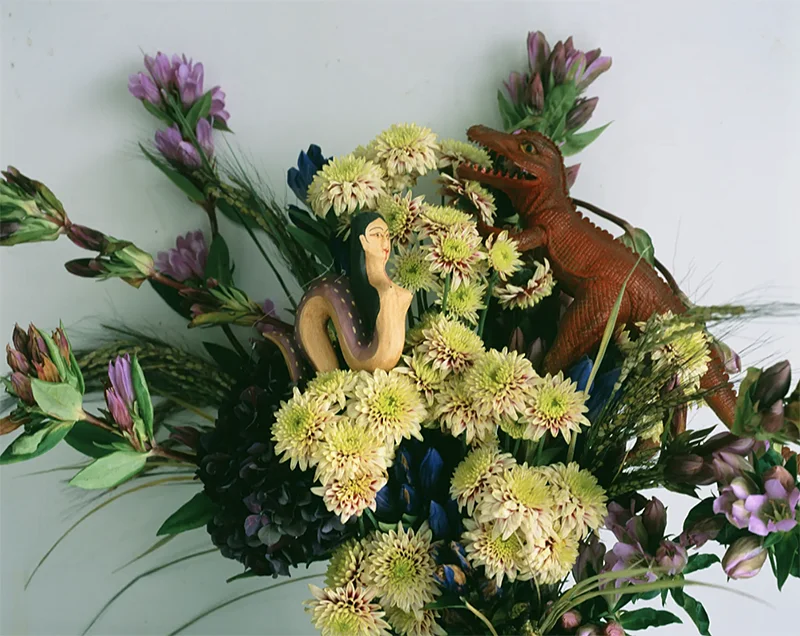
Nobuyoshi Araki’s vast archive, including
Flower Cemetery and
Tokyo Nude. In Araki’s photographs, flowers become psychologically charged objects, often interrupted by plastic figurines, toys, or traces of decay. Elsewhere, nude bodies appear beside unremarkable Tokyo streets, collapsing the boundaries between the private and public spheres. Throughout his career, Araki has approached photography diaristically, treating the camera as an extension of daily existence, desire, and memory.
The exhibition also includes more recent works by Ethridge inspired by luxury fashion commissions, studio interiors, and spontaneous snapshots taken during his travels in Japan. These images extend the exhibition’s broader preoccupation with objects as carriers of emotional and cultural residue. Shelves, flowers, clouds, fabrics, and fragments of architecture become linked through visual rhythm rather than narrative logic.
Together, the works reveal how both artists continually blur distinctions between documentation and invention. Whether through Araki’s intensely personal “I-photography” or Ethridge’s layered manipulations of surface and form, the exhibition suggests that photographs never merely record the world—they remake it through memory, desire, and association.
Image:
Untitled (Flower Cemetery), 2017 © Nobuyoshi Araki, courtesy of Anton Kern Gallery