At the Block Museum of Art,
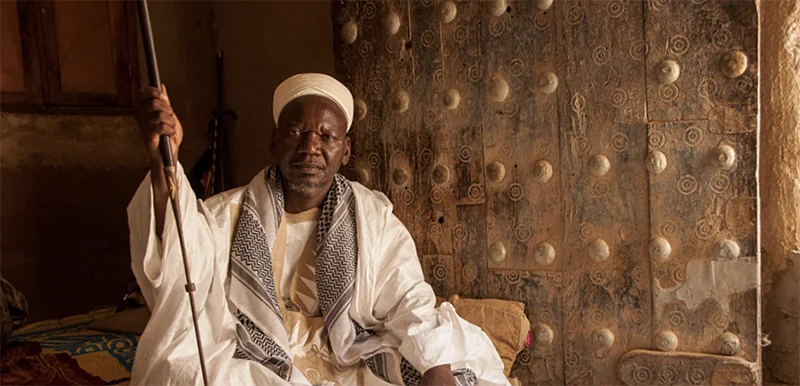
Hamdia Traoré’s “Des marabouts de Djenné” and Muslim Portraiture in Mali brings into focus a living tradition rooted in one of West Africa’s most historically significant cities. Djenné, long recognized as a center of Islamic scholarship, provides both the backdrop and the subject for Traoré’s quietly compelling portraits, produced in close dialogue with the community he knows intimately.
The series centers on marabouts—religious teachers and spiritual guides whose roles extend beyond instruction to include healing and mediation. Seated in composed, frontal poses, each figure appears surrounded by the tools of his practice: Qur’anic tablets, prayer beads, manuscripts, and protective amulets. The repetition of this visual structure establishes a sense of continuity and shared purpose, while subtle variations in posture, expression, and setting affirm the individuality of each subject. The earthen architecture of Djenné, with its distinctive textures and light, frames these encounters, grounding them in a specific cultural and geographic context.
Produced during a period marked by political instability in Mali, the photographs carry an added weight. They do not document crisis directly, but instead foreground endurance. The marabouts’ presence, calm and assured, suggests the persistence of knowledge systems and spiritual practices that have weathered generations of upheaval. In this sense, the work operates as both portraiture and testimony, offering a counterpoint to narratives that often reduce the region to conflict alone.
The exhibition expands this dialogue by placing Traoré’s color images alongside mid-20th-century black-and-white portraits drawn from the Archive of Malian Photography. Works by Mamadou Cissé, Abdourahmane Sakaly, and Tijani Sitou echo similar compositional strategies, revealing a lineage of representation that spans decades. Seen together, these photographs trace shifts in style and context while underscoring the enduring significance of the marabout figure.
Rather than presenting a fixed ethnographic view, the exhibition opens a space for reflection on authorship, continuity, and cultural self-representation. Through Traoré’s lens, portraiture becomes a means of affirming identity while engaging a broader visual history that continues to evolve.
Image:
Hamdia Traoré (Malian, born 1992), Yelpha Djiété, Marabout et Maître Coranique. Il est Imam de la Grande Mosquée de Djenné-Konofia (Yelpha Djiété, Marabout and Qur’anic Teacher. He is Imam of the Great Mosque of Jenne-Konofia), from the series Des marabouts de Djenné (Marabouts of Jenne), September 2018, printed 2023, Inkjet print, pigment-based. Mary and Leigh Block Museum of Art, Northwestern University, Irwin and Andra S. Press Collection Endowment Fund purchase. 2022.17.20. Image courtesy of the artist.