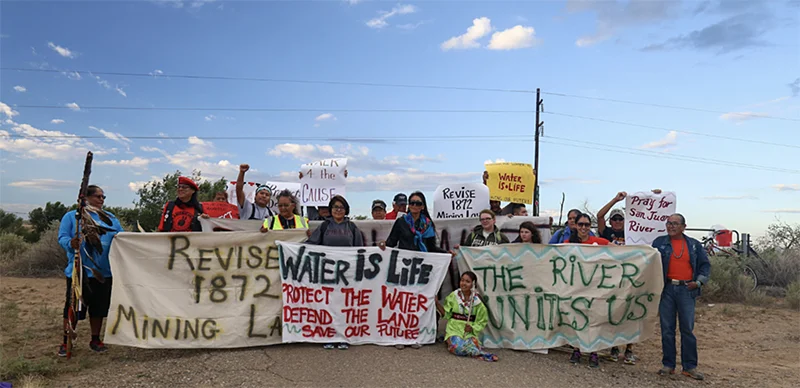
Tó Łitso (Yellow Water): Ten Years after the Gold King Mine Spill, presented at the Block Museum of Art, revisits one of the most visible environmental disasters in recent American history through a lens that is both intimate and expansive. A decade after the 2015 Gold King Mine spill sent millions of gallons of toxic wastewater coursing through the Animas and San Juan Rivers, artist and anthropologist Teresa Montoya retraces the path of contamination, revealing its enduring imprint across landscapes and communities.
Montoya’s project begins as a journey, following the flow of polluted water from Colorado into New Mexico, but it quickly unfolds into a layered examination of consequence. Her photographs do not settle for documentation alone. They register subtle traces of damage—discolorations, altered terrains, and quiet moments of disruption—while also capturing the resilience of the communities who continue to live with these conditions. In doing so, the work resists the spectacle often associated with environmental catastrophe, focusing instead on its prolonged aftermath.
What distinguishes
Tó Łitso is its interdisciplinary approach. Photographic images are presented alongside sound recordings, water samples, and mapping data, creating a dense network of information and perception. This combination underscores water as more than a resource; it becomes a carrier of memory, culture, and harm. For Indigenous communities, particularly within the Navajo Nation, water holds deep spiritual significance, and its contamination reverberates far beyond physical health, touching identity, tradition, and continuity.
Montoya’s work challenges conventional narratives of environmental damage by foregrounding Indigenous knowledge systems and lived experience. Rather than isolating the spill as a singular घटना, the exhibition situates it within a broader history of extraction and neglect in the American Southwest. The images, at times strikingly beautiful, at others unsettling, reflect this tension between visibility and invisibility—between what can be seen and what persists beneath the surface.
Ten years on,
Tó Łitso offers neither closure nor resolution. Instead, it insists on attention, asking viewers to consider how environmental crises continue to unfold over time, and how their effects remain embedded in both land and life.
Image:
Teresa Montoya (Diné, born 1984), Tó Łitso #22 (Yellow Water #22), from the series Tó Łitso (Yellow Water), 2016, Inkjet print. Mary and Leigh Block Museum of Art, Northwestern University, Block Board of Advisors Endowment Fund purchase. Image courtesy of the artist