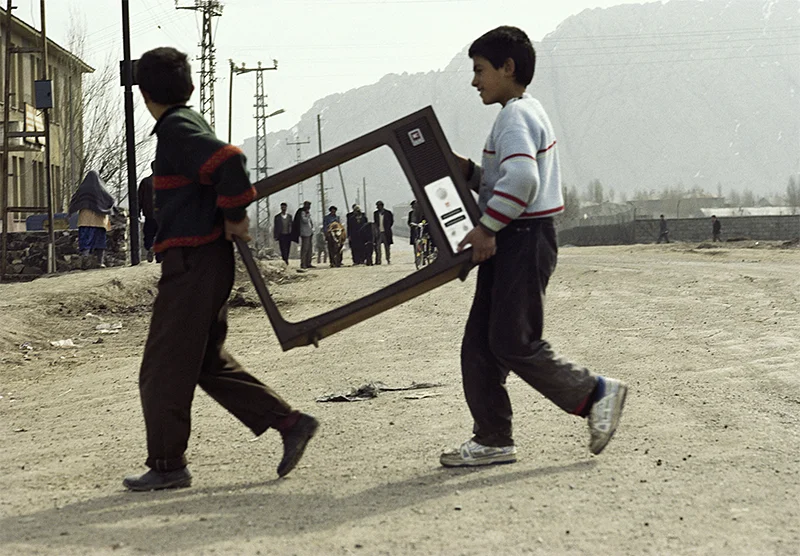
Living in the Fault Lines, presented at the Maison Française of New York University from April 17 through May 15, 2026, offers a meditation on crisis that resists spectacle. Rather than focusing on moments of rupture, the exhibition turns its attention to the slow, often imperceptible tensions that precede upheaval. Curated by doctoral researcher Charli Sas, the project frames instability not as an isolated event but as an ongoing condition—one that unfolds across time, bodies, and landscapes.
The photographs by
Reza, whose career spans more than five decades and over a hundred countries, reflect a sustained engagement with regions shaped by conflict, displacement, and political uncertainty. Known for his work in war zones and humanitarian contexts, the artist brings a measured, human-centered perspective to subjects often reduced to headlines. Here, his images emphasize duration: the accumulation of strain, the persistence of daily life under pressure, and the quiet resilience that emerges in unstable environments.
Faces, gestures, and fragments of everyday existence anchor the exhibition. These are not images of catastrophe in its most visible form, but of the conditions that make such events possible. The sense of immediacy coexists with a deeper temporal layer, suggesting that the present is always informed by forces that remain partially unseen. In this approach, dignity appears not as heroism, but as endurance—the capacity to continue inhabiting spaces marked by uncertainty.
Sas’s curatorial framework draws on literary and philosophical inquiry, positioning the notion of “fault lines” as both a physical and conceptual metaphor. The exhibition resonates with broader reflections on time, memory, and the politics of representation, encouraging viewers to consider how images can render visible what often escapes perception. It also aligns with Reza’s long-standing commitment to education and visual literacy, notably through initiatives that empower communities to tell their own stories.
By shifting the focus from rupture to process,
Living in the Fault Lines invites a more attentive form of looking. It suggests that understanding crisis requires patience and proximity, as well as a willingness to engage with what unfolds slowly, beneath the surface of events.
Image:
The Frame © Reza, courtesy of La Maison Française of New York University