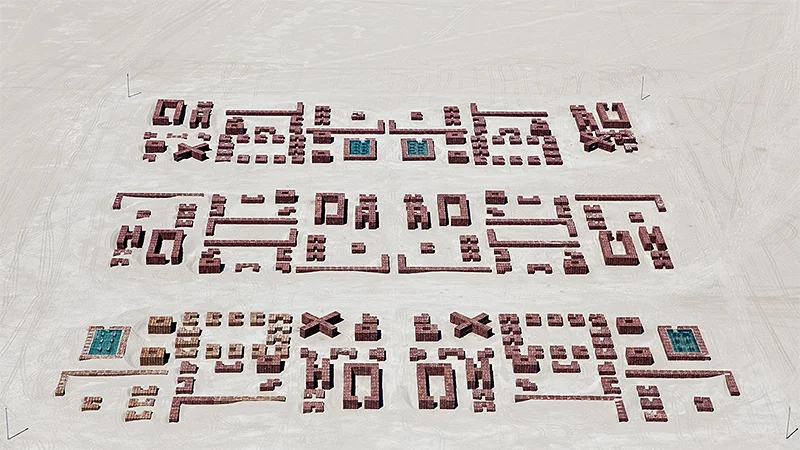
Desert Dialogues, on view at the Nevada Museum of Art from March 22, 2025 through December 27, 2027, opens a thoughtful exploration of the complex relationships between people and arid landscapes. Presented within the museum’s Art + Environment Education Lab, the exhibition invites visitors of all ages to reflect on the desert as a place shaped by imagination, survival, and transformation. Through photographs drawn largely from the museum’s renowned Carol Franc Buck Altered Landscape collection, the exhibition reveals how artists observe and interpret environments that are often misunderstood as empty or lifeless.
Across the works presented, deserts appear not as barren spaces but as environments filled with subtle activity and layered histories. Photographers depict vast horizons, delicate plant life, shifting sands, and weathered geological formations that testify to the resilience of life in extreme conditions. For many artists, these landscapes offer a sense of solitude and reflection, where immense skies and quiet terrain encourage contemplation. At the same time, other images document the marks left by human intervention—roads, dams, mining operations, and military installations—reminding viewers that deserts also serve as testing grounds for technological ambition and economic development.
At the heart of the exhibition stands a sculptural structure known as the Wagon Station, created by Andrea Zittel and customized by Aaron Noble. Originally installed at Zittel’s experimental compound A-Z West near Joshua Tree, the compact shelter resembles a hybrid between a pioneer wagon and a modern travel trailer. Designed as a minimal living unit, the structure reflects ideas of mobility, self-reliance, and adaptation—qualities historically associated with those who choose to inhabit remote desert territories.
Within the broader educational framework of the museum,
Desert Dialogues encourages close observation and discussion about environmental change. The Art + Environment Education Lab serves as a gathering space where students, researchers, and visitors encounter artworks alongside archival materials that illuminate the environmental histories of the American West. Together, these photographs and installations suggest that deserts are places of both fragility and possibility, where art becomes a powerful lens for understanding the evolving relationship between humanity and the natural world.
Image:
Nolan Preece, Target, Bravo 20 – Carson Sink, NV (Fallon Naval Air Station Bombing Range), 2:14 pm, 2013, Photograph. Nevada Museum of Art, Center for Art + Environment Archive Collections. Gift of Nolan Preece © Nolan Preece.