All about photo.com: photo contests, photography exhibitions, galleries, photographers, books, schools and venues.
Win a Solo Exhibition in April 2026 + An Exclusive Interview!

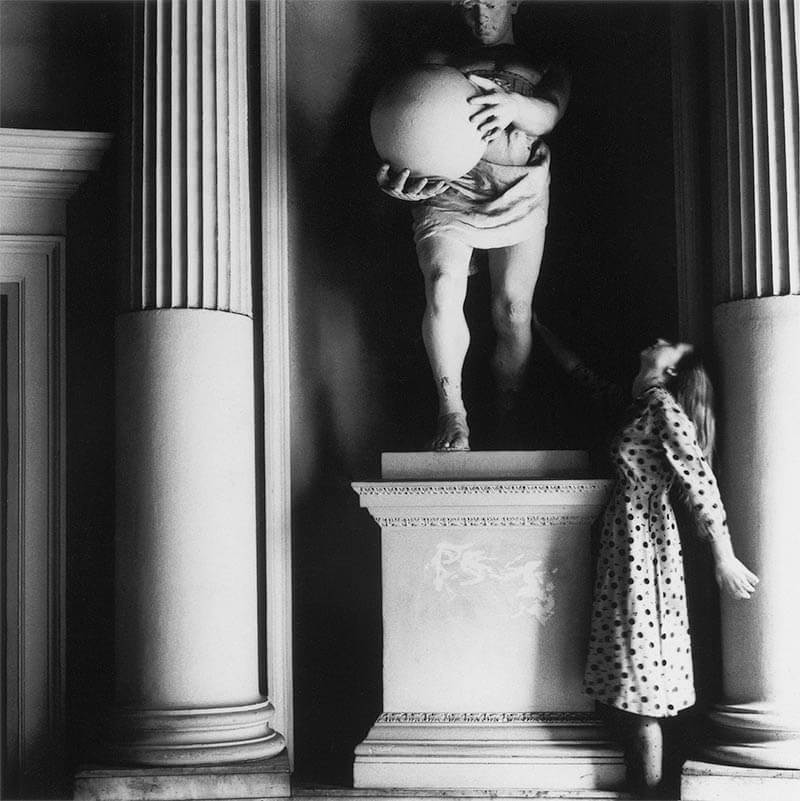
Francesca Woodman

From March 13, 2024 to April 27, 2024
Share
Francesca Woodman
522 West 21st Street
New York, NY 10011
Gagosian is pleased to announce its inaugural exhibition of works by Francesca Woodman. Opening on March 13 at 555 West 24th Street, New York, it will feature more than fifty lifetime prints—many of which have not been previously exhibited—including Blueprint for a Temple (II) (1980), the largest work she accomplished.

The exhibition presents key prints from approximately 1975 through 1980. Photographing in Providence, Rhode Island; Rome; Ravenna, Italy; and New York, Woodman situated herself and others within dilapidated interiors and ancient architecture to compose her tableaux. Using objects such as chairs and plinths along with architectural elements including doorways, walls, and windows, she staged contrasts with the performative presence of the figures, presenting the body itself as sculpture. In the Self-Deceit series (1978), she photographed herself nude in a room with crumbling walls, standing, crawling, or crouching with a frameless mirror. Through compositional fragmentation and blurring, Woodman throws into question the conceit that photography offers a revelation of the self.

On view for the first time since spring 1980, when it was included in Beyond Photography 80, a group exhibition at the Alternative Museum in New York, Blueprint for a Temple (II) is a collage assembled from twenty-four diazotype elements and four gelatin silver prints. Using diazotype, a medium typically employed to create architectural blueprints, allowed Woodman to work at a monumental scale. The composition depicts the right half of a temple façade and features four caryatids—female figures who form columns in classical architecture. The most famous examples of these features are on the Erechtheion at the Acropolis in Athens, which Woodman visited multiple times.

Made together with her Caryatid photographs (1980) and printed in sepia and inky blue diazotype, this work is one of two large-scale compositions realized. Blueprint for a Temple (I) (1980), now in the collection of the Metropolitan Museum of Art, New York, has a related composition. Approximately life-size, the four figures in Blueprint for a Temple (II) support an entablature and pediment assembled from photographs of tile mosaics, the claw feet of a tub, and other bathroom fixtures taken in friends’ New York City apartments, likely the same friends who posed as Woodman’s caryatids. Below the figures is a print joining multiple head profiles and a figure with arms occluded by marks Woodman made on its negative. On the work’s lower right are gelatin silver prints taken in bathrooms and a diazotype print that functions as a proposal or diagram of the work through sketches, photographs, and the following inscription:

Project A Blueprint for a Temple
For a temple of contemplative classical proportions
made out of classically inspired fragments of
its modern day counterpart the bathroom

Bathrooms with classical inspiration are often found in
the most squalid and chaotic parts of the city. They
offer a note of calm and peacefulness like
their temple counterparts offered to wayfarers
in Ancient Greece

A culmination of Woodman’s representation of the figure in space, the Blueprint for a Temple works prompt consideration of how she drew on classical themes throughout her career. In an untitled photograph made in 1978 at the Pastificio Cerere in Rome, a headless, half-dressed figure leans against an aged wall, her arms behind her back, emphasizing her torso. With her skirt sitting low on her waist and blurred by a gentle movement captured by the camera, the photograph anticipates Woodman’s preoccupation with caryatids and the body as sculpture. The same can be seen in earlier works, such as From Space² or Space² (1976), in which a figure emerges from behind torn wallpaper. As the artist noted around 1976–77, “I’m interested in the way that people relate to space. The best way to do this is to depict their interactions to the boundaries of these spaces. Started doing this with [ghost] pictures, people fading into a flat plane—ie becoming the wall under wallpaper or of an extension of the wall onto floor.”

A catalogue will accompany the exhibition, with an essay by Brooke Holmes, the Susan Dod Brown Professor of Classics at Princeton University. A public conversation between Holmes and Lissa McClure and Katarina Jerinic of the Woodman Family Foundation will take place in the gallery on April 17.

The exhibition in New York coincides with Francesca Woodman and Julia Margaret Cameron: Portraits to Dream In, a major survey at the National Portrait Gallery in London, on view from March 21 to June 16, 2024, before traveling to IVAM Institut Valencià d’Art Modern, Spain. With over 150 prints spanning the careers of both artists, the exhibition explores thematic affinities between two influential photographers who worked a century apart. A selection of Woodman’s photographs will also be presented by Gagosian at Burlington Arcade, London, from March 18 to April 6, 2024.

Image: Untitled, ca. 1977–78 © Francesca Woodman - Woodman Family Foundation/Artists Rights Society (ARS), New York
Our printed edition showcases the winners of AAP Magazine call of entries
All About Photo Magazine
Issue #54
Stay up-to-date  with call for entries, deadlines and other news about exhibitions, galleries, publications, & special events.

Exhibitions Closing Soon

David Wong
Viewpoint Photographic Art Center | Sacramento, CA
From February 11, 2026 to March 08, 2026
On view from February 11 to March 8, 2026 in the Main Gallery at Viewpoint Photographic Art Center in Sacramento, David Wong presents a body of work rooted in long-standing engagement with nature and wildlife photography. Wong’s images are not conceived as isolated moments of visual beauty, but as sustained encounters that encourage a slower, more attentive way of seeing. His photographs invite viewers to move beyond admiration toward reflection, offering wildlife as a point of connection rather than spectacle. Initially known for intimate animal portraits made in Tanzania, Wong’s practice has evolved toward a broader, more immersive vision of the natural world. His images emphasize presence and proximity, encouraging viewers to recognize animals as sentient beings within complex ecosystems. Subtle shifts in light, gesture, and environment guide the viewer into a contemplative space where curiosity replaces distance, and observation becomes a form of care. In this way, the work quietly advocates for deeper ecological awareness and shared responsibility. Wong’s commitment to photography extends well beyond his own practice. For decades, he has been active as a teacher, critic, curator, and workshop leader, shaping photographic communities across California and beyond. He has taught at institutions such as Vassar College and The Crocker Art Museum, while also leading workshops in cities, rural landscapes, and international destinations. His exhibitions, spanning coastal California galleries to spaces in New York, reflect both technical rigor and an enduring respect for the photographic print. International travel remains central to Wong’s artistic and educational philosophy. Over the past ten years, he has guided photography tours across Europe, Asia, Africa, and the Americas, with new destinations continuing to expand that reach. As a critic, judge, and longtime leader within regional camera clubs, he brings experience and generosity to every role he inhabits. At Viewpoint Photographic Art Center, where he also serves on the curatorial committee, Wong’s exhibition offers moments of stillness and wonder—an invitation to pause, look closely, and rediscover the natural world through renewed attention. Image: © David Wong
Angle of Incidence by J.B. Morton
Transmitter Gallery | Brooklyn, NY
From February 07, 2026 to March 08, 2026
Angle of Incidence by J.B. Morton, on view at Transmitter Gallery from February 7 to March 8, 2026, presents a body of work that reconsiders how we encounter nature in the built world. Morton’s photographs resist the comfort of the picturesque, turning instead toward moments where attention sharpens: the edge of a sidewalk, a spill of light across brick, the subtle choreography of lines and shadows shaped by weather and time. Nature is not distant or idyllic here, but immediate—embedded in everyday surroundings and alive with motion and tension. Working primarily in black and white, Morton focuses on rhythm and structure rather than description. His images trace repeating forms that never quite resolve, guided by shifts in light and atmosphere that give weight to air itself. These photographs suggest nature as a process rather than a place—something constantly reorganizing, even within spaces shaped by human habit. The eye is invited to linger, not to rest, but to follow the unpredictable logic of change as it unfolds across surfaces both familiar and overlooked. This inquiry deepens in Morton’s cyanotype Grain Pictures, where observation gives way to direct material engagement. Using wooden shavings gathered from his work as a picture framer, Morton employs contact printing to reveal forms at a near-cellular scale. Suspended in blue fields, these organic fragments resemble sediment drifting through water or thoughts passing through consciousness. The process sits between craft and experiment, emphasizing touch, chance, and transformation as integral to seeing. Across Angle of Incidence, Morton narrows the distance between looking and making. Found materials and photographic tools merge into images that reflect how culture and nature increasingly overlap, often inseparably. The work suggests that our technologies—artistic or otherwise—shape how we understand the world and ourselves within it. Presented within Transmitter’s experimental, multidisciplinary context, the exhibition offers a measured but insistent reminder of our material foundations, urging viewers to reconsider how attention, intuition, and environment intersect in an age of constant mediation. Image: Courtesy of J.B. Morton
Kian Berreman & Jack Devlin: Headwaters
Viewpoint Photographic Art Center | Sacramento, CA
From February 11, 2026 to March 08, 2026
On view from February 11 to March 8, 2026 in the Step Up Gallery at Viewpoint Photographic Art Center in Sacramento, Kian Berreman & Jack Devlin: Headwaters presents a deeply personal and place-based collaboration rooted in the landscapes of the Sierra Nevada. The exhibition brings together two artists whose friendship began in the mountains and has evolved into a shared commitment to conservation through visual storytelling. At its core, Headwaters reflects on origins—of rivers, relationships, and creative practices—and how these forces shape one another over time. The photographs in Headwaters trace the flow of the Yuba River Watershed, a vast and vital system that stretches from the granite highlands of the Sierra to the lowland marshes of the California Delta. Rather than presenting a singular narrative, the work reveals a network of interdependent forms: water, rock, forest, and human presence. The images speak quietly but insistently about balance, resilience, and fragility, acknowledging both the river’s life-giving power and the long history of environmental disruption it has endured, from extractive industries to the ongoing pressures of the Anthropocene. This exhibition marks the early chapter of The Yuba Project, an initiative founded by Berreman and Devlin to advocate for the protection of the watershed through art and collaboration with local communities and conservation groups. The Yuba River is not only an ecological system but also the ancestral homeland of the Nisenan Tribe, and its story carries layers of cultural, environmental, and historical significance. Through photography, the artists aim to foster awareness and responsibility, encouraging viewers to consider their own relationship to the land and water that sustain them. Kian Berreman approaches photography as both an artistic and educational practice, shaped by immersive experiences in the outdoors. Jack Devlin, a conservation photographer based internationally, brings a global perspective grounded in environmental advocacy. Together, their work in Headwaters feels less like a conclusion than an invitation—an opening gesture toward long-term stewardship, where art becomes a current carrying memory, care, and possibility downstream. Image: © Jack Devlin | Yuba Patterns
Steve Cozad: In the Shadow of Mount Everest
Viewpoint Photographic Art Center | Sacramento, CA
From February 11, 2026 to March 08, 2026
On view from February 11 to March 8, 2026 in the Main Gallery at Viewpoint Photographic Art Center in Sacramento, Steve Cozad: In the Shadow of Mount Everest presents a photographic journey into the cultural and spiritual landscapes shaped by the world’s highest mountain. Rising more than 29,000 feet above sea level, Mount Everest looms not only as a geographic monument but as a living presence that has influenced generations of life in Nepal and Tibet. Cozad’s photographs reflect this profound relationship between land and people. The Himalayas are shown here not as distant, untouchable peaks, but as an intimate framework for daily existence. Villages, paths, faces, and gestures reveal how deeply the mountains are woven into belief systems, rituals, and rhythms of everyday life. Elders carry histories etched by time and altitude, while younger generations move forward under the same towering silhouettes, inheriting traditions while shaping new narratives of their own. Cozad’s images honor this continuity, balancing the grandeur of the landscape with the quiet dignity of human presence. Based in Northern California, Steve Cozad approaches photography with a fine art sensibility grounded in patience and respect for place. Traveling extensively with his wife, he has built a body of work that celebrates both the majesty of the natural world and the diversity of those who inhabit it. His compositions emphasize light, scale, and atmosphere, drawing viewers into environments that feel both expansive and deeply personal. The photographs invite reflection rather than spectacle, encouraging a slower, more thoughtful engagement. Through this exhibition, Cozad shares more than images of remarkable terrain; he offers an invitation to reconnect with the planet’s fragile beauty. His work suggests that understanding begins with attention, and that appreciation can lead to stewardship. In the shadow of Mount Everest, these photographs speak to endurance, humility, and coexistence, reminding us that the world’s most extraordinary places are sustained not only by nature, but by the cultures that continue to live alongside it. Image: © Steve Cozad
Dis/Orientation
Photoworks at Glen Echo Park | Glen Echo, MD
From February 07, 2026 to March 08, 2026
Karen Keating’s photographs, now brought together in an expansive exhibition at Photoworks, trace a life shaped by curiosity, empathy, and the quiet power of observation. Spanning decades of work and more than forty handmade darkroom prints, the presentation reflects an artist who moves through the world with genuine attentiveness. Whether she is documenting the familiar rhythms of her hometown of Coshocton, Ohio, or forging connections with people thousands of miles away, Keating approaches every subject with patience and openness. Her portraits from Cuba and Honduras form the emotional core of the exhibition. In these works, Keating’s camera becomes a bridge, capturing not only faces but exchanges—moments marked by dignity, humor, and trust. The images occupy a space between documentary and personal encounter, revealing stories that reside in a gesture, a glance, or the texture of a lived-in environment. These photographs resonate not because they are dramatic, but because they honor the fullness of ordinary life. Alongside the international portraits are Keating’s early studies of Mothers and Daughters in Washington, DC during the 1970s. These images portray intimacy across generations, revealing both the tenderness and strength embedded in family relationships. Printed with an exquisite sensitivity to tone, they highlight the emotional complexity that unfolds in everyday domestic scenes. Keating’s nightscapes, created outdoors and often carrying a sense of hushed wonder, introduce another facet of her practice. Through soft gradients of light and shadow, she evokes nature as a place of contemplation. Her experiments with infrared film further expand the exhibition’s range, transforming familiar environments and portraits into something mysterious and otherworldly. Throughout the exhibition, what unites these varied bodies of work is Keating’s unwavering dedication to craft. Each print reveals her mastery of the darkroom, her careful modulation of blacks, greys, and luminous highlights. Together, these images form a deeply human record—proof of a photographer who sees with both precision and heart. Image: © Scott Davis
The Last Days of RFK Stadium
Multiple Exposures Gallery | Alexandria, VA
From January 27, 2026 to March 08, 2026
The Last Days of RFK Stadium presents a quiet yet resonant meditation on change, memory, and the passing of a civic landmark. On view at Multiple Exposures Gallery from January 27 through March 8, 2026, the exhibition features a series of black-and-white photographs by Washington, DC–based photographer Eric Johnson, who turns his lens toward the ongoing demolition of RFK Stadium. Long embedded in the city’s physical and cultural landscape, the stadium is shown here in transition, suspended between past significance and uncertain future. Johnson’s photographs follow the stadium through successive stages of deconstruction, revealing steel, concrete, and voids where crowds once gathered. Stripped of spectacle, the structure becomes sculptural, its forms echoing both endurance and fragility. The images function as a visual record of a planned disappearance, capturing the measured pace of demolition as an act of erasure and transformation. In this sense, the work is as much about time as it is about architecture, reflecting on how cities continually remake themselves while leaving traces of what came before. As a longtime resident of Capitol Hill, Johnson brings an intimate familiarity to the project. His repeated encounters with the stadium over decades inform a perspective rooted in proximity rather than nostalgia. The photographs acknowledge the slow decay that preceded demolition, while also embracing the deliberate choreography of dismantling as a subject in its own right. This methodical process, rendered in monochrome, emphasizes texture, contrast, and rhythm, allowing the viewer to linger on moments often overlooked in narratives of urban progress. Eric Johnson’s background in science and his self-directed photographic education contribute to the clarity and restraint evident in this body of work. Influenced by a tradition of contemplative black-and-white photography, his images balance observation with reflection. The Last Days of RFK Stadium stands as both farewell and document, offering a measured, thoughtful response to the end of a structure that once defined an era in Washington, DC’s shared experience. Image: Courtesy of the Artist. © Eric Johnson
Milk/Wine
Weisman Art Museum | Minneapolis, MN
From August 02, 2025 to March 08, 2026
Milk/Wine explores the fascinating relationship between art and time, asking what it means for a work of art to age. Whether through visible signs of decay—yellowed paper, cracking pigment, fading tones—or through the gradual shift in cultural values, every artwork carries the marks of its passage through history. Some images honor people or ideals that have since vanished; others reveal truths that resonate even more strongly today. Like milk or wine, art can spoil or mature, its meaning transforming as generations change their gaze. Composed primarily of prints, photographs, and works on paper, Milk/Wine reflects on the fragile and enduring nature of artistic expression. Certain pieces confront moments in collective memory that society may have chosen to forget or suppress. Others illustrate how the creative process itself embodies time—through material deterioration, archival scarcity, or deliberate layering that captures the tension between presence and loss. Each work holds within it both its original intention and the echo of every viewer who encounters it anew. By inviting contemporary audiences to interpret these works, the exhibition encourages a dialogue between past and present. It suggests that meaning is never fixed, but constantly reframed through cultural perspective and the lived experience of time. Labels written by members of the Weisman Art Museum staff and the WAM Collective bring modern reflections into direct conversation with the historical context of each piece, highlighting how perception evolves with each generation. In the end, Milk/Wine reminds us that all art, like life itself, exists in motion—subject to change, reinterpretation, and decay. Yet within that inevitable transformation lies beauty and truth: the understanding that time, in its slow and impartial way, reveals as much as it erodes. Image: Composite of Laura Crosby, Time Take (Sophie, 2 weeks), 2001, gelatin silver print, mat size: 31 5/8 × 31 5/8 in. Collection of the Weisman Art Museum at the University of Minnesota, Minneapolis. Gift of the artist. 2015.34.1 and Laura Crosby, Time Take (Margaret, 100 years), 1999, gelatin silver print, mat size: 31 5/8 × 31 5/8 in. Collection of the Weisman Art Museum at the University of Minnesota, Minneapolis. Gift of the artist. 2015.34.25
Selections from the Photography Collection: Food
Allentown Art Museum | Allentown, PA
From September 11, 2025 to March 08, 2026
Selections from the Photography Collection offers a continuing reflection on the rich diversity of vision that artists bring to the photographic medium. This latest installation from the Museum’s holdings turns its gaze toward a universal subject—food—and the myriad ways it shapes our lives. Through still lifes, portraits of farmers, intimate dining scenes, and bustling markets, the exhibition explores how sustenance is never merely physical but also deeply cultural, emotional, and social. Spanning nine decades and featuring nineteen artists, the photographs reveal how food binds people together across geography and generations. An image of hands harvesting fruit or a family gathered around a shared meal becomes a meditation on connection and continuity. The works evoke both the dignity of labor and the rituals of daily life, celebrating the beauty in what is often overlooked. Whether through the formal precision of a composed still life or the spontaneous rhythm of a street market, each artist finds poetry in the everyday act of nourishment. Among the highlights is Edward Henry Weston’s 1930 gelatin silver print Eggs, a study in simplicity and form that transforms the ordinary into the sublime. In Weston’s hands, the quiet geometry of eggshells becomes a meditation on balance and light—an emblem of how photography can turn sustenance into art. This iteration of Selections from the Photography Collection underscores how the act of eating, growing, and sharing food continues to define human experience. Supported by the Bernard and Audrey Berman Foundation and the Leon C. and June W. Holt Endowment, the exhibition invites viewers to see food not only as a necessity but as a mirror of community, creativity, and care. A new selection of works will open in the Fuller Gallery on March 14, 2026. Image: H. Donald Bortz (American, 1908–1962), Brenda Bortz, Allentown, Pennsylvania, 1951 (printed 1995), Kodachrome dye transfer print. Allentown Art Museum: Gift of Mary Rose Oldt, 2024. @H. Donald Bortz
Tawny Chatmon: Sanctuaries of Truth, Dissolution of Lies
National Museum of Women in the Arts | Washington, DC
From October 15, 2025 to March 08, 2026
The exhibition of Tawny Chatmon’s work at NMWA marks a new and profound chapter in the artist’s evolving creative journey. Bringing together selections from her most recent series, The Restoration (2021–present) and The Reconciliation (2024–present), this presentation expands the boundaries of her photography-based practice into assemblage, embroidery, film, and sound. These recent works build upon the luminous visual vocabulary established in earlier series such as If I’m no longer here, I wanted you to know… (2020–2021), Remnants (2021–2023), and Iconography (2023–present), which are also represented in the exhibition. Characterized by ornate patterns, radiant colors, and symbolic layering, Chatmon’s portraits—often of children—draw inspiration from Gustav Klimt’s opulent compositions and the golden mosaics of Byzantine art. Material choices play a vital role in Chatmon’s creative language. Her decision to move away from genuine gold reflects her awareness of the ethical and environmental issues surrounding the extraction of precious materials such as gold and cobalt, particularly in the Democratic Republic of the Congo. In response, her latest works embrace embroidery and textiles as alternative mediums, weaving new narratives of care, resilience, and reverence. In The Reconciliation, Chatmon addresses stereotypes about the food traditions of the African diaspora, reclaiming recipes and rituals that have sustained generations while celebrating their deep cultural and spiritual significance. The Restoration emerged from Chatmon’s commitment to confronting racist imagery found in antique dolls and figurines. By repainting and redressing these objects and placing them in the hands of children, she symbolically transforms symbols of harm into emblems of dignity and renewal. Across her practice, Chatmon calls upon viewers to recognize the sacredness and intrinsic worth of Black identity, illuminating stories of beauty, strength, and humanity that have long been overlooked or misrepresented. Image: Tawny Chatmon, Economic Heritage, from the series “The Reconciliation,” 2024; Embroidery and acrylic paint on archival pigment print, 47 x 32 in. (unframed) ©Tawny Chatmon, Courtesy of the artist and Galerie Myrtis
Tacita Dean: Blind Folly
Columbus Museum of Art | Columbus, OH
From October 08, 2025 to March 08, 2026
Tacita Dean: Blind Folly is the first major museum survey in the United States of work by British European visual artist Tacita Dean (b. 1965). The exhibition, organized in close collaboration with Dean, spotlights her career-defining approach to creating art through unmediated and chance-based drawing processes across a variety of mediums, from film to printmaking. Blind Folly, the show’s title, reflects Dean’s desire to let the behavior of her mediums dictate the results of her work. For the artist, the playful and old-fashioned phrase connoting foolishness, “blind folly,” represents the role chance and fate play in the creative act. Blind Folly brings together several of Dean’s monumental blackboard drawings along with rarely shown drawings from her studio on paper, found postcards, albumen photographs, and 16mm films. This selection includes several newly created works, some of which were inspired by Dean’s residency at the Menil Collection’s Cy Twombly Gallery, a Renzo Piano-designed building devoted to the work of late American artist Cy Twombly (1928–2011). Tacita Dean: Blind Folly is curated by Michelle White, Senior Curator, The Menil Collection, Houston, and presented at the Columbus Museum of Art in collaboration with Daniel Marcus, Curator of Collections and Exhibitions, and Rae Root, Roy Lichtenstein Curatorial Fellow. The exhibition is accompanied by the book Blind Folly or How Tacita Dean Draws, written by Michelle White (co-published by the Menil and MACK). The text, illustrated with more than forty images, is based on seven years of conversation between the author and the artist.
The Gay Harlem Renaissance
The New York Historical | New York, NY
From October 10, 2025 to March 08, 2026
Explore the vibrant and dazzling world of Harlem’s gay Black community during the 1920s and 30s. To mark the centennial of The New Negro, Alain Locke’s groundbreaking edited volume of literature and art, The Gay Harlem Renaissance invites visitors to immerse themselves in the richness of LGBTQ+ Black life during the height of the Harlem Renaissance. The exhibition makes the case that the influx of ideas and people into the neighborhood during the Great Migration, on a scale never before seen, enabled a vibrant, visible LBGTQ+ Black culture and network to flourish in Harlem. Facing racist practices and homophobic laws yet drawn by promise and possibility, these individuals created a space where they could gather, build community, and produce art that forever changed American culture. Uniting painting, sculpture, artifacts, documents, photographs, and music from collections across the country, The Gay Harlem Renaissance celebrates the creativity, innovation, and resilience of Black LGBTQ+ Harlemites. Curated by Allison Robinson, associate curator of history exhibitions and Anne Lessy, assistant curator of history exhibitions and academic engagement, with contributions from Rebecca Klassen, curator of material culture and decorative arts, and George Chauncey, author of Gay New York and DeWitt Clinton Professor of American History and Director of the Columbia Research Initiative on the Global History of Sexualities at Columbia University as chief historian. Lead support for The Gay Harlem Renaissance is provided by the Mellon Foundation.
Eduardo Chacon: Postcards from Nowhere
Boca Raton Museum of Art | Boca Raton, FL
From November 19, 2025 to March 08, 2026
Postcards from Nowhere presents an intimate installation of 42 photographs of people at work and play by South Florida humanist photographer Eduardo Chacon. This is a combined special exhibition that also features a selection of iconic street photographers from the Museum collection that inspire Chacon’s practice. Eduardo Chacon shoots straight photography with no cropping, no auto-focus, and all manual settings. By maintaining the integrity of the original scene, Chacon captures his surroundings rife with that thing most fleeting: human emotion. As a counter to a society obsessed with peering into our phones’ black mirrors, Chacon turns his camera’s eye ever outward and up and, in the blink of a lens, creates visual chronicles of human interaction, from a bartender mid-pour to a family fishing trip, to an embrace while gazing at the stars. Postcards from Nowhere, using only Chacon’s masterful control of timing, contrast, and composition in black-and-white, transports the viewer on a trip to their own personal realm. As the exhibition reveals, this could be anywhere worldwide, as long as it avoids modern technology in favor of a simpler time. Image: Eduardo Chacon, Hangover Bros, 2022 (printed 2023), archival print. Courtesy of the Artist
Advertisement
AAP Magazine #56 Shadows
Win a Solo Exhibition in April
AAP Magazine #56 Shadows
Call for Entries
AAP Magazine #56 Shadows
Publish your work in our printed magazine and win $1,000 cash prizes

Related Articles

Colour Me Modern: Claire Aho and the New Woman
Colour Me Modern: Claire Aho and the New Woman, celebrates the vibrant photography of the pioneering Finnish artist, Claire Aho (1925-2015) who brought wit, colour and cinematic flair to postwar image-making across her work in fashion, advertising and editorial. Presented by Hundred Heroines, the UK’s only museum dedicated to women in photography, this free exhibition, split over two sites, highlights how Aho, known as ‘the Grand Old Lady of Finnish Photography,’ helped shape a new visual language for Finland, presenting confi dent, contemporary women and transforming everyday scenes into carefully staged moments of style.
Fragilities & Resilience by Thibault Gerbaldi at the Jardin du Luxembourg
From March 21 to July 19, 2026, the French Senate will host Fragilities & Resilience, the first solo exhibition in France of internationally acclaimed photographer Thibault Gerbaldi. Presented outdoors on the iconic grilles of the Jardin du Luxembourg in Paris 6ème, the exhibition features 80 striking photographs captured across five continents, offering a breathtaking exploration of the fragile yet enduring connections between humans and nature. Entry is free, making this a rare opportunity for the public to experience Gerbaldi’s work on a monumental scale.
All About Photo Presents ’ Civilization’ by Damien Aubin
In Civilization, Damien Aubin turns his lens toward environments shaped not by nature, but by ambition. These are places engineered at a scale that exceeds the individual — infrastructures, industrial complexes, vast architectural systems that dwarf the human body and often eclipse it entirely. There are no protagonists here. No narratives unfolding in real time. Instead, Aubin photographs what remains when activity recedes: structures that continue to stand, operate, or simply endure.
Elliott Erwitt: Gold Standard
Weinstein Hammons Gallery is pleased to present Elliott Erwitt: Gold Standard, the third exhibition of photographs by Elliott Erwitt (1928–2023), one of the most influential photographers of the twentieth and twenty-first centuries.
FotoFocus Announces Big Tent Opening of FotoFocus Center
This summer, FotoFocus will expand on their vision and embark on a new chapter with the launch of Big Tent, the inaugural exhibition at the new FotoFocus Center, a 14,700 square foot, purpose-built structure to house photographic exhibitions and year-round programs. Bringing together work by over fifty artists (including An-My Lê, Catherine Opie, Dawoud Bey, Gordon Parks, Justine Kurland, Mitch Epstein, RaMell Ross, Sky Hopinka, Tina Barney and many more), the exhibition (on view May 29-August 22) reflects upon the current state of American democracy while also considering the efficacy of photography to be a catalyst for meaningful change.
 The Queering of Photography by Asa Johannesson
Stills are delighted to announce their spring exhibition: The Queering of Photography by Åsa Johannesson; the artist’s first solo exhibition in Scotland. The Queering of Photography takes place from 1 May – 27 June 2026, Preview: Thursday 30 April, 6–8pm. Åsa Johannesson is an artist working across photography and writing. Over the past two decades she has explored the possibilities of queer visual vocabulary within photographic portraiture – a practice that intertwines queer documentary approaches with performative formalist aesthetics.
Eko: Japan In Two Visual Narratives
From 5 March 2026, The National Maritime Museum in Amsterdam presents the exhibition Ekō – Japan in two visual narratives. Curated as artists conversing across time, the exhibit juxtaposes early photographs of Japan from the museum's own collection, including those by Felice Beato, with the contemporary work it inspired as captured by photographer and visual artist Anaïs López.
Photography and the Black Arts Movement at the Getty
From February 24 to June 14, 2026, the J. Paul Getty Museum presents Photography and the Black Arts Movement, 1955–1985, a landmark exhibition exploring how photographic practices helped shape one of the most influential cultural movements of the twentieth century. Organized by the National Gallery of Art, the exhibition reveals how artists across the African diaspora used images not simply to document history, but to transform it.
MoCP at Fifty: Collecting Through the Decades
The Museum of Contemporary Photography at Columbia College Chicago (MoCP) proudly announces its 2026 exhibition, MoCP at Fifty: Collecting Through the Decades, on view from January 22 through May 16, 2026.
Call for Entries
Solo Exhibition April 2026
Get International Exposure and Connect with Industry Insiders