All about photo.com: photo contests, photography exhibitions, galleries, photographers, books, schools and venues.
ENTER AAP MAGAZINE SHADOWS: GET PUBLISHED AND WIN $1,000 - LAST CALL

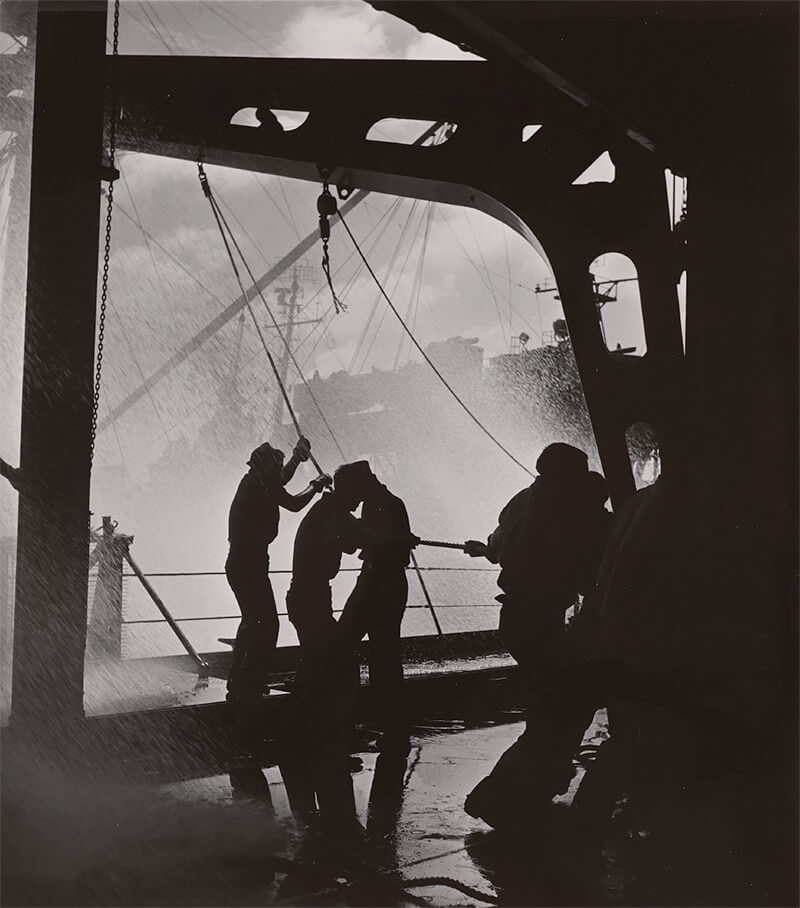
Though There Be Fury on the Waves

From March 14, 2020 to September 20, 2020
Share
Though There Be Fury on the Waves
1219 SW Park Avenue
Portland, OR 97205
In 1942, Portland-born photographer Victor Jorgensen enlisted in the Navy. Edward Steichen, the renowned modernist photographer and lieutenant commander who oversaw Naval photography during World War II, selected Jorgensen-a Reed College attendee and editor at The Oregonian newspaper-to serve with his elite Naval Aviation Photographic Unit. Between 1943 and 1945, Jorgensen photographed on board the aircraft carriers USS Lexington and USS Monterey, the destroyer USS Albert W. Grant, and the hospital ship USS Solace, which served in the Pacific during the world-altering conflict.

The works in this exhibition draw from a recent acquisition of vintage prints gifted to the Museum by Victoria Jorgensen Carman and Lee Jorgensen, the photographer's daughters. The exhibition commemorates the 75th anniversary of the end of World War II and Jorgensen's significant contribution to the field of documentary photography.
Our printed edition showcases the winners of AAP Magazine call of entries
All About Photo Magazine
Issue #54
Stay up-to-date  with call for entries, deadlines and other news about exhibitions, galleries, publications, & special events.

Exhibitions Closing Soon

Éléonore Simon: Valparaíso
Blue Sky, Oregon Center for the Photographic Arts | Portland, OR
From March 05, 2026 to March 28, 2026
Éléonore Simon: Valparaíso brings the restless spirit of the Chilean port city to Blue Sky Gallery from March 5 to 28, 2026. In this new presentation, Simon renders Valparaíso in luminous black and white, tracing its vertiginous staircases, corrugated facades, and watchful hillsides with a gaze that is both intimate and searching. The city, long shaped by arrivals and departures, becomes a psychological landscape—at once anchored to the Pacific and drifting toward memory. Suspended cable cars, empty terraces, and figures glimpsed in passing suggest a place caught between returning and taking flight, between holding on and letting go. Born in 1987 and based in Paris, Simon draws on her French-American background and her formation in art history and literature to shape a practice grounded in attentiveness. Though self-taught as a photographer, she approaches the medium with the rigor of a writer, attentive to nuance and silence. Street photography was her first language, and its discipline—patience, intuition, respect for contingency—continues to inform her work. In Valparaíso, documentary observation slips gently into reverie. Architecture tilts toward abstraction, shadows thicken into metaphor, and the horizon line becomes a threshold between lived experience and imagined return. The series, developed between 2017 and 2021 during extended stays in Chile, reflects years of walking the city’s hills and waterfront. Valparaíso, a historic seaport known for its layered history and precarious beauty, emerges here not as postcard spectacle but as an interior terrain. Simon’s images dwell on pauses: a curtain stirred by sea air, a solitary silhouette framed by a window, a ship dissolving into fog. Each photograph feels like a fragment of a larger, unfinished narrative. Alongside her exhibition history across Europe and the Americas, Simon remains active as a writer and collaborator, contributing to contemporary photography discourse while participating in international festivals and collectives. With Valparaíso, she offers a meditation on place as a vessel for memory—fragile, shifting, and deeply human. Image: © Éléonore Simon
Terri Warpinski: Death|s|trip
Blue Sky, Oregon Center for the Photographic Arts | Portland, OR
From March 05, 2026 to March 28, 2026
Terri Warpinski: Death|s|trip, on view at Blue Sky Gallery from March 5 through 28, 2026, bringing into focus the quiet, unmarked sites across present-day Berlin where lives were cut short at the Wall. Between 1961 and 1989, men, women, and even children attempted to flee East Germany in search of freedom. Many did not survive. Warpinski’s photographs return to these locations decades later, framing ordinary sidewalks, riverbanks, railway lines, and building facades that now bear little visible trace of the events that unfolded there. Through image and text, she restores names and stories to spaces long absorbed into the fabric of a reunified city. Rather than reconstructing the past through spectacle, Warpinski adopts a restrained and contemplative approach. Each work pairs a contemporary photograph with researched narratives drawn from archives, testimony, and historical records. The result is layered and elegiac. A stretch of the Spree River becomes a threshold between captivity and possibility; a nondescript street corner holds the weight of irreversible decision. By collapsing past and present within a single frame, she asks viewers to consider how landscapes carry memory—and how easily that memory can fade without deliberate acts of remembrance. An American artist born in 1955, Warpinski has spent more than four decades exploring intersections of personal, cultural, and environmental histories through lens-based and mixed media practices. A DAAD Fellow in Berlin in 2017, she deepened her engagement with German history while advancing this long-term project. Her career has included a Fulbright Senior Fellowship to Israel, international exhibitions from China to the Middle East, and recognition as an influential educator after 32 years at the University of Oregon. Her artist books and collaborative portfolios are held in major research collections, reflecting a sustained commitment to photography as both inquiry and archive. With Death|s|trip, Warpinski connects Berlin’s divided past to contemporary global realities. The work resonates beyond Germany, evoking ongoing struggles over borders, migration, and safe passage. In revisiting these sites with care and precision, she affirms photography’s enduring role as witness—steady, attentive, and unwilling to let the ground forget. Image: © Terri Warpinski
Brassaï: Secret Paris
Howard Greenberg Gallery | New York, NY
From February 07, 2026 to March 28, 2026
Brassaï: Secret Paris, on view from February 7 to March 28, 2026, at Howard Greenberg Gallery, offers a rare and atmospheric journey into the hidden corners of the French capital. Presented in collaboration with Grob Gallery in Geneva, the exhibition brings together nearly forty photographs that reveal Brassaï’s singular vision of Paris after dark, combining iconic images from Paris by Night with works from The Secret Paris, a series long kept from public view for its provocative and intimate subject matter. When Paris by Night was first published in 1933, it forever altered how the city was imagined and photographed. Brassaï wandered the streets until dawn, capturing mist-covered boulevards, quiet cafés, lovers in shadow, and figures on the margins of society with an empathy that felt both poetic and unsparing. These images distilled the mystery and sensuality of nocturnal Paris, shaping a visual language that continues to influence photographers today. The inclusion of photographs from The Secret Paris deepens this portrait of the city. These images push beyond romance into more concealed worlds, revealing spaces and encounters that challenged the moral boundaries of their time. Seen alongside the more familiar night scenes, they underscore Brassaï’s commitment to portraying Paris in its full complexity, without embellishment or censorship. The exhibition coincides with a newly released edition of Paris by Night, as well as a major presentation of Brassaï’s work at the Moderna Museet in Stockholm, reaffirming his international significance. Born Gyula Halász in 1899, Brassaï arrived in Paris in the 1920s and quickly became one of its most perceptive chroniclers, earning the nickname “the eye of Paris.” His background in journalism informed a practice rooted in observation, patience, and narrative depth. Beyond Paris, Brassaï photographed extensively across Europe and the Americas, though much of this work remains lesser known. Brassaï: Secret Paris brings focus back to the city that shaped him, presenting a timeless meditation on urban life, desire, and the enduring allure of the night. Image: © Estate Brassaï-RMN, Courtesy of Howard Greenberg Gallery, New York
Dan Estabrook: Forever & Never
Gitterman Gallery | New York, NY
From February 07, 2026 to March 28, 2026
Dan Estabrook: Forever & Never, on view at Gitterman Gallery from February 7 to March 28, 2026, offers a richly layered journey through more than three decades of image-making. Anchored by the release of Estabrook’s first major monograph, the exhibition gathers works that feel at once timeless and insistently present. Drawing from early photographic processes and mixed media, these images summon the spirit of the nineteenth century while engaging contemporary questions of identity, desire, and perception. Estabrook’s practice thrives in the tension between the seen and the imagined. His photographs often hover between the theatrical and the supernatural, where humor quietly unsettles melancholy and beauty brushes against the macabre. Handmade surfaces, visible gestures, and deliberate imperfections invite slow looking, reminding viewers that photography was once an act of touch as much as sight. In an era dominated by frictionless digital images, this work insists on the physical, sensual nature of photographic creation. The exhibition mirrors the structure of the monograph, unfolding across three interwoven chapters. Little Devils reflects on photography’s early entanglement with drawing, embracing experimentation and visual mischief. Ghosts & Models turns toward the intimate and sometimes unstable relationship between photographer and subject, evoking presence, absence, and projection. Broken Fingers shifts focus to the photograph as an object, where damaged edges, layered materials, and sculptural interventions echo the vulnerability and resilience of the human body itself. Rooted in Estabrook’s long engagement with alternative processes such as calotype, gum bichromate, and albumen printing, Forever & Never celebrates photography as an evolving, deeply human craft. The exhibition is less a retrospective than a constellation—ideas and images looping across time, resisting linear narratives. Together, the works form an anchor to curiosity, authenticity, and the enduring magic of photography, where meaning is built slowly, by hand, and meant to last far beyond the moment of exposure. Image: A Void, 2009. Salt print with cut-out. Courtesy of the Gitterman Gallery © Dan Estabrook
Jim Dow: Courthouse
Joseph Bellows Gallery | La Jolla, CA
From February 28, 2026 to March 28, 2026
Jim Dow: Courthouse is on view at Joseph Bellows Gallery from February 28 through March 28, 2026, revisiting a landmark photographic undertaking from the American Bicentennial era. Between 1976 and 1977, Jim Dow joined twenty-three other photographers commissioned for the Joseph E. Seagram’s County Court House Project, an ambitious effort to document civic architecture across the United States. The resulting archive—more than 11,000 negatives depicting over 1,100 county courthouses—now resides in the Prints and Photographs Division of the Library of Congress, forming one of the most comprehensive visual surveys of its kind. Dow focused on the South Atlantic and South-Central states, approaching each courthouse not as an isolated monument but as a living anchor within its town. Working with an 8 x 10-inch large-format camera, he recorded facades, interiors, and surrounding streets with measured precision. The clarity of gelatin silver contact prints reveals brickwork, clock towers, worn steps, and modest landscaping in exacting detail. Yet these photographs extend beyond architectural record. By situating each structure within its broader environment—adjacent storefronts, open skies, quiet squares—Dow evokes the rhythms of local life and the symbolic weight these buildings carry as centers of governance and gathering. Critics have recognized the project as a rare fusion of documentary rigor and cultural reflection, aligning it with earlier national surveys while retaining a distinctly contemporary sensibility. Dow’s images neither romanticize nor diminish their subjects; instead, they honor regional variation and vernacular character. In their symmetry and restraint, they echo traditions of American documentary photography while affirming the enduring relevance of careful observation. Born in Boston in 1942 and educated at the Rhode Island School of Design, Dow has balanced artistic practice with decades of teaching at institutions including Harvard and Princeton. His broader body of work—chronicling roadside architecture and signage—shares with Courthouse a deep respect for the built landscape. This exhibition underscores how, through patience and craft, photography sustains a record of civic identity that might otherwise fade from view. Image: Jury Box, Grady County Courthouse, Cairo, GA, 1976, vintage gelatin silver print © Jim Dow. Courtesy of the Joseph Bellows Gallery
Viktoria Sorochinski
Pictura Gallery | Bloomington, IN
From February 07, 2026 to March 28, 2026
Viktoria Sorochinski presents a poignant photographic exploration of place, memory, and identity in an exhibition on view at Pictura Gallery at the FAR Center for Contemporary Arts from February 7 through March 28, 2026. The photographs revolve around Poltava, a historic Ukrainian region whose quiet landscapes and reflective inhabitants become the foundation for a deeply human narrative. Rather than portraying events through statistics or headlines, Sorochinski focuses on the individuality of people who live within this cultural landscape, revealing lives filled with contemplation, creativity, and resilience. Many of the portraits unfold as intimate encounters. In one image, a priest sits in a modest room beside a shelf of books. His presence suggests dedication and patience as he works to revive a centuries-old Orthodox church and renew the spiritual life of the community around it. The quiet intensity of his gaze transforms the photograph into something more than documentation; it becomes a moment of connection between subject and viewer. In another portrait, a man sits alone in his kitchen, absorbed in his own thoughts. The scene conveys a stillness that hints at the inner lives of individuals whose stories rarely appear in public narratives. Sorochinski often pairs portraits with evocative landscapes, allowing one image to echo the mood or symbolism of another. A reflective pond filled with floating paper boats mirrors the arrangement of objects in a nearby interior photograph, suggesting that imagination and memory drift between physical spaces and mental worlds. These visual dialogues create a rhythm throughout the exhibition, inviting viewers to consider how personal reflections intersect with the wider environment of Poltava. A sense of historical weight quietly permeates the work. An aging map with fragile borders appears alongside photographs of the land itself, reminding viewers that the lines drawn across paper shape real lives and territories. The region carries echoes of centuries of conflict, including the famous battle fought there in 1709, yet Sorochinski’s images remain grounded in everyday humanity rather than spectacle. Born with Ukrainian roots and shaped by a multicultural life across several countries, Sorochinski approaches photography with sensitivity to cultural memory and displacement. Her photographs preserve fleeting details of a place whose identity continues to evolve, offering a thoughtful meditation on people, history, and the fragile continuity of community. Image: © Viktoria Sorochinski
Philippe Halsman: Portraits
Duncan Miller Gallery | Los Angeles, CA
From February 07, 2026 to March 28, 2026
Philippe Halsman: Portraits, on view from February 7 to March 28, 2026, celebrates the enduring legacy of one of the twentieth century’s most inventive portrait photographers. Born in Latvia and later working in Europe and the United States, Philippe Halsman developed a visual language that reshaped how public figures were photographed and perceived. His portraits are instantly recognizable for their clarity, directness, and psychological charge, revealing subjects not as distant icons but as complex individuals caught in moments of heightened presence. Halsman approached portraiture as an encounter rather than a mere recording. Combining rigorous technical control with an intuitive understanding of human behavior, he sought to disarm his sitters and capture something essential beneath the surface. His images of artists, scientists, political leaders, and entertainers demonstrate an uncommon ability to balance authority and vulnerability. Whether photographing Albert Einstein in quiet contemplation or crafting playful, high-energy compositions for magazine covers, Halsman consistently challenged the conventions of formal portraiture, favoring immediacy and engagement over static poses. A defining aspect of Halsman’s practice was his willingness to experiment. His celebrated collaborations with Salvador Dalí exemplify this spirit, merging surrealist imagination with photographic precision. These works, often humorous and meticulously staged, expanded the expressive possibilities of the medium and affirmed photography as a site of creative invention. At the same time, Halsman’s extensive work for leading publications helped establish a modern visual culture in which portrait photography played a central role in shaping public identity. Philippe Halsman: Portraits offers a concentrated view of a career that bridged tradition and innovation. The exhibition underscores how Halsman honored the classical foundations of portrait photography while pushing its boundaries through curiosity and experimentation. Decades after they were made, his images retain their vitality, reminding us that a great portrait is not simply a likeness, but a collaboration—an exchange of energy, intellect, and trust between photographer and subject. Image: Milton Berle, 1950 © Philippe Halsman
Brigitte Carnochan and Patrick Carroll: Fiber & Light
Themes + Projects | San Francisco, CA
From February 07, 2026 to March 28, 2026
Fiber & Light brings together two distinct yet deeply connected practices, offering a rare intergenerational conversation shaped by material, process, and memory. Presented as part of Themes + Projects’ 25th anniversary, the exhibition pairs the work of Brigitte Carnochan with that of her grandson, Patrick Carroll, marking the first time their art is shown side by side. The result is not a comparison, but a shared space where lineage becomes a living, evolving force. Brigitte Carnochan’s photo-based works are rooted in transformation. Through layered encaustic surfaces, her photographs move beyond representation, becoming tactile objects that seem to hold light within them. Natural forms are softened, obscured, and reimagined, inviting slow looking and quiet contemplation. Her long engagement with photography, teaching, and publishing has established a practice that values intuition, patience, and physical presence, qualities that resonate strongly in these luminous works. Patrick Carroll approaches material from a different direction, working primarily with knit textiles sourced from the fashion industry. Stretched, manipulated, and shaped, his pieces blur boundaries between language, garment, and sculpture. Words and structures emerge through repetition and tension, suggesting narratives that are felt as much as read. While firmly grounded in contemporary discourse, his work retains a sense of intimacy, reflecting on how meaning is carried through touch, labor, and reuse. Together, the works in Fiber & Light reveal unexpected parallels. Both artists treat material as a vessel for memory and sensation, allowing process to guide form. Light, whether absorbed into wax or caught in the weave of textile, becomes a connective element. This exhibition honors continuity without nostalgia, showing how creativity can pass through generations while remaining responsive to its time. In bringing these voices together, the gallery underscores art’s ability to bridge distance—between mediums, eras, and members of the same family. Image: Brigitte Carnochan, White Peony, photo encaustic, 12 x 16 inches © Brigitte Carnochan
Bailey Doogan: Close to the Bone with Dan Budnik: O’Keeffe at Home
Etherton Gallery | Tucson, AZ
From January 20, 2026 to March 28, 2026
At Etherton Gallery, Close to the Bone and O’Keeffe at Home are presented in quiet but potent dialogue, bringing together two artists who faced the subject of aging without sentimentality or retreat. Though working in different media and contexts, Bailey Doogan and Dan Budnik share a commitment to looking closely at lived experience, allowing time to register on the body and the self without apology or disguise. Bailey Doogan’s portraits confront viewers with an honesty that remains rare. Long before discussions of body politics entered mainstream discourse, she insisted on representing the aging body as it is lived rather than idealized. Her figures bear the marks of work, illness, sexuality, and endurance, rendered through expressive gesture or stark realism. Whether symbolic or direct, Doogan’s images refuse distance. They invite recognition, asking the viewer to acknowledge aging as a record of experience rather than decline. In this sense, her work feels both deeply personal and unavoidably political. Across the gallery, Dan Budnik’s photographs of Georgia O’Keeffe offer a different but complementary perspective. Taken in 1975, when O’Keeffe was in her late eighties, these images reveal an artist firmly present in her daily rhythms. Budnik photographs her not as an icon but as a woman at home, attentive to her surroundings, composed yet relaxed. The desert light, domestic spaces, and small gestures convey continuity rather than withdrawal, countering assumptions about creative life in old age. Budnik’s long career documenting artists, social movements, and American landscapes informs the sensitivity of this series. His camera neither intrudes nor romanticizes. Instead, it registers trust, allowing O’Keeffe’s authority and independence to remain intact. The resulting photographs suggest that age does not diminish agency, but can sharpen it. Together, these exhibitions form a measured meditation on time, visibility, and dignity. By pairing Doogan’s confrontational portraits with Budnik’s intimate photographs, Etherton Gallery underscores aging as an active state of being. The exhibition stands not only as a reflection on two remarkable practices, but also as a reminder that looking closely—without fear or embellishment—remains one of art’s most enduring responsibilities. Image: Georgia O’Keeffe with hands on pot, 1975 gelatin silver print. © Dan Budnik
List Projects 34: Brittany Nelson
MIT List Visual Arts Center | Cambridge, MA
From January 15, 2026 to March 29, 2026
List Projects 34: Brittany Nelson presents a body of work that drifts between scientific inquiry and emotional projection, where technology becomes a vessel for longing and imagination. Nelson’s practice is rooted in photography, yet it consistently expands beyond the image, drawing from archives, literature, and cinematic language to probe how humans search for connection—both with one another and with the unknown. Working with reimagined analog processes such as mordançage, bromoil, and tintype, Nelson treats photographic materials as unstable ground rather than fixed records. These techniques introduce erosion, residue, and chance, mirroring the imperfect ways memory and desire surface over time. Her interest in space exploration functions less as a celebration of technological triumph than as a metaphor for projection: the impulse to send signals outward in the hope of recognition, affirmation, or response. The exhibition’s new photographs and moving-image work, filmed at the Green Bank Observatory in West Virginia, place viewers inside a landscape where scientific rigor coexists with emotional vulnerability. Home to one of the world’s largest radio telescopes and a center for SETI research, the observatory becomes, in Nelson’s hands, a charged psychological site. The telescope looms not only as an instrument scanning the cosmos, but as an object onto which expectations, obsessions, and disappointments are quietly mapped. Nelson’s video work draws inspiration from Daphne du Maurier’s Rebecca, weaving themes of absence, fixation, and idealization into its structure. Sound plays a crucial role: the persistent hum of liquid-helium pumps pulses like a mechanical heartbeat, grounding the work in bodily sensation. Visually, the piece shifts between restrained 35mm imagery and increasingly restless handheld movement, building tension through repetition and rupture. The telescope itself becomes a stand-in for a lost relationship, turning the scientific pursuit of contact into an intimate narrative of attachment and release. In List Projects 34, Brittany Nelson reframes the search for extraterrestrial intelligence as a reflection of human interiority. The exhibition suggests that looking outward—to space, to archives, to machines—is often a way of confronting the limits of perception, and of reckoning with the desires we project onto the vast, silent unknown. Image: Brittany Nelson, Green Bank Telescope, 2025. Gelatin silver print. Courtesy the artist and PATRON Gallery © Brittany Nelson
Belonging in Transit
HistoryMiami Museum | Miami, FL
From November 21, 2025 to March 29, 2026
Belonging in Transit is a photography exhibition by Carlos Muñoz that examines the intimate realities of migration through a deeply personal lens. Centered on Redland, a vibrant migrant market on the outskirts of Miami, the series captures the daily intersections of diverse communities while reflecting the artist’s own experiences as a migrant. For Muñoz, Redland is more than a backdrop; it is a space that mirrors his journey, recalling memories of separation, evolving family connections, and the ongoing search for a sense of home. Muñoz’s approach goes beyond simple documentation. Rather than freezing a single moment, his images explore migration as a fluid, continuous experience shaped by movement, memory, and the pursuit of connection. The individuals in his photographs are not distant subjects—they resonate with echoes of the artist’s own life, conveying the resilience, vulnerability, and quiet determination that accompany the migrant experience. Each frame invites viewers to linger with the emotional complexity of displacement, acknowledging both loss and hope without offering tidy explanations. At its core, Belonging in Transit reframes belonging itself as a dynamic process. It is not a static destination but a condition constantly negotiated through lived experience. Through the juxtaposition of faces, gestures, and spaces, the exhibition emphasizes the universality of the search for home, community, and understanding, highlighting the shared human need for continuity and recognition. Muñoz’s work fosters empathy by revealing the intimate, often invisible, emotional landscape of migration. His photographs balance tenderness and honesty, capturing moments of quiet resilience, fleeting joy, and reflective contemplation. By situating personal narrative within a broader social context, Belonging in Transit offers a meditation on identity, place, and the ongoing effort to claim space in a world defined by movement and change. The exhibition is both a testimony to individual journeys and a reminder of our collective capacity for empathy and connection. Image: © Carlos Muñoz
Urban Forms
Juan Carlos Maldonado Collection | Miami, FL
From December 03, 2025 to March 29, 2026
Urban Forms brings together a newly acquired selection of photographs and the longstanding commitment of the Juan Carlos Maldonado Collection to geometric abstraction, creating a dialogue between image, architecture, and modernist aspiration. With this exhibition, JCMC highlights the conceptual and formal currents that connect Paolo Gasparini’s visual investigations to the broader legacy of 20th-century abstract thought. Gasparini, the Italian-Venezuelan photographer whose career spans more than six decades, is celebrated for his incisive reflections on Latin American urban life. In these photographs, he turns his attention to the monumental modernist projects that reshaped Brazil and Venezuela during the mid-century. His images, rich in contrast and rhythmic structure, reveal striking affinities between architectural innovation and the language of geometric abstraction. The exhibition positions these photographs not simply as documentary records, but as visual essays that echo the principles of Bauhaus, Neoplasticism, and the early Soviet avant-garde. By placing Gasparini’s work in conversation with the abstract-geometric masterpieces within the collection, Urban Forms underscores how artists and architects across continents pursued similar visions: the activation of surfaces through line and pattern, the intelligent modulation of light, and the creation of spaces capable of conveying emotional as well as functional clarity. These shared pursuits transformed cities into dynamic environments, where concrete and color could coexist with texture, shadow, and human presence. The show ultimately invites viewers to retrace this intertwined history of modern creativity. From late-19th-century formal experiments to the ambitious urban programs of the mid-20th century, visual artists and architects—sometimes unwittingly, sometimes in close alliance—imagined new ways of shaping the modern city. Their work sought to humanize expanding urban landscapes and to infuse them with aesthetic vitality. In this way, Urban Forms is more than an exhibition: it is an opportunity to reflect on the cultural ideals that animated modernity and the enduring connection between the built environment and the abstract visions that helped define it. Image: © Paolo Gasparini
Advertisement
AAP Magazine #56 Shadows
Win a Solo Exhibition in May
AAP Magazine #56 Shadows
Call for Entries
AAP Magazine #56 Shadows
Publish your work in our printed magazine and win $1,000 cash prizes

Related Articles

Magnum Square Print Sale in Partnership with The Photographers’ Gallery: Odyssey
Odyssey is more than a journey. It is a search for meaning, a crossing of thresholds, a story of growth and resilience. Bringing together a wide range of work from over 100 photographers, this Square Print Sale traces the paths we take across borders, through memory, and into the unknown. Presented in collaboration with The Photographers’ Gallery, the collection off ers works by artists including Martin Parr, Daidō Moriyama, Eve Arnold, Nadav Kander, Steve McCurry, Juno Calypso, Karen Knorr and more.
Elements of Wonder: When Nature Becomes Art by Jon McCormack
To coincide with Earth Day, CENTER, the nonprofit photography organization based in Santa Fe, NM, presents Elements of Wonder: When Nature Becomes Art, a photographic exhibition by Jon McCormack. The exhibition will be on view at CENTER from April 17 through May 17, 2026, with an Opening Reception on Friday, April 17, 5:00 – 7:00 PM, and an Artist Talk on April 30, from 5:30 – 6:30 PM (MT).
Gordon Parks: The South in Color
Jackson Fine Art is delighted to announce our spring exhibition Gordon Parks: The South in Color organized in partnership with The Gordon Parks Foundation. The exhibition is timed to commemorate two important milestones - the 70th anniversary of the landmark publication of Parks’ images of the segregated South in Life magazine and the 20th anniversary of the founding of The Gordon Parks Foundation. The South in Color will present more than thirty photographs from the artist’s Segregation Story series and debut a brand-new portfolio published by the Foundation. The exhibition brings together many of Parks’ images not previously shown in the gallery, alongside some of his most recognized such as At Segregated Drinking Fountain, Mobile, Alabama, to offer a fresh look at the series, and deepen its emotional and historical resonance.
Marilyn Stafford, Lee Miller, Colin Jones for UNSEEN at Art Rotterdam
The Albumen Gallery programme for UNSEEN at Art Rotterdam 2026 brings together three iconic names of mid-20th century photography. At a first glance the works of Marilyn Stafford, Lee Miller and Colin Jones cover quite a wide spectrum of photography. Notwithstanding that there are shared aspects across their respective bodies of work that invite interesting comparison with respect to thematic and artistic approach.
Circulation(s) Festival of young European photography
For its sixteenth edition, the Circulation(s) Festival continues to champion emerging European photography and its intersections with contemporary art. Founded in 2009 at the CENTQUATRE-PARIS, the festival has grown into a key platform for young creators, highlighting plural perspectives and experimental practices.
Colour Me Modern: Claire Aho and the New Woman
Colour Me Modern: Claire Aho and the New Woman, celebrates the vibrant photography of the pioneering Finnish artist, Claire Aho (1925-2015) who brought wit, colour and cinematic flair to postwar image-making across her work in fashion, advertising and editorial. Presented by Hundred Heroines, the UK’s only museum dedicated to women in photography, this free exhibition, split over two sites, highlights how Aho, known as ‘the Grand Old Lady of Finnish Photography,’ helped shape a new visual language for Finland, presenting confi dent, contemporary women and transforming everyday scenes into carefully staged moments of style.
Fragilities & Resilience by Thibault Gerbaldi at the Jardin du Luxembourg
From March 21 to July 19, 2026, the French Senate will host Fragilities & Resilience, the first solo exhibition in France of internationally acclaimed photographer Thibault Gerbaldi. Presented outdoors on the iconic grilles of the Jardin du Luxembourg in Paris 6ème, the exhibition features 80 striking photographs captured across five continents, offering a breathtaking exploration of the fragile yet enduring connections between humans and nature. Entry is free, making this a rare opportunity for the public to experience Gerbaldi’s work on a monumental scale.
All About Photo Presents ’ Civilization’ by Damien Aubin
In Civilization, Damien Aubin turns his lens toward environments shaped not by nature, but by ambition. These are places engineered at a scale that exceeds the individual — infrastructures, industrial complexes, vast architectural systems that dwarf the human body and often eclipse it entirely. There are no protagonists here. No narratives unfolding in real time. Instead, Aubin photographs what remains when activity recedes: structures that continue to stand, operate, or simply endure.
Elliott Erwitt: Gold Standard
Weinstein Hammons Gallery is pleased to present Elliott Erwitt: Gold Standard, the third exhibition of photographs by Elliott Erwitt (1928–2023), one of the most influential photographers of the twentieth and twenty-first centuries.
Call for Entries
Solo Exhibition May 2026
Get International Exposure and Connect with Industry Insiders