Nepantla: The Land is The Beloved, on view from May 18, 2024 through September 6, 2026, examines questions of migration, identity, and belonging through the perspectives of artists connected to the Arab diaspora in the American Southwest and West Coast. Drawing inspiration from the writings of cultural theorist Gloria Anzaldúa, the exhibition adopts the Nahuatl concept of “nepantla,” a state of being between worlds, to explore how borderlands become spaces of tension, memory, and creative resistance.
The exhibition brings together artists whose lives have been shaped by exile, displacement, immigration, and layered cultural histories. Through photography, installation, video, and mixed-media practices, the works reflect on the complexities of inhabiting multiple identities at once. Landscapes of deserts, border regions, suburbs, and urban spaces appear not simply as geographic settings, but as emotionally charged territories marked by colonial histories, migration routes, and personal memory. In many of the works, the land itself becomes a witness to both loss and survival.
Central to the exhibition is the influence of Edward Said’s theory of Orientalism, which examined how Western representations of North Africa and Southwest Asia reinforced systems of colonial power.
Nepantla: The Land is The Beloved expands that conversation into the context of the United States, connecting the visual mythology of the American frontier to histories of settler colonialism and cultural erasure. The participating artists challenge inherited narratives by reclaiming the landscape through intimate, lived experience rather than romanticized depictions of conquest or discovery.
Photography plays a particularly significant role throughout the exhibition. Some artists employ documentary strategies rooted in family archives and oral histories, while others use staged imagery, abstraction, or fragmented compositions to express the instability of memory and identity. The works resist singular interpretations, instead embracing the fractured and layered realities that define diasporic experience. This multiplicity echoes Anzaldúa’s understanding of border consciousness as a condition of constant negotiation and transformation.
By linking the histories of the U.S./Mexico border with those of the Arab diaspora,
Nepantla: The Land is The Beloved proposes a broader understanding of border art as a space where cultures intersect, identities evolve, and new forms of belonging emerge through acts of remembrance and resistance.
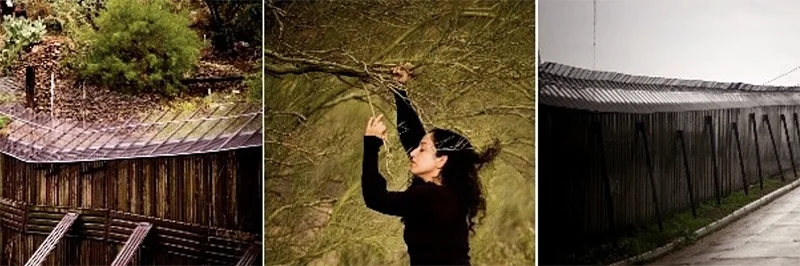
Image:
Sama Alshaibi, Borderland series, 2007. left: Nogales/Mexico; center: No-man’s Land II (along the Mexican/American Border); right: Nogales/USA. Digital archival print, 23 x 92 inches (overall). Courtesy of the artist