Rebels + Icons: The Photography of Janette Beckman stages a vivid conversation between street life and global culture, showing how images made on corners and in clubs can reshape fashion, music, and political voice.
Janette Beckman’s archive reads like a living timeline: punk’s ragged energy in 1970s London, the birth of Hip-Hop on New York streets, and the evolving politics of style and protest across decades. Her photographs do more than record moments; they trace the routes by which subcultures move from local assertion to worldwide influence.
Beckman’s portraits combine access with clarity. Whether she photographs Run‑D.M.C. in shell-toe Adidas, LL Cool J’s early swagger, or the sartorial ingenuity of communities reworking luxury into street language, her images capture both presence and process. Faces, clothes, and gestures emerge as forms of argument: identity declared through stance, costume, and the everyday props of survival and expression. The camera becomes a partner in cultural making, not merely a witness to it.
Beyond celebrity, Beckman’s strength is documentary intimacy. Street photos of crews, parades, rodeos, and neighborhood rituals reveal how collective life invents style and meaning out of constrained resources. Her I VOTE BECAUSE series extends that impulse into civic life, aligning image-making with activism and insisting that portraits can be calls to participation as much as records of selfhood. Archival notes and contact sheets in the show make visible the decisions that shaped iconic frames, reminding viewers that legend often rests on small, repeated choices.
Immersive elements—studio reconstructions, projection mapping, and film—translate Beckman’s practice into public experience, letting visitors move inside the lighting and sets that produced so many recognizable pictures. Across more than five hundred works, the exhibition argues that cultural authority rarely descends from above; it emerges from streets, clubs, and insistence. Beckman’s photographs keep that process in view: insurgent, inventive, and endlessly generative, they show how rebellion becomes style and how style, in turn, rewrites history.
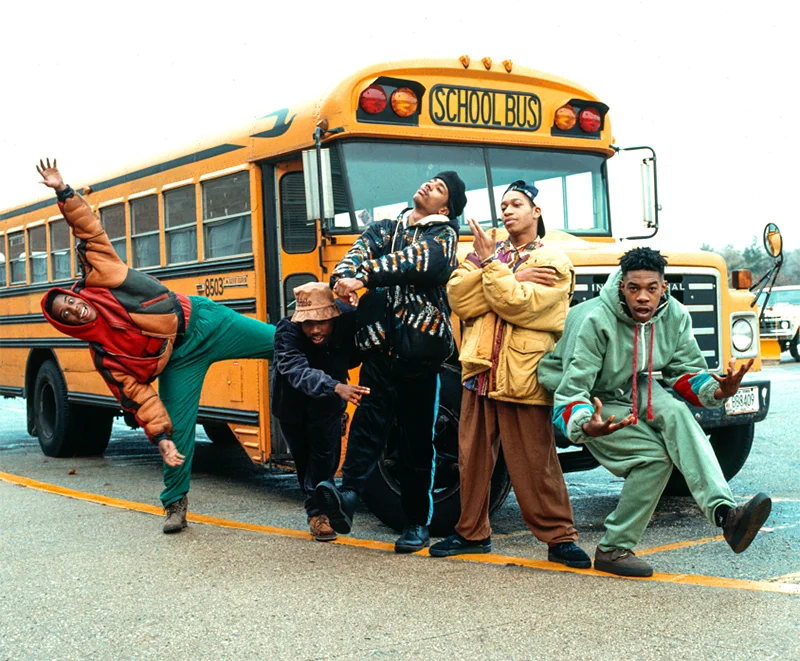
Image:
Leaders of the New School, Long Island, 1990 © Janette Beckman