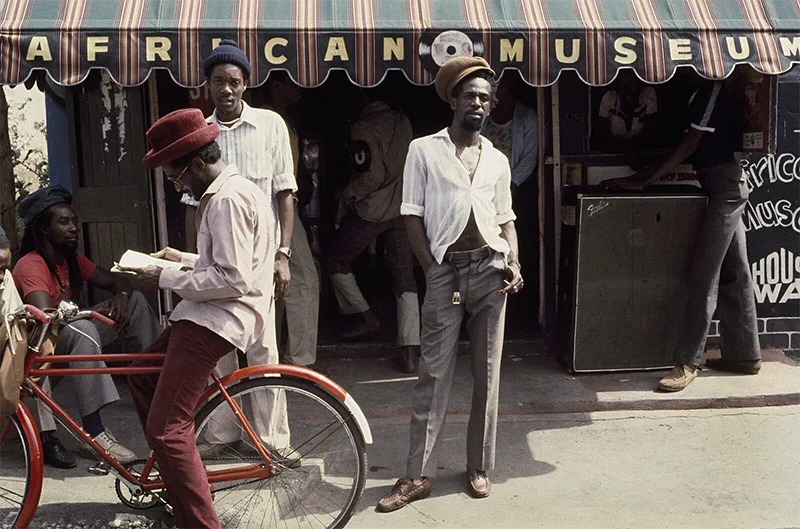
Dancing the Revolution: From Dancehall to Reggaetón, presented at the Museum of Contemporary Art Chicago from April 14 through September 20, 2026, examines the vibrant cultural histories of two influential musical movements that emerged from the Caribbean and its diasporas. Through photography, installation, video, and sound, the exhibition considers how dancehall and reggaetón function not only as musical styles but also as forms of collective expression rooted in resistance, celebration, and community. Across decades of artistic practice, musicians, dancers, and visual artists transform rhythm and movement into powerful vehicles for storytelling and social commentary.
The origins of dancehall trace back to Kingston during the late twentieth century, where sound systems—mobile sets of towering speakers and turntables—create improvised gathering spaces within neighborhoods. These events operate as both musical laboratories and civic forums, where DJs, dancers, and audiences shape the evolving language of the genre. Reggaetón emerges through parallel cultural exchanges linking the Caribbean with urban centers such as San Juan, Panama City, and New York City. Over time, these sounds travel widely, carrying with them stories of migration, identity, and cultural resilience.
Artists included in the exhibition explore the visual and political dimensions of these musical traditions. Filmmaker and installation artist Isaac Julien examines diasporic histories through immersive moving images, while sculptural and spatial interventions by Edra Soto evoke architectural forms connected to Caribbean memory. Other participants reflect on ecological and social themes tied to the region’s complex colonial legacies. Sound also plays a central role, notably through the presence of pioneering figures such as Lee "Scratch" Perry, whose experimental approach to reggae and dub shapes the sonic landscape from which later genres evolve.
The exhibition also reflects on the political energy embedded in dance culture. Public demonstrations in Puerto Rico during 2019 highlight how reggaetón’s signature movements enter the realm of protest as activists reclaim streets and plazas through collective performance. Within this context, dance operates as both celebration and defiance, transforming the body into an instrument of visibility. By bringing together artists working across disciplines,
Dancing the Revolution reveals how rhythm, movement, and visual culture intertwine to express enduring struggles for freedom and self-determination.
Image:
Beth Lesser (b. 1953, New York, NY; lives in Toronto, Canada), Singer Gregory Isaacs in front of his record shop, African Museum, on Chancery Lane, Kingston, Jamaica, 1984. Digital print; dimensions variable. Courtesy of the artist.