All about photo.com: photo contests, photography exhibitions, galleries, photographers, books, schools and venues.
Win a Solo Exhibition in July 2026 + An Exclusive Interview!

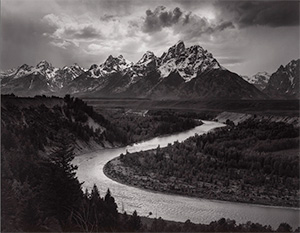
Ansel Adams: Signature Style

From February 29, 2020 to May 02, 2020
Share
Ansel Adams: Signature Style
1030 N. Olive Road
Tucson, AZ 85721
Ansel Adams's long photographic career saw a significant shift in style between his early work, made between 1916 and 1941, and his most recognizable production, from 1941 through the end of his life in 1984. The catalyst for this change was a commission from the federal government: in 1941 Adams was hired by the Department of the Interior to make photographs of the national parks as part of a mural project to adorn the new Interior building in Washington D.C. He was honored to be hired for a project of such importance and personal significance. With the broad American public in mind as his audience, he set out on a trip through the Western United States to picture the country's dramatic protected lands.

Although the large-scale murals were not completed in Adams's lifetime, the project had a huge impact on the photographer: the style he adopted for the national parks commission became his signature, characterizing much of his artwork for the rest of his life. He was so invested in taking pictures of America's national parks that in the late 1940s he applied for, and received, a Guggenheim fellowship to continue documenting spectacular wilderness places after the funding for the initial commission ran out.

This exhibition presents twenty-two photographs, illustrating three elements in his body of work: his signature style, the shift in style in 1941, and his commercial work. His signature style will be shown through later works and national parks pictures made either for the mural project or on his Guggenheim fellowship which exhibit characteristic elements. Pairs and groupings of works that contrast early and later works will track the shift in his style. And finally examples of his commercial photography, a little known but important component of his career, illustrate the development of his artistic language.
Stay up-to-date  with call for entries, deadlines and other news about exhibitions, galleries, publications, & special events.

Exhibitions Closing Soon

José Picayo: 35 Years in Photographs
Robin Rice Gallery | Hudson, NY
From April 09, 2026 to June 15, 2026
At Robin Rice Gallery, José Picayo: 35 Years in Photographs offers a wide-ranging survey of an artist whose practice resists easy categorization. On view from April 9 to June 15, 2026, the exhibition marks Picayo’s tenth solo presentation with the gallery, bringing together works produced between 1991 and 2025. The selection traces a career defined by technical rigor and a distinctive sensibility that merges formal elegance with an undercurrent of wit. Born in Havana in 1959 and shaped by a life that spans Cuba, Puerto Rico, and the United States, José Picayo developed a photographic language grounded in both discipline and experimentation. After settling in New York and studying at Parsons School of Design, he established himself within the editorial world, contributing to publications such as Harper’s Bazaar, Esquire, and The New York Times Magazine. His images, often poised between severity and playfulness, reveal a careful orchestration of composition, light, and gesture. Picayo’s commitment to analog processes remains central to his work. Rejecting digital manipulation in his personal practice, he relies on film, including large-format cameras and Polaroid formats, to create images that feel both timeless and materially grounded. This approach lends his photographs a tactile presence, reinforcing his belief in photography as a medium capable of transforming reality rather than simply recording it. The resulting works carry a sense of ambiguity, evoking earlier eras while remaining detached from any fixed moment in time. Beyond photography, Picayo’s recent engagement with textile practices extends his interest in craft and process. His exploration of weaving, taught in various New York institutions, reflects a continuity in his approach to making, where precision and materiality remain essential. At Robin Rice Gallery, 35 Years in Photographs stands as both a retrospective and a reaffirmation of an artist committed to the enduring possibilities of traditional photographic methods. Image: DEREK #1, 1995 © José Picayo, courtesy of the Robin Rice Gallery
Chester Higgins: Shared Memories
Bruce Silverstein Gallery | New York, NY
From April 16, 2026 to June 18, 2026
Chester Higgins: Shared Memories, presented from April 16 through June 18, 2026 at Bruce Silverstein Gallery, brings together more than forty photographs spanning nearly seven decades of artistic practice. The exhibition offers a powerful overview of the work of Chester Higgins, whose images form one of the most sustained photographic explorations of the African diaspora. Moving between black-and-white and color works, the exhibition traces a lifelong engagement with memory, heritage, and the spiritual and cultural continuity that connects communities across continents. Born in Fairhope in 1946 and raised in the rural American South during the Civil Rights era, Higgins developed his early photographic sensibility within a close-knit community shaped by church life, family ties, and the intellectual environment surrounding Tuskegee University. His earliest photographs reflect everyday moments of Black life in the South—scenes of worship, family gatherings, and community traditions that reveal resilience and dignity within a segregated society. When he later moved to New York City in the late 1960s, his perspective expanded while remaining deeply connected to the cultural foundations that shaped his upbringing. A pivotal journey to Senegal in 1971 opened a broader dialogue between African American history and its ancestral roots in Africa. Higgins returned repeatedly to the continent over the following decades, photographing spiritual ceremonies, cultural rituals, and landscapes tied to the history of the Atlantic diaspora. Images such as those made at Gorée Island confront the legacy of the transatlantic slave trade while emphasizing endurance, memory, and cultural survival. Other photographs made in Brazil, Egypt, and the United States reveal how traditions, beliefs, and identities continue to evolve across generations and geographies. Alongside his personal projects, Higgins spent nearly forty years as a staff photographer for The New York Times, producing widely circulated images that helped reshape public representations of Black life in the United States. His photographs portray families, scholars, spiritual leaders, and artists with intimacy and respect, offering an alternative visual narrative to the stereotypes that often dominated mainstream media. At the heart of Higgins’s practice lies a belief that photography serves as both witness and affirmation. Through portraits, documentary images, and his ongoing Black Pantheon series honoring influential cultural figures, his work constructs a living archive of memory and presence. Shared Memories gathers these decades of observation into a compelling meditation on identity, continuity, and the enduring strength of a global community. Image: Chester Higgins | State of Affairs, 2018 © Chester Higgins, courtesy of the Bruce Silverstein Gallery.
A Language We Share: Beverly Price and Gordon Parks
The Center for Art & Advocacy | Brooklyn, NY
From March 20, 2026 to June 19, 2026
A Language We Share: Beverly Price and Gordon Parks, on view from March 20 through June 19, 2026 at the Center for Art & Advocacy, presents a compelling intergenerational dialogue between contemporary photographer Beverly Price and 20th-century icon Gordon Parks. The exhibition highlights how photography functions simultaneously as a historical document and a symbolic medium, transmitting meaning across time while emphasizing enduring commitments to dignity, truth, and social responsibility. Price began her photographic practice in 2016, ten years after returning from incarceration, focusing on Washington, D.C.’s Southeast neighborhoods, particularly Anacostia and Barry Farms. Her images center children in their everyday lives, capturing moments of spontaneity, play, and reverie. In hyper-violent and over-policed environments, these photographs act as an assertion of care, preserving forms of childhood often threatened by structural inequities. By documenting lived experiences with both intimacy and attentiveness, Price transforms photography into a tool of protection and accountability. Parks’ work in the same neighborhoods, beginning in 1942 under the Julius Rosenwald Fellowship and his roles with the Farm Security Administration and Office of War Information, serves as both precedent and conversation partner. His photographs chronicled Black life in Washington, D.C., portraying children and communities with a blend of social critique and profound empathy. Parks’ images established the camera as a moral instrument, capable of bearing witness while shaping public understanding of social conditions. In A Language We Share, Price’s photographs are not imitations but continuations of Parks’ legacy. The exhibition pairs tender, playful, and resolute images of children with photographs documenting social and political protest, reflecting the intertwined nature of everyday life and civic struggle. Together, their works insist that joy, play, and creativity coexist with advocacy and social responsibility, and that photography can publish a first draft of history that remains alive, open, and carried forward by those who inherit it. Coinciding with the twentieth anniversary of Parks’ passing and the twentieth anniversary of Price’s return home in 2006, the exhibition emphasizes the persistence of images across generations, demonstrating how photographs continue to resonate and inspire dialogue beyond their creation. Image: Beverly Price, Water Boys, Washington DC, 2016 © Beverly Price, courtesy of the Center for Art & Advocacy
In progress
Salmagundi Art Club | New York, NY
From June 02, 2026 to June 19, 2026
In progress at SCNY presents recent work by the Photo Workshop Group, a photography collective made up of Salmagundi Club members who meet regularly to test ideas, compare approaches and work through technical challenges together. On view from June 2 to June 19, 2026, the exhibition reflects a year of practical sessions that moved from close-up studies and portrait lighting to night photography, still life, printing and field work. The group’s approach is hands-on and direct. Members bring cameras to monthly meetings, try out assignments, and learn by photographing in and around the clubhouse as well as at outside locations. Recent sessions included macro photography, indoor and outdoor portrait work, and still life studies in the Hartley Gallery and the Club library. The settings may be familiar, but the goal is to find fresh images in ordinary places and to solve problems of exposure, composition and light in real time. Several meetings pushed members into unfamiliar territory. Evening sessions around the Club and nearby streets focused on balancing natural and artificial light, while a visit to Gleason’s Gym in Dumbo offered a documentary setting with movement, low light and close attention to subjects. Printing and presentation also played a role, with a discussion led by fine-art printer James Senzer on paper choice, tonal range, mounting and framing. The program has also included presentations by guest artists working in portraiture and in newer image-making tools, including artificial intelligence. The exhibition includes work such as Maria Passannante-Der’s Boxer and Neil Allen’s Joyous Salmagundi Photogs, alongside other images made during the group’s recent meetings. Together, they show a range of visual styles but share the same foundation: observation, experimentation and the habit of learning by doing. The Photo Workshop Group meets monthly, usually on the last Friday, and remains open to Salmagundi Club members interested in photography. Its purpose is straightforward: to encourage conversation, technical growth and collaborative seeing through regular, practical work. Image: Rosemary Hawkins, Harbor in Bonavista, 2026 © Rosemary Hawkins
Western Cowboy: Reloaded
Colorado Photographic Arts Center CPAC | Denver, CO
From May 08, 2026 to June 20, 2026
Western Cowboy: Reloaded, on view at CPAC from May 8 through June 20, 2026, revisits one of the most enduring figures in American visual culture with a measured, contemporary lens. Curated by Samantha Johnston, the exhibition gathers six Colorado-based photographers—Juan Fuentes, Constance Jaeggi, Amanda Lopez, Jack Ludlam, Rob Hammer, and Ian Warren—whose work collectively challenges the simplified mythology of the cowboy and reframes it within a broader cultural and historical context. For generations, the cowboy has occupied a central place in the American imagination, often portrayed as a solitary figure embodying independence and resilience. Yet this exhibition shifts the focus away from that familiar narrative, drawing attention instead to the diverse communities and traditions that have shaped the American West. Indigenous histories, Hispanic heritage, and the practical realities of ranching and rodeo life all surface in these images, complicating the notion of a singular, unified identity. The photographers approach the subject from varied perspectives. Some turn toward portraiture, capturing riders, wranglers, and workers in moments of quiet presence that emphasize lived experience over legend. Others focus on the material culture of the West—worn leather, weathered landscapes, tools of labor—highlighting the tactile dimensions of a life often romanticized from a distance. Scenes of rodeo culture introduce a different energy, where physical endurance and risk replace the stillness of traditional iconography. What emerges is not a rejection of the cowboy figure, but a recalibration. The exhibition acknowledges the symbolic power of the image while insisting on a more nuanced understanding of its origins and meanings. By presenting multiple viewpoints, it opens a space for reconsideration, where the West appears less as a fixed idea and more as an evolving set of relationships between land, labor, and identity. Timed alongside significant historical anniversaries, Western Cowboy: Reloaded situates its inquiry within a broader reflection on national narratives. It suggests that revisiting familiar symbols can reveal overlooked histories, offering a more grounded and inclusive vision of the American West. Image: Cowpuncher, © Rob Hammer
Alma Haser
Candela Books + Gallery | Richmond, VA
From May 01, 2026 to June 20, 2026
The domestic sphere and the physiological realities of postpartum existence are subjected to a rigorous deconstruction in Tired, Warrior, Defeated, In Love, the first solo exhibition by Alma Haser at Candela Book Gallery. Running through June 20, 2026, the project moves away from the artist’s known focus on identical twins and complex paper folding to examine the systemic and biological pressures of motherhood. Haser, a German-born photographer based in the United Kingdom, utilizes grand silks and mixed-media prints to document the physical toll of caregiving, recording images of stretched skin, bruised tissue, and the structural changes of the maternal body. The work functions as a journalistic rebuttal to the sanitized, idyllic imagery of family life prevalent in commercial media, presenting instead a "patchwork" of time that reflects the mental load and chaotic nature of the role. The technical execution of the series involves a layering of time and form, where the boundaries between mother and child become visually indistinguishable. This "porosity" of identity is a central theme, exploring the simultaneous sensations of claustrophobia and euphoria. Haser’s methodology involves an ongoing dialogue with a cohort of mothers, incorporating their personal narratives and responses into the visual framework. By utilizing analogue techniques and sculptural manipulations, she creates a textured representation of self-sacrifice and rebirth. The exhibition highlights the instability of the maternal persona, framing it as an experience rooted in both the biological imperative and the sociological expectations placed upon women. The result is a stark, evidence-based portrait of a journey that is as much about the loss of the former self as it is about the creation of new life. Complementing the photographic works is Four Legs, a series of unique ceramic miniature chairs displayed alongside their photographic counterparts. This segment of the exhibition serves as a physical manifestation of the artist’s need for autonomy within the domestic environment. Haser describes the repetitive act of crafting these objects as a means of exerting control over a micro-space, providing a psychological counterweight to the unpredictability of daily life. This multidisciplinary approach—combining photography, sculpture, and text—reinforces Haser’s standing as a transformative figure in contemporary portraiture. Her work, which previously earned the Taylor Wessing Portrait Prize, continues to challenge the viewer’s perception of reality, forcing a confrontation with the raw and often messy data of human development and survival within the family unit. Image: © Alma Haser
Daniel John Lockwood: Naturally Wisconsin
PhotoMidwest Gallery | Madison, WI
From May 02, 2026 to June 20, 2026
Daniel John Lockwood: Naturally Wisconsin presents nature not as backdrop, but as a language of its own. In this body of work, Lockwood turns toward the woods, water, fields, and seasonal shifts of Wisconsin to explore what lies beneath visible beauty: rhythm, structure, and a quiet spiritual charge. His photographs do more than describe a place. They ask how a landscape communicates when words fall short, when color becomes feeling, and form becomes a kind of hidden order. The exhibition reflects a deeply attentive way of seeing. Lockwood’s images hold close to the physical world, yet they also move toward something more elusive. A stand of trees, a patch of reflected light, the geometry of branches, or the layered tones of snow and earth become occasions for reflection. Rather than treating nature as a simple subject to be recorded, he approaches it as a source of mystery, one that rewards patience and close looking. The result is a photographic language shaped by stillness, observation, and an almost devotional awareness of pattern. Lockwood’s thinking echoes a belief that nature carries meaning beyond immediate appearance. In these works, that meaning emerges through contrast: softness and structure, lyricism and discipline, surface and depth. His titles and visual interventions gently redirect the viewer, inviting a more active encounter with color and composition. The images remain grounded in straight photography, yet they also hint at interpretation, as if each scene were asking to be read as well as seen. At a moment when daily life pulls attention away from the natural world, Naturally Wisconsin offers a slower, more contemplative register. The exhibition suggests that art can renew awareness of our connection to the environment, not by explaining it away, but by restoring the conditions for wonder. In Lockwood’s hands, nature becomes both subject and invitation: to look longer, to feel more deeply, and to recognize the living intelligence of the world around us. Image: BACKWATER BALLET © Daniel Lockwood
Mike Brodie: New And Selected Works
Casemore Gallery | San Francisco, CA
From May 02, 2026 to June 20, 2026
Mike Brodie, on view from May 2 to June 13, 2026 at Casemore Gallery, marks the gallery’s first solo exhibition with the American photographer, whose work has come to define a raw and immersive vision of life on the margins. Known for his early years documenting freight train travel across the United States, Brodie’s images offer a perspective shaped not by observation from afar, but by lived experience within the communities he photographs. Brodie’s entry into photography begins almost by accident, after discovering a Polaroid camera in the early 2000s. What follows is a period of constant movement, as he travels alongside a network of drifters, hitchhikers, and train hoppers. Shooting under the name “The Polaroid Kidd,” he produces a series of intimate portraits and scenes that capture both the harshness and camaraderie of transient life. These early works, characterized by their immediacy and physical closeness, quickly gain recognition for their unfiltered portrayal of a rarely seen subculture. As materials change, so does his approach. The transition from Polaroid to 35mm film marks a shift toward a broader narrative, culminating in the publication of A Period of Juvenile Prosperity. The book receives widespread acclaim and situates Mike Brodie within a lineage of American photographers concerned with movement, identity, and the open road. His photographs echo earlier traditions while maintaining a distinctly contemporary sensibility, rooted in personal connection rather than detached documentation. After stepping away from photography for several years, Brodie returns with new work that reflects a different phase of life. His more recent images, gathered in the monograph Failing, trace a quieter yet no less intense exploration of relationships, labor, and introspection. The focus shifts from collective experience to more personal narratives, revealing the passage of time and the complexities that accompany it. This exhibition brings these trajectories into focus, presenting Brodie’s practice as both a record of a specific moment and an ongoing inquiry into belonging and survival. His photographs remain grounded in empathy, offering a view of American life that resists simplification while retaining a sense of immediacy and truth. Image: Mike Brodie, #5060, 2025, Archival Pigment Print © Mike Brodie, courtesy of the Casemore Gallery
Sander Vos
Catherine Couturier Gallery | Houston, TX
From May 16, 2026 to June 20, 2026
At the Catherine Couturier Gallery, the exhibition Sander Vos unfolds as a meditation on perception and the mechanics of seeing. Presented from May 16 to June 20, 2026, the show introduces audiences to a body of work that resists the immediacy often associated with contemporary photography. Born in 1988 in the Netherlands and now based in London, Sander Vos approaches the medium as a site of construction rather than documentation, challenging viewers to reconsider how images are formed and understood. Vos builds his photographs through a process of fragmentation and recomposition. Drawing from portraits, still lifes, and mundane objects, he assembles layered compositions that hover between abstraction and recognition. The familiar becomes unstable: a face dissolves into planes of light, a simple object fractures into overlapping perspectives. This deliberate disruption interrupts the ease of visual consumption, encouraging a slower, more attentive mode of looking. In these images, clarity is never immediate but gradually negotiated through sustained observation. Central to the work is the interplay of light, shadow, and negative space. These elements do not merely describe form but actively reshape it, creating visual tensions that guide the viewer’s eye while withholding resolution. Vos works across both digital and analog techniques, combining photographic capture with collage-like interventions that blur the boundaries between mediums. The resulting images feel at once precise and elusive, grounded in reality yet drifting toward something more introspective and psychological. The exhibition also reflects the growing international recognition of Vos’s practice. Recent distinctions, including a juror’s selection at the LensCulture Portrait Awards and accolades such as the Graciela Iturbide Award and the PX3 Paris Photo Prize, underscore the relevance of his approach within a broader photographic landscape. His work also appears on the cover of AAP Magazine Shapes 2024, further marking his visibility within the field. Exhibitions at Photo London and the London Art Fair further situate his work within an evolving dialogue on contemporary image-making. At Catherine Couturier Gallery, his photographs offer a space where perception slows, inviting viewers to engage with the act of seeing as an unfolding process rather than a fixed conclusion. Image: Interpolation 07, 2024, archival pigment print © Sander Vos, courtesy of the Catherine Couturier Gallery
Markus Brunetti: FACADES IV
Yossi Milo Gallery | New York, NY
From April 30, 2026 to June 20, 2026
Markus Brunetti: FACADES IV, on view at Yossi Milo Gallery from April 30 to June 20, 2026, presents an immersive encounter with Europe’s most enduring sacred architecture. For more than two decades, Brunetti has devoted his artistic life to photographing cathedrals, churches, monasteries, and synagogues, approaching each structure with a rigor and patience that echoes the dedication of their original builders. His work offers not documentation in the conventional sense, but a sustained act of reverence toward architectural form, craft, and belief. At the heart of the exhibition are works from Brunetti’s ongoing FACADES series, images constructed through an exacting process that pushes photography beyond its traditional limits. For each monument, Brunetti produces thousands of photographs over extended periods of time, carefully capturing every surface, detail, and irregularity. These images are later assembled into seamless composites that eliminate perspective distortion, presenting the building frontally and in its entirety. The resulting works offer a clarity of vision that feels almost timeless, recalling the compositional balance and idealized symmetry found in classical painting. Brunetti’s practice is governed by strict self-imposed rules. Each façade is photographed head-on, beneath an overcast sky that neutralizes shadow and dramatization. By returning repeatedly to the same site and living in close proximity to the structure, the artist develops an intimate understanding of the building’s rhythms and proportions. This slow, methodical engagement allows the architecture to emerge as both object and subject, stripped of distraction and revealed in quiet authority. Integral to this journey is Brunetti’s collaboration with Betty Schöner, with whom he travels across Europe in a converted firetruck that serves as a mobile studio and living space. Together, they research and select sites that reflect the cultural, religious, and stylistic diversity of sacred architecture across the continent. Their nomadic existence underscores the project’s depth of commitment, transforming the act of photographing into a way of life. In these monumental yet contemplative images, Brunetti achieves something rare: a vision of architecture seemingly suspended outside of time. His facades stand complete, unified, and serene, inviting viewers to contemplate human ambition, devotion, and the enduring power of built form. Image: Badia Fiesolana, Fiesole, 2022-2025 Archival Pigment © Markus Brunetti
Humid Traces
Ford Foundation Gallery | New York, NY
From February 19, 2026 to June 20, 2026
Humid Traces, presented at the Ford Foundation Gallery from February 19 through June 20, 2026, brings water to the forefront as both subject and witness. At a moment defined by rising temperatures and intensifying climate instability, the exhibition examines how rivers, seas, and wetlands become charged sites where migration, memory, and power intersect. Water is shown not as a passive backdrop, but as an active force shaping human movement and redefining political boundaries. Across immersive installations, soundscapes, photography, video, and data-driven works, the exhibition reveals how attempts to control water—through borders, infrastructure, and extraction—ultimately expose its resistance to domination. Water carries histories within its currents, absorbing traces of displacement, labor, and survival. In doing so, it undermines rigid systems that seek to define who may cross and who must remain, suggesting alternative ways of understanding territory as fluid rather than fixed. The participating artists, drawn from diverse geographic and cultural contexts, approach water as both material and metaphor. Their works trace coastlines, riverbeds, and migratory routes shaped by colonial legacies, environmental degradation, and contemporary policy. Whether documenting contested waterways or visualizing unseen flows, these practices reveal how bodies of water become mirrors of global inequality while also holding the potential for shared responsibility and collective care. Curated by Federico Pérez Villoro, the exhibition is grounded in sustained research into political ecologies and technological systems. His long-term engagement with border rivers and access to freshwater informs the show’s emphasis on water’s shifting morphology and its capacity to redraw maps. Rather than presenting definitive answers, the exhibition invites viewers to listen, observe, and move alongside water’s rhythms, recognizing its agency and its role as an archive of lived experience. Ultimately, Humid Traces proposes water as a connective medium—one that links distant geographies through common vulnerability and resilience. By following its flows, the exhibition gestures toward new forms of solidarity that emerge not from imposed lines, but from shared dependence on a resource that refuses to be contained. Image: Zishaan A Latif. The Edge, 2023. Courtesy of the Artist. © Zishaan A Latif
Picturing Isabella
Isabella Stewart Gardner Museum | Boston, MA
From February 19, 2026 to June 21, 2026
Picturing Isabella, on view at the Fenway Gallery from February 19 to June 21, 2026, offers a nuanced exploration of Isabella Stewart Gardner’s lifelong negotiation with visibility, celebrity, and self-invention. Living at a moment when photography was becoming central to modern life, Gardner simultaneously benefited from and resisted its power. This exhibition reveals how her reluctance to be photographed was not simply shyness, but a deliberate strategy—one that allowed her to maintain control over how she was seen, remembered, and ultimately mythologized. Early photographs show Gardner as a young woman shaped by the conventions of late nineteenth-century portraiture: formal poses, composed expressions, and a clear assertion of social standing. As her influence grew and her public profile expanded, her relationship to the camera shifted. She became increasingly selective, choosing when and how she would appear, often obscured by veils, shadows, or turned profiles. These gestures transformed photography into a performative space where absence and suggestion carried more weight than direct representation. The exhibition brings together an evocative range of materials, including personal snapshots, travel photographs, newspaper images, and candid moments shared with friends and animals. Rather than constructing a single definitive portrait, these fragments accumulate into a layered and sometimes contradictory image of Gardner—private yet theatrical, guarded yet expressive. Each photograph hints at a woman keenly aware of the power of images, and equally aware of their limitations. In resisting the camera, Gardner shaped a public persona that thrived on mystery and contradiction. Ultimately, Picturing Isabella suggests that Gardner’s most enduring self-portrait is not found in any photograph, but in the museum she built. Carefully staged, deeply personal, and intentionally enigmatic, the Gardner Museum stands as an extension of her identity—an architectural and curatorial statement that replaced the traditional portrait. Through this lens, the exhibition invites viewers to reconsider how legacy is constructed, and how the act of withholding can be as powerful as the act of display. Image: Isabella Stewart Gardner Museum, Boston (P33w35) Otto Rosenheim (German, 1871–1955), Isabella Stewart Gardner, 1906. Gelatin silver print
Advertisement
AAP Magazine #59 Shapes
Win a Solo Exhibition in July
AAP Magazine #59 Shapes
Call for Entries
AAP Magazine #59 Shapes
Publish your work in our printed magazine and win $1,000 cash prizes

Related Articles

Huxley-Parlour Presents ‘Select Works, 1962-2019’ by Joel Meyerowitz
Huxley-Parlour Gallery is thrilled to announce Select Works, 1962-2019, a major exhibition celebrating the enduring legacy of world-renowned photographer Joel Meyerowitz. Marking the artist’s fourth solo show with the gallery, this carefully curated collection brings together twenty-five seminal photographs. Spanning a remarkable six-decade career, the exhibition tracks the evolution of Meyerowitz's influential photographic voice and his pioneering approach to the medium, offering viewers an intimate look at how one of masters of modern photography transformed the way we view the world.
CPW Upstate Photography Biennial
This summer, CPW (Center for Photography at Woodstock) will debut the inaugural Upstate Photography Biennial, a major new exhibition celebrating the thriving photographic arts scene across upstate New York. Bringing together the work of 39 artists, the landmark exhibition offers a compelling snapshot of the region’s creative vitality and its growing influence on contemporary photography.
Beneath the Surface: Mining and American Photography
Beneath the Surface to feature some 150 photographs by 100 artists spanning 185 years of society and industry in the United States
photo basel 2026 Celebrates the Expanding Language of Photography
Switzerland’s Premier Photography Event Returns for Its 11th Edition. Shifting Frames: Photo Basel 2026 Redefines the Limits of Fine Art Photography A Convergence of Legends: Curating 450 Masterworks
All About Photo Presents ’Fading Shehuo’ by Chris Yan
All About Photo is proud to present Chris Yan as the featured artist of our upcoming solo exhibition with his project Fading Shehuo, showcased exclusively on All About Photo. A project preserving the Spirit of Rural China Through Street Photography.
Belfast Photo Festival 2026: Horizons
The 2026 edition takes visitors towards new ‘Horizons’, a theme that positions photography at a critical threshold in an age of AI-generated imagery, automation and algorithmic seeing. The festival returns as the medium undergoes profound transformation and its claims to truth, trust, authorship and materiality are increasingly being questioned.
Meryl Meisler: Queer-Friendly Nightlife Now
Nearly five decades after documenting disco-era revelry, photographer Meryl Meisler returns with a bold new body of work capturing the pulse of contemporary queer nightlife—its grit, glamour, and enduring sense of community. Meryl Meisler: Queer-Friendly Nightlife Now premieres the CPW's inaugural Upstate Photography Biennial, a new exhibition series featuring 39 artists from across the region, opening May 30, 2026.
Prix Pictet Exhibition Makes U.S. Debut at MoCP
The Museum of Contemporary Photography at Columbia College Chicago (MoCP) will present Prix Pictet Storm from May 29 through August 22, 2026, marking the U.S. debut of the internationally touring exhibition dedicated to photography and sustainability. Organized in partnership with Prix Pictet — widely recognized as the world’s leading award focused on photography and sustainability — the exhibition brings together twelve exceptional contemporary photographers whose work explores environmental instability, political unrest, social tension, and the fragile state of the modern world.
Marilyn Monroe at 100: Landmark Exhibition Opens at National Portrait Gallery
Exploring Monroe’s life, career and legacy , the exhibition will include portraits created by many of the greatest photographers and artists of the 21th and 21st centuries , including Andy Warhol, Pauline Boty and Richard Avedon .
Call for Entries
Win A Solo Exhibition in July
Get International Exposure and Connect with Industry Insiders