All about photo.com: photo contests, photography exhibitions, galleries, photographers, books, schools and venues.
FINAL CALL TO ENTER AAP MAGAZINE WOMEN: GET PUBLISHED AND WIN $1,000
Eric Kim
Eric Kim
Eric Kim

Eric Kim

Country: United States
Birth: 1988

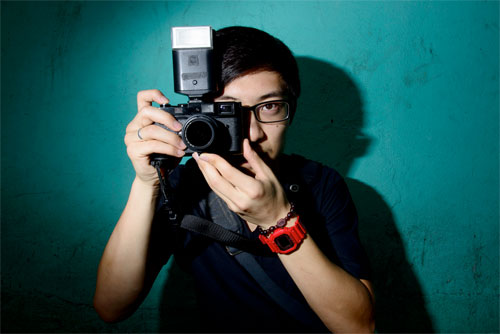
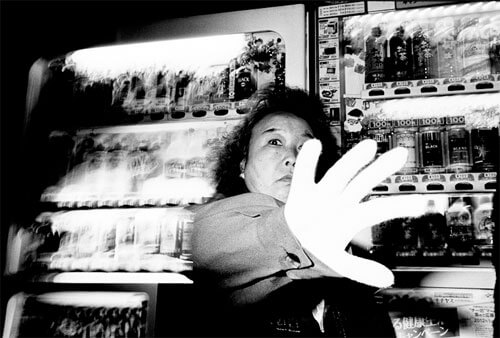
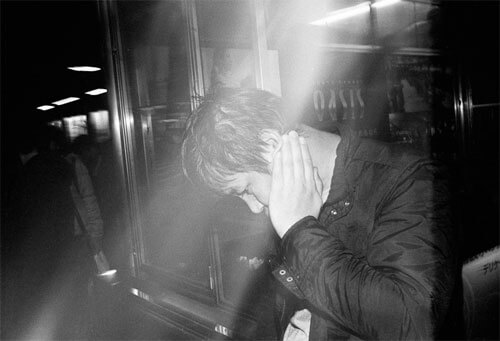
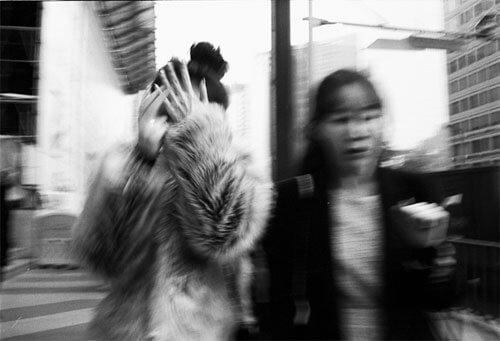
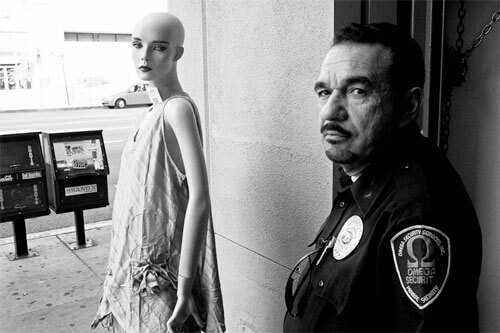
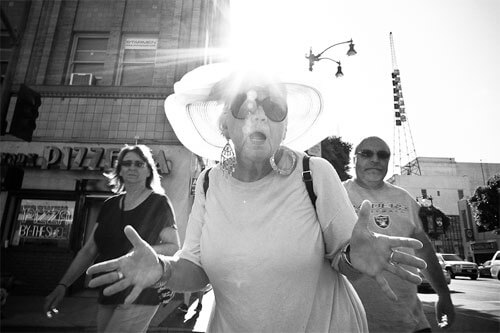
Eric Kim is an international street photographer currently based in Los Angeles. Through his blog and workshops, he teaches others the beauty of street photography, how to find their own style and vision, as well as how to overcome their fear of shooting strangers.

In the past he has done collaborations with Leica, Magnum, as well as Invisible Photographer Asia. He is currently an instructor at UC Riverside Extension, teaching a university-level street photography course. Last year he was also one of the judges for the London Street Photography Festival.

He has exhibited his work at the Leica stores in Singapore, Seoul, and Melbourne. He has taught workshops in Beirut, Seoul, Tokyo, Amsterdam, Berlin, Hong Kong, San Francisco, Los Angeles, Chicago, Sydney, Melbourne, Zurich, London, Toronto, Mumbai, Singapore, Kuala Lumpur, and Kota Kinabalu.

Source: Expert Photography


Artist Statement

"My first interest in street photography happened by chance. I was standing at a bus stop and I saw a man with horn-shaped glasses reading a book. There was something so genuine and unique about the moment. My heart was palpitating and the second I brought my camera to my eye, he looked directly at me and I instinctively clicked. My heart froze, but I made my first street photograph, without even realizing it. Being interested in both street photography and the approach, I started to experiment shooting street photography using my background knowledge studying sociology at UCLA.

I started experimenting getting very close when shooting, and surprisingly never got punched in the face for taking photos (yet). Now through my blog and my workshops, I travel the world and teach others the beauty of street photography and how people can overcome their fear of shooting strangers. Teaching is my passion, and in the past I taught a photography class to under-privileged youth in Los Angeles, I taught a university-level online course at UC Riverside extension, and even a Sociology of Facebook and Online Social Networks while a student at UCLA.

I also love participating in collaborations as I am currently a contributor to the Leica blog, I was one of the judges for the London Street Photography Contest 2011, and have done two collaborations with Samsung (I starred in a Samsung Galaxy Note 2 commercial and a campaign for the Samsung NX 20 camera). I have also been interviewed by the BBC about the ethics of street photography. I have had some of my work exhibited in in Los Angeles and at the Leica stores in Singapore, Seoul, and Melbourne. I have also taught street photography workshops in Beirut, Seoul, Tokyo, Amsterdam, Berlin, Hong Kong, San Francisco, Los Angeles, Chicago, Sydney, Melbourne, Zurich, London, Toronto, Mumbai, Singapore, Kuala Lumpur, and Kota Kinabalu (and more to come). My motto is always to shoot with a smile, and from the heart."

 

Eric Kim's Video

Inspiring Portfolios

Call for Entries
AAP Magazine #55 Women
Publish your work in our printed magazine and win $1,000 cash prizes
 
Stay up-to-date  with call for entries, deadlines and other news about exhibitions, galleries, publications, & special events.

More Great Photographers To Discover

Beth Galton
United States
Beth Galton is a photo-based artist, with an educational background in the natural sciences and three decades of experience as a professional photographer in the editorial and commercial arena. These elements of her history are the lens through which she explores the world. Her work has been recognized by organizations including Graphis, Communication Arts, the Tokyo International Foto Awards, Julia Margaret Cameron Award, IPA Awards, AAP, and the PDN Taste Awards. The Cut Food series was exhibited in Montpellier Contemporain, Aperture, and Beth Urdang Gallery. It was part of ‘The Fence’, a 7-city, traveling outdoor exhibition, it was published in the Washington Post, and covered by NPR. Both Lenscratch and Rfotofolio picked up the Memory of Absence series. Additionally, A Vita Plantae, and Memory of Absence have been exhibited at Wave Hill, Soho Photographic Gallery, The Center for Fine Art Photography (CO), The Center for Photographic Art (CA), The Florida Museum of Photographic Arts, Griffin Museum of Photography, Praxis Gallery, and SE Center for Photography. The Washington Post recently published Beth’s work from her series Covid Diary, a document of her time in confinement. About Cut Food "What started as a ubiquitous burrito shot, turned into an exploration of iconic food through a fresh perspective. We chose subjects which we felt were symbols within our Western food culture, and sought to move past the normal “appetite appeal” to look deeply and with curiosity into them. My intention was to give the ordinary a sense of magic show quality. Real, but also astonishing." About A Vita Plantae "This collection explores the relationship between art and science in a three-part series of organic images: Roots, Potato Love, and Time Preserved. These images seek to reveal some of the long-hidden truths of plants: their movement and grace, the nature of time, and the almost unbearable fragility of life. " About Memory of Absence "In 2017, my mother and father—who had not lived together for 50 years, died within 3 days of each other. In this series, I sought to convey a sense of memory and loss through the composition of found ephemera and botanical matter. The volatile botanicals represent the ever-changing nature of memory —an unstable and profoundly unreliable process."
Cedric Delsaux
France
1974
Cédric Delsaux was born in 1974. For almost 20 years, his oeuvre has sought to deconstruct our conventional view of the relationship between reality and photography. His aim is for the medium of photography to no longer directly express Reality, but rather the Fiction through which it is perceived. First known for his work as an advertising photographer, he has since made a name for himself through his personal long-term photo series. His first, Here To Stay/Nous resterons sur terre, was published in 2008 in France, and by Monacelli Press (Random House) in the US the following year. This series takes us on a subjective tour of symbolic places in our (post)modern world; these places are at once beautiful and ugly, conventional and crazy. His second, Dark Lens, was published in France in 2011 by Éditions Xavier Barral, distributed in the US by D.A.P., and translated into Japanese through publisher X-Knowledge. George Lucas wrote the foreword to the book. Dark Lens places characters from the Star Wars saga into real-world settings—like Dubai, Lille or the banlieue of Paris—and reveals the extent to which our perception of a city passes through the filter of fiction. In his next series, Échelle 1, he asked random passers-by to stand on a white wooden base, instantly transforming them into 1:1 scale figurines. For his 2014 book, Zone de repli, published by Éditions Xavier Barral, he spent three years reexploring an infamous news story, revisiting the haunts of a notorious imposter-murderer. The series he made with "France Territoire Liquide", a group co-founded with three other photographers, featured in an exhibition at the Bibliothèque nationale de France in 2017 (Paysages français: Une aventure photographique) and in a collected volume published by Éditions du Seuil ("Fiction&Cie" collection). Welcome to the Dark Corporation. It all began over 14 years ago with Dark Lens, Delsaux's initial series combining everyday places with the universe of Star Wars. Hailed an international success (...), it was honored by the Master himself, George Lucas.* After taking a break, Cédric Delsaux now reawakens the fantasy with this new opus, irreversibly breaking down the boundaries between Reality and Fiction... While the vehicles and characters of the famous Star Wars saga still haunt the real-world places he shoots—like Paris, Dubai, Marseilles, and Abu Dhabi—, this time Delsaux has worked with a full team (designer, 3D graphic artists, retouchers) to further tear back the veil between true and false, to the point that we begin to wonder if even the slightest frontier still remains. What was originally a simple confrontation between Reality and Science Fiction is finished; now the World and the "Dark Corporation" become one. It is as if the characters of the series have now permanently settled on Earth, bringing with them their ancient powers. These new residents have acquired their own vehicles, which are inspired by the Hollywood saga but recreated in the style of earthlings, borrowing design and techniques from the world that came before, the one that belonged to humankind... With this approach Cédric Delsaux combines two opposing states, reality and fantasy, as if to suggest that one can no longer be perceived without the other. The present of his photographs is no longer in the indicative, but is modified using some unknown conjugation to produce a sort of present of the conditional, distorting Roland Barthe's formula "this has been" into a puzzling "and if this was". Delsaux also uses his sets to suggest a looming, insidious threat. Each piece of land he captures depicts the latent conflict between human beings and the technology they have created... And he has an original way of exploiting the modern myth that is Star Wars to summon up all the anxieties and ambitions of a generation abandoned at the edge of the gaping chasm left by the disappearance of the Grand Narratives. Designer Vincent Gravière
Alison Wright
United States
1961 | † 2022
Alison Wright, an award-winning documentary photographer and author, has travelled to 150 countries photographing indigenous cultures and people while covering issues concerning the human condition. She is a recipient of the Dorothea Lange Award in Documentary Photography, a two-time winner of the Lowell Thomas Travel Journalism Award, and an Explorers Club Fellow. She was recently named a National Geographic Traveler of the Year as someone who travels "with a sense of passion and purpose." Alison has published ten books. Her upcoming book, Grit and Grace: Women at Work documents the empowerment of women working in global communities (Schiffer 2021). Her work has been published in numerous magazines including National Geographic, National Geographic Traveler, National Geographic Adventure, Outside, Islands and Smithsonian. Alison's life was nearly cut short during a devastating bus accident on a remote jungle road in Laos. Her best-selling memoir, Learning to Breathe; One Woman's Journey of Spirit and Survival, chronicles her inspirational story of survival, the years of rehabilitation and her ongoing determination to recover and continue traveling the world as an intrepid visual storyteller. This experience while working in post disaster/conflict areas inspired her to establish a foundation called Faces of Hope (facesofhope.org); a non-profit that globally supports women and children's rights by creating visual awareness and donating directly to grass-roots organizations that help sustain them through education and healthcare. About Human Tribe "The emotive beauty and grace of the human face, in all its diversity, will never cease to inspire me but it's the enduring spirit of our collective tribe of humanity that will always certainly amaze me. One of the many things I have learned during my years of global travel as a documentary photographer is that no matter how unique we may look in appearance, from the exotic to the mundane, we basically have the same universal desires and concerns. Our needs are actually quite simple: to love and be loved; to have a useful place in our society with some meaningful and fulfilling occupation in our life; work that will hopefully provide us with enough money in our pocket to get by; food on the table; education, health and safety for ourselves, our family and our children. The freedom to be oneself is a right that creates the exquisiteness of our human race. These portraits are an unguarded moment in the lives of a few of the people I have photographed from our remarkable human tapestry. Some are celebrating significant events, while others are living out ordinary days. Others are merely struggling to survive. Many are from countries whose lives are in flux or change due to war, natural disaster or the inevitable rapid progression of modernity. I feel drawn to those who live close to the land, documenting communities that may not last even another generation. Most are surprised that I actually wanted to stop and photograph someone who is considered in their culture to be such an ordinary looking person. From tribes in Africa, to nomads in Asia, survivors of post conflict and disaster, families and individuals around the world have graciously opened up their homes and hearts to me. Surprisingly, I have discovered that it is often the ones who have the least who share the most. I find compassion in what can seem to be a world of chaos. The planet, at times, can seem so vast, with the numbers almost too large for us to comprehend. But when you capture the look in someone's eyes, an intimate stare, a knowing glance, his or her situation becomes a shared experience, a more personal connection. Their eyes seem to radiate a dignity, a claim for a right to be seen, no matter what their circumstances. These eyes are what initially draws us in and connects us together. These photos are a celebration of the universal human spirit within us all. It is what bonds us as humankind, a continued thread, as together we continue this journey on the pilgrimage of life. "
Horst P. Horst
Germany/United States
1906 | † 1999
Horst P. Horst (born Horst Paul Albert Bohrmann), was a German-American fashion photographer. The younger of two sons, Horst was born in Weißenfels-an-der-Saale, Germany, to Klara (Schönbrodt) and Max Bohrmann. His father was a successful merchant. In his teens, he met dancer Evan Weidemann at the home of his aunt, and this aroused his interest in avant-garde art. In the late 1920s, Horst studied at Hamburg Kunstgewerbeschule, leaving there in 1930 to go to Paris to study under the architect Le Corbusier. While in Paris, he befriended many people in the art community and attended many galleries. In 1930 he met Vogue photographer Baron George Hoyningen-Huene, a half-Baltic, half-American nobleman, and became his photographic assistant, occasional model, and lover. He traveled to England with him that winter. While there, they visited photographer Cecil Beaton, who was working for the British edition of Vogue. In 1931, Horst began his association with Vogue, publishing his first photograph in the French edition of Vogue in December of that year. It was a full-page advertisement showing a model in black velvet holding a Klytia scent bottle. His first exhibition took place at La Plume d'Or in Paris in 1932. It was reviewed by Janet Flanner in The New Yorker, and this review, which appeared after the exhibition ended, made Horst instantly prominent. Horst made a portrait of Bette Davis the same year, the first in a series of public figures he would photograph during his career. Within two years, he had photographed Noël Coward, Yvonne Printemps, Lisa Fonssagrives, Count Luchino Visconti di Madrone, Duke Fulco di Verdura, Baron Nicolas de Gunzburg, Princess Natalia Pavlovna Paley, Daisy Fellowes, Princess Marina of Greece and Denmark, Cole Porter, Elsa Schiaparelli, and others like Eve Curie. Horst rented an apartment in New York City in 1937, and while residing there met Coco Chanel, whom Horst called "the queen of the whole thing". He would photograph her fashions for three decades. He met Valentine Lawford, British diplomat in 1938, and they lived together until Lawford's death in 1991. Horst adopted a son, Richard J. Horst, whom they raised together. In 1941, Horst applied for United States citizenship. In 1942, he passed an Army physical, and joined the Army on July 2, 1943. On October 21, he received his United States citizenship as Horst P. Horst. He became an Army photographer, with much of his work printed in the forces' magazine Belvoir Castle. In 1945, he photographed United States President Harry S. Truman, with whom he became friends, and he photographed every First Lady in the post-war period at the invitation of the White House. In 1947, Horst moved into his house in Oyster Bay, New York. He designed the white stucco-clad building himself, the design inspired by the houses that he had seen in Tunisia during his relationship with Hoyningen-Huene. Horst is best known for his photographs of women and fashion, but is also recognized for his photographs of interior architecture, still lifes, especially ones including plants, and environmental portraits. One of the great iconic photos of the Twentieth-Century is "The Mainbocher Corset" with its erotically charged mystery, captured by Horst in Vogue’s Paris studio in 1939. Designers like Donna Karan continue to use the timeless beauty of "The Mainbocher Corset" as an inspiration for their outerwear collections today. His work frequently reflects his interest in surrealism and his regard of the ancient Greek ideal of physical beauty. Lighting is more complex than one thinks. There appears to be only one source of light. But there were actually reflectors and other spotlights. I really don’t know how I did it. I would not be able to repeat it. -- Horst P. Horst, on his 1939 photograph Mainbocher Corset His method of work typically entailed careful preparation for the shoot, with the lighting and studio props (of which he used many) arranged in advance. His instructions to models are remembered as being brief and to the point. His published work uses lighting to pick out the subject; he frequently used four spotlights, often one of them pointing down from the ceiling. Only rarely do his photos include shadows falling on the background of the set. Horst rarely, if ever, used filters. While most of his work is in black & white, much of his color photography includes largely monochromatic settings to set off a colorful fashion. Horst's color photography did include documentation of society interior design, well noted in the volume Horst Interiors. He photographed a number of interiors designed by Robert Denning and Vincent Fourcade of Denning & Fourcade and often visited their homes in Manhattan and Long Island. After making the photograph, Horst generally left it up to others to develop, print, crop, and edit his work. One of his most famous portraits is of Marlene Dietrich, taken in 1942. She protested the lighting that he had selected and arranged, but he used it anyway. Dietrich liked the results and subsequently used a photo from the session in her own publicity. In the 1960s, encouraged by Vogue editor Diana Vreeland, Horst began a series of photos illustrating the lifestyle of international high society which included people like: Consuelo Vanderbilt, Marella Agnelli, Gloria Guinness, Baroness Pauline de Rothschild and Baron Philippe de Rothschild, Helen of Greece and Denmark, Baroness Geoffroy de Waldner, Princess Tatiana of Sayn-Wittgenstein-Berleburg, Lee Radziwill, Duke of Windsor and Duchess of Windsor, Peregrine Eliot, 10th Earl of St Germans and Lady Jacquetta Eliot, Countess of St Germans, Antenor Patiño, Oscar de la Renta and Françoise de Langlade, Desmond Guinness and Princess Henriette Marie-Gabrielle von Urach, Andy Warhol, Nancy Lancaster, Yves Saint Laurent, Doris Duke, Emilio Pucci, Cy Twombly, Billy Baldwin, Jacqueline Kennedy Onassis, Amanda Burden, Paloma Picasso and Comtesse Jacqueline de Ribes. The articles were written by the photographer's longtime companion, Valentine Lawford, a former English diplomat. From this point until nearly the time of his death, Horst spent most of his time traveling and photographing. In the mid-1970s, he began working for House & Garden magazine as well as for Vogue. Horst's last photograph for British Vogue was in 1991 with Princess Michael of Kent, shown against a background of tapestry and wearing a tiara belonging to her mother-in-law, Princess Marina, who he had photographed in 1934. He died at his home in Palm Beach Gardens, Florida at 93 years of age.Source: Wikipedia I don’t think photography has anything remotely to do with the brain. It has to do with eye appeal. -- Horst P. Horst
Thomas Dodd
United States
Thomas Dodd is a visual artist and photographer based out of Atlanta, Georgia who has developed a style that he calls "painterly photo montage" - a method he employs during principal photography and in editing software with which he crafts elaborately textured pieces that have a very organic and decidedly non-digital look to them. His work often has mythic and quasi-religious themes that pay homage to Old Master art traditions while at the same time drawing from psychological archetypes that evoke a strong emotional response from the viewer. Although his artwork resembles paintings, his pieces are entirely photographic in nature, fusing many images into a cohesive whole. His larger works are often presented in a mixed media form that adds a depth and texture that complements the photography beautifully. Thomas has had numerous exhibitions of his works in many cities in the USA and around the world. He has had recent shows in New York City, Paris, Mexico City, New Orleans, Tokyo, San Antonio, Seattle, and in his hometown of Atlanta. Dodd's photographs have been featured in many magazines, on book and album covers and he frequently teaches workshops and webinars on photo-editing and marketing for artists. Thomas began his career as a visual artist in 2005. Before that, he was best known as the harpist and songwriter for the 1990s musical group Trio Nocturna, a Celtic Gothic ensemble that put out three critically-acclaimed albums ("Morphia", "Tears of Light" and "Songs of the Celtic Night") and performed at author Anne Rice's annual Halloween balls in New Orleans, as well as spawning an offshoot band called the Changelings. Thomas also played harp on two albums by Michael Gira (the driving force behind the influential post-punk band the Swans): "the Body Lovers" and the Angels of Light "New Mother". The images that Thomas creates are basically a visual equivalent of the music he composed in the 1990s. Mythic themes and their relation to emotions and psychological states continue to be his primary subjects and motivations. Source: thomasdodd.com Interview with Thomas Dodd All About Photo: When did you realize you wanted to be a photographer? Thomas Dodd: There was a period in my early teens where I was inspired by seeing a gallery show of Ansel Adams’ work, and for a short time thereafter I was compelled to study black and white film photography (of course, digital did not exist back then in the 1970s), but that inspiration quickly was replaced by the kick in the ass I received when I heard the Sex Pistols (in 1977) which made me run out and get a guitar so I could take out my teen angst upon the (non-listening) world! AAP: Where did you study photography? With whom? TD: My father taught me the basics of the camera back in the 1970s. I also took a darkroom course in high school. My reemergence as a photographer in 2006 (after a 25 year musical career playing the Celtic harp) was basically a self-taught one with quite a few online tutorials along the way! AAP: Do you have a mentor? TD: My father was a great influence on me- both as a photographer and a human being. AAP: How long have you been a photographer? TD: Since 2006. My brief dabbling in photography in the 70s barely counts! AAP: Do you remember your first shot? What was it? TD: My first real photoshoot was of my friend (and first Muse) Halley dressed in a beautiful Rococo-themed dress she made. We wandered through the streets of downtown Decatur Ga. at around midnight searching for street light to shoot in. AAP: What or who inspires you? TD: Beauty inspires me. Great painters inspire me. An artistic or chameleonesque model inspires me... AAP: How could you describe your style? TD: “Painterly” photo montage with an artistic approach AAP: Do you have a favorite photograph or series? TD: My favorite photo is always the one I am currently working on! AAP: What kind of gear do you use? Camera, lens, digital, film? TD: I really am not one of those photographers who likes to talk about gear because I think the most important tool that an artist possesses is their imagination... but I shoot with a Sony A57 using a 18-70mm lens. AAP: Do you spend a lot of time editing your images? For what purpose? TD: I seem to spend ALL my time editing photos - What purpose? Self expression and sometimes' client satisfaction! AAP: Favorite(s) photographer(s)? TD: Jan Saudek - for the way he created such boldly erotic personal imagery while hiding from a repressive Communist regime... He also used texture and color in a very painterly way which has influenced me a great deal. AAP: What advice would you give a young photographer? TD: Don't be in a hurry to "succeed", and shun advice like "Fake it ‘til you make it". It takes TIME and PATIENCE to develop your own style. Always follow your own voice and don't be swayed by what is currently popular, and don't forget to ENJOY it - this is not supposed to feel like work! AAP: What mistake should a young photographer avoid? TD: Becoming an imitation or a copy of another photographer. Being in a hurry to get published or displayed in galleries is another common mistake. Take the time and develop your craft for a few years before you start thinking about sharing it with the world! AAP: Any quotes you would like to share? TD: "I am steadily surprised that there are so many photographers that reject manipulating reality, as if that was wrong. Change reality! If you don't find it, invent it!" - Pete Turner AAP: What current projects are you working on? TD: Nothing I can tell you about, but I will drop a hint and say it involves shattering some commonly held preconceptions about a "marginalized" segment of society. AAP: Your best memory as a photographer? TD: There have been so many, it's hard to choose an absolute best but I will say my first solo show, my first print sale and my first publication were all high points! AAP: Your worst souvenir as a photographer? TD: My broken D50 which gasped it’s last breath 5 clicks into a nude shoot! Or maybe the memory card and external hard drive that I irretrievably lost data from. Here is some more good advice - ALWAYS use an online backup in addition to discs and hard drives! AAP:The compliment that touched you most? TD: When my 92 year old Mother came to my first big gallery show in Atlanta (featuring some very large nude images) and said she was proud of me... AAP: Your favorite photo book? TD: Bob Carlos Clarke's "The Dark Summer" and Helmut Newton's "White Women". AAP: An anecdote? TD: I long ago learned as a model photographer that the crucial things to pack in your camera bag are not extra lenses, filters and light meters, They are instead bobby pins, safety pins, hair ties, insect repellent and sun block. Oh yeah, and a few model releases too! AAP: Anything else you would like to share? TD: Please feel free to "like" my Facebook page and introduce yourself.
Francis Malapris
Schizothymic baby-boomer, at the age of 12 Francis takes refuge in computer science and excels in this field despite social and academic failure. In 1996, as he becomes an engineer, he meets the need to preserve memories of the Moment and tries photography. Gradually, this utopia fades to give way to the sensitivity he has so long repressed. 20 years later, he is an accomplished self-taught artist through the study of technique and the masters who inspire him such as Raymond Depardon, Rafael Minkkinen and Daido Moriyama. Key encounters have formed his photographic approach to bring him to social contact and staging. He then abandons computer sciences to exploit his bubbling creativity, full of sensitivity. The human being is then at the center of his work, after the fashion of the "Self" (Freud), which lies between unconscious desires and moral standards. Affected by the death of a friend, he undertakes a strong introspection that will highlight neuroses that he crystallizes through nude photography. In 2011, he begins the IN SITU project about mental escape, a phenomenon that concerns him. In 2014, he develops a shooting process to build the AQUATIC series. In 2017, the images encounter a great success, are published and exhibited at the FEPN in Arles, namely with the festival bill. With his installation in the heart of the Saint Anne chapel, Francis goes beyond photography to offer a contemporary art installation which sublimates female energy. Artist Statement "The human element is a fantastic material. I like observing bodies, their movements and expressions, sometimes with the idea of appropriating them. The part that fascinates me the most, because almost inaccessible, is the soul, at the head of the personality with its tastes, emotions and especially its history. Then comes the complex relationship to society, which evolves with environment and time. I approach the person naturally with openness and sensitivity, on the lookout for singularities that may resonate in me. From object, 'the other' becomes a proper individual, whose distinguishable particles and sub-particles I highlight. The main theme of the work I am presenting is that of the relation to reality: whereas the physical body is submitted to the present, imagination is free to roam without constraint in time and space. The ambiguity of this permanent oscillation between rational and irrational, resignation and escape, motivates me in my research where letting go is the motto. The plurality of my projects illustrates the richness of mental spaces that I have visited. Whether dreamlike or real, I put limits only on the possible interpretation of the codes that I use."
Cornell Capa
United States
1918 | † 2008
Cornell Capa (born Kornél Friedmann; April 10, 1918 – May 23, 2008) was a Hungarian American photographer, member of Magnum Photos, photo curator, and the younger brother of photo-journalist and war photographer Robert Capa. Graduating from Imre Madách Gymnasium in Budapest, he initially intended to study medicine, but instead joined his brother in Paris to pursue photography. Cornell was an ambitious photo enthusiast who founded the International Center of Photography in New York in 1974 with help from Micha Bar-Am after a stint of working for both Life magazine and Magnum Photos. Born as Kornél Friedmann in Budapest, he moved, aged 18, to Paris to work with his elder brother Robert Capa, a photo-journalist. In 1937, Cornell Capa moved to New York City to work in the Life magazine darkroom.[4] After serving in the U.S. Air Force, Capa became a Life staff photographer in 1946. The many covers that Capa shot for the magazine included portraits of television personality Jack Paar, painter Grandma Moses, and Clark Gable. In 1953 he visited Venezuela to make a photo-report of Caracas, on this trip he had the opportunity to photograph the artist Armando Reverón. In May 1954, his brother Robert Capa was killed by a landmine, while covering the final years of the First Indochina War. Cornell Capa joined Magnum Photos, the photo agency co-founded by Robert, the same year. For Magnum, Cornell Capa covered the Soviet Union, Israeli Six-Day War, and American politicians. Beginning in 1967, Capa mounted a series of exhibits and books entitled The Concerned Photographer. The exhibits led to his establishment in 1974 of the International Center of Photography in New York City. Capa served for many years as the director of the Center. Capa has published several collections of his photographs including JFK for President, a series of photographs of the 1960 presidential campaign that he took for Life magazine. Capa also produced a book documenting the first 100 days of the Kennedy presidency, with fellow Magnum photographers including Henri Cartier-Bresson and Elliott Erwitt. Capa died in New York City on May 23, 2008, of natural causes at the age of 90.Source: Wikipedia Cornell Capa (originally Cornell Friedmann) was born in Budapest and moved to Paris in 1936 to join his brother, Robert, who had escaped from the increasingly anti-Semitic climate of Hungary in 1930. Although he had intended to study medicine, Cornell was drawn to photography through his brother and began making prints for him, as well as for Henri Cartier-Bresson and Chim (David Seymour). This experience encouraged him to become a professional photojournalist, and in 1937 he moved to New York to pursue a career. After he had worked in the darkrooms of the Pix agency and LIFE for a few years, his first photo story was published in Picture Post in 1939. During World War II, Capa worked for the US Army Air Corps Photo-Intelligence Unit and the Army Air Corps's public relations department. In 1946, he became a staff photographer at LIFE, based mainly in the American Midwest, and covered some three hundred assignments over the next three years. He was the magazine's resident photographer in England for two years, after which he returned to the United States, to produced some of his most well-known photo essays, on subjects such as Adlai Stevenson's presidential campaign and the education of mentally retarded children. Upon Robert's death in 1954, Capa left LIFE to continue his borther's work at Magnum, the international cooperative photography agency co-founded in 1947 by Robert, Henri Cartier-Bresson, Chim (David Seymour), and George Rodger. Over the next twenty years, Capa photographed many important stories for Magnum, including the activities of the Perón government in Argentina; the Democratic National Conventions of 1956, 1960 and 1968; and John F. Kennedy's first hundred days in office. Capa's photographic production slowed in the mid-1970s as he devoted himself more to the care and promotion of other photographers' work through his International Fund for Concerned Photography. In 1964, he organized the exhibition The Concerned Photographer, which led to the establishment of the International Center of Photography, an organization dedicated to the support of photography as a means of communication and creative expression, and to the preservation of photographic archives as a vital component of twentieth-century history. Capa received ICP's Lifetime Achievement Award in 1995. Capa served as ICP's Director Emeritus until his death in 2008.Source: International Center of Photography In Mr. Capa’s nearly 30 years as a photojournalist, the professional code to which he steadfastly adhered is best summed up by the title of his 1968 book “The Concerned Photographer.” He used the phrase often to describe any photographer who was passionately dedicated to doing work that contributed to the understanding and well-being of humanity and who produced “images in which genuine human feeling predominates over commercial cynicism or disinterested formalism.” The subjects of greatest interest to Capa as a photographer were politics and social justice. He covered both presidential campaigns of Adlai Stevenson in the 1950s and also became a good friend of Stevenson. He covered John F. Kennedy’s successful presidential run in 1960, and then spearheaded a project in which he and nine fellow Magnum photographers documented the young president’s first hundred days, resulting in the book “Let Us Begin: The First One Hundred Days of the Kennedy Administration.” (He got to know the Kennedys well; Jacqueline Kennedy Onassis would become one of the first trustees of the I.C.P.) In Argentina, Mr. Capa documented the increasingly repressive tactics of the Peron regime and then the revolution that overthrew it. In Israel, he covered the 1967 Six Day-War. The vast number of picture essays he produced on assignment ranged in subject from Christian missionaries in the jungles of Latin America to the Russian Orthodox Church in Soviet Russia during the cold war, the elite Queen’s Guards in England and the education of mentally retarded children in New England. His work conformed to all the visual hallmarks of Life magazine photography: clear subject matter, strong composition, bold graphic impact and at times even a touch of wit. In his 1959 essay about the Ford Motor Company, for example, one picture presents a bird’s-eye view of 7,000 engineers lined up in rows behind the first compact car all of them were involved in developing: a single Ford Falcon. “I am not an artist, and I never intended to be one,” he wrote in the 1992 book Cornell Capa: Photographs. “I hope I have made some good photographs, but what I really hope is that I have done some good photo stories with memorable images that make a point, and, perhaps, even make a difference.”Source: The New-York Times
Advertisement
AAP Magazine #55 Wmen
Win a Solo Exhibition in April
AAP Magazine #55 Wmen

Latest Interviews

Exclusive Interview with Anastasia Samoylova
Anastasia Samoylova is an American artist whose photographic practice is shaped by close observation and a deep attentiveness to place. Working between documentary and formal exploration, she photographs landscapes, architecture, and everyday scenes with a sensitivity to light, structure, and atmosphere. Since relocating to Miami in 2016, her work has increasingly focused on how environments—both natural and built—carry social, cultural, and emotional traces. We asked her a few questions about her practice and her way of seeing, to better understand the thoughts and experiences that shape her work—while allowing the images themselves to remain open and speak in their own time.
Exclusive Interview with Marijn Fidder
Marijn Fidder is a Dutch documentary photographer whose work powerfully engages with current affairs and contemporary social issues. Driven by a deep sense of social justice, she uses photography to speak on behalf of the voiceless and to advocate for the rights of those who are most vulnerable. Her images have been widely published in major international outlets including National Geographic, CNN Style, NRC Handelsblad, Volkskrant, GUP New Talent, and ZEIT Magazin. Her long-term commitment to disability rights—particularly through years of work in Uganda—culminated in her acclaimed project Inclusive Nation, which earned her the title of Photographer of the Year 2025 at the All About Photo Awards. She is also the recipient of multiple prestigious honors, including awards from World Press Photo and the Global Peace Photo Award. We asked her a few questions about her life and work.
Exclusive Interview with Josh S. Rose
Josh S. Rose is a multidisciplinary artist working across photography, film, and writing. His practice bridges visual and performing arts, with a strong focus on movement, emotion, and the expressive potential of the image. Known for his long-standing collaborations with leading dance companies and performers, Rose brings together authenticity and precise composition—a balance he describes as “technical romanticism.” His work has been commissioned and exhibited internationally, appearing in outlets such as Vogue, at the Super Bowl, in film festivals, and most recently as a large-scale installation for Lincoln Center for the Performing Arts. A sought-after collaborator, he has worked with major artists, cultural institutions, and brands, following a previous career as Chief Creative Officer at Interpublic Group and the founder of Humans Are Social. We asked him a few questions about his life and work.
Interview with Maureen Ruddy Burkhart
Photographer Maureen Ruddy Burkhart brings a quietly attentive and deeply human sensibility to her exploration of the world through images. Shaped by a life immersed in photography, film, and visual storytelling, her work is guided by intuition, observation, and an enduring interest in the emotional undercurrents of everyday life. With a practice rooted in both fine art traditions and documentary awareness, she approaches her subjects with sensitivity, allowing subtle moments to emerge naturally rather than be imposed. Her series Til Death, selected as the Solo Exhibition for February 2025, reflects this long-standing commitment to photography as a space for reflection rather than spectacle. Drawn to moments that exist just outside the expected frame, Burkhart’s images suggest narratives without resolving them, leaving room for ambiguity, humor, and quiet connection. We asked her a few questions about her life and work.
Exclusive Interview with Peter Ydeen
Winner of AAP Magazine #45 Travels, his series reflects this unique vision—capturing the spirit of place through subtle layers of light, color, and emotion. Whether traveling abroad or observing the rhythms of his own surroundings, Ydeen creates images that feel both grounded and enchanted, inviting viewers into a world where reality and reverie meet.
Exclusive Interview with Julie Wang
Chinese-born photographer Julie Wang brings a poetic, contemplative sensitivity to her visual exploration of the world. Having lived for nearly equal parts of her life in China, Europe, and the United States, she approaches her subjects with the nuanced perspective of someone shaped by many cultures. This blend of distance, curiosity, and emotional resonance infuses her work with a quiet depth, allowing her to reveal the fragile beauty and subtle tensions that often pass unnoticed.
Exclusive Interview with Ghawam Kouchaki
American photographer Ghawam Kouchaki brings a sharply observant and introspective gaze to the streets of Japan’s capital. Based in Los Angeles, he approaches Tokyo with the distance — and curiosity — of an outsider, allowing him to uncover the city’s subtle contradictions, quiet tensions, and fleeting gestures that often go unnoticed. His series Tokyo no no, selected as the Solo Exhibition for December 2024, explores the hidden undercurrents of urban life: the unspoken rules, the small ruptures in routine, the poetic strangeness found in everyday moments. Through muted tones, instinctive timing, and meticulous framing, Kouchaki reveals a Tokyo that exists somewhere between reality and imagination — both intimate and enigmatic. We asked him a few questions about his life and work.
Exclusive Interview with Tommi Viitala
Tommi Viitala, winner of AAP Magazine #44: Street, is a Finnish photographer celebrated for his striking and cinematic street photography. With a keen eye for atmosphere and composition, he captures fleeting urban moments that reveal the poetry of everyday life. His work often explores the tension between solitude and connection within contemporary cityscapes, blending documentary realism with artistic sensibility. Viitala’s photographs have been exhibited internationally and recognized for their strong visual storytelling and emotional depth. We asked him a few questions about his life and work.
Exclusive Interview with Robert Mack
Robert Mack is a California-based visual artist, photographer, and filmmaker. His fine art photography and films have been exhibited widely in the United States and Europe, with major shows at the Baltimore Museum of Art and the Reiss-Engelhorn Museum in Mannheim, Germany. Both institutions hold his work in their permanent collections. Working across different media, Mack has built a career exploring the complexities of human presence and representation. In 1981, while living in Baltimore, he produced The Perkins Project: Not Guilty by Reason of Insanity, a rare photographic and film study inside Maryland’s hospital for the criminally insane. These stark yet compassionate black-and-white portraits remain one of his most powerful and controversial bodies of work.
Call for Entries
AAP Magazine #55 Women
Publish your work in our printed magazine and win $1,000 cash prizes