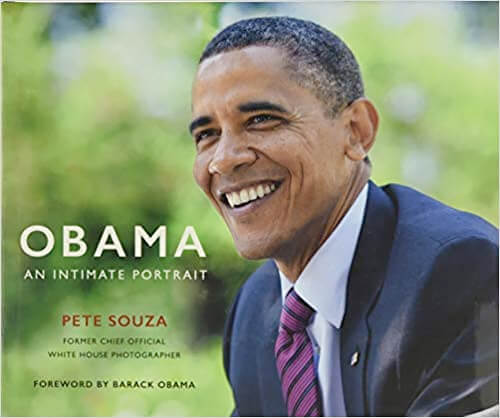
During Barack Obama's two terms, Pete Souza was with the President during more crucial moments than anyone else--and he photographed them all. Souza captured nearly two million photographs of President Obama, in moments highly classified and disarmingly candid.
Obama: An Intimate Portrait reproduces more than 300 of Souza's most iconic photographs with fine-art print quality in an oversize collectible format. Together they document the most consequential hours of the Presidency--including the historic image of President Obama and his advisors in the Situation Room during the bin Laden mission--alongside unguarded moments with the President's family, his encounters with children, interactions with world leaders and cultural figures, and more.
Souza's photographs, with the behind-the-scenes captions and stories that accompany them, communicate the pace and power of our nation's highest office. They also reveal the spirit of the extraordinary man who became our President. We see President Obama lead our nation through monumental challenges, comfort us in calamity and loss, share in hard-won victories, and set a singular example to "be kind and be useful," as he would instruct his daughters.
This book puts you in the White House with President Obama, and will be a treasured record of a landmark era in American history.Age Range: Adult
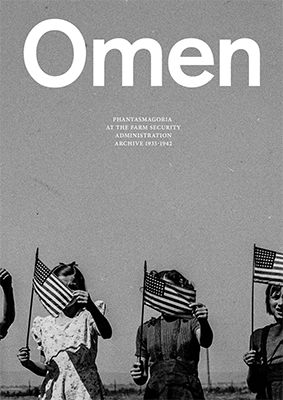
Drawing from approximately 40,000 works of the Farm Security Administration Photographic Archive (1935–42) housed at the New York Public Library, Omen reviews and reframes this landmark project of modern American documentary photography. The monumental project features works by storied photographers such as Russell Lee, Dorothea Lange, Ben Shahn, Walker Evans, Carl Mydans, Arthur Rothstein, Gordon Parks and Jack Delano. Many of the more iconic images that arose from this initiative were instrumental in constructing a hegemonic narrative of triumph against adversity in Depression-era America. In scrutinizing the backgrounds and secondary characters of some lesser-known photographs, however, a more turbulent story emerges.
Omen is co-edited by Mexican artists León Muñoz Santini and Jorge Panchoaga, providing a fresh perspective on this quintessentially American study. The image sequence amplifies the eerie details in enlarged, stark black-and-white images, creatively cropped and abutted together to form insidious connections. These hidden stories are premonitions of the visible and invisible specters of systemic injustice that characterize American society, their cycles renewing with each successive generation. Thus, Omen at once serves as a mirror for the anguished reality of today, and as a device for reflection on how historical and documentary photography is read and understood: taking the editorial gaze to its ultimate consequences. The book includes a narrative text by novelist and poet Lucy Ives.
For some travelers, a hotel is simply a place to stay. For LEONE, it is an experience shaped by atmosphere, people, and a sense of belonging. His third book, *A Place We Like*, grew out of a years-long search for that elusive feeling. Published as the inaugural title under the Leisure imprint of C41 Magazine, the project serves as both a visual guide to some of Europe’s most remarkable hotels and a personal reflection on the meaning of hospitality.
Discover Crossing, Kaplan’s powerful documentary photography project capturing Roxham Road, the irregular Canada-US border crossing used by refugees from 2018 to 2023.
Spurred by Trump-era immigration policies, this tiny site between New York and Quebec became a safe, highly unusual microcosm of global migration. Over four years, Kaplan photographed the entire ecosystem—from local cab drivers and border police to the asylum-seekers themselves. Moving past traditional media tropes of victimhood, these photographs challenge stereotypes to highlight the immense courage and resilience required to step into an unknown future before the site's closure in 2023.
I have spent years looking at Lee Friedlander’s America. It has always been a country of sharp angles, cluttered street corners, and shadows that seem to swallow the photographer whole. So when I picked up his latest monograph, Life Still, I expected the familiar noise of his world. Instead, I found something stranger: a 91-year-old master holding his breath.
Part of a bigger journey of liberation through self-exploration, this new photobook by Jo Ann Chaus is above all a collection of self-portraits, complemented by landscapes, still lifes and domestic interiors observed and inhabited by the photographer-cum-model
Blending photography and poetry, Burnt Eyes explores nostalgia, memory, and identity, offering a profound reflection on the complexities of belonging and the stories that shape us.
Seasons of Time by Nathalie Rubens is an intimate and fearless photobook exploring the emotional distance and deep connection between mother and daughter, while confronting the beauty, vulnerability, and physical reality of a woman’s aging body with rare honesty.
1804 continues Rich-Joseph Facun’s exploration of life in the Appalachian foothills of Southeast Ohio, this time turning his lens toward the local university and its complex, symbiotic relationship with the surrounding community.
GOST Books presents Robin Bernstein’s debut photobook MAPALAKATA, a compelling visual investigation into landscape, memory, and the layered histories of Southern Africa. The project offers a nuanced reflection on how geography is not only inhabited, but continually rewritten through movement, extraction, and shifting narratives of belonging.