Archipelago, a debut photobook by
Yolanda del Amo, explores the tension between the inner and exterior realities of human life. Through staged tableaus featuring friends and family, Del Amo constructs moments that expose the social frameworks shaping identity, class, family, and gender. Her photographs illustrate how closeness and separation coexist within the same space and reveal the fragile balance between connection and solitude.
Photographed between 2004 and 2014, Archipelago was made with a large-format camera, using real interiors and outdoor locations in various countries including Spain and the United States. Her sitters are not professional actors but friends and relatives taking part in constructing scenes of imagined relationships. The result is a fusion of observation and design, where tension arises between authenticity and performance. Influenced by the dance theater of Pina Bausch, Del Amo brings the same precision to gesture and control that Bausch used to translate emotion into movement, shaping each photograph into an expressive study of human behavior.
The book of approximately fifty photographs becomes a theatre of human relationships where every image is a distinct story, and the reader is invited to observe and read the emotional exchanges between its subjects. In one scene, a couple with a newborn embodies this tension: the mother, turned away from her family, sits by a sunlit window with her robe loose and her stare blank, while the father, absorbed in feeding the baby, remains unaware of her distance. Small objects — tissues, a baby bottle — mark the reality of new parenthood, while the woman’s withdrawal suggests exhaustion, perhaps depression.
In another photograph a young couple is side by side in separate beds, each staring at a laptop, their faces illuminated by the screens. The wedding portraits of her over his bed and his over hers suggest the novelty of their matrimonial status, yet there is already a lack of affection. Here Del Amo, years before it became a public anxiety, pictured how technology contributes to isolation even in shared space. In another image, an older couple inhabits an immaculate living room, where he stands at the window, and she waits on the sofa. The symmetry of the room, matching lamps, grand mantel, and ordered decor adds to the emotional chill. The distance between these two is measured not in steps but in years.
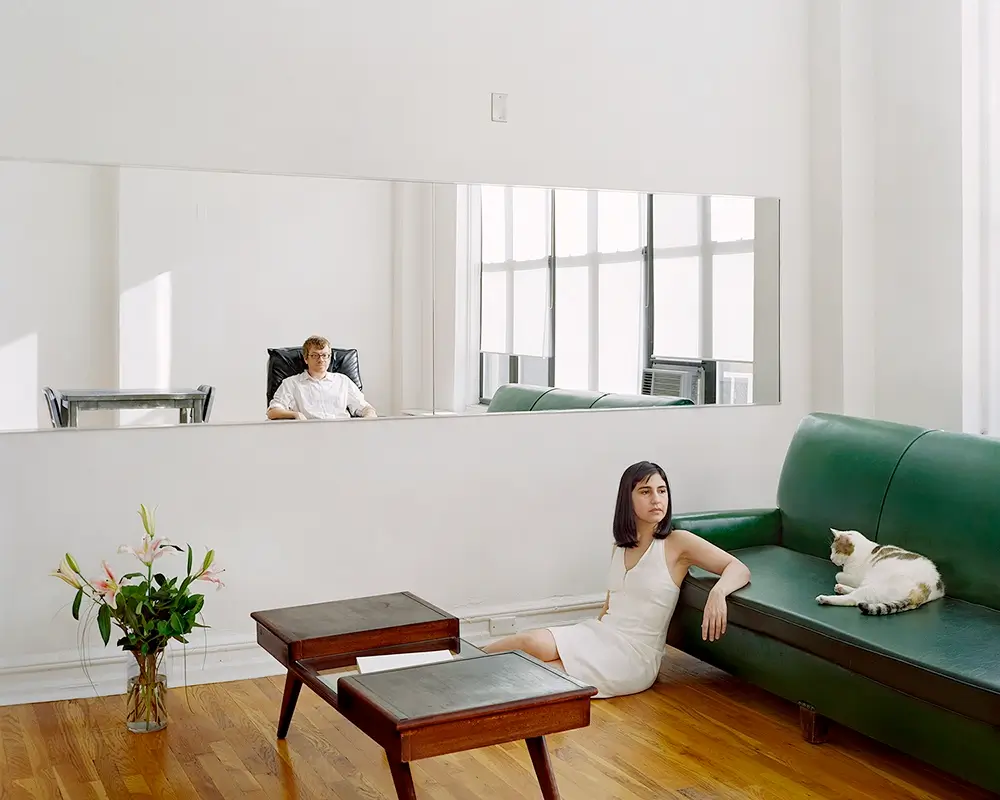
Claudia, Peter, Luna, 2006 © Yolanda del Amo
Together, the photographs form a study of intimacy and estrangement. They depict people performing roles that both define and confine them. Del Amo’s style is deliberate: though compositions are balanced and quiet, each portrait is emotionally charged. The silence in her pictures carries the weight of what is unsaid but quite obvious.
Both essayists in the book, renowned photography critics, take a shot at interpreting the relationships between the people depicted in Archipelago. In her essay Islands in the Sea of Life, Vicki Goldberg writes that Del Amo
“found elegant, suggestive, sometimes faintly mysterious solutions to the constriction of time and the inclusion within one frame of both inner feelings and outer distances between people.” Goldberg describes Del Amo as
“playwright, director, and stage manager” of her own photographic theater, where each image unites psychological tension with formal clarity. She notes that Del Amo was after
“something slightly stranger than reality, that throws reality off,” and that her pictures show
“the struggle to reconcile the needs for relation and for individuality.”
Jean Dykstra, in Alone Together, writes that Del Amo’s photographs
“contain secrets, mysteries that simmer beneath the surface.” She describes them as
“staged tableaux” where each person
“appears to be in his or her own world.” Dykstra connects Del Amo’s sensibility to theater and cinema, noting her admiration for Antonioni and Brecht, and her visual precision shaped by painting and dance. She observes that Del Amo’s use of color — the
“emotional register of a lemon-yellow bedroom” or the “bright blue of an empty swimming pool” — deepens the emotional distance she portrays.
“We are always performing roles in front of one another,” Del Amo says. Dykstra sees this as the quiet heart of Archipelago: the human wish to connect, and the equal wish to remain apart.
“Archipelago is an exploration of interpersonal connections and disconnections, and the dichotomy between the longing for closeness and the need for individuality. The relationship between the people in the images defines itself through the setting, which becomes a psychological extension of their character. Using silence as a platform, these photographs operate as a collection of ‘islands,’ separated by the loneliness of each one and linked by the intimate bond of belonging to the same world.” —Yolanda del Amo
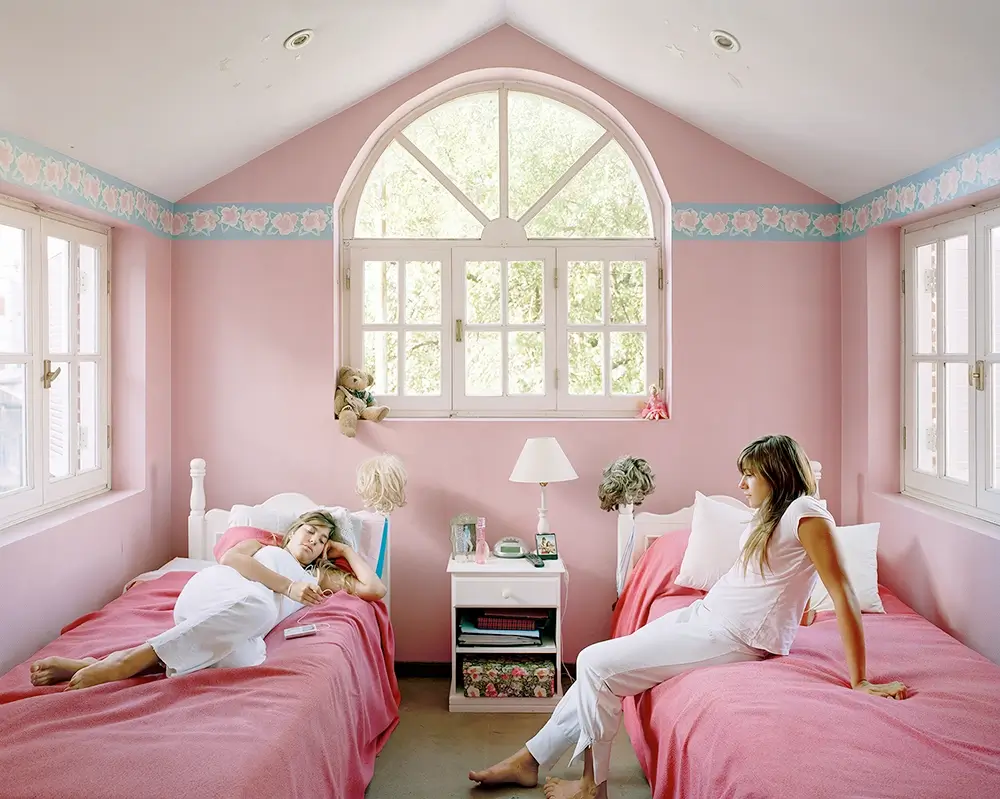
Macarena, Rosario, 2007 © Yolanda del Amo
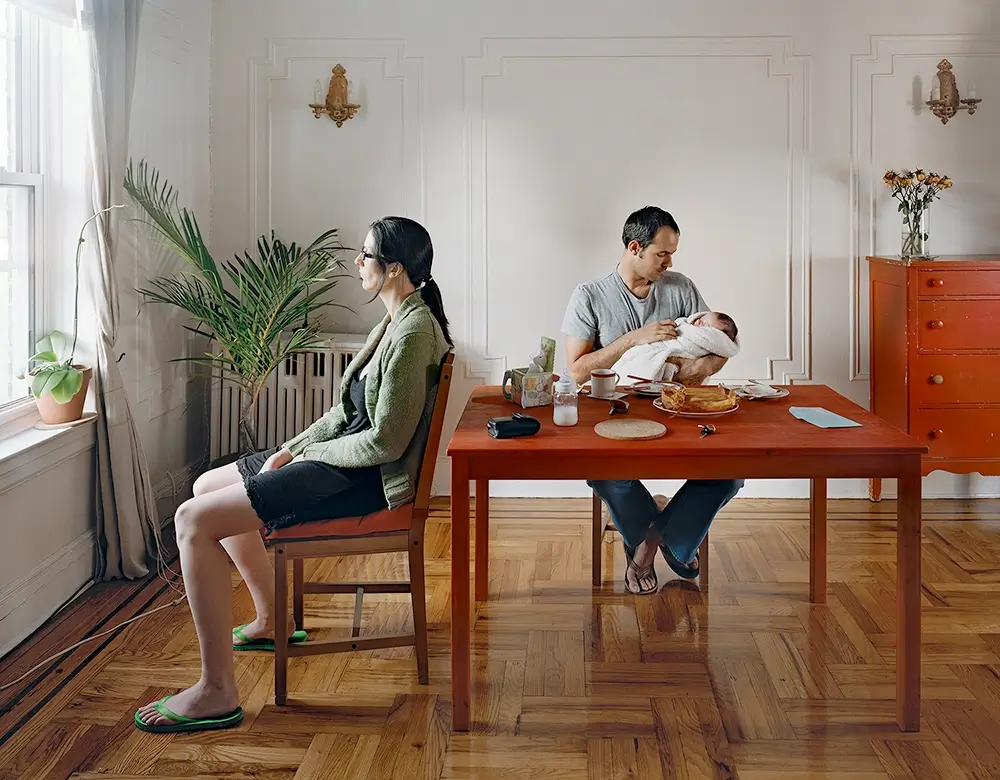
Elena, Malena, Dean, 2005 © Yolanda del Amo
Yolanda del Amo is a Spanish-born, New York-based photographic artist with an MFA from the Rhode Island School of Design. Her work has been exhibited nationally and internationally, and supported by numerous institutions including the Jerome Foundation, the New York State Council on the Arts, and the Spanish Ministry of Culture, among others.
www.yolandadelamo.com
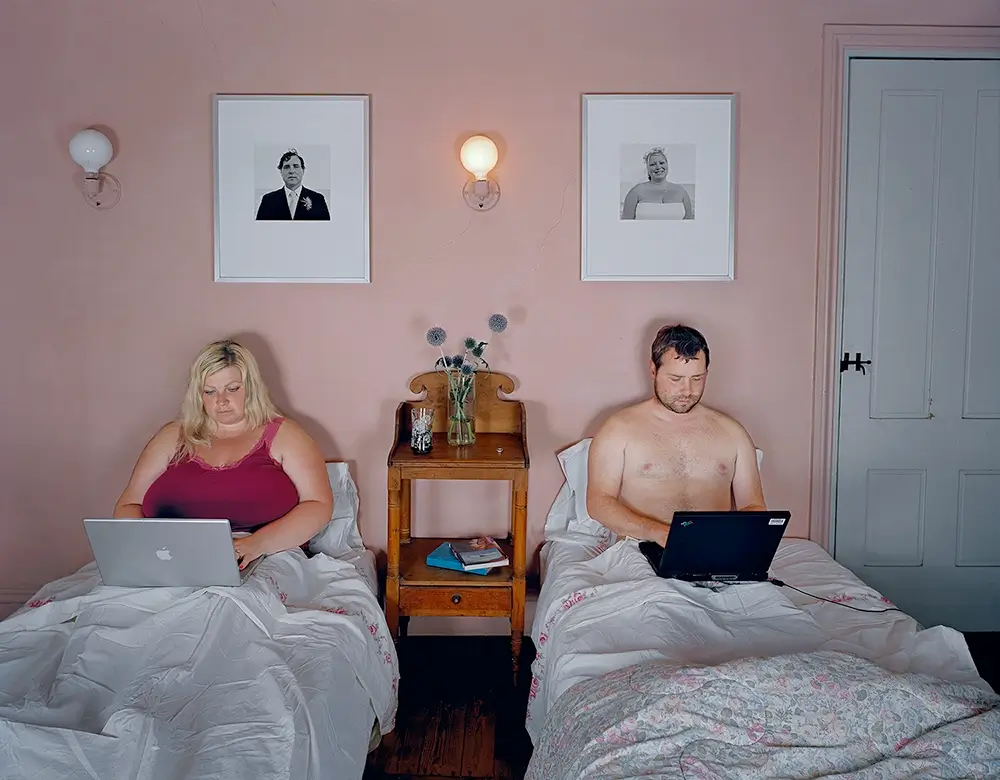
Jesse, Kerry, 2005 © Yolanda del Amo