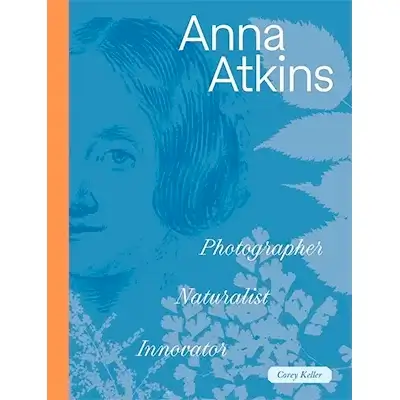
Before reading this book, I thought I already knew
Anna Atkins. Like many photographers and photo enthusiasts, I had seen reproductions of her delicate cyanotypes of seaweed and other botanical specimens. These images, often described as elegant and fragile, are striking in their clarity and composition. But
Anna Atkins: Photographer, Naturalist, Innovator provides a deeper understanding of her work, showing not only her skill as an image-maker but also her role as a pioneer in the history of photography.
Written by Corey Keller, this volume is short but dense with information and beautifully illustrated. Keller presents Atkins’s life and achievements in a clear and accessible manner, making the book suitable for photographers, collectors, and anyone interested in photographic history. The text balances biographical detail, historical context, and technical discussion, giving readers a thorough understanding of both the person and her work.
One of the most significant aspects highlighted in the book is that Anna Atkins may have created the first photographic book in history. For more than a century,
William Henry Fox Talbot’s The Pencil of Nature (1844–1846) was considered the first book illustrated with photographs. However, Atkins’s Photographs of British Algae: Cyanotype Impressions was produced several months earlier, preceding Talbot’s publication. This fact reshapes how we understand the origins of photographic publishing and underscores her pioneering role in the medium.
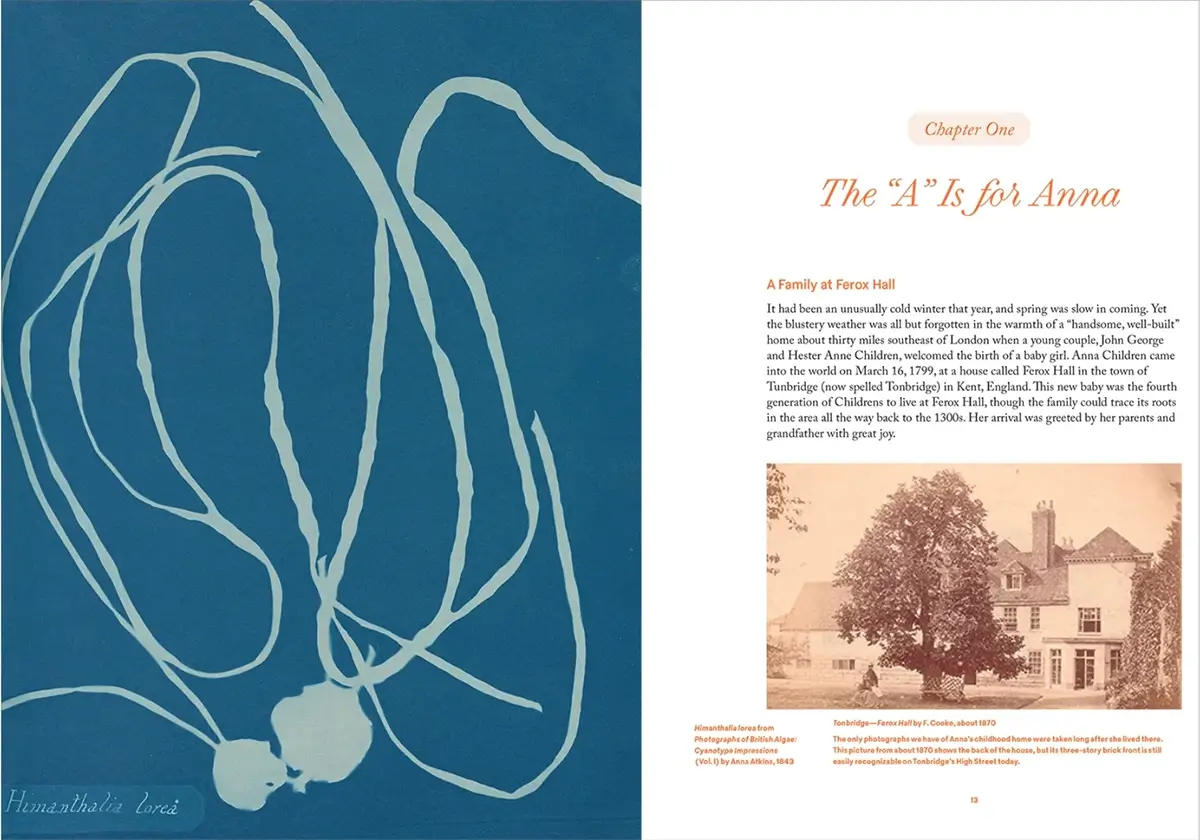
© Anna Atkins, Courtesy The J. Paul Getty Trust
Atkins’s book was also unique in its approach. Unlike Talbot, who documented objects and scenes, Atkins focused on scientific specimens, particularly algae. Each copy was handmade at home, with original cyanotype prints carefully placed on each page. The book was never commercially published, and she distributed it privately to friends and botany lovers. This was partly due to the social constraints faced by women in Victorian England, which limited her access to professional scientific and artistic networks.
This aspect of her story leads to one of the most interesting anecdotes in the book. Atkins signed her handmade copies with the initials “A.A.”. When the historian William Lang Jr. rediscovered the book in 1889, nearly fifty years after its creation, he believed “A.A.” stood for Anonymous Amateur. Only later was it recognized that these initials referred to Anna Atkins, a woman whose work had been largely overlooked. This anecdote illustrates both the ingenuity and the invisibility of women’s contributions in the history of science and photography.
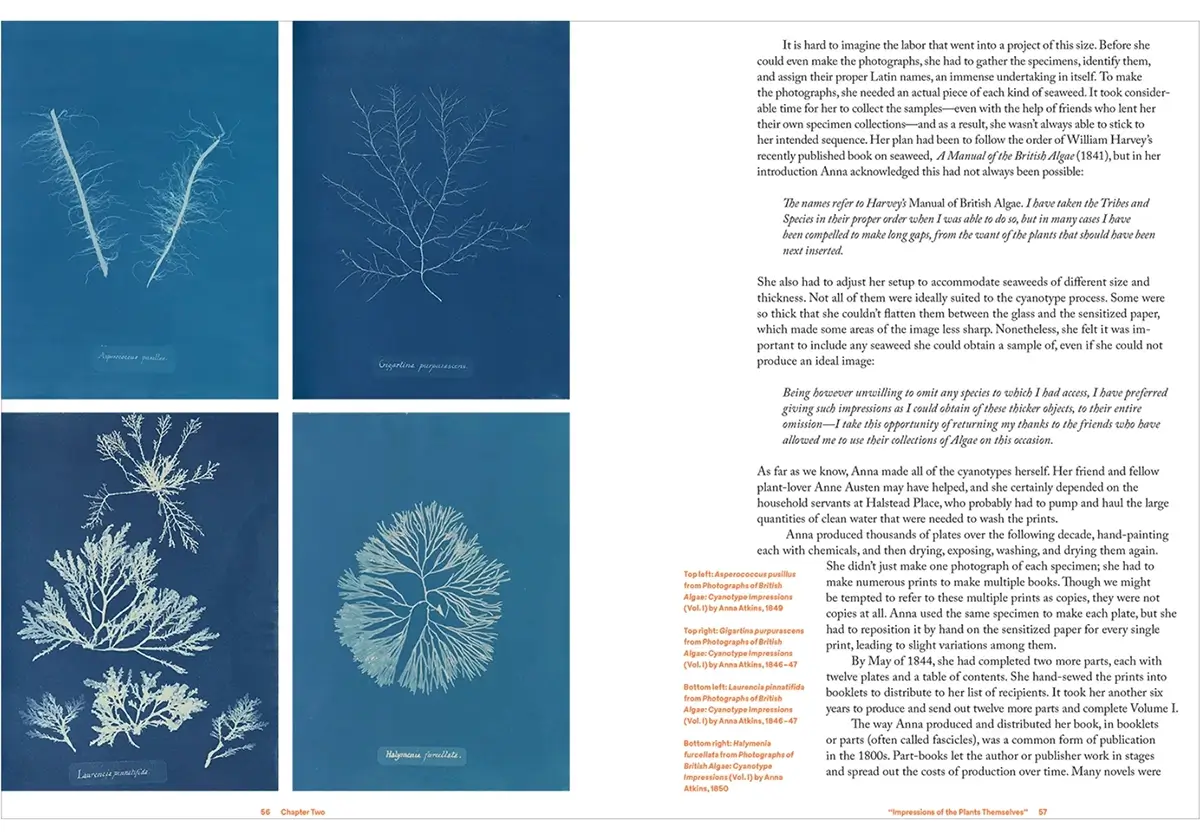
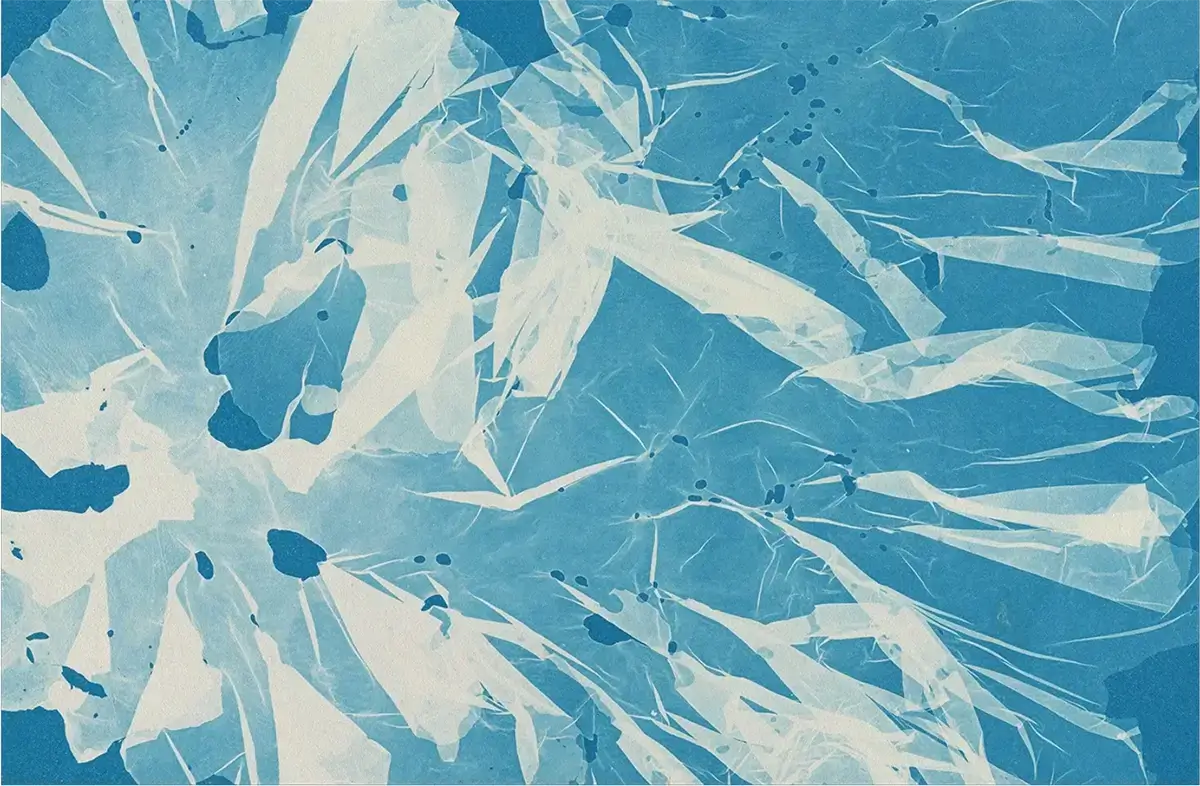
The cyanotypes themselves are presented in the book with high-quality reproductions. They reveal a meticulous attention to composition, exposure, and detail. There is no camera involved — the images are created entirely with light, chemistry, and direct contact with the specimens. These qualities make Atkins’s work not only scientifically valuable but also visually striking. The book emphasizes the technical process and shows how her method anticipated modern photographic experimentation.
Corey Keller also situates Atkins within the broader scientific and photographic networks of her time. Her collaboration with John Herschel, who developed the cyanotype process, and her careful observation of natural specimens demonstrate her dedication to both science and photographic craft. Keller shows that Atkins was not merely recording specimens; she was translating them into a visual language that combined accuracy, aesthetics, and experimentation.
© Anna Atkins, Courtesy The J. Paul Getty Trust
While the book is concise at 112 pages, it is thoughtfully organized and well designed. The balance between text and images allows readers to engage closely with the cyanotypes, while the historical commentary provides context without overwhelming the visuals. Each chapter contributes to a clear narrative that traces Atkins’s life, her work, and her enduring influence.
Anna Atkins: Photographer, Naturalist, Innovator is recommended for photographers, artists, historians, and anyone interested in the origins of photography. It is a detailed, well-researched, and visually engaging work that situates Atkins’s achievements in both artistic and scientific contexts. For readers who want to understand the early history of photographic publishing, the technical innovation of cyanotypes, and the challenges faced by women in Victorian science, this book is an essential resource.
This publication not only illuminates the work of a remarkable woman but also invites reflection on how photography, science, and visual culture intersect. Anna Atkins emerges as a figure of quiet innovation, whose meticulous practice and creative vision continue to resonate in photographic discourse today.
© Anna Atkins, Courtesy The J. Paul Getty Trust