All about photo.com: photo contests, photography exhibitions, galleries, photographers, books, schools and venues.
Final Call to enter All About Photo Awards: $5,000 Cash Prizes - Juror Steve McCurry

Anthony Barboza: Moments of Humanity

From November 22, 2022 to January 14, 2023
Share
Anthony Barboza: Moments of Humanity
41 East 57th Street
New York, NY 10022
Beginning in the 1960s and continuing into the present day, Anthony Barboza (b. 1944 New Bedford, MA) has enjoyed a long career in photography. One of the most important African American photographers of his generation, Barboza poetically captures the resilient spirit of Black Life in America by engaging with his subjects on a personal level. He left Massachusetts for New York City and joined the Kamoinge Workshop in 1963, a prominent movement of African American artists who work together to redefine African American art, images and representations, which was then headed by critically acclaimed photographer Roy DeCarava. Barboza was introduced to other like-minded artists through this workshop including Louis Draper, Adger Cowans, Shawn Walker and Ray Francis, who all became a source of support for Barboza. Portraits of Ming Smith, the first female artist to join Kamoinge, are featured in this exhibition, including candid shots working in the studio and posed portraits around New York City.

Barboza’s birth corresponded with the early years of Johnson Publishing who focused on African American life. It generated new opportunities for Black photographers, allowing them to be both subject and storyteller, empowered with the ability to control their own images and narratives. John H. Johnson founded the publishing company in Chicago with its first journal Negro Digest in 1942, followed by Ebony in 1945. Jet magazine appeared in 1951 while young Barboza was still in elementary school. Seeing people and cultures that he recognized through national coverage opened new possibilities and aspirations for Barboza. As he matured during the post-World War II era, he witnessed the dramatic shifts in the nation’s sociopolitical landscape that would come to lay the groundwork for the modern civil rights era, where his generation would lead a more ardent discourse on race and representation in America.

During his time in Florida between 1965-1968, Barboza’s camera became a tool for addressing injustices he witnessed while living in the South. His photograph Come on Children, Let’s Sing (1968) features six children on the front porch of an impoverished local family home. Taken the same year that Martin Luther King Jr. launched a cross-country tour to recruit participants for his Poor People’s Campaign, the photograph documents the faces of those most impacted by economic injustice and lack of access to opportunities. Liberty (1966) poignantly echoes a similar sentiment, where we see a dilapidated ‘LIBERTY’ sign falling apart against a dark wall that speaks to the inequality and hardships endured by the Black community at the hands of their own country. In a single snap of the camera’s shutter, Barboza captures these complicated histories and narratives through which he has lived.

The work of Barboza has been acclaimed by many critics and historians, including Aaron Bryant, curator of photography and visual culture at the National Museum of African American History and Culture, Smithsonian Institution, who stated that “Barboza has captured earnest moments of humanity. He has produced a body of work that reflects a range of artistic genres, subjects, and cultural memories. Viewers participate in his visual exchange of thought and imagination to discover that they are part of a culture that interprets the world in similar ways. Part poet, prophet, and reformer, Barboza reflects narratives of cultural history and memory through his photography”. Hilton Als, a Pulitzer Prize winning writer and critic wrote that “what ultimately elevates Barboza’s work inside and outside of the studio is his belief in humankind, in a way that recognizes how we all hold the copyright on our own lives, and the stories we mean to tell about ourselves are always true stories, and worthy of respect and attention. Barboza helps reveal the pages of our individual narratives to ourselves and thus the world. In the end, Barboza’s gift is the dignity we hope for and find within ourselves, buried magically in his camera’s lens.”

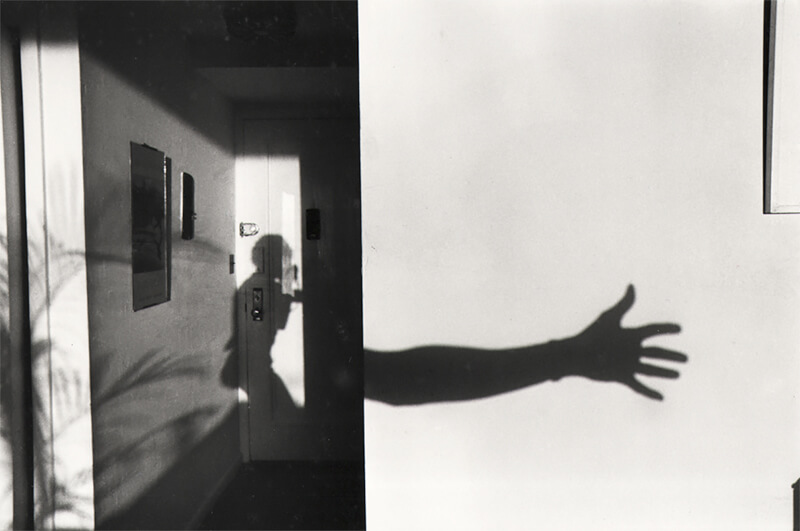
The photographer sees himself as both observer and participant in the environment, as evident in two self-portraits on view in this exhibition, taken in the 1970s, that explore the complexities of depth, perspective and the strikingly surreal contrast between Barboza’s own shadow and the surrounding light. His experimentation with lighting and determination to capture a feeling in everyday scenes are prevalent throughout his work, as Barboza said himself that “the photograph finds you, you don’t find the photograph. When it finds you, it means you are open enough to allow it to come to you, and then you get it. You’re walking down the street, and you’re into this rhythm, and all of a sudden you see something. You get into that sort of dreaming state”. His keen eye for composition is evident in Watching Marilyn Monroe (1970s), where the minimalist composition works to transform Warhol's painting of Marilyn Monroe into a hallway through a dream-like illusion of depth (Eye Dreaming 2022).

Barboza’s photographs have appeared in numerous publications, including The New Yorker, Sports Illustrated, Time, Newsweek, Life Magazine and Essence. His work is included in the permanent collections of such institutions as the Museum of Modern Art, the Houston Museum of Fine Arts, the New Jersey State Museum, Brooklyn Museum of Art, Studio Museum of Harlem, Cornell University, the Schomburg Center for Research in Black Culture, the Boston Museum of Fine Arts, the Carnegie Museum of Art, the Virginia Museum of Fine Arts, and the J. Paul Getty Museum, as well as private and corporate collections.
Our printed edition showcases the winners of AAP Magazine call of entries
All About Photo Magazine
Issue #53
Stay up-to-date  with call for entries, deadlines and other news about exhibitions, galleries, publications, & special events.

Exhibitions Closing Soon

Paul McCartney Photographs 1963–64: Eyes of the Storm
Frist Art Museum | Nashville, TN
From November 07, 2025 to January 26, 2026
Organized by the National Portrait Gallery, London, this exhibition is an intimate and historic opportunity to see the extraordinary archive of recently discovered photographs taken by Paul McCartney between December 1963 and February 1964. Over the course of these three short months, the Beatles—Paul McCartney, John Lennon, George Harrison, and Ringo Starr—were propelled from being the most popular band in Britain to an unprecedented international cultural phenomenon.. The photographs in this exhibition, taken by McCartney with his own camera, provide a uniquely personal perspective on what it was like to be a Beatle at the start of Beatlemania—from gigs in Liverpool and London to performing on the Ed Sullivan show in New York for an unparalleled television audience of 73 million people.. Drawn from McCartney’s own personal archive, the majority of these images have never been seen before. They allow us to experience the Beatles’ extraordinarily rapid rise from a successful regional band to global stardom through McCartney’s eyes. At a time when so many camera lenses were on them, this perspective—from the inside—brings fresh insight to the band, their experiences, the fans, and the early 1960s.. Paul McCartney Photographs 1963–64: Eyes of the Storm has been organized by the National Portrait Gallery, London, England, in collaboration with Paul McCartney. It is curated by Sir Paul McCartney with Sarah Brown for MPL Communications and Rosie Broadley for the National Portrait Gallery. Image: Paul McCartney. Self-portrait. London, 1963. © 1963-1964 Paul McCartney under exclusive license to MPL Archives LLP
Spark of a Nail
Baxter Street | New York, NY
From November 20, 2025 to January 28, 2026
BAXTER ST at the Camera Club of New York presents Spark of a Nail, an exhibition of new and recent works by photographer Morgan Levy, on view from November 20, 2025, to January 28, 2026. This body of work foregrounds women and non-binary individuals within the intersections of photography, labor, and architecture. Through collaborative, participatory practice, Levy explores the overlooked gestures of craft and construction, reimagining how acts of making can shape both physical environments and social relationships. Her images invite reflection on the power of creative labor to forge communities of care and resistance in spaces historically dominated by patriarchal structures. In Spark of a Nail, Levy works alongside tradespeople from apprenticeship programs and professional workshops, creating photographs that blend documentary, performance, and staged composition. Each image becomes a site of collaboration and conversation—between gesture and material, between artist and worker. The resulting scenes convey a sense of quiet strength, where moments of exertion and repose coexist, revealing the tenderness embedded within the act of building. Through deliberate framing, Levy positions cis-men at the edges of her compositions, constructing a world primarily inhabited by women and non-binary figures engaged in their own systems of creation and solidarity. Drawing inspiration from early twentieth-century labor photography and the feminist art practices of the 1970s and 1980s, Levy extends this lineage with a contemporary sensitivity. Echoes of Betty Medsger’s investigative photography and Lynda Benglis’ sculptural subversions of industrial materials resonate through her work. By merging visual research, field observation, and reenactment, Levy reclaims and redefines the visual language of labor. Spark of a Nail ultimately proposes a reimagined landscape of work—one where collaboration, artistry, and agency intersect, illuminating new possibilities for representation and belonging in both art and society. Image: © Morgan Levy
Phantom Sun: Ohan Breiding
Baxter Street | New York, NY
From November 20, 2025 to January 28, 2026
BAXTER ST at the Camera Club of New York presents Phantom Sun, a solo exhibition by Swiss-American artist and filmmaker Ohan Breiding, curated by Mathilde Walker-Billaud, the 2025–2026 Guest Curatorial recipient. On view from November 20, 2025, to January 28, 2026, the exhibition brings together photography, video, and archival material to examine how landscapes bear witness to histories of erasure, displacement, and resilience. Breiding’s lens-based approach transforms the natural world into a space of testimony—one that reveals both ecological fragility and enduring forms of care. At the center of Phantom Sun is Breiding’s engagement with the Killed Negatives, a collection of images originally created under the Farm Security Administration (FSA) during the Great Depression. These photographs, once deemed unsuitable for publication and physically punctured to mark their rejection, expose the selective narratives that shaped America’s visual record of that era. By reanimating these discarded negatives, Breiding challenges the authority of the archive and its power to define whose stories are told and whose are omitted. The resulting installation overlays the ghosts of the past with present-day questions about belonging, stewardship, and visibility. Through the recurring motif of the black hole—floating above the rejected images—Breiding transforms absence into a site of inquiry. This circular void becomes both a wound and a portal, inviting viewers to look through the gaps of history and imagine what might emerge from them. In collaboration with Walker-Billaud, the artist expands the documentary tradition pioneered by Roy Stryker and his FSA team, pushing it toward a trans-feminist reimagining of care, ecology, and collective memory. Phantom Sun ultimately proposes a new kind of seeing—one that acknowledges loss while illuminating the persistence of life and meaning in the spaces once cast aside. Image: © Ohan Breiding
Markus Klinko: Bowie Remembered in Black and White
bG Gallery | Santa Monica, CA
From January 03, 2026 to January 28, 2026
Markus Klinko: Bowie Remembered in Black and White, on view at bG Gallery from January 3 through January 28, 2026, offers a moving tribute to one of the most influential artistic collaborations of recent decades. Marking ten years since David Bowie’s passing, the exhibition revisits iconic portraits taken by Markus Klinko and reintroduces them in newly released black-and-white editions that feel both timeless and newly intimate. Originally photographed in color during the celebrated 2001 sessions that accompanied Bowie’s Heathen era, these images take on a heightened emotional resonance when stripped of hue. Light and shadow now carry the weight of expression, revealing Bowie as a figure suspended between vulnerability and control. The absence of color sharpens every gesture and gaze, allowing the viewer to focus on the subtle theatricality that defined Bowie’s presence before the camera. Several key works anchor the exhibition. The haunting Heathen portrait, with Bowie blindfolded and bandaged, evokes fragility, transformation, and inner vision. In The Protector, his silhouette appears both grounded and spectral, while The Pack merges myth and instinct as Bowie stands poised among wolves. In quieter moments such as Smoking, stillness and introspection take center stage, underscoring Bowie’s ability to inhabit multiple identities without ever losing himself. Klinko’s sculptural, cinematic approach plays a crucial role in shaping these images. Known for his collaborations with leading figures in music and fashion, the photographer brings a refined sense of drama and precision to each composition. Yet his work with Bowie remains singular, defined by trust, creative risk, and a shared understanding of image as performance. Seen together, these photographs are more than portraits; they are meditations on legacy, collaboration, and the power of reinvention. Bowie Remembered in Black and White invites viewers to reflect on Bowie not only as an icon, but as an artist whose visual language continues to resonate—quietly, boldly, and far beyond the moment it was made. Image: Markus Klinko - The Realization, 2001Fujicolor Crystal Archive Print © Markus Klinko
SCNY 149th Annual black & white
Salmagundi Art Club | New York, NY
From January 06, 2026 to January 30, 2026
SCNY 149th Annual black & white, on view at the Rockwell Gallery from January 6 to January 30, 2026, continues the storied tradition of the Salmagundi Club’s historic monochromatic exhibitions. As the oldest members’ showcase of its kind in the United States, this juried presentation features black and white or sepia-toned drawings, graphics, photographs, paintings, and sculptures by the Club’s artist members, offering a unique glimpse into both contemporary practice and the legacy of over a century of artistic excellence. The first Annual black & white exhibition took place in 1878, just a few years after the founding of the Salmagundi Club. Originally, participation was open to non-members, creating a rich catalogue of work that reflected the artistic currents of the time. Many of these early pieces found their way into the rapidly expanding magazine market of the late 19th century, linking the exhibition to a broader cultural and commercial context. Over the decades, the show has evolved while retaining its commitment to celebrating the expressive power of monochrome. Today, the Annual black & white exhibition remains a touchstone for artists and audiences alike. Within the restrained palette of black, white, and shades of gray, Salmagundi artists demonstrate technical precision, inventiveness, and emotional resonance across a range of media. Each work highlights the ability of line, texture, and contrast to convey depth, movement, and mood, inviting viewers to engage with form and composition in their purest expressions. Visitors to the Rockwell Gallery will encounter a broad spectrum of artistic voices, from finely detailed sketches and photographic studies to evocative sculptural forms. The exhibition embodies both a warm sense of nostalgia and a celebration of living artists, underscoring the Salmagundi Club’s enduring role as a hub for creativity, mentorship, and community. SCNY 149th Annual black & white is a testament to the timeless allure of monochromatic art and the ongoing vitality of one of New York’s most cherished artistic institutions. Image: Rosemary Hawkins, Harbor in Bonavista, 2026 © Rosemary Hawkins
Anastasia Samoylova: Now, Voyager
Dot Fiftyone Gallery | Miami, FL
From November 30, 2025 to January 30, 2026
In Now, Voyager, Anastasia Samoylova expands her visual vocabulary into the realm of painting, creating a dialogue between photography, gesture, and reflection. Her new body of work merges photographic imagery with poured and dripped paint, producing hybrid compositions that exist between documentation and abstraction. Inspired by Walt Whitman’s call to exploration—“Now, Voyager, sail thou forth to seek and find”—the series continues Samoylova’s journey to understand the shifting identity of America through a lens that is both personal and poetic. While her earlier projects—FloodZone, Floridas, Image Cities, and Atlantic Coast—examined the physical and cultural landscapes shaped by human ambition, Now, Voyager turns inward. Here, paint flows like weather across photographic surfaces, alternately obscuring and revealing what lies beneath. The result is a visual metaphor for transformation: an image constantly in flux, where clarity and dissolution coexist. Samoylova’s compositions shift between moments of elegance and disruption. A peacock feather dissolves into a cascade of pale pigment; a faded flag trembles in a wash of color; handwritten words on a wall echo quiet philosophies about impermanence and growth. Through these juxtapositions, the artist contemplates endurance and fragility—how ideals, memories, and dreams persist even as they fade. Engaging with the legacies of artists such as Rauschenberg, Richter, and Polke, Samoylova’s overpainted photographs resist both sentimentality and despair. They invite viewers to inhabit the uncertain space between image and emotion, to voyage through a landscape that mirrors the complexity of contemporary experience. In this series, America is not a fixed image but a mutable state of mind—shaped by vision, history, and the continual act of searching. Image: © Anastasia Samoylova
Emilia Martin: I saw a tree bearing stones in the place of apples and pears
Pictura Gallery | Bloomington, IN
From November 07, 2025 to January 30, 2026
Emilia Martin’s exhibition I saw a tree bearing stones in the place of apples and pears at Pictura Gallery invites viewers into a world where the boundaries between myth, belief, and lived experience quietly blur. Drawing on ancient narratives surrounding meteorites, Martin reflects on how these celestial fragments have long held symbolic power, carrying meanings that exceed simple scientific classification. Her work begins with an interest in relics and the way objects are transformed by touch, ritual, and proximity. Just as a modest keepsake becomes sacred by brushing against a saint’s body, a meteorite changes its status the moment it enters human consciousness. Across centuries and cultures, these stones were believed to be messages from the heavens, warnings from angered gods, or companions tethered to the earth to prevent their escape back into the sky. Some communities ground them into powder to ingest, trusting in a celestial medicine; others built rituals, songs, and sites of worship around their mysterious presence. Modern Western science acknowledged meteorites as real only in the late eighteenth century, dismissing earlier accounts as superstition or naive storytelling. This historical gap fascinates Martin. For her, these rocks reveal more than natural phenomena—they reveal who has been permitted to define truth and whose voices have been relegated to the realm of legend. Through her images and research, she questions how narratives are shaped, shared, and suppressed, especially among those like her ancestors who lived and labored under open skies. In this exhibition, the rock becomes a vessel of histories, a wandering body that holds memory without words. Martin imagines it finding its voice at last, reclaiming its stories and speaking across time. With her blend of photography, writing, and sound, she reflects on how myth and fact intermingle, offering a quiet meditation on belief, knowledge, and the fragile spaces that connect the two. Image: © Emilia Martin
Elijah Gowin: Spirit and shadow
Robert Mann Gallery | New York, NY
From December 11, 2025 to January 31, 2026
Spirit and Shadow unfolds as a quiet meditation on the fleeting brilliance that inhabits the natural world, offering a space where brief illuminations linger like whispered memories. Fireflies rise and fall along the curve of a river, sketching trembling pathways of light that feel both ancient and newborn. Snowflakes drift with equal delicacy, each one a tiny, vanishing universe. Whether glowing or glistening, these small wanderers move through darkness as though guided by an unseen rhythm, their trails weaving together like strands of breath suspended in time. Presented by Robert Mann Gallery, Spirit and Shadow brings together the evocative work of Elijah Gowin, an artist whose photographs uncover the luminous pulse within nocturnal landscapes. Traveling to places as varied as Virginia, Malaysia, and Thailand, Gowin seeks the fireflies’ quiet radiance, capturing their shimmering presence at dusk. Against these summer scenes, he sets the winter hush of falling snow, the flakes’ pale blues and whites echoing the electric trails of lightning bugs. The exhibition becomes a meeting point of seasons, light sources, and states of being. Gowin’s approach invites chance and mystery into each frame. Working in complete darkness, he embraces unpredictable visual effects that blur edges, dissolve distinctions, and allow colors to erupt with surprising intensity. Lines of yellow sweep across the compositions while bright orbs shimmer like crystals in motion. Trees, riverbanks, and other natural forms emerge softly from the shadows, as if recalled from a dream. At times, the fireflies seem like stars loosened from the sky, drifting downward with the gentleness of falling snow. In this interplay of movement and stillness, light becomes both spirit and shadow—an emblem of transformation and reverence. Gowin aligns his practice with seasonal rhythms and lunar cycles, honoring the fragile ecosystems that give rise to such wonders. Each photograph invites viewers to pause, to dwell in the threshold between presence and disappearance, and to consider how even the smallest glimmer can reshape the darkness that surrounds it. Image: Tree 1, 2012 © Elijah Gowin
Raphael Avigdor:  Both Sides Now
Rebecca Hossack Art Gallery | Miami, FL
From December 01, 2025 to January 31, 2026
Raphael Avigdor’s newest body of work offers a contemplative journey through the quiet drama of the sky, where clouds become both subject and metaphor. In his forthcoming exhibition, the artist invites viewers to linger on the suspended moments he has gathered during his travels, transforming shifting atmospheric forms into reflections on time, movement, and perception. Each image carries the sense of an encounter—an instant when the world seems to pause just long enough for memory to take shape. The title of the exhibition, Both Sides Now, resonates with the spirit of duality at the heart of these works. Like the song that inspired it, the photographs navigate the tension between what is seen and what is felt. Avigdor captures clouds not simply as meteorological formations but as emotional landscapes, places where observation and introspection meet. Light drifts across the images with a soft authority, shaping contours that echo both fleeting impressions and long-held recollections. Through these shifting skies, the artist suggests that every view is layered: outer vision blending naturally with inner response. Avigdor’s longstanding engagement with photography underpins the clarity and purpose of this series. Having spent decades documenting cultures and environments around the world, he brings the same sensitivity to these quiet skyscapes that he has applied to the people and places encountered throughout his career. The clouds become a universal subject, yet they retain a sense of personal dialogue—fragments of experience gathered from journeys across continents. Although rooted in the present, the work reflects the breadth of Avigdor’s practice, one shaped by curiosity, travel, and an ever-deepening attention to the nuances of visual storytelling. The photographs in Both Sides Now express a simple yet profound truth: that in watching the sky, one observes not only the world above but also the shifting landscapes of one’s own interior life. Image: Raphael Avigdor Courageous I, 2025 archival print 101.6 x 152.4 cm 40 x 60 in (RA029) © Raphael Avigdor
Danny Lyon: The Texas Prison Photographs
Howard Greenberg Gallery | New York, NY
From December 05, 2025 to January 31, 2026
Danny Lyon: The Texas Prison Photographs at Howard Greenberg Gallery presents a compelling and historic exploration of incarceration in Texas during 1967-68. This exhibition, Lyon’s first with the gallery following its announcement of representation in April 2025, brings together photographs, films, drawings, and ephemeral materials that reveal the lived realities of prison life in vivid, unflinching detail. The show opens with a reception on December 5 from 5:30 to 7:30 p.m., with the artist in attendance, offering viewers a unique opportunity to engage directly with one of photography’s most influential documentarians. Danny Lyon’s work in Texas captures the complexities of the penal system through a participatory lens. Unlike traditional photojournalists, Lyon immersed himself in the communities he documented, living and interacting with his subjects to create intimate, authentic portrayals. His images in this exhibition convey both the harshness and humanity of prison life, from quiet moments of reflection to the stark architecture of confinement. Through these works, Lyon examines power, control, and resilience, offering a nuanced perspective that challenges viewers to reconsider notions of justice and social structures. Lyon’s approach to documentary photography was radical in the 1960s, informed by his involvement in the Civil Rights Movement and his groundbreaking book, The Bikeriders, which chronicled the Chicago Outlaws motorcycle club. His New Journalism style emphasized participation over observation, allowing him to capture the textures, emotions, and stories that might have been lost to an outsider. In his own words, “I was a participant who also happened to be a photographer,” highlighting his philosophy of deep engagement as the foundation of his practice. The Texas Prison Photographs not only documents a specific time and place but also marks an enduring exploration of the ethics, intimacy, and responsibility of documentary photography. By presenting these works alongside films, drawings, and ephemera, the exhibition offers a multidimensional view into Lyon’s method and vision, cementing his legacy as a pioneering voice in socially engaged visual storytelling. Image: © Danny Lyon, Courtesy of Howard Greenberg Gallery, New York
Yamamoto Masao
Robert Koch Gallery | San Francisco, CA
From December 04, 2025 to January 31, 2026
Robert Koch Gallery presents a contemplative exhibition devoted to the poetic universe of Yamamoto Masao, offering a rare opportunity to trace the breadth of his vision across several of his most celebrated series. Rooted in a Zen-infused understanding of the world, Yamamoto’s work invites viewers to slow down and rediscover the quiet marvels hidden in daily life. His photographs remind us that attentive looking can reveal moments of grace that often pass unnoticed. Working primarily with small-format toned silver gelatin prints, Yamamoto turns his lens toward the natural world that surrounds him: a fleeting shadow across a stone, a bird poised in mid-flight, the texture of aging bark, or the gentle shift of light along a rural path. These subtle images carry a sense of stillness, yet they also feel alive, as though the air around them continues to move. Some prints bear hand coloring or traces of intentional wear—creases, soft abrasions, or delicate surface treatments—that echo the passage of time and lend each work a sense of intimate history. Animals appear throughout his photographs with a quiet but striking presence. They rarely dominate the scene; instead, they seem to drift into the frame as companions or messengers. Their calm gaze and understated gestures create a bridge between the physical world and a more spiritual realm, offering a reminder of our shared place within the natural order. Yamamoto considers each photograph an autonomous object, yet he is equally attentive to the relationships that form when images are arranged together. In groupings or installations, one picture subtly extends into the next, creating visual rhythms that behave like layered musical notes. The exhibition embraces this approach, allowing works from different series to converse across time and theme, revealing harmonies that might otherwise remain unseen. Born in Gamagori City in 1957 and now living in Yamanashi, Yamamoto has exhibited widely around the world. His photographs, celebrated for their meditative depth and refined simplicity, are held in major museum collections and continue to inspire viewers to search for meaning in life’s smallest gestures. Image: Kawa=Flow #1674, 2016, Gelatin silver print with mixed media 5 7/8 x 8 3/4 in. © Yamamoto Masao
Nuclear Injustice
Pace University Art Gallery | New York, NY
From November 15, 2025 to January 31, 2026
Nuclear Injustice, on view at the Pace University Art Gallery from November 15, 2025 through January 31, 2026, confronts the enduring human, environmental, and political legacies of nuclear testing and bombings. This group exhibition brings together the work of Kathy Jetñil-Kijiner, Alan Nakagawa, Michael Wang, and Will Wilson, whose practices span photography, video, sound installation, sculpture, and conceptual interventions. Each artist interrogates the often unseen impacts of atomic history, from poisoned landscapes to Indigenous resistance and global campaigns for a nuclear-free world. Jetñil-Kijiner’s video poems poignantly reflect on the Marshall Islands, where decades of nuclear testing left both environmental devastation and intergenerational trauma. Her work entwines memory, culture, and place, foregrounding the resilience of Marshallese communities and the ongoing struggle to preserve identity in the face of ecological destruction. In a complementary approach, Nakagawa transforms sound into witness: field recordings from the Hiroshima Atomic Dome and the Wendover Hangar are sculpted into immersive audio spaces, prompting reflection on the reverberations of historical violence and the ethical weight of human choices. Will Wilson’s photography highlights the ongoing consequences of uranium mining on Indigenous lands, revealing the connection between nuclear extraction and broader systems of colonial exploitation. His images confront the legacies of displacement, contamination, and cultural erasure while honoring Indigenous resilience. Michael Wang engages scientific and ecological frameworks, exploring nuclear containment and exposure through conceptual installations that link contemporary concerns to the history of land art, emphasizing humanity’s moral responsibility toward the environment. Curated by Sarah Cunningham and Joel Wilson, with the guidance of Emily Welty, Nuclear Injustice challenges audiences to consider the physical, social, and ethical dimensions of nuclear technology. Together, the works transform sites of devastation into spaces for remembrance, renewal, and activism. By connecting history, environment, and culture, the exhibition invites viewers to reckon with past harms while envisioning a more just and nuclear-free future. Image: Will Wilson, Auto Immune Response: Confluence of Three Generations, photography, 2015 © Will Wilson
Advertisement
All About Photo Awards 2026
Win a Solo Exhibition in March
All About Photo Awards 2026
Call for Entries
All About Photo Awards 2026
$5,000 Cash Prizes! Juror: Steve McCurry

Related Articles

The Gordon Parks Foundation Celebrates 20 Years
The Gordon Parks Foundation is celebrating its 20th anniversary with a yearlong series of exhibitions, publications, fellowships and events, all of which will highlight how the legacy of Gordon Parks (1912–2006) continues to inform contemporary artistic practice in new and innovative ways. Since its founding in 2006 to steward Parks’ multifaceted work as a photographer, musician, writer and filmmaker, the Foundation has steadily grown and expanded its capacity to provide crucial support to emerging, mid-career and late-career artists across a wide variety of disciplines. This focus on interdisciplinarity is at the heart of both the Foundation and the legacy of Parks himself, who believed unreservedly in the power of art to be a catalyst for social change and to illuminate the human condition.
Eugène Atget: The Making of a Reputation
The International Center of Photography (ICP) is proud to present Eugène Atget: The Making of a Reputation, an exhibition that examines how Eugène Atget (1857–1927) came to be regarded as one of the forefathers of modern photography through the timely and tireless advocacy of Berenice Abbott. Featuring historic prints from ICP’s collection alongside landmark publications and other printed ephemera, the exhibition reconsiders the role that Abbott played in establishing Atget’s now-canonical status, sometimes to the detriment of her own remarkable career as a photographer. Though Atget didn’t live to see it, Abbott became the ideal steward, proving that every photographer needs a champion.
Zhang Kechun: The Yellow Desert
Huxley-Parlour is pleased to present The Yellow Desert, a photography exhibition by contemporary Chinese photographer Zhang Kechun. Featuring eleven new large-format works from his latest series, begun in August 2025, the exhibition explores the Gobi Desert across Northern China and Southern Mongolia. Through landscape photography that bridges history, culture, and human presence, Zhang Kechun examines the complex relationship between desolation, memory, and modern life in this vast and evolving terrain.
All About Photo Presents ’Fay and Gay’ by Samantha Yancey
The project Fay and Gay by Samantha Yancey, on view throughout January 2026, offers an intimate and deeply human portrait of devotion, routine, and shared identity. This compelling body of work centers on Fay and Gay, twin sisters born in 1936 near Pelahatchie, Mississippi, whose lives have unfolded side by side for nearly nine decades.
Alia Ali
Gilman Contemporary presents a striking introduction to the work of Alia Ali, an artist whose multicultural background spanning Yemen, Bosnia, and the United States deeply informs her visual language. Her photographs, rich in pattern and color, navigate the complex terrain of identity, migration, and belonging. Rather than offering conventional portraiture, Ali envelops her subjects in boldly patterned textiles, allowing fabric itself to become both veil and voice. These coverings obscure familiar markers of identity, inviting viewers to question how much of what we think we know about a person is shaped by what we see—or what we assume.
Bigaignon x rhinoceros gallery - Act 2/3: Col Tempo
In Rome, rhinoceros gallery, the art space founded by Alessia Caruso Fendi within Palazzo Rhinoceros, presents “Act 2/3: Col Tempo (With Time)”,the second chapter of a trilogy of exhibitions developed in collaboration with the Paris-based gallery Bigaignon. On view from November 26, 2025 to January 14, 2026, this new exhibition is dedicated to the essential element of time,marking the continuation of a three-part project that will unfold through March 2026.
Yamamoto Masao
Robert Koch Gallery unveils a rare and essential exhibition dedicated to Japanese photographer Yamamoto Masao, bringing together works from several of his most celebrated series, including A Box of Ku, Nakazora, Kawa=Flow, Bonsai, and Tomasu. This presentation offers a profound immersion into one of contemporary photography’s most poetic and contemplative voices—an artist whose practice invites viewers to slow down, breathe, and rediscover the hidden beauty embedded in everyday life.
All About Photo Presents ’Notes From The Edge’ by Antonio Denti
All About Photo is proud to announce Antonio Denti as the winner of the December Solo Exhibition Contest, selected by internationally acclaimed photographer Ed Kashi. His long-term project, “Notes from the Edge,” offers a striking and poetic exploration of what it means to live in a world caught between collapse and rebirth.
My Circus by Ellen von Unwerth
Fotomuseum aan het Vrijthof in Maastricht presents an exhibition by famous Paris-based German fashion and fine art photographer Ellen von Unwerth from 31 January until 13 September 2026. The high-profile exhibition My Circus features 160 iconic photographs of models and pop musicians in which femininity, playfulness, eroticism, and fashion take center stage. The stylish images were created for fashion brands, publications, and her own inspiring VON magazine and books.
Call for Entries
All About Photo Awards 2026
$5,000 Cash Prizes! Juror: Steve McCurry