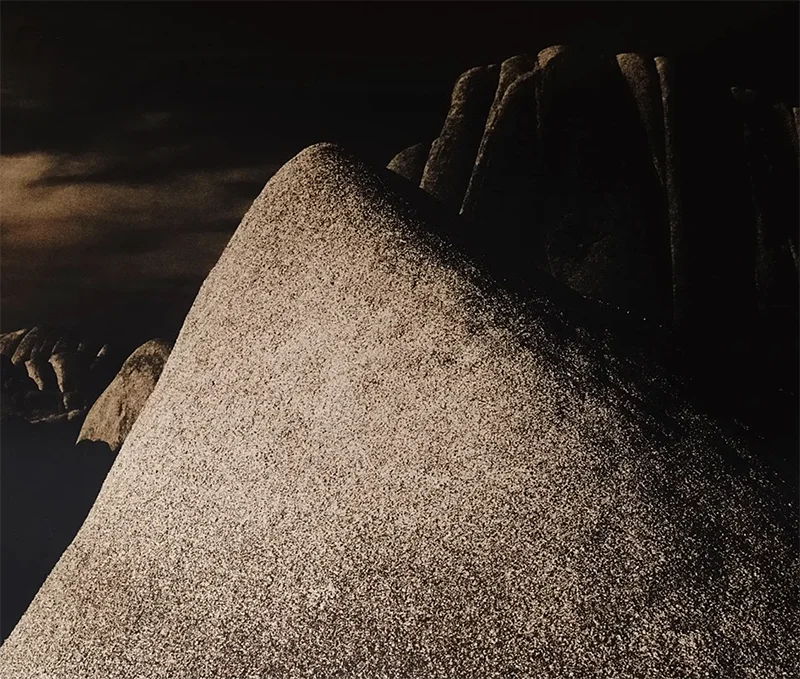

Solo. presents Guillaume Zuili: When the Sun Goes Down, on view through 24 October 2026, showcasing select prints from the photographer's acclaimed high desert landscapes dating from 2021. The exhibition highlights Zuili's mastery of Lith printing, a creative process using vintage black-and-white darkroom printing papers that produces warm sepia tones and minimal compositions with a timeless, cinematic quality.
Born in Paris in 1965, Zuili has lived and worked in Los Angeles since 2001, focusing his lens on capturing what he considers the truest, most unique expression of his adopted city. More recently, his source of refuge from that urban expanse—the desert landscape of Joshua Tree—has become his obsession. A lifelong student of film, Zuili pays homage to classic American Westerns in this series, drawing on a visual vocabulary shaped by cinema rather than photography alone. "Cinema is my matrix," the artist explains. "Photography came later, but it all started with movies."
The signature work in the show, When the Sun Goes Down #59, punctuates the night sky with a starkly illuminated monolithic boulder rising from a desolate stone plateau, recalling the iconic imagery from Stanley Kubrick's 2001: A Space Odyssey. The image feels otherworldly, yet grounded in the actual geology of Joshua Tree National Park, which straddles two distinct desert ecosystems: the Colorado Desert and the Mojave Desert.
Zuili's career as a photojournalist for VU' Agency has been internationally recognized, leading to the publication of work documenting French settlements in India between 1986 and 1995. His first book, Pondichéry, Chandernagor, Mahé, Karikal et Yanaon, was published by Éditions du Chêne in 2003. His pinhole series on Los Angeles, Smoke & Mirrors, became a book published by Galerie Clémentine de la Féronnière, with whom he continues to exhibit annually at Paris Photo.
The Lith printing process Zuili employs creates incredibly extreme contrasts while maintaining silk-like highlights, producing the blackest of blacks alongside a wild range of colors unachievable with traditional black-and-white formats. This technique, which leaves room for chance and unpredictability, reveals the materiality of photography itself—its grain, roughness, and texture. The result is work that feels both documentary and dreamlike, capturing the American West through a lens filtered by European sensibility and cinematic memory.
Image: When the Sun Goes Down #59 © Guillaume Zuili, courtesy of the solo. gallery.










 Instagram
 Facebook
 Pinterest
 X / Twitter