Some photographs ask us to look closer, while others invite us to stop and listen. For Italian photographer Andrea Bettancini, born and raised in a small seaside town in northern Italy, silence is both a subject and a method. Shaped by the quiet, foggy winters of his hometown, his work seeks the soul of a place in its pauses, its empty spaces, and its solitary figures.
Trained in art history and fashion design, Andrea brings a designer's sense of composition and consistency to a practice rooted in photojournalism, street photography, and symbolic storytelling. His images sit between documentary observation and personal vision, telling, in his own words, the story of his emotional experience of a place rather than simply the place itself.
His series The Background Noise earned him first prize in AAP Magazine #53: Travels. Part of his ongoing exploration of the Indian subcontinent, the project offers a less stereotypical vision of India, away from crowds and colors, in search of a constant echo running beneath the chaos. Its best-known image, Maidan, shows a mounted soldier standing almost motionless in the morning fog of Kolkata's largest park, a moment of calm in the middle of a visual storm.
Andrea's work has been recognized by several photography awards and publications. He also designs photobooks, including the recent IPA Award-winning book by Fabio Domenicali, and is currently developing a new body of work on southern India, which explores its religious diversity and a political landscape that differs sharply from the north.
We spoke with Andrea about his path into photography, the making of The Background Noise, his approach to editing and building a series, and the ideas behind his new project.
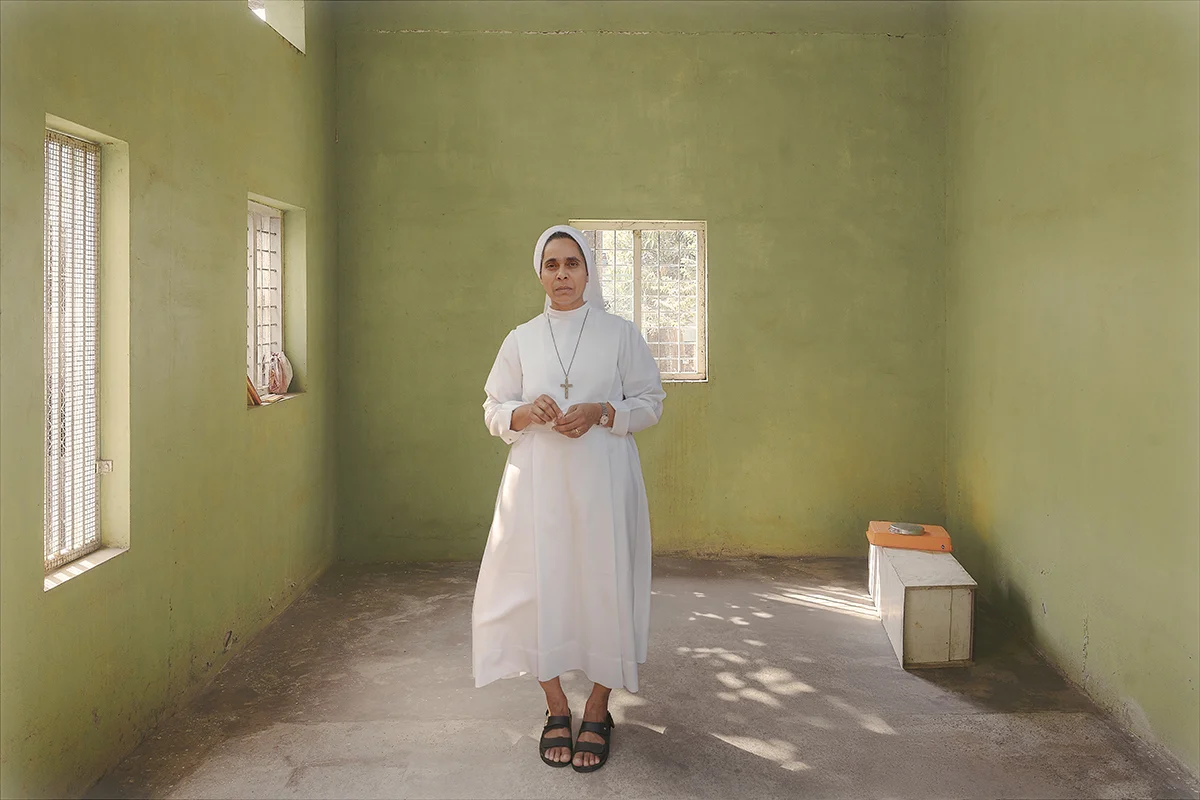
© Andrea Bettancini
I think winter, where I live, has been a particularly strong source of inspiration. The silence and the sense of “absence” that envelop empty spaces during the winter months have influenced my reflective approach to photography and helped me develop the ability to read the soul of a place.
How did you become a photographer? Was it a gradual discovery, or was there a particular moment when you realized that photography was the medium through which you wanted to express yourself?
I have always been fascinated by photography, and my approach to it was certainly a gradual discovery. I loved the entire process required to achieve the image I had in mind, from developing the film to making the print. I have also always felt an almost “fetishistic” attraction to cameras as objects in their own right, wonderful things beyond their practical function.
You studied fashion design in Milan and worked as a designer before developing your photographic practice. How has your background in design influenced the way you compose images and approach visual storytelling?
My education was fundamental in shaping my photographic vision, beginning with art high school, even before I attended design school. Studying art history helps develop a compositional and expressive sensibility; after all, photography has always drawn inspiration from painting.
Fashion design school, in turn, taught me the importance of maintaining stylistic and narrative consistency, just as one must when designing a clothing collection.

© Andrea Bettancini
First of all, I believe photojournalism is one of the highest forms of photography. In my view, photography should have documentation as its primary objective.
Photographic storytelling, however, can be shaped by a personal vision that enriches it with symbols and metaphors. I do not believe photography should be neutral or free of judgment.
You won first prize in AAP Magazine #53: Travels with The Background Noise. How did this project begin, and what were you hoping to explore through it?
The Background Noise is part of my ongoing visual exploration of the Indian subcontinent, in search of a different, less stereotypical vision of this multifaceted world. In a sense, it is also a search for my own photographic roots, which lead me back to silence and to the reorganization of visual chaos into a form of compositional order.
Why did you choose the title The Background Noise? What does it mean to you, and how does it relate to your experience of India?
The Background Noise is an attempt to find a background echo, a constant flow running beneath the chaos. It is about finding balance where everything seems like an impossible disorder to untangle—a sense of calm in the middle of a visual storm.

© Andrea Bettancini
Maidan is one of many photographs I took that morning in Kolkata’s largest park. The mounted soldiers, in an almost empty park enveloped in the morning mist, were perfectly in tune with what I have just described: silence and calm. So, yes, I immediately recognized the potential of that moment.
India is often photographed through its crowds, colors, and intense activity. Your images sometimes focus instead on silence, distance, and solitary figures. Was this a conscious choice, or did your way of seeing the country evolve over time?
The choice was conscious, but it did not happen immediately. It came after an earlier trip to India, during which my photographic approach had been different, less reflective. I think this is part of the process of encountering a new world that needs to be explored, understood, and internalized: it takes time for the way you look at something to develop into a personal vision.

© Andrea Bettancini
The project took shape during the journey, as often happens to me, by allowing myself to be permeated by the perceptions and sensations I experience in the place that hosts me. Naturally, selecting and editing the photographs is always a necessary process that takes place afterward.
In the meantime, I have developed a new project that is also about India and explores certain aspects of the country in greater depth. What fascinates me is precisely the way these “Russian dolls” open up: the more deeply you engage with a place, the more you begin to understand aspects of it that unlock further narrative possibilities.
Your photographs sometimes seem to sit between documentary observation and something almost dreamlike. How do you balance recording reality with your own interpretation of what you see?
As I have already said, I believe visual storytelling, when it does not involve “hot” images intended for purely documentary reportage, needs to be enriched by a personal vision. I never simply tell the story of a place; I tell the story of my emotional experience of that place.

© Andrea Bettancini
When I decide to photograph a place in order to tell its story, I walk for miles. As I wander, something may catch my attention: a situation, an atmosphere, a person, or even an ordinary object.
I have learned to trust these impressions. If something strikes me, it will almost always make a good photograph, because it will be an “honest” image, born of a spontaneous response. Instinct is essential in this sense: it helps build the skeleton of the narrative.
Alongside these images, I also include photographs that I construct more deliberately. I may ask someone to pose, placing them in a space and against a background that I consider appropriate. This allows me to add a more orderly punctuation to the narrative.
Your images often contain a strong sense of atmosphere, with fog, distance, empty space, or isolated figures playing an important role. How do these elements influence the way you approach a location?
This brings me back to my roots, to the winter silence of the place where I live. Fog is often a great ally because it reduces depth, isolates the subject, and makes them the undisputed protagonist of the image.
I always try to avoid including too many elements in a photograph. They can create confusion and prevent the viewer from focusing on the subject.

© Andrea Bettancini
This is fundamental. Whenever possible, a photograph should remain open. If viewers cannot develop their own interpretation, the image loses its interest.
A closed image leaves no room for the viewer: it has already said everything and can no longer open up onto other worlds.
When building a photographic series, how do you decide which images belong together? Does the meaning of a photograph change when it becomes part of a larger sequence?
This is a fundamental subject in photography, and it would require an enormous amount of discussion.
A single photograph captures a moment and stands on its own: if it is not a good photograph, it is worth nothing. A photographic series, on the other hand, can—and, in my opinion, should—be built on something beyond the quality of its individual images. It becomes a unified body of work whose meaning exists only as a whole. You cannot extract one photograph and judge it independently of the context in which it appears.
A series needs content and pauses, fullness and emptiness, formal and semantic connections. It is like music, which needs notes but also moments of silence; otherwise, it is nothing but noise.
Editing is fundamental and represents one of the most difficult obstacles for a photographer to overcome, because it requires the ability to distance oneself from the emotions invested in individual images.
It often happens that a “beautiful” photograph to which a photographer is particularly attached turns out to be useless, or even detrimental, within a series. Conversely, an image that seems “ugly” or apparently devoid of content may prove absolutely essential.
Today, sometimes editors do more of the photography than photographers themselves. But that would open up an endless discussion.

© Andrea Bettancini
The answer is yes: they offer two different perspectives, but they also reflect two different stages of maturity in looking at the same place.
In Cruise Passengers, you juxtaposed a luxury cruise ship departing from Trieste with children diving in Zanzibar. What led you to bring these two scenes together, and how do you approach subjects such as inequality and migration without reducing them to a simple message?
That image was, in a sense, a kind of “game,” if you’ll allow me to call it that: a visual construction designed to approach a thorny subject such as migration from a different angle.
This inevitably leads into politics, but ultimately everything is political. The tragedy of migration is an increasingly pressing issue affecting the entire developed Western world, and it has also become a powerful tool of “mass distraction.” Politicians often use it to encourage people to react emotionally rather than think rationally.
Migration lies at the very origins of human civilization. We cannot expect people forced to live on the margins of human dignity not to seek better living conditions. Certain political forces seek to strip us of our capacity for empathy and push us toward permanent conflict.
India is a country of extraordinary diversity, and you have returned to it over several years. What keeps drawing you back, and how has your relationship with the country changed over time?
My relationship with India has changed as my understanding of the country has grown. The new project I have developed has a more explicitly political dimension and focuses on a very specific region of the country.

© Andrea Bettancini
I believe that everything we read and look at influences us in one way or another. I would not say that any one photographer has determined my approach to photography, although there are certainly artists whose work I particularly admire, such as Josef Koudelka and Helmut Newton.
As for cinema, I would certainly mention Alejandro González Iñárritu and Ridley Scott.
Your work has received recognition through several photography awards and publications. Has this recognition changed the way you approach your work, or mainly given you more opportunities to share it with an audience?
I would not say that awards and recognition have changed my approach to photography at all. What matters more to me is the opportunity they offer for sharing and discussion. After all, sharing and discussion are precisely what can open up new horizons.
What are you currently working on, and what projects do you have planned for the coming months or years? Are there any new bodies of work, travels, or collaborations you are particularly excited about and would like to share with us?
As I mentioned earlier, I have worked on a new project about India, which has already received an award and been published in Italy.
The work focuses exclusively on southern India and on certain distinctive features that set it apart from the rest of the country. In particular, it explores the strong presence of Christian communities living alongside Muslim and Hindu communities, within a political landscape that differs sharply from the right-wing Hindu nationalism promoted by Narendra Modi’s ruling party, which is particularly influential in the north of the country, where these dynamics fuel division and conflict.
The project brings together political symbolism, religious iconography, and portraiture to tell the story of a different India—one that embraces differences as a value and as an opportunity for peaceful coexistence.

© Andrea Bettancini
In fact, designing photobooks is perhaps the aspect of photography I enjoy most. A book is the most extensive and elaborate form of photographic storytelling.
I have designed several photobooks, one of which has been published. I also work on the design of books by other photographers. One of the most recent projects for which I handled the design and graphic layout has just won an IPA Award. It is a book by Fabio Domenicali, a very talented photographer I collaborate with.
I am currently working on two more publications.
When you begin a new project, do you usually have a clear idea of what the final body of work will look like, or do you prefer to discover its direction along the way?
I generally try to give the work a direction during the shooting stage itself. Later, when I begin putting the images together, other possible paths often emerge within the same project.
Looking ahead, are there new directions you would like to explore in your photography, whether in terms of subject matter, technique, or the way you present your work?
I do not really like following a single, consistent path; I find it boring. This can make my work appear less uniform and less immediately recognizable as the work of the same photographer.
What matters to me is that each individual project is cohesive and consistent in its own right. I am not interested in producing a series of projects that all look alike in terms of photographic approach or post-production.

© Andrea Bettancini
Absolutely. I think this is normal for any photographer. I often come across scenes by chance that strike me and that I feel compelled to photograph, even if it is just with my phone.
These images do not necessarily belong to a project, but sooner or later they might become part of one.
What do you hope people take away from your photographs? Do you see photography primarily as a way to understand the world, explore your own relationship with it, or reveal its contradictions?
As I have already said, in my view, documentation remains the highest form of photography. Today, however, other visual languages have emerged that are more concerned with the photographer’s inner world than with the world outside.
I often perceive a strong element of nihilism and individualism in these approaches, along with a certain tendency toward uniformity. In my view, this is also linked to the increasingly dominant role of editors in selecting images and to the direction imposed by some photography schools. These institutions can end up homogenizing and flattening photographic choices, confining them within a framework of stylistic conventions and meanings constructed after the fact.
The result is sometimes a form of photography that is essentially emotional but ultimately has nothing to say.
I hope my images will always encourage viewers to reflect on the world I am trying to portray.
Is there anything about your photography or your current projects that you would like to share that we haven't covered in these questions?
The images accompanying this interview belong to my latest body of work, once again dedicated to India.

© Andrea Bettancini








 Instagram
 Facebook
 Pinterest
 X / Twitter